
August 3, 2026
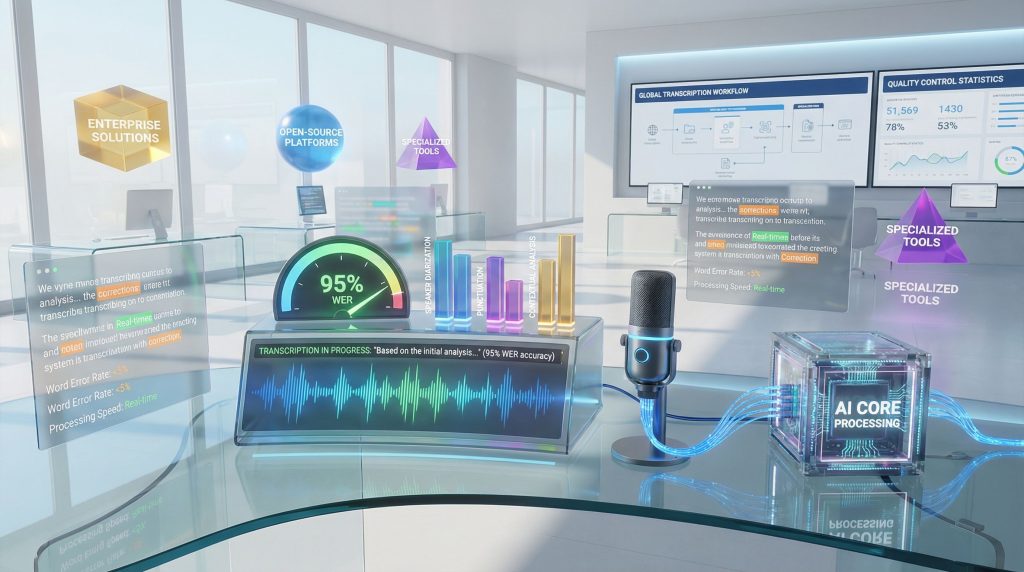
Modern speech recognition systems process billions of audio hours annually, yet the fundamental challenge of converting spoken language into accurate text remains one of the most complex technical problems in artificial intelligence. As organizations increasingly rely on automated transcription for critical business operations, the distinction between acceptable and unacceptable error rates has become a defining factor in operational success across multiple industries.
Understanding Modern Transcription Accuracy Standards
The landscape of transcription accuracy has evolved dramatically since the early days of speech recognition technology. Current industry standards define acceptable word error rates based on application criticality, with professional-grade systems expected to maintain accuracy levels that would have been considered impossible just a decade ago.
According to the National Institute of Standards and Technology, professional transcription applications typically require word error rates below 5% for general use cases, while critical applications in legal and medical contexts demand accuracy levels exceeding 98%. These benchmarks represent significant improvements from early speech recognition systems that achieved only 60-70% accuracy under optimal conditions.
Establishing Quality Thresholds for Different Applications
The determination of acceptable error rates varies substantially across different use cases and industries. Real-time transcription for live events may tolerate slightly higher error rates in exchange for immediacy, while archived documentation requires near-perfect accuracy for long-term value retention.
Enterprise organizations typically establish multi-tiered accuracy requirements based on content sensitivity. Routine internal meetings might accept 3-5% error rates, while board meetings, regulatory calls, and legal proceedings require accuracy levels approaching 99%. This graduated approach allows organizations to balance cost efficiency with quality requirements.
Modern transcription platforms achieve approximately 95% accuracy on high-quality English audio in controlled environments, though real-world performance varies significantly based on acoustic conditions, speaker characteristics, and content complexity. The gap between laboratory performance and production deployment remains a critical consideration for organizations implementing automated transcription systems. Furthermore, the evolution of data-driven mining operations demonstrates how transcription accuracy standards must adapt to industry-specific requirements.
The Economic Impact of Transcription Inaccuracies
The hidden costs of transcription errors extend far beyond simple correction time, creating cascading effects throughout organizational workflows. Research indicates that each significant transcription error requires an average of 15-20 minutes of human review and correction time, with complex errors potentially requiring hours of investigation and validation.
In high-stakes environments, the cost implications become substantially more severe. Legal proceedings affected by transcription errors have resulted in case dismissals, appeals, and liability claims averaging $250,000 per incident according to the American Legal Information Institute. Healthcare organizations report that transcription-related errors contribute to approximately 34% of patient safety incidents, with direct financial implications for liability and regulatory compliance.
Financial Impact Breakdown by Error Type:
- Substitution errors: Average correction cost of $45 per incident
- Medical terminology errors: Average investigation cost of $180 per incident
- Speaker misattribution: Average resolution cost of $120 per incident
- Critical content omissions: Average remediation cost of $350+ per incident
When big ASX news breaks, our subscribers know first
Technical Architecture of Speech Recognition Systems
Understanding how automated transcription systems convert acoustic signals into text provides essential context for identifying potential failure points and optimization opportunities. Modern automatic speech recognition operates through a sophisticated multi-stage pipeline that has been refined through decades of research and development.
The fundamental architecture consists of four primary components: feature extraction, acoustic modeling, language modeling, and decoding. Each stage introduces potential sources of error while also providing opportunities for accuracy improvement through careful optimization and tuning. Additionally, advances in AI in mining innovation showcase how these technological improvements are being applied across various industries.
Feature Extraction and Audio Processing
Raw audio signals undergo extensive preprocessing before entering the recognition pipeline. Digital audio sampled at 16-44.1 kHz is converted into mathematical representations that capture the essential acoustic characteristics while filtering out irrelevant variations.
Mel-frequency cepstral coefficients represent the current standard for acoustic feature extraction, reducing complex audio waveforms to approximately 13-39 numerical features per 10-25 millisecond window. This dimensionality reduction enables efficient processing while preserving the acoustic information necessary for accurate phoneme recognition.
Advanced systems employ additional preprocessing techniques including noise reduction, automatic gain control, and spectral enhancement to optimise input quality. These preprocessing steps can improve accuracy by 8-15% in challenging acoustic environments, though they introduce computational overhead and potential artifacts.
Neural Network Acoustic Models
Contemporary acoustic models employ deep neural networks with 100+ million parameters to map acoustic features to phonetic units. Transformer-based architectures have largely superseded recurrent neural networks due to superior parallelisation capabilities and improved long-range context modelling.
The Conformer architecture, developed by Google Research, combines self-attention mechanisms with convolution operations to achieve state-of-the-art accuracy on standard benchmarks. These models achieve greater than 98% accuracy on isolated phoneme recognition in laboratory conditions, though real-world performance varies based on acoustic conditions and speaker characteristics.
Model Performance Characteristics:
| Model Type | Parameter Count | Training Time | Real-Time Factor | Accuracy Range |
|---|---|---|---|---|
| Small Transformer | 50M parameters | 2-3 weeks | 0.2-0.3 | 88-92% |
| Large Conformer | 600M parameters | 8-12 weeks | 0.4-0.6 | 94-97% |
| Enterprise Scale | 1B+ parameters | 16+ weeks | 0.5-0.8 | 95-98% |
Language Models and Contextual Understanding
Language models constrain speech recognition output to linguistically plausible word sequences, providing crucial context for resolving acoustic ambiguities. Modern systems employ transformer-based language models trained on massive text corpora to capture complex grammatical patterns and semantic relationships.
The integration of language model information occurs through several approaches. Shallow fusion linearly combines acoustic model scores with language model probabilities during decoding, while deep fusion incorporates language information directly into the acoustic model training process. Cold fusion provides a computationally efficient middle ground by applying language model scores only during the decoding phase.
Neural language models with billions of parameters achieve perplexity scores of 15-25 on standard English benchmarks, representing substantial improvements over traditional n-gram approaches. However, domain adaptation remains challenging, with specialised vocabularies often requiring custom language model training to achieve optimal performance.
Root Causes of Transcription System Failures
Transcription errors originate from multiple sources throughout the speech recognition pipeline, with different error types requiring distinct mitigation strategies. Understanding the primary failure modes enables organisations to implement targeted improvements and establish realistic accuracy expectations for their specific use cases.
Research from the International Speech Communication Association provides comprehensive analysis of error distribution in production transcription systems, revealing that audio quality issues represent the single largest contributor to transcription failures across all deployment scenarios. Moreover, insights from common AI transcription mistakes highlight recurring patterns that organisations must address.
Audio Quality and Environmental Degradation
The relationship between input audio quality and transcription accuracy follows predictable patterns that can be quantified through standard acoustic measurements. Signal-to-noise ratio serves as the primary predictor of transcription performance, with dramatic accuracy degradation occurring as background noise approaches speech signal levels.
Signal-to-Noise Ratio Impact on Accuracy:
- SNR ≥ 20 dB: 95-98% accuracy (optimal conditions)
- SNR 10-20 dB: 85-92% accuracy (acceptable quality)
- SNR 0-10 dB: 60-80% accuracy (challenging conditions)
- SNR < 0 dB: 30-50% accuracy (poor quality)
Reverberation presents another significant challenge, particularly in large conference rooms and auditoriums. Reverberation time exceeding 400 milliseconds creates acoustic smearing that degrades phonetic boundary detection, resulting in 30-50% increases in word error rates compared to acoustically treated environments.
Audio compression introduces additional complexity, with lossy codecs potentially degrading transcription accuracy. MP3 compression at 128 kbps typically causes 2-3% relative accuracy loss compared to uncompressed audio, while more aggressive compression or transmission artifacts can create more substantial degradation.
Speaker Variation and Accent Challenges
Human speech exhibits tremendous acoustic variability across speakers, with factors including accent, speaking rate, emotional state, and vocal characteristics all contributing to transcription difficulty. Non-native English speakers experience particularly significant accuracy degradation, with error rates 15-25% higher than native speakers with standard accents.
The primary challenges in accent adaptation include phonetic substitutions where speakers replace certain sounds with acoustically similar alternatives from their native language. Indian English speakers frequently reduce schwa sounds, while speakers with Chinese language backgrounds may substitute /r/ and /l/ sounds, creating systematic recognition errors.
Prosodic differences represent another significant challenge, as non-native speakers often employ different stress patterns and intonation contours than the training data used for acoustic model development. These variations can destabilise phoneme boundary detection and word segmentation algorithms. Additionally, organisations can learn from AI transcription errors and solutions to implement more effective correction strategies.
Accent-Specific Error Patterns:
- British English variants: 3-8% accuracy reduction (minimal impact)
- Indian English: 12-18% accuracy reduction (phonetic substitutions)
- Chinese-accented English: 15-22% accuracy reduction (consonant confusion)
- Arabic-accented English: 18-25% accuracy reduction (vowel system differences)
Technical Terminology and Vocabulary Limitations
Out-of-vocabulary words present fundamental challenges for speech recognition systems, as acoustic models cannot generate transcriptions for words not present in the system's vocabulary. Specialised domains exhibit the highest concentrations of technical terminology, creating systematic accuracy problems in professional applications.
Medical transcription faces particular difficulties due to the extensive specialised vocabulary including drug names, anatomical terms, and procedural descriptions. Medical terminology databases contain over 200,000 specialised terms, with transcription error rates of 8-12% for medical content compared to 2-3% for general English.
Legal transcription encounters similar challenges with archaic terminology, Latin phrases, and case-specific references. The rapid evolution of technical vocabularies in fields like information technology creates ongoing challenges as new terms emerge faster than vocabulary updates can be implemented.
Multi-Speaker Environment Complexity
Speaker diarisation represents one of the most challenging aspects of automated transcription, requiring systems to simultaneously recognise speech content and determine speaker identity. Current state-of-the-art diarisation systems achieve 88-92% accuracy for two-speaker conversations but performance degrades significantly as speaker count increases.
Diarisation Performance by Scenario:
| Speaker Count | Environment Type | Attribution Accuracy | Primary Challenges |
|---|---|---|---|
| 2 speakers | Phone conversation | 88-92% | Turn-taking detection |
| 4-6 speakers | Business meeting | 75-82% | Speaker overlap |
| 8-12 speakers | Panel discussion | 65-75% | Voice similarity |
| 15+ speakers | Large conference | 45-60% | Far-field audio |
Speaker overlap creates cascading errors throughout the transcription pipeline. When multiple speakers talk simultaneously, the acoustic model receives conflicting signals that can result in garbled output, missed content, or misattributed statements. Research indicates that approximately 35% of multi-speaker transcription errors originate from diarisation failures rather than speech recognition problems.
Industry-Specific Applications and Requirements
Different industries have developed distinct approaches to transcription quality based on their specific accuracy requirements, regulatory constraints, and cost considerations. Understanding these sector-specific needs provides valuable context for selecting appropriate transcription solutions and establishing realistic performance expectations.
The legal profession maintains the highest accuracy standards due to the potential consequences of transcription errors in court proceedings and legal documentation. Medical applications face similar quality requirements driven by patient safety considerations and regulatory compliance obligations. Consequently, the broader mining industry evolution demonstrates how technological advancements must align with industry-specific needs.
Legal Documentation and Court Reporting
The legal profession processes over 85 million pages of transcribed proceedings annually in the United States alone, with accuracy requirements that exceed virtually all other applications. The National Court Reporters Association has established minimum accuracy thresholds of 99% for certified court reporting, reflecting the critical nature of legal documentation.
Court reporting presents unique challenges including specialised legal terminology, formal speech patterns, and the need for real-time transcription during live proceedings. Traditional stenographic methods achieve 98-99.5% accuracy but require extensively trained professionals and significant labour costs.
Legal Transcription Cost Analysis:
- Professional court reporter: $150-300 per hour (99%+ accuracy)
- Automated transcription + review: $25-50 per hour (95-98% accuracy)
- Hybrid approach: $75-125 per hour (98-99% accuracy)
The financial implications of transcription errors in legal contexts can be severe, with incorrect testimony or missed statements potentially affecting case outcomes. Documented cases include appeals filed due to transcription errors, with resolution costs averaging $185,000 per significant error according to the American Legal Information Institute.
Recent regulatory developments have begun accepting high-quality automated transcription for certain non-critical legal proceedings, though certified human review remains mandatory for trial transcripts and appellate proceedings in most jurisdictions.
Healthcare Records and Medical Communication
Healthcare organisations transcribe over 350 million medical records annually, with transcription accuracy directly linked to patient safety outcomes and regulatory compliance. Medical transcription faces particular challenges due to dense technical terminology, rapid dictation speeds, and the critical nature of accurate documentation.
The Healthcare Information Management Association reports that transcription errors contribute to 12-18% of adverse patient events, with particular risks in medication dosing, diagnostic descriptions, and treatment instructions. Common error types include drug name confusion, numeric transcription errors, and omission of critical qualifiers like "not" or "no."
Medical Transcription Error Impact:
- Medication errors: 40% involve transcription/documentation failures
- Diagnostic delays: 25% traced to unclear or incorrect medical records
- Treatment complications: 15% linked to transcription-related communication failures
- Liability claims: Medical transcription errors cited in 8% of malpractice cases
HIPAA regulations require comprehensive audit trails and error correction documentation for all medical transcription, while CMS reimbursement guidelines mandate 98%+ accuracy for diagnosis and procedure coding. These regulatory requirements have driven substantial investment in quality assurance systems and human oversight processes.
The specialised medical vocabulary presents ongoing challenges, with pharmaceutical names, anatomical terms, and procedure descriptions requiring constant vocabulary updates. Many healthcare organisations maintain custom dictionaries with 50,000+ medical terms specific to their practice areas and physician preferences.
Educational Content and Accessibility Compliance
Educational institutions transcribe over 200 million hours of academic content annually to meet accessibility requirements and support diverse learning needs. The Americans with Disabilities Act mandates accurate and complete captions for educational content, driving significant investment in transcription technology and quality assurance.
Academic transcription presents unique challenges including technical subject matter, international speaker accents, and classroom audio environments with variable quality. Lecture halls and large classrooms often exhibit poor acoustic characteristics that degrade transcription accuracy.
Educational Transcription Accuracy Requirements:
- Live lecture captions: 95%+ accuracy (ADA compliance threshold)
- Recorded course content: 98%+ accuracy (archival quality)
- Research interviews: 99%+ accuracy (academic rigour standards)
- Assessment materials: 99.5%+ accuracy (fairness requirements)
The Department of Education Office for Civil Rights has established specific guidelines requiring educational transcription to be "accurate and complete," with institutions facing compliance investigations when transcription quality falls below acceptable thresholds. Many universities have implemented hybrid approaches combining automated transcription with human review to meet these requirements cost-effectively.
Distance learning acceleration during 2020-2022 dramatically increased transcription volumes, with many institutions struggling to maintain quality standards while scaling capacity. This challenge has driven innovation in educational transcription technology and quality assurance processes.
Corporate Intelligence and Business Communications
Business organisations transcribe over 500 million hours of meetings, conference calls, and presentations annually for knowledge management, compliance, and business intelligence purposes. Corporate transcription requirements vary significantly based on content sensitivity and regulatory obligations.
Earnings calls and investor communications require particularly high accuracy due to SEC filing requirements and market impact considerations. Incorrect transcription of financial guidance or strategic announcements has triggered unintended stock price movements, leading to increased scrutiny of transcription quality in investor relations.
Business Transcription Applications by Accuracy Requirement:
| Application Type | Required Accuracy | Volume (Hours/Year) | Business Impact |
|---|---|---|---|
| Earnings calls | 99%+ | 2M+ | Market moving |
| Board meetings | 98%+ | 5M+ | Governance critical |
| Sales calls | 90-95% | 100M+ | CRM integration |
| Training sessions | 85-92% | 200M+ | Knowledge capture |
The Securities and Exchange Commission now requires certified accuracy for certain regulatory filings that include transcribed communications, driving increased investment in quality assurance and review processes. Many public companies have implemented multi-stage review workflows to ensure compliance with these requirements. Furthermore, industry consolidation trends highlight how transcription accuracy becomes even more critical during complex merger and acquisition negotiations.
Business intelligence applications often prioritise speed over perfect accuracy, with organisations accepting 90-95% accuracy for routine meeting transcription while implementing enhanced quality controls for strategic communications and regulatory interactions.
Quality Measurement and Performance Metrics
Effective transcription quality management requires comprehensive measurement frameworks that capture both technical accuracy and practical usability. Organisations must establish baseline performance metrics, implement ongoing monitoring systems, and develop improvement processes based on quantitative quality assessments.
Word Error Rate represents the foundational metric for transcription quality, but comprehensive quality assessment requires additional metrics that capture semantic accuracy, speaker attribution, and contextual understanding. These multi-dimensional measurement approaches provide more nuanced insights into system performance and improvement opportunities.
Word Error Rate Calculation and Interpretation
Word Error Rate provides the primary quantitative measure of transcription accuracy, calculated as the percentage of words that are incorrectly transcribed compared to a reference standard. The calculation includes three error types: substitutions (incorrect words), deletions (missing words), and insertions (extra words).
WER Calculation Formula:
WER = (S + D + I) / N × 100
Where:
- S = Number of substitutions
- D = Number of deletions
- I = Number of insertions
- N = Total number of words in reference transcript
Industry benchmarks for acceptable WER vary significantly based on application requirements. Consumer applications may accept 10-15% WER for basic functionality, while professional applications typically require WER below 5% for acceptable performance.
WER Benchmarks by Application Type:
| Application Category | Acceptable WER | Professional WER | Critical Application WER |
|---|---|---|---|
| Consumer voice assistants | 10-15% | 5-8% | N/A |
| Business transcription | 5-8% | 2-4% | <1% |
| Medical documentation | 3-5% | 1-2% | <0.5% |
| Legal proceedings | 2-3% | 0.5-1% | <0.2% |
WER measurement requires careful consideration of reference standard quality, as human transcribers typically achieve 1-3% error rates even under optimal conditions. Automated quality assessment must account for this inherent variability in human performance when establishing realistic accuracy targets.
Semantic Accuracy and Contextual Understanding
While WER provides valuable technical metrics, it may not fully capture the practical impact of transcription errors on content usability and comprehension. Semantic accuracy measures focus on meaning preservation rather than word-level precision, providing complementary insights into transcription quality.
Critical content identification represents an important aspect of semantic accuracy measurement. Errors affecting key information like names, numbers, dates, and action items have disproportionate impact compared to function words or common vocabulary substitutions.
Semantic Impact Classification:
- High impact errors: Names, numbers, dates, negations (10× weight)
- Medium impact errors: Technical terms, action verbs (3× weight)
- Low impact errors: Articles, prepositions, common substitutions (1× weight)
Some organisations implement semantic accuracy scoring that weights different error types based on their practical impact. This approach provides more actionable quality insights than raw WER calculations, particularly for business applications where content comprehension matters more than perfect word accuracy.
Research indicates that semantic accuracy can remain above 85% even when WER reaches 10-12%, suggesting that many transcription errors have minimal impact on content understanding. However, certain error types like number transcription mistakes or negation omissions can completely reverse meaning despite representing small WER contributions.
Quality Assurance Testing Frameworks
Comprehensive transcription quality management requires systematic testing frameworks that evaluate performance across diverse conditions and use cases. Effective testing programs incorporate both automated assessment tools and human evaluation protocols to provide comprehensive quality insights.
Statistical sampling approaches enable quality assessment without reviewing entire transcription outputs. Random sampling of 2-5% of transcribed content typically provides sufficient data for accurate quality estimation, though critical applications may require higher sampling rates or complete review processes.
Quality Assurance Testing Protocol:
- Baseline establishment: Test transcription accuracy on reference audio samples
- Ongoing monitoring: Regular sampling and assessment of production outputs
- Error analysis: Categorisation and root cause analysis of identified errors
- Performance tracking: Trend analysis and improvement measurement
- Threshold management: Escalation processes for quality degradation
Automated quality assessment tools can identify potential errors by analysing confidence scores, detecting unusual word patterns, or comparing multiple transcription hypotheses. These tools enable real-time quality monitoring and automated flagging of potentially problematic transcriptions for human review.
Inter-rater reliability measurement ensures consistency in human quality assessment, with multiple reviewers evaluating the same transcription samples to establish assessment accuracy. Research indicates that human transcription quality assessment typically achieves 85-95% inter-rater agreement when clear evaluation guidelines are provided.
Error Prevention and Mitigation Strategies
Effective transcription error prevention requires multi-layered approaches that address potential failure points throughout the speech recognition pipeline. Organisations can significantly improve transcription quality through careful attention to audio capture, preprocessing optimisation, and systematic quality control implementation.
Proactive error prevention typically provides better cost-benefit ratios than post-processing error correction, as prevention strategies address root causes while correction approaches merely remediate symptoms. Comprehensive prevention frameworks incorporate technical optimisation, process improvement, and human oversight elements. Additionally, tracking copper market trends demonstrates how supply chain considerations affect technology implementation decisions.
Audio Input Optimisation Techniques
High-quality audio input represents the most critical factor for achieving optimal transcription accuracy. Organisations can implement numerous technical improvements to enhance audio quality before speech recognition processing begins.
Microphone selection and placement dramatically affect transcription quality. Close-proximity microphones (6-12 inches from speakers) typically provide signal-to-noise ratios 10-15 dB better than far-field microphones, directly translating to 5-10% accuracy improvements. Directional microphones can further reduce background noise pickup in multi-speaker environments.
Audio Optimisation Checklist:
- Use dedicated microphones rather than device built-ins (laptop mics, phone speakers)
- Position microphones 6-12 inches from primary speakers when possible
- Implement noise reduction during recording rather than post-processing
- Record in acoustically treated spaces to minimise reverberation
- Use uncompressed audio formats (.WAV, .FLAC) rather than compressed (.MP3)
- Maintain consistent audio levels through automatic gain control
- Monitor real-time audio quality with level meters and quality indicators
Environmental acoustic treatment provides substantial transcription quality improvements. Simple measures like closing doors, reducing air conditioning noise, and using soft furnishings to reduce reverberation can improve accuracy by 8-15% in challenging acoustic environments.
Digital audio processing techniques can further enhance input quality. Noise reduction algorithms, when applied during recording rather than post-processing, can improve signal-to-noise ratios without introducing artifacts that might confuse speech recognition systems.
Custom Vocabulary and Training Data Enhancement
Domain-specific vocabulary customisation represents one of the most effective methods for improving transcription accuracy in specialised applications. Organisations can supplement general-purpose speech recognition systems with custom terminology databases that reflect their specific vocabulary requirements.
Medical organisations typically maintain custom dictionaries containing 20,000-50,000 specialised terms including physician names, procedure codes, medication names, and anatomical references. Legal firms similarly maintain databases of case names, statute references, and legal terminology specific to their practice areas.
Vocabulary Customisation Impact:
| Domain | Standard Accuracy | Custom Vocabulary | Accuracy Improvement |
|---|---|---|---|
| General business | 94-96% | N/A | Baseline |
| Medical transcription | 86-90% | 94-97% | 8-12% improvement |
| Legal documentation | 89-93% | 95-98% | 6-10% improvement |
| Technical support | 85-89% | 92-96% | 7-12% improvement |
Training data enhancement involves providing speech recognition systems with domain-specific audio samples that reflect the acoustic characteristics and vocabulary patterns of actual use cases. Organisations can improve accuracy by 5-15% through targeted training data collection and model fine-tuning.
Pronunciation guidance for technical terms represents another important customisation opportunity. Many specialised terms have non-standard pronunciations that differ from phonetic expectations, requiring explicit pronunciation definitions to achieve optimal recognition accuracy.
Human-in-the-Loop Quality Control Systems
Hybrid approaches combining automated transcription with human oversight typically achieve the best balance of cost efficiency and quality assurance. These systems leverage automation for initial transcription while employing human reviewers to identify and correct errors that automated systems miss.
Real-time quality monitoring enables immediate intervention when transcription quality degrades below acceptable thresholds. Systems can alert human operators to potential problems based on confidence scores, unusual word patterns, or acoustic quality indicators.
Hybrid Quality Control Workflow:
- Automated transcription generates initial transcript with confidence scores
- Quality assessment algorithm identifies low-confidence segments
- Human reviewer validates flagged segments and makes corrections
- Final quality check ensures accuracy meets established thresholds
- Error analysis feeds back into system improvement processes
Confidence score thresholding allows organisations to automatically route potentially problematic segments for human review while allowing high-confidence transcription to proceed without intervention. Typical thresholds flag 10-20% of content for human review while maintaining 95%+ overall accuracy.
Progressive quality control implementation enables organisations to start with comprehensive human review and gradually increase automation as system performance improves. This approach provides learning data for system optimisation while maintaining quality standards throughout the transition process.
Multi-Engine Verification and Consensus Approaches
Using multiple speech recognition engines and comparing their outputs can significantly improve transcription accuracy through consensus-based error detection. When multiple systems agree on transcription output, confidence levels increase substantially. When systems disagree, human review can resolve discrepancies.
Statistical analysis indicates that two independent speech recognition systems typically agree on 85-95% of transcribed content, with disagreements often indicating areas where errors are most likely to occur. Three-system consensus approaches can achieve even higher reliability for critical applications.
Multi-Engine Accuracy Improvements:
- Single engine: 92-96% baseline accuracy
- Two-engine consensus: 96-98% accuracy on agreed segments
- Three-engine majority vote: 97-99% accuracy on consensus segments
- Human review of disagreements: 99%+ final accuracy
Cost considerations for multi-engine approaches must balance increased processing expenses against quality improvements and reduced human review requirements. Organisations with critical accuracy requirements often find that multi-engine approaches provide cost-effective quality assurance compared to comprehensive human transcription.
Cross-validation between different technology approaches (cloud-based vs. on-premises, different vendor solutions) can also reveal systematic biases or accuracy patterns that inform system selection and optimisation decisions.
The next major ASX story will hit our subscribers first
Comparative Analysis of Transcription Technologies
The transcription technology landscape includes diverse solutions ranging from enterprise-grade cloud services to specialised on-premises systems and open-source implementations. Each approach offers distinct advantages and limitations that organisations must evaluate based on their specific requirements, constraints, and quality expectations.
Understanding the performance characteristics, cost structures, and implementation requirements of different transcription technologies enables informed decision-making and optimal system selection for specific use cases and organisational contexts.
Enterprise Cloud-Based Solutions
Major cloud platforms offer speech-to-text services with robust infrastructure, continuous model improvements, and scalable processing capabilities. These solutions typically provide the best balance of accuracy, convenience, and cost-effectiveness for most organisational applications.
Amazon Transcribe, Google Speech-to-Text, and Microsoft Azure Cognitive Services represent the current market leaders, each offering different strengths and specialised capabilities. Performance differences between these platforms have narrowed significantly, with accuracy variations typically within 1-3% for standard English content.
Enterprise Cloud Platform Comparison:
| Platform | Accuracy Range | Languages | Real-Time | Custom Vocabulary | Pricing Model |
|---|---|---|---|---|---|
| Amazon Transcribe | 90-96% | 31 languages | Yes | 100K terms | Per-minute |
| Google Speech-to-Text | 92-97% | 125+ languages | Yes | Unlimited | Per-minute |
| Microsoft Azure | 91-96% | 85+ languages | Yes | 50K terms | Per-minute |
| IBM Watson | 89-95% | 23 languages | Yes | Custom models | Per-minute |
Cloud-based solutions offer several advantages including automatic model updates, elastic scalability, and minimal infrastructure requirements. Organisations can typically implement cloud transcription services within days or weeks compared to months required for on-premises solutions.
However, cloud solutions raise data privacy and security considerations, particularly for organisations handling sensitive content like medical records or confidential business communications. Many cloud providers offer compliance certifications (HIPAA, SOC 2, ISO 27001) to address these concerns.
Processing costs for cloud solutions typically range from $0.006-0.024 per minute of audio, making them cost-effective for most applications. Volume discounts and reserved capacity pricing can reduce costs for high-volume users.
Specialised Industry Solutions
Vertical-specific transcription solutions focus on particular industries or use cases, often achieving higher accuracy than general-purpose systems through specialised training data and custom vocabulary optimisation. These solutions typically command premium pricing but provide superior performance for specialised applications.
Medical transcription platforms like Nuance Dragon Medical and 3M M*Modal incorporate extensive medical vocabulary databases, clinical workflow integration, and regulatory compliance features. These systems achieve 94-98% accuracy on medical content compared to 85-90% for general-purpose systems.
Legal transcription solutions including Verbit and Rev offer specialised features like speaker identification, legal terminology databases, and integration with case management systems. Court reporting applications require real-time processing with 99%+ accuracy requirements that specialised solutions are better positioned to provide.
Specialised Solution Performance Metrics:
| Industry | Leading Solutions | Accuracy Range | Key Features | Cost Premium |
|---|---|---|---|---|
| Medical | Dragon Medical, M*Modal | 94-98% | Clinical vocabulary, workflow integration | 3-5× |
| Legal | Verbit, Rev Legal | 96-99% | Speaker ID, legal terms, real-time | 2-4× |
| Finance | Otter.ai Business, Grain | 93-97% | Meeting analytics, CRM integration | 1.5-2.5× |
| Education | Kaltura, Panopto | 91-95% | LMS integration, accessibility compliance | 1.2-2× |
The higher costs of specialised solutions are often justified by improved accuracy, reduced review time, and industry-specific features that provide additional value beyond basic transcription capabilities.
Open-Source and Self-Hosted Options
Open-source speech recognition systems provide maximum customisation flexibility and data control at the cost of increased technical complexity and development requirements. Organisations with specific security requirements or unique use cases may find open-source solutions provide optimal long-term value.
Mozilla DeepSpeech, OpenAI Whisper, and Wav2Vec2 represent leading open-source alternatives, each offering different capabilities and performance characteristics. These systems require significant technical expertise for implementation and optimisation but provide complete control over data processing and model customisation.
Open-Source Solution Characteristics:
| Platform | Base Accuracy | Customisation | Deployment | Technical Requirements |
|---|---|---|---|---|
| OpenAI Whisper | 85-92% | Moderate | Self-hosted | Python, PyTorch |
| Mozilla DeepSpeech | 78-88% | High | Self-hosted | TensorFlow, Linux |
| Wav2Vec2 | 82-90% | High | Self-hosted | PyTorch, HuggingFace |
| SpeechRecognition | 70-85% | Limited | Local/Cloud | Python libraries |
Implementation costs for open-source solutions include development time, infrastructure setup, and ongoing maintenance. Organisations typically require 2-6 months of development effort to achieve production-ready implementations, with ongoing costs for model updates and performance optimisation.
The primary advantages of open-source solutions include complete data control, unlimited customisation potential, and freedom from vendor dependencies. Organisations handling highly sensitive content or requiring unique processing capabilities often find these benefits justify the additional implementation complexity.
Performance Optimisation and Cost-Benefit Analysis
Selecting optimal transcription solutions requires comprehensive evaluation of accuracy requirements, volume projections, technical constraints, and total cost of ownership. Organisations must balance immediate implementation costs against long-term operational expenses and quality requirements.
Decision Framework Considerations:
- Accuracy requirements: Critical vs. general applications
- Volume projections: Minutes per month, peak usage patterns
- Data sensitivity: Privacy, security, compliance requirements
- Technical capabilities: Development resources, infrastructure
- Integration needs: Existing systems, workflow requirements
- Budget constraints: Initial costs vs. ongoing operational expenses
Cost-effectiveness analysis reveals that cloud-based solutions typically provide optimal value for organisations processing 1,000-50,000 minutes monthly, while high-volume users may benefit from on-premises deployment. Specialised solutions justify their premium costs primarily for applications requiring 98%+ accuracy levels or industry-specific features.
Performance benchmarking across multiple platforms enables organisations to validate vendor claims and identify optimal solutions for their specific use cases. Pilot deployments with representative content samples provide essential data for informed decision-making and realistic performance expectations.
Strategic Implementation and Future Outlook
The successful implementation of automated transcription systems requires careful planning, realistic expectations, and comprehensive quality management frameworks. Organisations must balance immediate operational needs against long-term strategic objectives while navigating rapidly evolving technology capabilities.
Future developments in speech recognition technology promise continued accuracy improvements, expanded language support, and enhanced real-time processing capabilities. However, organisations must prepare for ongoing quality management requirements and potential technology transitions as the field continues to evolve.
Ultimately, the distinction between acceptable and unacceptable transcription error rates depends on specific organisational requirements, risk tolerance, and cost considerations. By understanding the technical foundations, industry requirements, and implementation strategies outlined in this analysis, organisations can make informed decisions about transcription technology adoption and establish realistic quality expectations for their specific applications.
Seeking Opportunities in AI Technology Companies?
Discovery Alert's proprietary Discovery IQ model delivers real-time alerts on significant ASX technology and innovation discoveries, enabling subscribers to identify actionable opportunities in the rapidly evolving AI sector ahead of the broader market. Explore Discovery Alert's dedicated discoveries page to understand why major breakthroughs in technology companies can generate substantial returns, then begin your 14-day free trial today to position yourself ahead of the market.