
August 14, 2026
Transforming West Africa's Agricultural Commodity Architecture
Agricultural commodity financing across developing economies has historically operated through external capital dependency models that constrain domestic value creation. These systems typically require producer nations to pledge raw materials as collateral, creating structural bottlenecks that prevent local processing and value addition. Understanding these dynamics becomes critical as major commodity-producing regions reassess their economic sovereignty strategies.
The evolution of commodity financing mechanisms reflects broader questions about resource control, industrial development, and economic independence in resource-rich nations. Traditional models often prioritise immediate liquidity access over long-term value capture, creating persistent dependency cycles that limit domestic industrial growth potential. Modern capital raising methods are evolving to address these structural challenges.
When big ASX news breaks, our subscribers know first
Redefining Commodity Financing Through Domestic Capital Mobilisation
Ghana's strategic pivot toward domestically-funded cocoa financing reforms in Ghana represents a fundamental restructuring of agricultural commodity economics. The West African nation, responsible for approximately 20% of global cocoa production, has announced plans to eliminate foreign-backed financing arrangements in favour of local currency bond mechanisms.
This transformation addresses a core structural constraint: when cocoa beans serve as collateral for international financing, they cannot be allocated to domestic processing facilities. President John Mahama articulated this limitation, explaining that collateralised beans must be shipped to foreign markets per financing agreements, preventing local value addition opportunities.
Key Financial Architecture Changes:
- Domestic Bond Issuance: Ghanaian cedi-denominated securities replace foreign pre-financing arrangements
- Debt Restructuring: GH¢5 billion debt conversion to equity strengthens COCOBOD's financial position
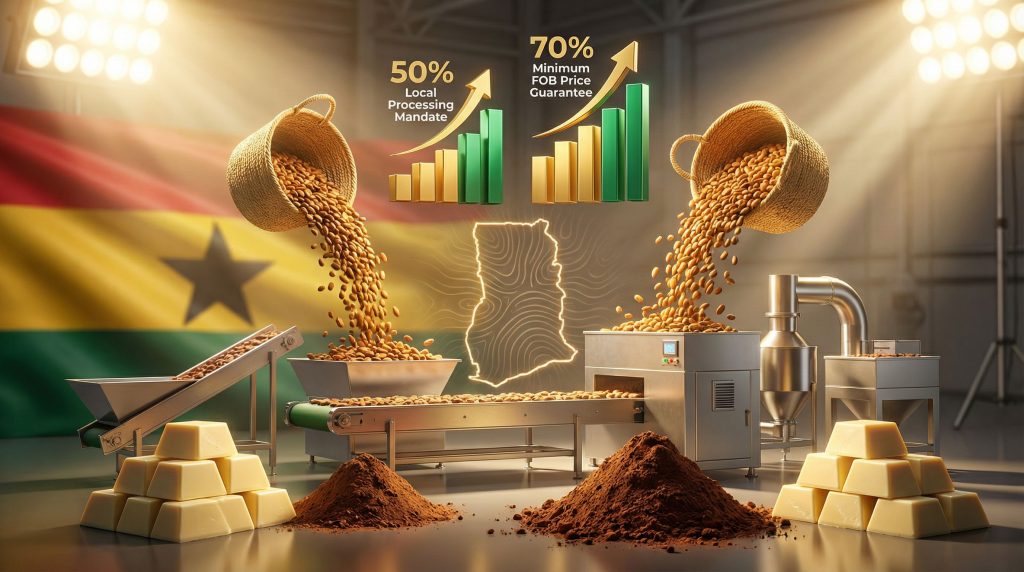
- Producer Price Guarantees: Automatic adjustment mechanisms ensure farmers receive minimum 70% of gross FOB pricing
- Processing Mandate: 50% domestic processing requirement creates guaranteed local allocation
Operational Mechanics of Cedi-Based Financing
The new financing structure operates through revolving fund mechanisms that maintain full allocation control within Ghana's borders. Unlike traditional pre-financing where international buyers provide upfront capital in exchange for guaranteed raw bean deliveries, the domestic system enables COCOBOD to direct beans toward highest-value applications.
This approach leverages Ghana's existing processing infrastructure, including facilities capable of handling 400,000 tons annually. Previously, these assets remained underutilised due to collateral restrictions that prevented bean allocation to domestic processors. Furthermore, commodity trading focus has shifted toward value-added products globally.
The automatic price adjustment formula incorporates multiple variables to ensure farmer compensation remains competitive with global markets whilst supporting domestic processing objectives. This mechanism balances producer welfare with industrial development goals.
Breaking Traditional Collateral Dependency Cycles
Foreign-backed commodity financing traditionally operates through collateralisation mechanisms that create systematic constraints on domestic value addition. International financiers provide upfront capital to purchasing agencies, requiring raw materials as security against loan default risk.
This structure generates a fundamental bottleneck: collateralised commodities cannot be diverted to alternative applications without violating financing agreements. For Ghana, this meant that beans pledged as collateral could not be allocated to local processors, regardless of available processing capacity or potential value addition opportunities. However, industry evolution trends suggest increasing focus on domestic processing capabilities.
Traditional Model Constraints:
| Stage | Process | Limitation |
|---|---|---|
| Financing | Foreign capital provision | Creates collateral obligations |
| Procurement | Bean purchasing and storage | Beans pledged as security |
| Allocation | Distribution decisions | Restricted to export channels |
| Processing | Value addition opportunities | Cannot access collateralised inputs |
| Revenue | Final value capture | Limited to raw commodity pricing |
Processing Capacity Utilisation Analysis
Ghana's existing cocoa processing infrastructure represents significant underutilised industrial assets under traditional financing arrangements. State enterprises like Cocoa Processing Company (CPC) and revived Licensed Buying Companies possess established capacity that remains constrained by raw material access limitations.
The domestic financing transition directly addresses this utilisation bottleneck by ensuring consistent bean allocation to local processors. This shift transforms idle processing capacity into active value-addition assets, fundamentally altering Ghana's position in global cocoa value chains.
Processing facilities can produce multiple higher-value products from raw cocoa inputs, including cocoa butter, powder, and intermediate semi-finished goods. Each processing stage captures additional margins beyond base commodity pricing. Moreover, understanding ETC investment guide principles helps investors assess these value chain transformations.
Value Chain Transformation Through Mandatory Processing Requirements
Ghana's 50% domestic processing mandate represents a strategic repositioning from raw commodity exporter to semi-finished product supplier. This shift captures higher-margin segments within global cocoa value chains whilst reducing direct competition in raw material markets.
Value Addition Analysis:
- Raw cocoa beans: Base commodity pricing with minimal margin capture
- Cocoa butter: Premium refined product commanding 2-3x higher pricing
- Cocoa powder: Ground cocoa solids with 1.5-2x pricing premiums
- Semi-finished products: Intermediate goods enabling enhanced export value retention
The processing mandate ensures consistent raw material allocation to domestic facilities whilst maintaining export market participation through value-added products. This approach balances immediate revenue generation with long-term industrial development objectives.
Industrial Infrastructure Optimisation Strategy
Rather than constructing new processing facilities, Ghana's cocoa financing reforms in Ghana prioritise optimisation of existing industrial assets. The Cocoa Processing Company (CPC) serves as the primary state enterprise vehicle for scaled processing implementation, whilst Licensed Buying Companies provide distributed capacity across cocoa-producing regions.
This asset utilisation approach reduces capital investment requirements whilst maximising returns from existing infrastructure. Processing capacity expansion occurs through operational efficiency improvements and technology upgrades rather than greenfield development.
The institutional framework combines centralised processing through CPC with decentralised operations via Licensed Buying Companies, creating geographic distribution that reduces transportation costs and improves farmer accessibility.
Producer Price Stabilisation Through Market-Linked Mechanisms
Traditional commodity financing often creates payment delays and price volatility that undermine farmer incentives and production consistency. Ghana's reformed pricing mechanism addresses these challenges through automatic adjustment formulas tied to multiple market variables.
Producer Price Formula Components:
- World market correlation: Direct linkage to international cocoa pricing trends
- Exchange rate adjustments: Currency fluctuation compensation mechanisms
- Production volume variables: Supply-based pricing modifications
- Minimum guarantee floor: 70% FOB pricing protection regardless of market conditions
This structure provides farmers with greater price predictability whilst maintaining competitiveness with global market rates. The automatic adjustment mechanism reduces administrative delays associated with manual price-setting processes. In addition, volatility hedging strategies become increasingly important for price risk management.
Revenue Retention and Foreign Exchange Impact
Domestic financing eliminates foreign exchange outflows associated with international pre-financing arrangements, retaining more cocoa sector revenues within Ghana's economy. This shift increases local currency circulation whilst reducing dependence on external capital markets.
The transition supports President Mahama's broader economic objective to grow foreign exchange reserves beyond $20 billion by 2029, part of a comprehensive economic reset agenda addressing currency stability and international payment capacity, as outlined in Ghana's new cocoa sector policy.
Revenue retention extends beyond immediate cash flow improvements to encompass multiplier effects throughout Ghana's agricultural economy, supporting rural employment, transportation networks, and supporting service industries.
Regional Competitive Positioning and Market Dynamics
Ghana's strategic pivot toward processing-focused exports creates differentiated positioning relative to other major cocoa producers, particularly Côte d'Ivoire, which maintains higher raw commodity export volumes. This differentiation reduces direct competition in raw material segments whilst creating competitive advantages in semi-finished product markets.
The reforms align with Ghana's broader 2030 objective to eliminate raw mineral ore exports, representing a comprehensive resource sovereignty strategy across multiple commodity sectors. This coordinated approach positions Ghana as a value-added exporter rather than raw material supplier.
Strategic Positioning Benefits:
- Market differentiation: Semi-finished products versus raw commodity competition
- Margin capture: Higher-value product segments with enhanced pricing power
- Supply chain control: Domestic allocation flexibility enabling responsive market participation
- Industrial development: Manufacturing sector growth supporting employment creation
Global Supply Chain Restructuring Implications
Ghana's shift toward semi-processed exports will require international chocolate manufacturers and commodity traders to adjust sourcing strategies. Traditional procurement models focused on raw bean purchases must adapt to semi-finished product specifications and quality requirements.
This transformation may influence global cocoa price discovery mechanisms, particularly given Ghana's position as the world's second-largest producer. Reduced raw bean exports could create supply constraints in commodity markets whilst increasing semi-finished product availability.
International buyers may need to develop new supply chain partnerships focused on value-added products rather than raw materials, potentially creating opportunities for long-term procurement agreements and technology transfer arrangements.
The next major ASX story will hit our subscribers first
Implementation Risk Assessment and Mitigation Strategies
The success of domestic cocoa financing reforms in Ghana depends on several critical factors that require coordinated management and risk mitigation approaches. Financial market capacity represents a primary consideration, as Ghana's capital markets must demonstrate sufficient depth and institutional investor appetite for commodity-backed securities.
COCOBOD's financial health improvement through debt restructuring enhances bond market credibility, but sustained investor confidence requires consistent operational performance and transparent financial reporting. The GH¢5 billion debt-to-equity conversion provides immediate balance sheet strengthening whilst reducing debt service obligations.
Critical Success Factors:
- Capital market capacity: Domestic institutional investor participation in cocoa bonds
- Processing infrastructure scaling: Coordinated capacity expansion across existing facilities
- Farmer payment consistency: Maintaining timely compensation despite financing model changes
- Quality control systems: Ensuring semi-finished products meet international standards
Operational Scaling Challenges
Meeting the 50% processing mandate requires coordinated operational improvements across multiple facilities and institutional frameworks. The revival of Licensed Buying Companies provides distributed processing capacity, but effective coordination between state enterprises and private sector participants demands robust management systems.
Processing infrastructure scaling must occur without compromising product quality or delivery consistency to international buyers. Technical standards for cocoa butter, powder, and intermediate products require maintenance throughout capacity expansion phases.
Quality assurance systems become increasingly critical as processing volumes increase and product specifications become more complex. Investment in laboratory facilities, testing equipment, and technical expertise supports scaled operations whilst maintaining export market access.
Performance Metrics and Monitoring Framework
Successful implementation of Ghana's cocoa financing reforms in Ghana requires comprehensive performance monitoring across multiple dimensions of economic and operational impact. Short-term metrics focus on immediate transition effectiveness, whilst medium-term indicators assess broader structural transformation success.
Short-term Success Indicators (2026-2027):
- Domestic bond subscription rates: Market acceptance of cedi-denominated cocoa securities
- Processing capacity utilisation: Percentage of available infrastructure actively engaged
- Farmer payment timeliness: Reduction in payment delays compared to traditional financing
- Export value per ton improvements: Premium capture through semi-finished products
Medium-term Performance Metrics (2027-2030):
- Semi-processed product export growth: Volume and value expansion in cocoa butter, powder
- Manufacturing sector job creation: Employment generation throughout processing value chain
- Foreign exchange retention rates: Domestic revenue capture versus traditional model
- COCOBOD financial performance: Operational efficiency and debt service capacity
Economic Impact Assessment Framework
Comprehensive impact assessment requires monitoring direct and indirect economic effects across Ghana's agricultural and industrial sectors. Direct impacts include processing facility employment, farmer income improvements, and export revenue changes.
Indirect effects encompass transportation, logistics, technical services, and supporting industries that benefit from increased domestic processing activities. Multiplier effects throughout rural economies may generate broader development outcomes beyond immediate cocoa sector improvements.
Regional development indicators track geographic distribution of economic benefits, ensuring processing activities contribute to balanced growth rather than concentrated urban development. Rural employment creation particularly supports broader poverty reduction and economic inclusion objectives.
Broader Economic Sovereignty Implications
Ghana's cocoa financing transformation represents one component of a comprehensive resource sovereignty strategy extending across multiple commodity sectors. The parallel commitment to eliminate raw mineral ore exports by 2030 indicates systematic restructuring of Ghana's position in global commodity markets, as announced by Ghana's presidency.
This approach prioritises domestic value addition over immediate revenue maximisation, accepting short-term transition costs in exchange for enhanced long-term economic control and value capture. The strategy reflects broader African development philosophies emphasising industrialisation and reduced commodity dependency.
Resource Sovereignty Components:
- Financing independence: Domestic capital mobilisation replacing foreign dependency
- Processing control: Mandatory local value addition requirements
- Revenue retention: Increased domestic economic multiplier effects
- Industrial development: Manufacturing sector growth through commodity processing
Success in cocoa sector reforms could establish frameworks for similar transformations across Ghana's mining, agriculture, and energy sectors, creating comprehensive economic sovereignty across resource industries.
"This comprehensive approach to resource sovereignty demonstrates Ghana's commitment to breaking traditional commodity dependency cycles whilst building sustainable industrial capacity" – Financial analysis from domestic policy reforms.
Disclaimer: This analysis discusses economic reforms and projections that involve inherent uncertainties and implementation risks. Actual outcomes may differ from projected results due to market conditions, operational challenges, or policy modifications. Investors should conduct independent research and consider multiple risk factors when evaluating commodity sector investments or policy impacts.
Ghana's cocoa financing reforms represent a fundamental restructuring of agricultural commodity economics, addressing financing constraints, value chain positioning, and economic sovereignty simultaneously. The comprehensive approach encompassing domestic capital mobilisation, processing mandate compliance, and farmer welfare optimisation creates multidimensional value propositions extending beyond traditional commodity export models.
Implementation success depends on coordinated execution across financial markets, industrial capacity, and regulatory frameworks, with potential implications for similar reforms throughout resource-dependent economies across Africa.
Ready to Profit from the Next Major Commodity Discovery?
Discovery Alert's proprietary Discovery IQ model delivers real-time alerts on significant ASX mineral discoveries, instantly empowering investors to identify actionable opportunities ahead of the broader market. Understand why historic discoveries can generate substantial returns by visiting Discovery Alert's dedicated discoveries page, showcasing examples of exceptional outcomes like De Grey Mining and WA1 Resources.