
July 15, 2026
Why Single-Point Infrastructure Dominance Creates Outsized Market Risk
When a single piece of infrastructure controls the flow of 90% of a nation's export capacity for any commodity, the operational calendar of that asset becomes a market event in its own right. This is the structural reality underpinning South Africa's thermal coal export system, where one rail corridor and one terminal collectively determine the country's contribution to global seaborne coal supply. Understanding how planned maintenance intersects with throughput targets, historical performance trends, and global buyer exposure is essential for anyone navigating the seaborne thermal coal market in 2026.
The confirmed Transnet coal rail closure dates in South Africa for 2026 centre on a 12-day window running from 21 July to 1 August, during which Transnet Freight Rail (TFR) will suspend normal operations along the North Corridor to carry out track renewals, signalling upgrades, and major infrastructure repairs. For coal producers, terminal operators, vessel schedulers, and spot buyers alike, this window represents a predictable but consequential supply constraint with cascading effects across multiple import markets.
When big ASX news breaks, our subscribers know first
The North Corridor as a Chokepoint: Understanding the Infrastructure Dependency
The TFR North Corridor is the singular arterial rail link connecting South Africa's inland coalfields to the coast. At its terminus sits Richards Bay Coal Terminal (RBCT), which handles approximately 90% of the country's thermal coal exports, making it one of the most strategically significant coal export facilities in the Southern Hemisphere, according to Argus Media.
This concentration of export capacity through a single rail corridor and terminal creates an asymmetric risk profile that is rarely appreciated in full by market participants outside the region. A disruption at any point along the North Corridor, whether planned or otherwise, does not merely affect one producer or one shipment. It compresses national export capacity almost entirely.
RBCT management has publicly indicated that it expects more than 60 million tonnes of coal deliveries in 2026, with an internal operational ambition to sustain a 65 million tonne per year run rate. The distinction between these two figures is instructive: the 60 million tonne expectation reflects a realistic operational assessment, while the 65 million tonne ambition represents the corridor's theoretical recovery ceiling under optimal conditions.
How TFR's Maintenance Calendar Has Evolved Over Time
The 2026 July closure is not an isolated event. It sits within a long pattern of annual maintenance interventions, though the character of that pattern has changed meaningfully over the past several years. What was once a predictable single annual window has evolved into a more complex, fragmented maintenance regime. Furthermore, global coal supply challenges have amplified the significance of each planned closure window.
| Year | Maintenance Window | Duration | Classification |
|---|---|---|---|
| 2019 | July 2–11 | 10 days | Standard planned |
| 2021 | July 20–26 | 7 days | Adjusted (civil unrest) |
| 2022 | November 8–25 | 18 days | Force majeure (derailment) |
| 2024 | February, March, November (multiple) | Fragmented | Revised corridor schedule |
| 2025 | November 18–27 | 10 days | Single and double-line closure |
| 2026 | July 21 – August 1 | 12 days | Confirmed planned |
Source: Argus Media, May 2026
The trajectory is revealing. Between 2019 and 2021, TFR operated within a conventional single annual maintenance model, clustered around the July period. The November 2022 derailment shattered that predictability, triggering an emergency force majeure declaration that kept lines closed from 8 to 25 November with no advance warning to market participants.
By 2024, the maintenance regime had restructured entirely, with TFR introducing multiple closure windows spread across February, March, and November under a revised corridor schedule. The 2025 shutdown introduced further operational complexity, combining a single-line closure from 18 to 23 November with a double-line closure from 24 to 27 November, with full repair completion not achieved until an estimated 13 December 2025.
The progression from a clean annual window to multi-phase, multi-month closure sequences across the calendar year points toward a maintenance backlog being addressed incrementally rather than resolved comprehensively. Each intervention buys operational time rather than restoring infrastructure to design standards.
What the 2026 Shutdown Actually Involves
The July 2026 maintenance programme encompasses three distinct categories of infrastructure work, each addressing a different dimension of corridor operational integrity:
- Track renewal: Replacement of degraded rail sections to restore design speed limits and load-bearing capacity along the North Corridor, ensuring the line can sustain the tonnage volumes required to meet RBCT's annual targets
- Signalling system upgrades: Modernisation of control and safety infrastructure, targeting reductions in operational delays and improvements in post-reopening throughput efficiency
- Major infrastructure repairs: Remediation of accumulated wear across bridges, culverts, and rail bed structures that cannot be safely addressed during live coal operations due to their structural nature
The classification of these works as requiring a full corridor shutdown reflects the load-bearing and safety criticality of the interventions involved. Unlike minor maintenance that can be performed during reduced-speed or overnight windows, the 2026 programme demands a clean operational break.
This is precisely why planned shutdowns, despite their supply chain disruptions, are operationally preferable to deferred maintenance. The November 2022 derailment illustrated the alternative outcome with uncomfortable clarity: an 18-day emergency closure with no advance market preparation, no pre-positioned stockpiles, and immediate spot price pressure for Richards Bay-origin cargoes.
Volume Impact: The Numbers Behind the Disruption
Historical throughput data during TFR maintenance windows reveals a pattern that goes beyond simple supply disruption. The volume delivered during shutdown periods has deteriorated significantly year-on-year, suggesting the effective operational impact of each closure is expanding.
| Metric | 2024 | 2025 |
|---|---|---|
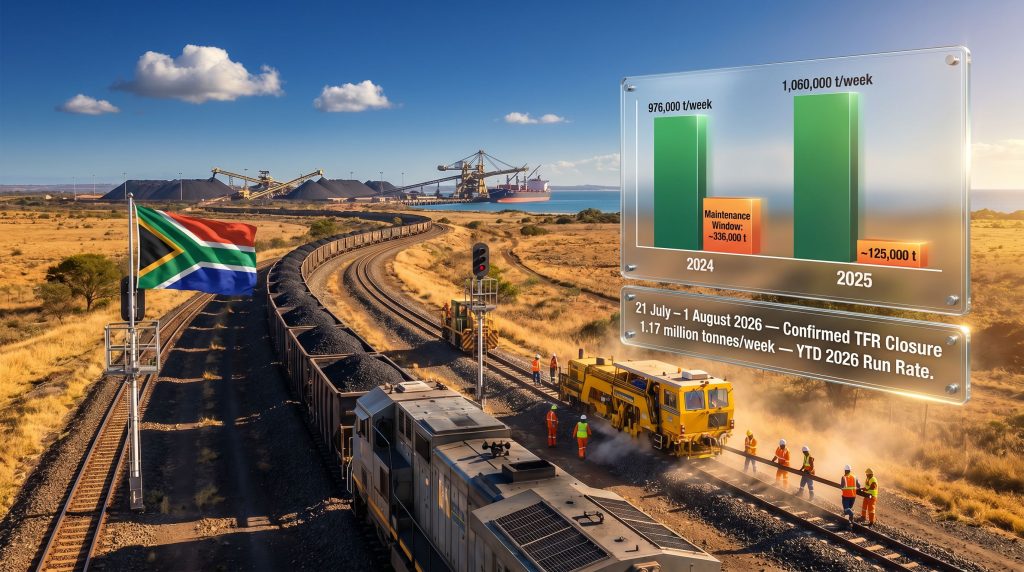
| Maintenance window deliveries | ~336,000 t | ~125,000 t |
| Average weekly deliveries (normal) | ~976,000 t/week | ~1,060,000 t/week |
| Approximate shortfall vs. weekly average | ~640,000 t | ~935,000 t |
| Maintenance window as % of weekly average | ~34% | ~12% |
Source: Argus Media, May 2026
The decline from 336,000 tonnes during the 2024 maintenance window to just 125,000 tonnes in 2025 represents a 63% reduction in throughput performance during equivalent periods. Three explanations are plausible, and they are not mutually exclusive:
- Works during the 2025 window were more extensive or invasive, restricting residual corridor capacity more severely
- The effective shutdown duration extended beyond the announced window dates
- Compounding operational constraints, such as fleet availability or external disruptions, reduced the corridor's ability to maintain even partial throughput during works
What is clear from the data is that the maintenance window volume shortfall is worsening, not stabilising. Buyers and traders with active South African coal exposure should treat this trend as a forward-looking risk factor, not a historical curiosity. Consequently, the commodity price impacts on seaborne markets during commodity price impacts closure periods are likely to intensify.
Is the 60 Million Tonne Target for 2026 Still Within Reach?
Despite the structural challenges, 2026 year-to-date performance provides genuine grounds for measured optimism. Between 1 January and 20 April 2026, TFR transported 18.8 million tonnes of coal by rail to RBCT, translating to a weekly average of approximately 1.17 million tonnes, according to Argus Media data.
This weekly average exceeds both recent annual baselines:
- 2024 weekly average: 976,000 tonnes
- 2025 weekly average: 1,060,000 tonnes
- 2026 YTD weekly average: 1,170,000 tonnes (+10.4% above 2025)
Annualised at the current pace across 52 weeks, this trajectory projects to approximately 60.8 million tonnes, placing the system within range of the publicly stated 60 million tonne target. However, this calculation assumes consistent weekly performance through the remainder of the year, an assumption that the July maintenance window and any unplanned disruptions will test.
The narrowness of the margin is worth noting. If the July shutdown delivers throughput performance closer to the 2025 maintenance window level of 125,000 tonnes rather than the 2024 level of 336,000 tonnes, the volume shortfall versus a normal operating week grows to nearly 935,000 tonnes across the closure period. Over a 12-day window, this represents a meaningful drag on the annual total.
The next major ASX story will hit our subscribers first
TFR's Pre-Shutdown Acceleration Strategy
To partially offset the supply gap created by maintenance closures, TFR historically increases delivery volumes to RBCT in the weeks immediately preceding the shutdown. This pre-positioning strategy serves multiple functions:
- Builds terminal stockpile buffers that can sustain vessel loading schedules during the reduced-throughput window
- Allows mine operators and logistics chains to coordinate forward sales and vessel nominations with greater certainty
- Provides buyers with pre-purchased inventory positions that reduce spot market exposure during the closure
The effectiveness of this acceleration strategy depends entirely on corridor conditions in the lead-up period. Several persistent structural vulnerabilities can compress or eliminate the pre-shutdown accumulation window:
- Cable theft and infrastructure vandalism, which remains a chronic problem on South African rail networks and directly reduces effective throughput capacity
- Locomotive fleet availability, where ageing rolling stock and maintenance backlogs limit TFR's ability to surge deliveries even when demand exists
- Power supply instability, creating operational vulnerabilities along the corridor during periods of national grid stress
- Labour disruptions, where industrial action within TFR or at RBCT can eliminate the buffer-building window entirely
When the pre-shutdown acceleration strategy fails to execute, the downstream effect is compounded. Not only does the maintenance window deliver reduced volumes, but the terminal enters the closure period with lower-than-planned stockpiles, amplifying the supply gap visible to seaborne buyers.
Global Market Implications: Who Bears the Exposure?
South Africa occupies a distinctive position in global seaborne thermal coal markets as a swing supplier capable of serving both Atlantic and Pacific basin buyers. Richards Bay-origin cargoes compete across European, Indian, and Southeast Asian import markets depending on freight economics and price differentials. In addition, resource export bottlenecks in competing supplier nations can amplify the market impact of South African supply disruptions.
During the 12-day 2026 maintenance window, the effective removal of 900,000 to 1.1 million tonnes of potential export volume from global seaborne supply creates measurable spot market pressure, particularly for buyers relying on Richards Bay cargoes as a cost-competitive alternative to Indonesian or Australian supply.
The price exposure is not uniform across buyer categories:
| Buyer Type | Exposure Level | Mitigation Available |
|---|---|---|
| Forward-covered utilities | Low | Price and volume locked prior to window |
| Spot buyers (India, Pakistan, SE Asia) | High | Must source alternative origins at premium |
| Traders with long physical positions | Medium | Can benefit from short-term spot premium |
| Mine operators with pre-planned stockpiles | Low | Pre-positioned against maintenance |
The Richards Bay FOB benchmark functions as a globally watched price reference for high-calorific-value thermal coal. Supply compression during the maintenance window historically generates short-term spot price premiums for Richards Bay-origin cargoes, creating arbitrage dynamics between forward-covered and spot-exposed market participants.
The contrast between planned and unplanned closures is critical to understanding the price impact differential:
| Closure Type | Lead Time | Volume Predictability | Market Price Impact |
|---|---|---|---|
| Annual planned maintenance | Weeks to months | High | Moderate, typically pre-priced |
| Force majeure (derailment, civil unrest) | None | None | Severe, immediate spike |
| Partial single-line closure | Days to weeks | Medium | Low to moderate |
A Structural Reading of TFR's Infrastructure Trajectory
Perhaps the most important insight embedded in the historical closure data is not the 2026 window itself, but the trajectory it represents. The evolution from a single predictable annual shutdown to an increasingly fragmented, multi-window maintenance regime reflects a broader infrastructure condition that has worsened over time. Moreover, geopolitical mining risks in the region add further complexity to long-term supply reliability assessments.
The shift to multiple closure windows across the 2024 calendar year, the introduction of both single and double-line closures during 2025, and the continued 12-day duration in 2026 collectively suggest that TFR is addressing an accumulated infrastructure backlog through incremental intervention rather than comprehensive rehabilitation. Each maintenance window resolves immediate safety and operational concerns while leaving underlying structural wear to compound further.
For market participants with medium to long-term South African coal exposure, this trajectory carries implications beyond any single maintenance window. If the pattern of worsening maintenance window throughput continues, and if the corridor requires increasingly invasive annual interventions, the effective annual export capacity available from RBCT may face a structural ceiling that throughput ambitions alone cannot overcome.
Frequently Asked Questions
When is the Transnet coal line closed in 2026?
The confirmed Transnet coal rail closure dates in South Africa for annual maintenance run from 21 July to 1 August 2026, covering approximately 12 days of reduced or suspended coal rail operations serving Richards Bay Coal Terminal. Freight industry reporting confirms these dates align with TFR's standard annual programme.
How much coal volume is lost during the maintenance shutdown?
Based on 2024 and 2025 data, deliveries during the maintenance window have ranged from 125,000 to 336,000 tonnes, compared with normal weekly averages of 976,000 to 1,060,000 tonnes. The shortfall has worsened year-on-year, from approximately 640,000 tonnes below the weekly average in 2024 to nearly 935,000 tonnes in 2025.
Is RBCT on track to meet its 60 million tonne target for 2026?
As of 20 April 2026, TFR was transporting approximately 1.17 million tonnes per week to RBCT, ahead of both 2024 and 2025 weekly averages. Annualised, this pace projects to approximately 60.8 million tonnes, placing the target within reach provided no major unplanned disruptions occur.
Does TFR publish an official annual coal delivery target?
TFR has not formally issued an annual coal delivery target for 2026. The 60 million tonne expectation and 65 million tonne ambition cited in market reporting originate from RBCT management, which is operationally dependent on TFR's corridor performance.
What makes an unplanned closure worse than a planned maintenance window?
Planned closures allow coal producers, terminal operators, and buyers to pre-position stockpiles, adjust vessel schedules, and manage procurement exposure well in advance. Unplanned events such as derailments or civil disruptions offer no lead time, compressing supply with no market preparation possible. The November 2022 derailment demonstrated this dynamic, producing an 18-day closure that the market could not hedge against in advance.
Which global buyers are most exposed to the July 2026 closure?
Spot buyers in India, Pakistan, and Southeast Asia who rely on Richards Bay cargoes as a cost-competitive supply option face the greatest exposure during the maintenance window. Utilities and industrial consumers with forward purchase coverage are substantially insulated from short-term spot price pressure.
Disclaimer: This article contains forward-looking assessments based on publicly available data and historical throughput trends. Annualised volume projections are estimates derived from year-to-date performance and should not be interpreted as guaranteed outcomes. Commodity markets involve inherent uncertainty, and actual throughput figures may differ materially from projections depending on unplanned operational events, infrastructure performance, and broader market conditions. This article does not constitute financial or investment advice.
Want to Stay Ahead of Commodity Supply Disruptions Before They Move Markets?
Discovery Alert's proprietary Discovery IQ model scans ASX announcements in real time, delivering instant alerts on significant mineral discoveries across more than 30 commodities — turning complex market data into clear, actionable investment opportunities for both short-term traders and long-term investors. Explore how major discoveries have historically generated substantial returns on Discovery Alert's discoveries page, and start your 14-day free trial today to position yourself ahead of the broader market.