
May 19, 2026
The global energy storage sector has entered a phase of unprecedented technological convergence, where mature battery chemries, sophisticated grid integration protocols, and artificial intelligence-driven management systems are creating entirely new market paradigms. This transformation extends far beyond simple cost reductions, fundamentally reshaping how energy infrastructure operates across multiple economic sectors. As nations worldwide grapple with the complexities of renewable energy integration, the trends shaping India's battery energy storage market have emerged as a particularly compelling laboratory for next-generation storage deployment strategies.
Economic Transformation Beyond Traditional Subsidy Models
India's battery energy storage system (BESS) market has undergone a fundamental economic restructuring that signals broader global trends in energy storage commercialisation. The shift from government-dependent deployment models to market-driven economics represents one of the most significant developments in contemporary energy infrastructure planning, particularly relevant to battery metals investment considerations.
Market-Driven Price Discovery Mechanisms
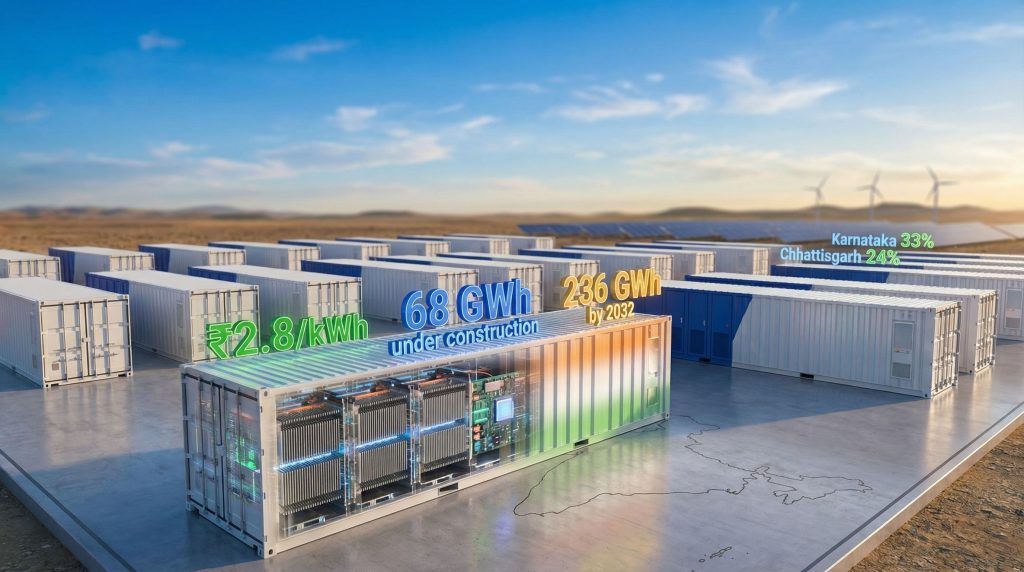
Recent utility-scale procurement processes have demonstrated that effective storage costs have declined from approximately ₹8-10 per kWh to as low as ₹2.8 per kWh through competitive bidding mechanisms. This dramatic cost reduction has occurred through genuine market competition rather than subsidised deployment programs. The transformation has been particularly evident in large-scale standalone battery storage tenders, where developers have successfully bid at prices that indicate underlying technology costs have reached commercially viable thresholds.
The Central Electricity Authority's procurement studies indicate that market-discovered pricing in recent Rajasthan BESS tenders has established new national benchmarks for storage capacity charges, measured in rupees per MW per month. These pricing mechanisms have moved beyond simple energy arbitrage models to incorporate multiple revenue streams including frequency regulation, spinning reserves, and peak capacity provision.
Revenue Stacking and Portfolio Integration
Modern BESS projects increasingly employ sophisticated revenue stacking strategies that combine:
- Capacity charges for grid reliability services
- Energy arbitrage through peak-shaving and load-shifting operations
- Ancillary services including frequency regulation and voltage support
- Behind-the-meter applications for commercial and industrial customers
- Hybrid project integration with solar and wind generation assets
This multi-revenue approach has enabled project developers to achieve financial viability even as government support mechanisms have been recalibrated. The Viability Gap Funding (VGF) scheme ceiling has been significantly reduced compared to initial estimates, reflecting improved market economics and reduced dependency on subsidy support.
Financial Innovation in Project Structuring
Advanced financing mechanisms have emerged to address the capital-intensive nature of storage deployments. Cap-and-floor risk mitigation frameworks provide developers with revenue certainty whilst maintaining exposure to market upside potential. These structures particularly benefit long-duration storage projects where revenue predictability over 15-20 year asset lifecycles becomes critical for debt financing.
Storage-as-a-service business models have gained traction, allowing utilities and commercial customers to access storage capabilities without large upfront capital investments. This approach separates energy storage ownership from operational benefits, enabling more flexible deployment across different customer segments.
When big ASX news breaks, our subscribers know first
Technology Architecture Evolution Beyond Battery Chemistry
The technical evolution of India's storage infrastructure has shifted from component-level optimisation to system-level integration priorities. This transformation reflects a broader industry maturation where reliability, safety, and lifecycle performance have become paramount considerations.
Integrated System Platforms
Contemporary BESS deployments emphasise fully integrated platforms that combine power conversion systems (PCS), energy management systems (EMS), battery management systems (BMS), fire safety protocols, and thermal management within engineered containerised solutions. This approach contrasts sharply with earlier "stitched-together" component strategies that created integration risks and performance uncertainties.
Modern systems feature multi-MW power conversion capabilities with DC voltages up to 1500V and round-trip efficiencies in the high-90 percentage range. These specifications enable grid-scale deployments with minimal power conversion losses and simplified electrical infrastructure requirements.
| System Specification | Performance Range | Key Benefits |
|---|---|---|
| Power Conversion Scale | 150 kVA – 5.5 MVA | Modular scalability |
| Energy Configuration | 300 kWh – 5+ MWh | Flexible duration ratios |
| DC Operating Voltage | Up to 1500V | Reduced conductor requirements |
| Round-Trip Efficiency | High-90s percentage | Minimised conversion losses |
| Operating Lifespan | 15-20 years | Long-term asset economics |
Advanced Battery Management and Safety Systems
Safety considerations have evolved from peripheral concerns to boardroom-level priorities that influence fundamental system architecture decisions. Modern deployments incorporate multi-level protection systems including:
- Module-level battery management systems for granular cell monitoring
- Integrated fire suppression systems designed for lithium-ion battery applications
- Outdoor-rated enclosures capable of withstanding extreme ambient conditions
- Predictive thermal management to optimise battery performance and longevity
The emphasis on comprehensive safety protocols reflects lessons learned from early deployments and increasing insurance company scrutiny of battery storage installations, alongside developments in battery recycling breakthrough technologies.
Artificial Intelligence and Predictive Analytics
AI-enabled energy management systems have emerged as critical differentiators for performance optimisation and lifecycle management. These systems employ machine learning algorithms to:
- Predict optimal charge/discharge cycling based on grid conditions and market prices
- Identify potential component failures before they impact system availability
- Optimise thermal management to extend battery calendar life
- Coordinate fleet-level operations across multiple storage installations
Advanced fleet monitoring capabilities enable remote performance optimisation and predictive maintenance scheduling, reducing operational costs and improving asset utilisation rates.
Diversification Beyond Renewable Integration Applications
Whilst grid-scale renewable integration remains the primary market driver, India's BESS sector has demonstrated remarkable diversification across multiple infrastructure applications. This expansion represents a fundamental broadening of storage value propositions beyond traditional four-hour solar-plus-storage configurations.
Thermal Power Plant Flexibility Enhancement
India has initiated pilot programs deploying storage systems at coal-fired power plants to reduce ramping stress and improve mid-day solar absorption capabilities. These installations enable thermal plants to maintain efficient operating temperatures whilst accommodating variable renewable energy output. The National Thermal Power Corporation (NTPC) has led large-scale procurement processes specifically targeting thermal plant flexibility applications.
This approach addresses a critical grid management challenge as India's renewable capacity expands toward the 500 GW non-fossil energy target. Storage systems at thermal plants enable more efficient grid balancing without requiring rapid thermal unit cycling that reduces equipment lifespan and increases maintenance costs. Furthermore, these developments support broader energy transition dynamics across the power sector.
Transportation Infrastructure Integration
Railway and metro network applications have demonstrated high-reliability use cases for advanced battery storage systems. Kolkata Metro's BESS deployment provides backup traction power and improves system resilience during grid disturbances. These installations require exceptional reliability standards due to public safety implications and demonstrate storage system capabilities under demanding operational conditions.
Rail network storage applications offer several advantages:
- Regenerative braking energy capture during train deceleration phases
- Peak demand reduction during morning and evening rush periods
- Emergency backup power for signal systems and lighting
- Grid stability support for electrified rail corridors
Commercial and Industrial Deployment Strategies
Commercial and industrial facilities increasingly employ storage systems for peak demand shaving, diesel generator displacement, and solar self-consumption optimisation. These applications become economically viable where grid tariff structures include significant demand charges or time-of-use pricing differentials.
Manufacturing facilities particularly benefit from storage systems that provide:
- Power quality improvement for sensitive industrial processes
- Backup power during grid outages to prevent production losses
- Demand charge reduction by peak shaving during high-cost periods
- Solar energy time-shifting to maximise renewable energy utilisation
Electric Vehicle and Data Centre Support
High-power DC charging stations and hyperscale data centres create sharp, localised grid demands that storage systems can effectively manage. Hybrid installations combining renewable generation, battery storage, and EV charging infrastructure are gaining traction as India's electric vehicle adoption accelerates.
These integrated energy hubs offer multiple benefits:
- Peak demand buffering to reduce grid infrastructure upgrade requirements
- Renewable energy storage for time-shifted charging during off-peak periods
- Power quality support for sensitive electronic equipment
- Grid services provision during periods when charging demand is low
Policy Framework Development and Regulatory Architecture
India's energy storage policy framework has evolved from experimental support mechanisms to comprehensive regulatory architecture that positions storage as essential grid infrastructure. This transformation reflects growing recognition that storage systems are fundamental to achieving long-term renewable energy deployment targets.
Storage Mandate Implementation
Regulatory frameworks have progressed from voluntary deployment incentives to mandatory storage requirements that escalate from initial 1% levels to projected 4% by 2029-30. These mandates apply to new renewable energy projects and ensure that variable generation resources include corresponding storage capacity for grid stability.
The Central Electricity Authority's optimal generation mix studies indicate requirements for tens of gigawatts of BESS capacity by 2029-30 to support India's 500 GW non-fossil energy target. This planning horizon provides market participants with long-term demand visibility that supports investment decisions and supply chain development.
Transmission Infrastructure and Grid Access
Policy reforms have addressed critical infrastructure barriers through:
- Transmission charge waivers for storage systems providing grid services
- Streamlined grid interconnection procedures for standalone storage projects
- Technical standards development for grid-forming inverter capabilities
- Certification requirements ensuring safety and performance standards
These regulatory improvements reduce deployment barriers and create standardised frameworks for system integration across different utility territories.
State-Level Procurement Strategies
Individual state governments have developed tailored procurement mechanisms reflecting local grid characteristics and renewable energy resources. Karnataka has captured 33% of national BESS deployment, whilst Chhattisgarh represents 24% of total capacity through industrial applications. Gujarat accounts for 16% of installations supported by progressive state-level policy frameworks.
Storage has moved from experimental pilots to mainstream asset class recognition, with multi-GWh annual deployments expected over the next 3-5 years across central and state utility procurement processes.
Regional deployment patterns indicate that southern and western states dominate 70% of current installations, reflecting better grid infrastructure, higher renewable energy penetration, and more supportive regulatory environments. This concentration parallels Australia's green metals leadership in critical minerals supporting energy storage technologies.
Supply Chain Localisation and Manufacturing Strategy
India's approach to battery storage supply chain development reflects broader strategic priorities around domestic manufacturing capability and reduced import dependency. The "Make in India" framework specifically targets energy storage as a strategic sector requiring indigenous value creation.
What are the key domestic manufacturing initiatives?
Government policies have established comprehensive support frameworks for local battery manufacturing including:
- Production-linked incentive schemes for battery cell manufacturing
- Technology transfer partnerships with international manufacturers
- Quality assurance and testing infrastructure development
- Workforce development programmes for specialised technical skills
These initiatives aim to reduce current import dependency whilst building export capabilities for other emerging markets with similar deployment conditions. Significantly, developments include plans for a battery-grade lithium refinery to support domestic production capabilities.
Co-Development Partnership Models
International technology providers have established co-development partnerships with Indian companies to localise system design and manufacturing processes. These collaborations enable adaptation of global technology platforms to Indian operating conditions including extreme ambient temperatures, dust exposure, and monsoon humidity levels.
Partnership approaches typically include:
- Joint venture manufacturing facilities with shared technology access
- Design optimisation for Indian grid codes and environmental conditions
- Local supply chain integration to reduce costs and lead times
- Export market development leveraging India's cost competitiveness
Strategic Risk Mitigation
Supply chain localisation efforts address multiple strategic risks including:
- Import tariff exposure for critical battery components
- Foreign exchange rate volatility affecting project economics
- Geopolitical supply disruption risks for strategic materials
- Technology access limitations during international trade disputes
Long-term planning scenarios anticipate substantial domestic manufacturing capacity capable of supporting both Indian deployment requirements and export opportunities to other South Asian and African markets.
Regional Market Development and Geographic Patterns
India's battery storage deployment exhibits distinct regional concentration patterns that reflect varying grid infrastructure maturity, renewable energy resource availability, and state-level policy support frameworks. Understanding these geographic dynamics provides insight into future market expansion opportunities.
Current Market Concentration Analysis
| State/Region | Market Share | Primary Applications | Key Drivers |
|---|---|---|---|
| Karnataka | 33% | Utility-scale renewable integration | Progressive RE policy, grid infrastructure |
| Chhattisgarh | 24% | Industrial applications | Manufacturing base, power quality needs |
| Gujarat | 16% | Hybrid solar-storage projects | Business-friendly policies, high solar potential |
| Delhi-NCR | 83% of new C&I installations | Commercial building applications | High electricity tariffs, reliability concerns |
Southern and western states currently dominate 70% of total installations, reflecting more mature renewable energy markets, better grid infrastructure, and supportive regulatory frameworks. These regions have established themselves as proving grounds for next-generation storage technologies and business models.
Emerging Market Opportunities
Northern and eastern regions represent significant untapped potential for storage deployment, constrained primarily by:
- Limited grid infrastructure capacity for large-scale renewable integration
- Lower industrial electricity tariffs reducing C&I storage economics
- Regulatory frameworks still developing storage-specific policies
- Financing availability for early-stage market development
However, these regions offer substantial long-term growth opportunities as grid infrastructure improvements and renewable energy deployment accelerate. Anticipated transmission system upgrades will enable larger-scale storage integration to support renewable energy evacuation from resource-rich areas.
Infrastructure Development Requirements
Regional expansion requires coordinated investments in:
- Transmission system strengthening to accommodate bidirectional power flows
- Distribution network upgrades for behind-the-meter storage integration
- Testing and certification facilities to ensure system quality and safety
- Technical workforce development for installation and maintenance capabilities
The next major ASX story will hit our subscribers first
Investment Pipeline Dynamics and Market Trajectory
India's battery storage investment pipeline demonstrates remarkable growth momentum with current project development activity indicating significant market expansion over the next decade. Understanding these capacity projections and tender activities provides critical insight into sector maturation patterns, particularly regarding the trends shaping India's battery energy storage market.
Capacity Development Projections
Current market analysis indicates India operates approximately 0.5 GWh of baseline battery storage capacity with substantial additional capacity under various development phases. The development pipeline includes 68 GWh currently under construction across utility-scale, commercial, and industrial applications.
Long-term projections suggest India requires 236 GWh of total storage capacity by 2032 to support renewable energy integration targets and grid stability requirements. More ambitious scenarios targeting 2047 energy security objectives indicate potential requirements reaching 1,840 GWh of installed capacity.
Procurement Activity Acceleration
Recent tender activity demonstrates substantial market acceleration with:
- 44% year-on-year increase in total tendered storage capacity
- 113% growth in auction activity across central and state utilities
- 381% year-on-year increase in hybrid renewable-plus-storage procurement
- Multi-GWh project scales becoming standard for utility procurements
This procurement acceleration reflects growing utility confidence in storage technology performance and improving project economics that support larger-scale deployments. Additionally, these developments align with broader energy storage trends in India shaping the market.
Pipeline Development Challenges
Despite robust demand growth, several factors could constrain market development:
- 210 GWh supply shortfall relative to 2032 projected requirements
- Ultra-low bidding practices creating project sustainability concerns
- Limited domestic manufacturing capacity for projected deployment scales
- Grid infrastructure upgrades required for large-scale storage integration
These challenges highlight the need for coordinated policy support, supply chain development, and infrastructure investment to achieve long-term deployment targets. Furthermore, India's aggressive pricing trends have raised concerns about project viability in the market.
Investment Risk and Opportunity Assessment
Current market conditions present both opportunities and risks for investment participants:
Opportunities:
- First-mover advantages in emerging applications and regions
- Technology integration capabilities for system-level solutions
- Policy support frameworks reducing deployment barriers
- Export market potential leveraging Indian cost competitiveness
Risks:
- Aggressive pricing competition potentially undermining project returns
- Technology performance validation under Indian operating conditions
- Regulatory framework evolution affecting project economics
- Supply chain dependency on imported critical components
Technical Performance Standards and Grid Integration Requirements
India's battery storage sector has established increasingly sophisticated technical performance requirements that reflect growing grid integration complexity and long-term asset reliability expectations. These standards ensure storage systems can provide essential grid services whilst maintaining operational effectiveness over projected 15-20 year lifecycles.
Grid Integration and Reliability Specifications
Modern storage systems must demonstrate round-trip efficiencies in the high-90 percentage range whilst maintaining consistent performance across varying ambient conditions and duty cycles. These efficiency standards directly impact project economics by minimising energy losses during charge-discharge cycling operations.
Grid-forming inverter capabilities have become essential requirements for utility-scale installations, enabling storage systems to:
- Establish stable voltage and frequency references during grid disturbances
- Provide black-start capabilities for system restoration following major outages
- Support weak grid conditions in areas with limited transmission infrastructure
- Coordinate with other distributed energy resources for optimal grid performance
Safety and Environmental Performance Standards
Comprehensive safety protocols address the unique risks associated with large-scale lithium-ion battery installations:
- Multi-level fire suppression systems specifically designed for battery applications
- Thermal runaway detection and isolation to prevent cascading failures
- Explosive atmosphere protection meeting international safety standards
- Environmental monitoring for temperature, humidity, and gas emissions
Outdoor-rated enclosures must withstand ambient temperatures exceeding 45°C, monsoon humidity levels, and dust exposure whilst maintaining internal environmental controls necessary for optimal battery performance.
Performance Validation and Testing Protocols
Comprehensive testing requirements ensure system reliability under Indian grid conditions:
- Factory acceptance testing for complete integrated systems
- Site commissioning validation confirming installation quality
- Performance monitoring throughout operational lifecycles
- Predictive maintenance protocols to optimise asset utilisation
These testing frameworks provide utilities and investors with confidence in long-term asset performance whilst identifying potential issues before they impact system availability.
Market Challenges and Growth Constraints
Despite robust growth momentum, India's battery storage market faces several structural challenges that could constrain development trajectory and project success rates. Addressing these limitations requires coordinated industry and policy responses to ensure sustainable market expansion.
What are the primary technical limitations?
Current deployment faces significant technical constraints including:
- Limited domestic manufacturing capacity relative to projected demand requirements
- Inadequate testing and certification infrastructure for validating system performance
- Skilled workforce shortages in specialised installation and maintenance roles
- Unvalidated long-term performance data under Indian operating conditions
These technical barriers particularly impact larger-scale projects where system integration complexity and operational requirements exceed current industry capabilities.
Financial and Market Structure Risks
Aggressive bidding practices have created sustainability concerns across multiple project categories:
- Ultra-low bid prices that may not reflect actual project costs and risks
- Capital-intensive economics requiring innovative financing mechanisms
- Revenue uncertainty for projects dependent on evolving market structures
- Technology cost volatility affecting project economic assumptions
The 210 GWh supply shortfall relative to 2032 projected requirements indicates substantial market development challenges that require expanded manufacturing capacity and improved supply chain coordination.
Regulatory and Policy Evolution
Evolving regulatory frameworks create both opportunities and uncertainties:
- Grid code modifications affecting technical performance requirements
- Market mechanism changes influencing revenue potential
- State policy variations creating implementation complexity
- International trade policies affecting component costs and availability
These regulatory dynamics require market participants to maintain flexible business models capable of adapting to changing policy environments.
Strategic Market Position and Future Outlook
India's battery energy storage market has transitioned from experimental deployment to strategic infrastructure development, positioning the sector for substantial growth whilst establishing India as a potential global leader in storage technology adaptation and deployment.
Market Maturation Indicators
Several key developments signal fundamental market maturation when assessing the trends shaping India's battery energy storage market:
- Integration into national energy planning processes and long-term capacity requirements
- Transition from subsidy-dependent to market-driven economics through competitive procurement
- Technology focus evolution from component optimisation to system-level integration
- Business model sophistication incorporating multiple revenue streams and risk management
These maturation indicators suggest India's storage market has achieved sufficient scale and sophistication to support sustained long-term growth across multiple application segments.
Global Market Position and Export Potential
India's emerging position in global energy storage markets reflects several competitive advantages:
- Adaptation capabilities for challenging operating environments and grid conditions
- Cost-competitive manufacturing leveraging domestic labour and material advantages
- System integration expertise developed through diverse deployment experience
- Export market opportunities to other emerging economies with similar infrastructure challenges
Successful domestic deployment provides validation for Indian technology solutions that could compete effectively in international markets, particularly across South Asia, Africa, and other regions with comparable grid infrastructure characteristics.
Long-Term Strategic Implications
India's battery storage sector development carries broader strategic implications for national energy security and economic development:
- Energy independence through reduced reliance on fossil fuel imports
- Grid modernisation enabling higher renewable energy penetration levels
- Industrial competitiveness through improved power quality and reliability
- Technology leadership in critical infrastructure sectors
The sector's evolution from policy-driven trials to commercially viable deployments demonstrates India's capability to develop strategic technology sectors through coordinated government support and private sector innovation.
These developments position India's battery energy storage market as a critical component of the nation's energy transition strategy whilst creating opportunities for technology leadership and export market development across similar emerging economy contexts worldwide.
Ready to Capitalise on India's Battery Storage Boom?
As India's battery energy storage market evolves into a multi-billion dollar opportunity with 236 GWh projected capacity requirements by 2032, identifying the right mineral discovery companies becomes crucial for investors. Discovery Alert's proprietary Discovery IQ model delivers instant notifications on significant battery metals discoveries across the ASX, helping you position ahead of market movements in lithium, nickel, cobalt, and other critical energy storage materials. Begin your 30-day free trial today to secure your advantage in this rapidly expanding sector.