June 5, 2026
The Infrastructure Advantage Rewriting Uranium Development Economics
The economics of uranium development have long been dictated by depth. For decades, the defining characteristic of a high-value uranium deposit was how far underground it sat, with the Athabasca Basin's unconformity-hosted orebodies commanding premium attention precisely because of their extraordinary grades at depths that tested engineering limits. That model shaped capital allocation, development timelines, and investor expectations across an entire generation of uranium projects.
However, a structural shift is underway. As nuclear power transitions from a legacy baseload technology to a front-line clean energy asset, and as artificial intelligence data centres drive power demand to levels that utility planners are still recalibrating for, the uranium sector faces a timing problem that high-grade deep deposits cannot easily solve. The question is no longer only about grade or geological endowment. It is increasingly about which projects can reach production within the timeframe that markets actually need.
That is the strategic proposition underpinning the Triton Uranium Atlas Project in Uranium City, Saskatchewan, a development that positions near-surface, open-pit uranium as a competitive alternative to conventional deep mining precisely when the uranium supply gap is widening fastest.
When big ASX news breaks, our subscribers know first
What the Atlas Project Actually Represents
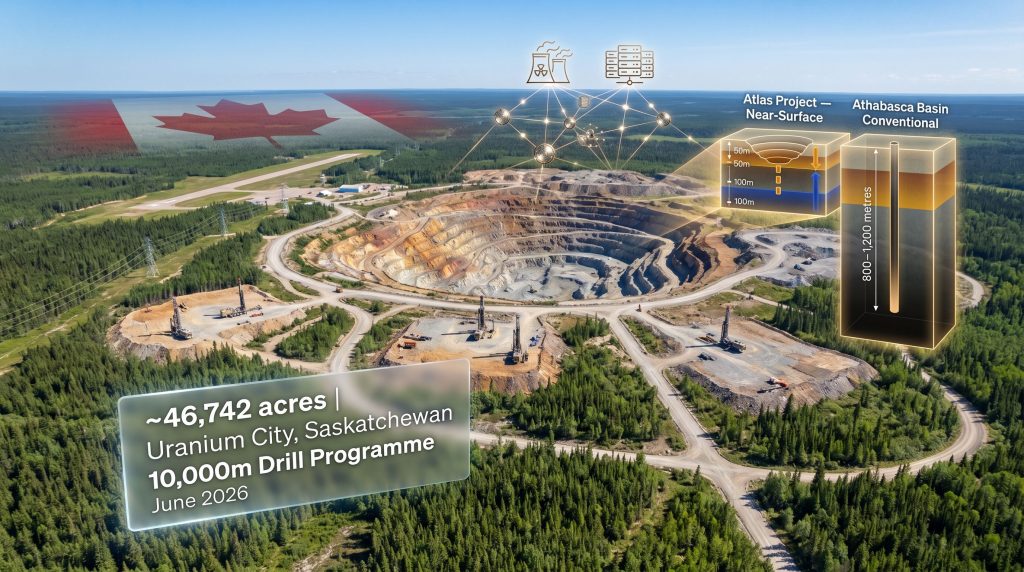
Triton Uranium controls approximately 46,742 acres of mineral dispositions in northern Saskatchewan, with the majority of tenure in good standing through 2032. Following the 2026 exploration programme, these terms are expected to be extended for additional years, providing medium-term tenure security aligned with the project's development trajectory.
The immediate operational priority is a 10,000-metre drill programme targeting four priority zones, including the historic Dubyna Mine area. Drilling is scheduled to commence in June 2026, marking the transition from planning and tenure consolidation into active on-site exploration. The programme is designed around an open-pit development model targeting near-surface mineralisation, a deliberate structural choice that sets the Atlas Project apart from the basin-scale uranium developments that typically dominate investor discussions.
Triton Uranium is fast-tracking its Saskatchewan project in a possible bid to secure a US listing, further underscoring the strategic ambition behind the Atlas Project's accelerated development timeline.
Atlas Project: Key Metrics at a Glance
| Metric | Detail |
|---|---|
| Total Mineral Dispositions | ~46,742 acres |
| Location | Uranium City, northern Saskatchewan, Canada |
| Tenure Standing | Majority in good standing through 2032 |
| Planned Drill Programme | 10,000 metres across four priority target zones |
| Drilling Commencement | Scheduled June 2026 |
| Mining Method | Open-pit (near-surface mineralisation focus) |
| Depth Advantage vs. Athabasca Basin | Surface vs. 800-1,200 m conventional depths |
Why Uranium City? Understanding the Geological and Strategic Logic
Northern Saskatchewan's uranium history predates the Athabasca Basin's emergence as a global mining centre. The Uranium City district was among the earliest commercial uranium production areas in Canada, with activity accelerating during mid-twentieth century demand cycles before declining sharply in the 1970s and 1980s when lower uranium prices made extraction uneconomic. That decline left behind something valuable: a rich geological record.
Decades of federal and provincial geological surveys, historical drilling data, and production records create a foundation of documented mineralisation that substantially reduces exploration risk compared to frontier territories. When Triton targets zones including the Dubyna Mine area, it is not prospecting into unknown geology. It is systematically following geological frameworks established through prior government research and historical mining activity.
Key Geological Distinction:
The Uranium City district sits outside the Athabasca Basin's deep unconformity-hosted deposit model. This is a critical differentiation. While Athabasca Basin projects target extraordinarily high-grade ore at depths of 800 to 1,200 metres, the Uranium City region hosts near-surface mineralisation accessible through open-pit methods. Furthermore, lower grades at near-surface depths can be economically competitive when measured against the capital intensity and timeline requirements of deep unconformity development.
The region's prospectivity is therefore not evaluated on the same metrics as Athabasca Basin projects. The comparison framework shifts from grade-at-depth to total delivered cost, including capital expenditure, development timeline, and infrastructure requirements.
The Cost Architecture of Open-Pit vs. Deep Underground Uranium
Understanding why near-surface open-pit development matters requires clarity on where capital actually goes in conventional deep uranium mining. The Athabasca Basin's highest-grade deposits demand:
- Shaft sinking to depths of 800 metres or more, a multi-year capital programme in isolation
- Specialised underground mining equipment, ventilation systems, and ground support infrastructure
- Freeze curtains and ground freezing programmes to manage groundwater at depth
- Extended construction periods before any ore reaches surface
- Continuous underground maintenance expenditure throughout mine life
Open-pit development eliminates or substantially reduces each of these cost centres. Ore is accessed from surface, material is moved with conventional mining equipment, and the operational footprint is managed without the complexity of deep underground logistics.
Development Model Comparison: Atlas Project vs. Athabasca Basin
| Factor | Atlas Project (Uranium City) | Athabasca Basin Conventional |
|---|---|---|
| Target Depth | Near-surface / open-pit | 800-1,200 m underground |
| Mining Method | Open-pit | Underground / ISR |
| Infrastructure Status | Existing roads, power, airstrip | Requires greenfield build |
| Development Timeline | Compressed (infrastructure-ready) | Typically decade-long |
| Capital Intensity | Lower | Higher |
| Geological Risk Profile | Supported by historic data | High-grade but technically complex |
The Atlas Project's existing infrastructure base amplifies these advantages further. Rather than constructing access routes, power connections, and transport logistics from scratch, the project leverages assets already in place from the district's historical mining period:
- Established service road network connecting key areas
- Grid power access already available on-site
- Airstrips capable of accommodating large transport aircraft for personnel and equipment movement
- Multiple logistics corridors via ice roads and seasonal barge systems
- Proximity to the historic Dubyna Mine area, one of four priority drill targets
Each of these pre-existing assets directly reduces pre-production capital requirements and compresses the time between exploration commencement and potential production decision.
How the 10,000-Metre Drill Programme Advances Toward Resource Definition
A drilling programme of this scale serves a specific function in the uranium development sequence. It is not exploratory in the frontier sense. With historical geological data providing a targeting framework, the 10,000-metre programme is designed to systematically test and define mineralisation across priority zones in sufficient density to support resource estimation under recognised standards. Understanding how to interpret drill results is consequently essential for investors evaluating progress at this stage.
The development pathway from programme commencement to resource definition follows a structured sequence:
- Target Generation – Historical geological data, airborne geophysics, and surface sampling identify priority zones across the four target areas
- Programme Design – Drill spacing, depth targets, and hole orientations are modelled against documented mineralisation trends and historical production data
- On-Site Mobilisation – Equipment and personnel deployment, with June 2026 commencement representing this phase for the Atlas Project
- Core Extraction and Logging – Drill core is extracted, geologically logged, and sampled for laboratory submission
- Assay and Interpretation – Laboratory results are integrated into evolving geological models across the four target zones
- Resource Estimation Pathway – Sufficient drilling density enables maiden or updated resource estimation under NI 43-101 or equivalent reporting standards
- Scoping and Feasibility Studies – Resource data feeds into preliminary economic assessments informing open-pit mine design parameters
The inclusion of the historic Dubyna Mine area as a priority target is particularly significant. Previous mining activity provides ore body geometry data, historical production grade information, and geological continuity evidence that informs drill targeting precision. This is meaningfully different from drilling into unmined, undocumented ground. In addition, a well-structured definitive feasibility study will ultimately be required to translate resource definition into confirmed project economics.
The Demand Side: Why Timing Is No Longer Abstract
The uranium market's current dynamics create a specific kind of urgency that has not characterised previous demand cycles. Two converging forces are reshaping the demand profile simultaneously.
Nuclear energy's policy renaissance is driven by a fundamental reassessment of grid reliability requirements. As intermittent renewable capacity expands, dispatchable baseload power becomes structurally more valuable. Nuclear power, which produces zero direct emissions at scale, has transitioned in policy frameworks from a legacy technology toward a forward-looking clean energy pillar. This shift is most pronounced in the United States, where energy policy discussions increasingly centre on grid reliability, energy security, and reducing dependence on foreign-controlled energy sources.
Artificial intelligence data centres represent the less anticipated demand driver. The computational infrastructure supporting large-scale AI model training and inference requires continuous, reliable power supply at volumes that are straining regional grid capacity in multiple markets. Data centre operators are increasingly evaluating nuclear power purchase agreements and small modular reactor deployment as solutions to their baseload power requirements. This demand signal is additive to the existing nuclear generation fleet's fuel requirements.
The Supply-Side Constraint:
North American uranium supply remains structurally constrained. Domestic production is limited, and utility markets continue to draw on foreign-controlled sources and strategic inventories that sit outside Western supply chains. As uranium market volatility intensifies, the gap between available domestic supply and projected consumption continues to widen.
The critical investor insight here is a misalignment between demand timing and supply development timelines. Most uranium projects in active development face multi-year construction programmes before reaching production. For a utility seeking supply agreements for reactors operational within the next three to five years, the pipeline of available domestic supply is materially constrained.
Projects capable of compressing development timelines therefore carry a market-timing advantage that extends beyond their geological characteristics. Speed, as Triton's chief executive has emphasised, is the dimension most misaligned with current demand urgency. Furthermore, uranium market dynamics in 2025 suggest that investment strategies must increasingly account for this supply-demand misalignment.
The next major ASX story will hit our subscribers first
Community, Governance, and the Social Licence Framework
The Atlas Project's development framework includes explicit commitments to northern Saskatchewan community outcomes. Job creation in the Uranium City region and active engagement with Indigenous communities represent governance pillars that form part of the project's development approach, alongside adherence to applicable environmental standards.
This is not incidental to project development. Social licence considerations in Canadian mining have become increasingly material to project timelines and regulatory outcomes. Projects that establish Indigenous cooperation frameworks and community employment commitments early in development are generally better positioned for regulatory progression than those that address these considerations reactively.
The Uranium City district's historical mining legacy means community relationships with the uranium industry have deep roots, both positive through employment history and complex through environmental and social legacy considerations. Triton's stated commitment to community value creation reflects awareness of this context.
Risk Factors Every Investor Should Understand
The Atlas Project is an exploration-stage development. No production timeline has been confirmed, no resource estimate has been published under NI 43-101 or equivalent standards, and no preliminary economic assessment has been completed. These are standard characteristics of early-stage mining development, but they define the nature of investment risk at this stage.
Risk Assessment Summary
| Risk Category | Nature of Risk | Mitigating Factor |
|---|---|---|
| Exploration Risk | Drill results may not confirm economic mineralisation | Historical geological data reduces targeting uncertainty |
| Timeline Risk | No confirmed production schedule exists | Infrastructure-ready model compresses development path |
| Regulatory Risk | Environmental and permitting approvals required | Saskatchewan has established uranium regulatory frameworks |
| Market Risk | Uranium spot price volatility affects economics | Rising demand from nuclear and AI power sectors supports price floor |
| Capital Risk | Full development requires significant funding | Open-pit model reduces capital intensity vs. underground alternatives |
Several additional dimensions deserve consideration for sophisticated analysis:
- Grade uncertainty at near-surface depths relative to Athabasca Basin unconformity deposits is a genuine variable. Open-pit economics require ore grades sufficient to support processing costs and generate commercial returns, a threshold that drilling results will need to address.
- Regulatory progression in Saskatchewan follows established uranium mining frameworks administered through the Canadian Nuclear Safety Commission. While the province has extensive uranium regulatory experience, environmental assessment requirements and permitting timelines represent genuine schedule variables.
- Market timing risk operates in both directions. Uranium spot price movements between exploration commencement and potential production decisions could materially affect project economics in either direction.
This article does not constitute financial advice. The Atlas Project is at an early development stage, and all forward-looking statements regarding timelines, resources, and production potential are subject to significant uncertainty. Independent due diligence is essential before any investment decision.
Frequently Asked Questions: Triton Uranium Atlas Project
What is the Atlas Project and where is it located?
The Atlas Project is Triton Uranium's flagship uranium development covering approximately 46,742 acres of mineral dispositions in the Uranium City district of northern Saskatchewan, Canada.
How does the Atlas Project differ from Athabasca Basin uranium projects?
The Triton Uranium Atlas Project in Uranium City, Saskatchewan targets near-surface mineralisation accessible through open-pit mining methods, compared to Athabasca Basin projects that require underground development at depths of 800 to 1,200 metres. This distinction creates a lower capital intensity profile and potentially compressed development timeline.
When will drilling begin at the Atlas Project?
Drilling is scheduled to commence in June 2026 across four priority target zones, including the historic Dubyna Mine area.
What infrastructure already exists at the Uranium City project site?
The project benefits from established service roads, grid power access, airstrips capable of handling large transport aircraft, and multiple logistics routes via ice roads and seasonal barge systems.
Why is Uranium City considered prospective for uranium development?
The district hosts extensive documented uranium mineralisation supported by decades of federal and provincial geological data. Historical mining activity, including the Dubyna Mine, provides additional geological context reducing exploration targeting uncertainty.
What is the significance of near-surface uranium mineralisation for project economics?
Near-surface deposits accessible by open-pit mining methods eliminate the capital costs associated with deep shaft development, underground infrastructure, and specialised underground mining equipment. This fundamentally alters the capital intensity and development timeline profile relative to deep unconformity-hosted deposits.
How does the Atlas Project connect to North America's uranium supply challenges?
North American uranium supply remains constrained by limited domestic production and reliance on foreign-controlled sources. The Triton Uranium Atlas Project in Uranium City, Saskatchewan is positioned to address both the supply gap and the timeline requirements created by accelerating demand from nuclear energy expansion and AI-driven power consumption. Triton Uranium eyes a 2026 US listing as nuclear fuel demand rises, further reflecting the company's confidence in its strategic positioning.
What the Atlas Project Signals About the Next Phase of Uranium Supply
The Triton Uranium Atlas Project in Uranium City, Saskatchewan represents more than a single exploration programme. It reflects a broader strategic hypothesis about where the next generation of Western uranium supply will come from, and how quickly it can be developed.
The conventional development model, centred on extraordinary grades at extraordinary depths, delivers uranium at a cost that includes years of pre-production capital investment and multi-decade development timelines. That model served the market adequately during periods of gradual demand growth. It is, however, increasingly misaligned with a market characterised by supply urgency, domestic production imperatives, and accelerating demand from both established and emerging power sectors.
Projects that can compress the development timeline by leveraging historical geological data, existing infrastructure, and lower-complexity mining methods occupy a strategically differentiated position in that environment. Whether the Atlas Project can fulfil that positioning depends on what the 10,000-metre drill programme reveals about the nature, continuity, and grade of near-surface mineralisation across the four priority zones.
The key milestones to monitor over the coming development period include:
- Confirmation of drilling commencement at the scheduled June 2026 date
- Initial assay results from priority zones, particularly the Dubyna Mine area
- Geological continuity data across the four target zones
- Progress toward resource estimation under NI 43-101 standards
- Preliminary economic assessment commencement once resource parameters are established
Each milestone represents a de-risking event that translates geological potential into quantified economic parameters. For a sector where supply urgency is real and development timelines are the constraining variable, the pace of that progression matters as much as the technical outcomes themselves.
Want to Stay Ahead of the Next Major Uranium Discovery on the ASX?
Discovery Alert's proprietary Discovery IQ model delivers real-time alerts on significant ASX mineral discoveries — including uranium — instantly translating complex geological data into actionable investment insights for both short-term traders and long-term investors. Explore why historic mineral discoveries have generated substantial returns and begin your 14-day free trial today to position yourself ahead of the broader market.