July 29, 2026
The Regulatory Architecture Reshaping Canada's Critical Minerals Race
Global demand for copper and gold is not slowing down. As the energy transition accelerates and defence industries modernise, the pressure on mining jurisdictions to deliver permitted, construction-ready projects within predictable timeframes has never been more acute. The Troilus Filon initiative Quebec selection has emerged as a compelling case study in how government can restructure its interface with advanced-stage mining projects without compromising environmental rigour.
Quebec has moved decisively in this direction. The province's newly established Filon initiative, embedded within its 2025-2031 Strategy for the Development of Critical and Strategic Minerals, represents a structural rethink of how government interfaces with advanced-stage projects. The Troilus copper-gold project, one of the largest of its kind in Quebec, has been named among the first recipients of this specialised coordination support.
When big ASX news breaks, our subscribers know first
What the Filon Initiative Actually Does: Beyond the Headlines
Coordination, Not Acceleration
It is worth being precise about what the Troilus Filon initiative Quebec selection actually represents, because misconceptions are easy to form. Filon is not a fast-track permitting scheme. It does not compress environmental review timelines, waive regulatory requirements, or confer any form of pre-approval. What it does is fundamentally different, and arguably more valuable over the long term.
The initiative introduces a dedicated coordination layer between project proponents and the constellation of Quebec government ministries and agencies responsible for issuing permits and authorisations. Each selected project is assigned a specialised mining expert whose role is to guide the company through administrative processes, proactively identify bureaucratic bottlenecks, and facilitate structured engagement with relevant government bodies.
The distinction matters enormously for investors and project developers: Filon selection signals strategic importance and development maturity, but it does not constitute permitting approval, construction authorisation, or any guaranteed regulatory outcome.
How Filon Compares to Standard Permitting Pathways
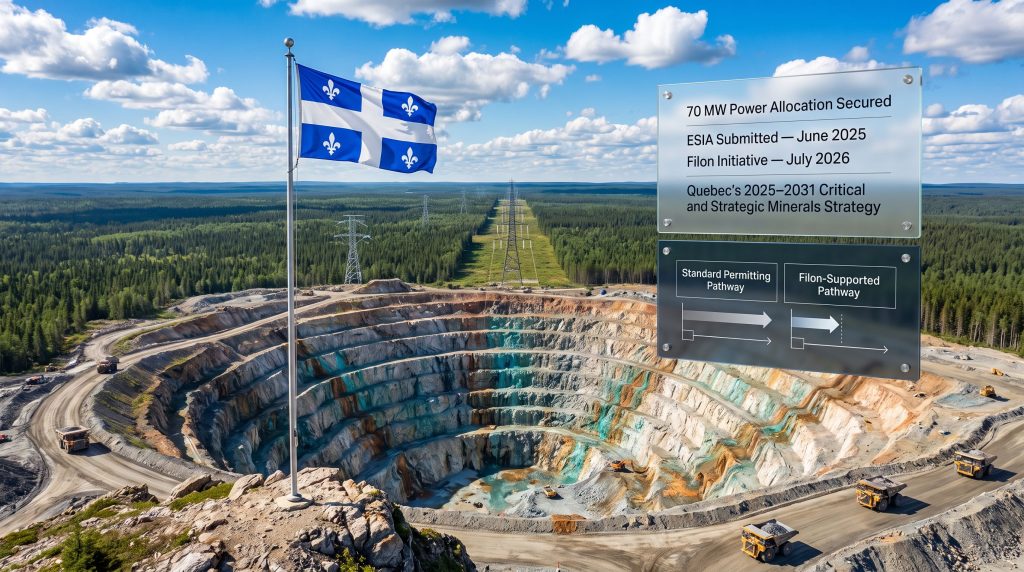
Under a conventional permitting pathway in Quebec, project proponents must self-navigate a multi-ministry approval landscape. Delays frequently arise not from substantive regulatory objections but from administrative friction, unclear sequencing between agencies, and reactive rather than proactive engagement. Filon addresses precisely these structural inefficiencies, as the table below illustrates.
| Feature | Standard Permitting Pathway | Filon-Supported Pathway |
|---|---|---|
| Government coordination | Multi-ministry, self-navigated | Dedicated expert assigned per project |
| Bottleneck identification | Reactive | Proactive, ongoing engagement |
| Environmental review | Standard process | Maintained in full |
| Predictability for proponents | Variable | Structured and guided |
| Eligibility | All projects | Strategic projects only |
The result is a more predictable regulatory journey, not a shorter environmental review. That nuance is critical for any stakeholder seeking to understand what Filon selection means in practical terms. Understanding the mining permitting realities helps contextualise why this distinction carries such weight for project developers and institutional investors alike.
The Policy Framework Behind the Initiative
Filon sits within Quebec's broader 2025-2031 Critical and Strategic Minerals Strategy, a framework designed to position the province as a reliable, responsible supplier of materials essential to clean energy technology, electric vehicles, and advanced manufacturing. Copper, given its centrality to electrification infrastructure, is a primary focus. For a deeper look at how these materials intersect with critical minerals and energy security, the stakes become even clearer.
The initiative also arrives in the context of a proposed federal-provincial agreement between the Governments of Quebec and Canada aimed at harmonising environmental assessments under a so-called "One Project, One Review" framework. If enacted, this agreement would reduce duplication between provincial and federal review processes while preserving the rigour of each. For mining proponents like Troilus, the combination of Filon at the provincial level and a harmonised federal-provincial assessment process at the national level could meaningfully reduce the uncertainty that has historically made Canadian mining timelines difficult to forecast.
It is important to note that the "One Project, One Review" framework remains a proposed agreement as of the date of this writing. Its implications for specific projects, including Troilus, have not been formally confirmed.
Why Troilus Was Selected: Reading the Strategic Signals
Advanced Development Stage as a Differentiator
Not every mining project qualifies for Filon support. Selection criteria appear to emphasise two key factors: strategic minerals alignment and advanced development maturity. Troilus satisfies both, and the Troilus project financing structure further reinforces the project's credibility as a serious development candidate.
The project formally submitted its Environmental and Social Impact Assessment in June 2025, a document that represents years of baseline environmental studies, community consultation, engineering work, and impact modelling. ESIA submission is not a minor administrative step. It marks the point at which a project has crossed from exploration-stage aspiration into serious permitting engagement with government regulators.
By the time Filon selection was announced in July 2026, Troilus had also secured a 70 MW hydroelectric power allocation from Hydro-Quebec and the Ministere de l'Economie, de l'Innovation et de l'Energie. This power allocation is significant for two reasons. First, it confirms access to clean, low-cost electricity, a material advantage in an era where energy costs and carbon intensity are increasingly scrutinised by investors and offtake partners alike. Second, it demonstrates that Quebec's infrastructure agencies view the project as sufficiently credible and advanced to warrant locking in long-term power capacity.
Project Timeline at a Glance
- June 2025: Environmental and Social Impact Assessment formally submitted to Quebec regulators
- June 2026: 70 MW hydroelectric power allocation secured from Hydro-Quebec and MEIE
- July 2026: Selected as one of the first recipients of Filon initiative specialised support
Copper and Gold in Quebec's Resource Development Framework
Quebec's mineral endowment is genuinely exceptional by global standards. The province sits atop the Canadian Shield, one of the world's oldest and most mineralised geological formations, with lithologies that have produced world-class deposits of gold, copper, nickel, lithium, and rare earth elements. The Troilus district in northern Quebec has a documented production history, with the original Troilus mine operating from 1997 to 2010 and producing over two million ounces of gold equivalent during its operational life.
This historical production context is often underappreciated. Legacy infrastructure, established haul roads, existing tailings management areas, and prior environmental baseline data all reduce the technical and financial risk profile of redevelopment projects relative to greenfield discoveries. For a jurisdiction prioritising efficient development of materials central to a national critical minerals strategy, selecting a project with this kind of established footprint makes strategic sense.
Quebec's Regulatory Positioning in the Canadian Mining Landscape
Provincial Permitting Efficiency: A Comparative Lens
Canada's mining jurisdictions vary enormously in their regulatory efficiency and predictability. British Columbia has faced sustained criticism for permitting timelines that stretch beyond a decade for major projects. Furthermore, the Northwest Territories mining jurisdiction operates within a complex dual federal-territorial framework that adds layers of procedural complexity. Ontario, while historically mining-friendly, has its own multi-agency approval challenges for projects affecting the Ring of Fire and other environmentally sensitive areas.
Quebec has generally been regarded as a more structured environment, supported by the BAPE (Bureau d'audiences publiques sur l'environnement) process, which, while thorough, follows defined procedural timelines. The introduction of Filon adds a proactive coordination layer on top of this existing framework, consequently setting Quebec apart as potentially the most investor-friendly major mining jurisdiction in the country.
What International Jurisdictions Can Learn
The coordination-first model that Filon embodies is not without precedent internationally. Australia's Major Projects Facilitation Agency and Finland's single-window permitting approach for battery mineral projects share conceptual DNA with Quebec's initiative. However, what distinguishes Filon is its explicit embedding within a strategic minerals strategy, ensuring that coordination resources are directed toward projects that align with provincial economic objectives rather than being available to all comers indiscriminately. Mining Weekly's coverage of the announcement underscores the broader industry significance of this model.
Frequently Asked Questions: Troilus Filon Initiative Quebec
What is the Filon initiative in Quebec?
Filon is a specialised support service established by the Quebec government to improve coordination among ministries and agencies involved in the authorisation process for strategic mining projects. It assigns a dedicated expert to each selected project to guide proponents through administrative processes and identify potential bottlenecks.
Which projects have been selected for Filon support?
The Troilus copper-gold project was named among the first projects to receive Filon support, announced in July 2026 by Quebec's Minister of Natural Resources and Forests.
Does Filon approval mean a mining project is guaranteed to proceed?
No. Filon selection reflects a project's strategic importance and development maturity. It does not constitute permitting approval, construction authorisation, or any guaranteed regulatory outcome. All environmental review processes remain intact.
What is the Troilus Project and where is it located?
The Troilus Project is a large-scale copper-gold development project located in northern Quebec, Canada. The project area has a documented mining history, with the original mine operating from 1997 to 2010.
How does Filon interact with federal environmental assessment processes?
Filon operates at the provincial level. It is complemented by a proposed federal-provincial "One Project, One Review" agreement that seeks to harmonise provincial and federal environmental assessments to reduce duplication, though this framework remains a proposal and its project-specific implications have not been formally confirmed.
The next major ASX story will hit our subscribers first
Key Takeaways: Policy Milestones and Strategic Implications
| Data Point | Detail |
|---|---|
| Initiative name | Filon |
| Governing strategy | Quebec's 2025-2031 Critical and Strategic Minerals Strategy |
| Project type supported | Advanced-stage strategic mining projects |
| Troilus ESIA submission | June 2025 |
| Power allocation secured | 70 MW hydroelectric (June 2026) |
| Filon selection announced | July 2026 |
| Federal-provincial framework | Proposed "One Project, One Review" agreement |
The Broader Signal for Global Critical Minerals Supply Chains
The Troilus Filon initiative Quebec story is not just about one project or one province. It reflects a broader realignment happening across Western mining jurisdictions, where governments are recognising that regulatory predictability is itself a form of competitive infrastructure. In a world where critical minerals projects compete for finite pools of institutional capital, the difference between a jurisdiction that offers structured, expert-guided permitting coordination and one that does not can determine where billions of dollars in mine development investment ultimately flow.
For project developers, the takeaway is straightforward: advancing to ESIA submission stage, securing infrastructure commitments like power allocations, and demonstrating community and environmental diligence are the qualities that attract both regulatory coordination support and investor confidence. For the broader industry, Quebec's Filon model offers a replicable template that other Canadian provinces and international jurisdictions would be wise to study carefully.
This article contains forward-looking statements and references to proposed regulatory frameworks. Readers should note that proposed agreements, including the "One Project, One Review" federal-provincial framework, have not been formally enacted and their specific implications for individual projects remain unconfirmed. This content is for informational purposes only and does not constitute financial or investment advice.
Want to Stay Ahead of Significant ASX Mineral Discoveries Before the Broader Market Does?
Discovery Alert's proprietary Discovery IQ model delivers real-time alerts on major ASX mineral discoveries — instantly translating complex geological and market data into actionable investment insights for both short-term traders and long-term investors. Explore historic discovery returns on Discovery Alert's dedicated discoveries page and begin your 14-day free trial today to position yourself ahead of the market.