June 4, 2026
The Hidden Gating Factor That Separates Viable Mines From Stranded Assets
Energy access is rarely the first variable investors scrutinise when evaluating a mining project. Reserve size, grade, jurisdiction, and permitting status tend to dominate the conversation. Yet across the global resource sector, some of the most technically sound projects have stalled not because of geological uncertainty or regulatory failure, but because securing a reliable, sufficient, and cost-stable power supply proved far more complex than anticipated.
In large-scale copper and gold operations, power is not a utility consideration that gets resolved late in the development cycle. It is a foundational input that shapes construction timelines, operating cost structures, emissions profiles, and ultimately, bankability. This reality is increasingly relevant given the growing critical minerals demand driven by global decarbonisation targets.
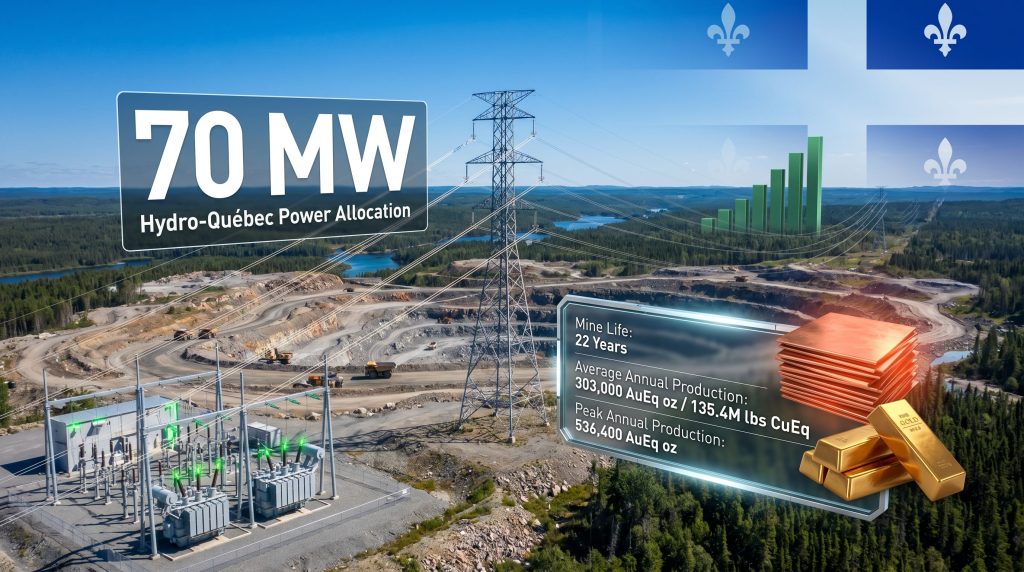
Understanding this reality reframes what it means when a major copper-gold project secures a 70 MW Troilus power allocation from Hydro-Québec for the Troilus Project, confirmed in coordination with Quebec's Ministère de l'Économie, de l'Innovation et de l'Énergie (MEIE). This is not an administrative checkbox. It is the resolution of one of the most structurally significant uncertainties in a mine's pre-construction journey.
When big ASX news breaks, our subscribers know first
What a Formal Power Allocation Actually Represents in Quebec's Energy Framework
Quebec operates one of the most distinct industrial energy frameworks in North America. Hydro-Québec, the provincially owned utility, manages an electricity grid sourced overwhelmingly from hydroelectric generation. Industrial power allocations are not automatic entitlements. They require a formal application process, assessment by both the utility and the MEIE, and a determination that sufficient grid capacity exists to serve the requesting project.
For mining projects, this process carries particular significance. A formal allocation from Hydro-Québec confirms that:
- The project has been assessed and recognised as a viable industrial electricity consumer
- Sufficient grid capacity has been reserved specifically for that project's construction and operational phases
- The project can proceed through financing and construction planning with energy supply certainty confirmed
- The applicant has successfully navigated a multi-stakeholder approval process involving both the utility and a provincial ministry
The formal power request for the Troilus Project was submitted in early 2025, with the approval following sustained engagement between Troilus Mining Corp., Hydro-Québec, and government stakeholders. This multi-year lead time reflects standard practice for large-scale resource development: energy planning cannot begin when shovels are ready to turn. It must begin years earlier, embedded within the broader feasibility and permitting work.
Why 70 MW and What That Number Reflects About Operational Scale
How Does Power Demand Map Across a Mine's Lifecycle?
To contextualise a 70 MW allocation, it helps to understand how energy demand maps across a mine's lifecycle. During construction, power demand is substantial but variable, driven by site preparation, civil works, equipment commissioning, and processing plant construction. Once a mine reaches steady-state operations, power consumption becomes more predictable but equally demanding, sustaining crushing and grinding circuits, pumping systems, ventilation, processing infrastructure, and site-wide facilities.
For a large-scale open-pit or combined operation of the Troilus Project's magnitude, 70 MW is a materially significant allocation that reflects the full operational footprint described in the May 2024 definitive feasibility study. That study outlined:
| Project Metric | Detail |
|---|---|
| Feasibility Study Published | May 2024 |
| Mine Life | 22 years |
| Average Annual Production | 303,000 AuEq oz / 135.4M lbs CuEq |
| Peak Annual Production | 536,400 AuEq oz |
| Construction Workforce | ~1,000 direct positions |
| Operational Workforce | 680+ permanent positions |
| Power Allocation Secured | 70 MW |
A 22-year mine life with peak annual production exceeding 536,000 gold-equivalent ounces demands continuous, uninterrupted energy supply at industrial scale. The 70 MW allocation is sized to accommodate both the construction phase, where power requirements ramp up across a compressed period, and the long operational life that follows.
Pre-Built Infrastructure: The Competitive Advantage That Changes the Capex Equation
Why Does Existing Transmission Infrastructure Matter So Much?
One of the most underappreciated aspects of the Troilus Project's development profile is the transmission infrastructure already in place at the site. Many greenfield mining projects in remote or semi-remote locations must budget for, permit, and construct their own transmission corridors before a single tonne of ore can be processed. This adds years to development timelines and hundreds of millions of dollars to capital expenditure estimates.
The Troilus site benefits from a fundamentally different starting position:
| Infrastructure Component | Status | Strategic Benefit |
|---|---|---|
| 161 kV High-Tension Power Lines | 107 km in place | Eliminates greenfield transmission capex |
| On-Site Substation | Connected and operational | Enables immediate grid integration |
| Hydro-Québec Power Allocation | 70 MW approved | Confirms energy availability for full operations |
| Grid Energy Source | Low-carbon hydroelectric | Supports Scope 2 emissions reduction objectives |
The existence of 107 kilometres of 161 kV high-tension powerlines already connected to an on-site substation means the 70 MW allocation can be drawn down through existing infrastructure. This removes transmission corridor construction from the critical path entirely, reducing both capital risk and execution complexity for future construction contractors and lenders assessing the project.
For project finance lenders, this distinction matters considerably. Transmission infrastructure that must be built represents a contingent liability: cost overruns, permitting delays, and construction risks all sit on the project balance sheet. Transmission infrastructure that already exists, however, represents a de-risked asset, one whose value becomes even clearer when assessed alongside a confirmed power allocation.
The ESG Dimension: Why Low-Carbon Power Is Now a Bankability Factor
The source of the 70 MW allocation deserves specific attention. Quebec's grid is among the lowest-carbon electricity systems in the world, deriving the overwhelming majority of its generation capacity from hydroelectric sources. For a copper-gold mining project planning a 22-year operational life, this matters across multiple dimensions.
Scope 2 emissions represent the indirect greenhouse gas emissions associated with purchased electricity. For energy-intensive mining operations, Scope 2 can represent a significant portion of a project's total carbon footprint. Furthermore, access to Hydro-Québec's hydroelectric grid structurally reduces this emissions category, improving the project's overall carbon intensity metrics relative to operations powered by fossil fuel-based grids. The broader trend toward renewable power in mining further underscores why this grid access is so strategically valuable.
This matters increasingly to three key stakeholder groups: institutional investors applying ESG screening frameworks, offtake partners in copper and gold markets facing their own downstream emissions obligations, and project finance lenders whose sustainable finance policies increasingly require carbon disclosure and reduction pathways.
Beyond the emissions profile, Hydro-Québec's industrial electricity rates are recognised as among the most competitive in Canada and globally. For a project with a 22-year mine life, the compounding effect of lower, regulated energy costs on operating expenditure is material. Quebec's industrial power pricing has historically provided a structural cost advantage to energy-intensive operations relative to jurisdictions relying on diesel generation, natural gas, or less regulated electricity markets.
How This Milestone Fits the Broader De-Risking Architecture
Large-scale mining project development is best understood as a parallel de-risking process across multiple workstreams. Technical, permitting, environmental, community, financial, and infrastructure risks must each be reduced to a threshold level before project financing can be assembled and construction mobilisation authorised.
The Troilus power allocation from Hydro-Québec resolves the energy infrastructure workstream in a decisive way. When assessed alongside the recently announced Troilus financing package and detailed engineering work, the approval meaningfully compresses the gap between development-stage classification and construction-ready status.
From a project finance perspective, confirmed power access removes a key item from the due diligence risk register. Lenders and equity co-investors conducting bankability assessments will evaluate energy supply certainty as a prerequisite condition. Without a confirmed allocation from a recognised, creditworthy utility, that condition remains open. With the 70 MW allocation secured, it is closed.
In project finance terms, each closed risk item reduces the probability-weighted cost of capital for a development asset. The cumulative effect of multiple resolved risk items — power, permitting, engineering, and infrastructure — is a meaningful re-rating of the project's financing attractiveness.
The next major ASX story will hit our subscribers first
Scale, Jurisdiction, and Strategic Position in Canada's Critical Minerals Landscape
The Troilus Project occupies a strategically significant position within Canada's broader critical minerals development pipeline. It is currently the largest copper project at the permitting stage in Quebec and ranks among the largest undeveloped gold projects in Canada by reserve scale.
Copper occupies a central position in the global energy transition narrative. The worsening copper supply crunch and demand projections across electric vehicles, grid-scale energy storage, renewable energy infrastructure, and electrification of industrial processes consistently point to a structural supply deficit emerging over the coming decade. New copper mines take between 10 and 20 years from discovery to production, and the pipeline of large-scale, fully permitted projects in stable jurisdictions is demonstrably thin.
The Troilus Project's combination of scale, infrastructure readiness, grid connectivity, and jurisdictional stability in Quebec places it within a narrow cohort of projects capable of contributing meaningfully to North American copper supply within a relevant timeframe. The project is expected to support domestic copper supply needs while generating approximately 1,000 direct construction jobs and more than 680 permanent operational positions in northern Quebec, delivering sustained regional economic benefit across its 22-year operational life. Industry coverage confirms the scale of this milestone within the broader Canadian mining landscape.
Frequently Asked Questions: Troilus Power Allocation from Hydro-Québec
What is the Troilus Project and where is it located?
The Troilus Project is a large-scale copper-gold development asset situated in north-central Quebec, Canada. It is operated by Troilus Mining Corp. and is currently advancing through permitting, detailed engineering, and project financing processes simultaneously.
How much power has been allocated and by whom?
A 70 MW allocation has been approved by Hydro-Québec and the MEIE to support both the construction phase and long-term mine operations.
Why is this considered a de-risking milestone rather than a routine approval?
Power allocation in Quebec's regulated energy framework requires formal application, multi-stakeholder review, and grid capacity assessment. Confirmation removes a key gating condition from project finance due diligence and validates the project's construction readiness from an energy infrastructure perspective.
Is transmission infrastructure already in place at the site?
Yes. A 107-kilometre network of 161 kV high-tension powerlines is already installed and connected to an on-site substation, meaning the project does not need to construct transmission infrastructure as part of its development capital program.
What are the environmental benefits of hydroelectric power for this project?
Access to Quebec's hydroelectric grid directly reduces the project's Scope 2 carbon emissions, supports ESG compliance obligations, and provides competitively priced renewable energy across the full 22-year mine life.
What economic impact is projected for the region?
The project is expected to create approximately 1,000 direct jobs during the construction phase and sustain over 680 permanent positions during operations, with broader regional economic multiplier effects for northern Quebec communities.
Key Takeaways: What the 70 MW Approval Signals Across Multiple Dimensions
The Troilus power allocation from Hydro-Québec for the Troilus Project is significant across operational, financial, environmental, and strategic dimensions simultaneously:
- Operationally, it confirms that sufficient, reliable energy will be available to support a 22-year mine life at a production scale averaging 303,000 AuEq ounces annually
- Financially, it removes a key due diligence condition from project finance checklists, supporting the project's transition toward construction-ready classification
- Environmentally, it locks in access to one of the world's lowest-carbon industrial electricity grids, structurally reducing Scope 2 emissions across the project's full operational life
- Infrastructurally, the pre-existing 107 km transmission corridor and on-site substation mean the allocation can be utilised without additional transmission capital expenditure
- Strategically, it reinforces the project's position as the largest copper project at the permitting stage in Quebec and one of Canada's most significant undeveloped gold assets
Energy security is not a late-stage consideration in mine development. It is a foundational pillar that must be resolved before financing structures can be finalised and construction timelines can be credibly committed to. With this allocation secured, and permitting, engineering, and financing advancing in parallel, the Troilus Project is demonstrably moving from development-stage asset toward the threshold of construction readiness.
This article contains forward-looking statements and projections based on publicly available information from Troilus Mining Corp.'s May 2024 Feasibility Study and related disclosures. Actual outcomes may differ materially from projections. This content does not constitute financial advice. Readers should conduct independent due diligence before making investment decisions.
Want To Catch The Next Major Mineral Discovery Before The Market Moves?
Discovery Alert's proprietary Discovery IQ model scans ASX announcements in real time, instantly identifying significant mineral discoveries and turning complex data into actionable opportunities for both traders and long-term investors — explore historic examples of exceptional discovery returns to understand what's at stake, then begin your 14-day free trial at Discovery Alert to position yourself ahead of the broader market.