
July 31, 2026
The Hidden Supply Chain War Being Fought Through Industrial Waste
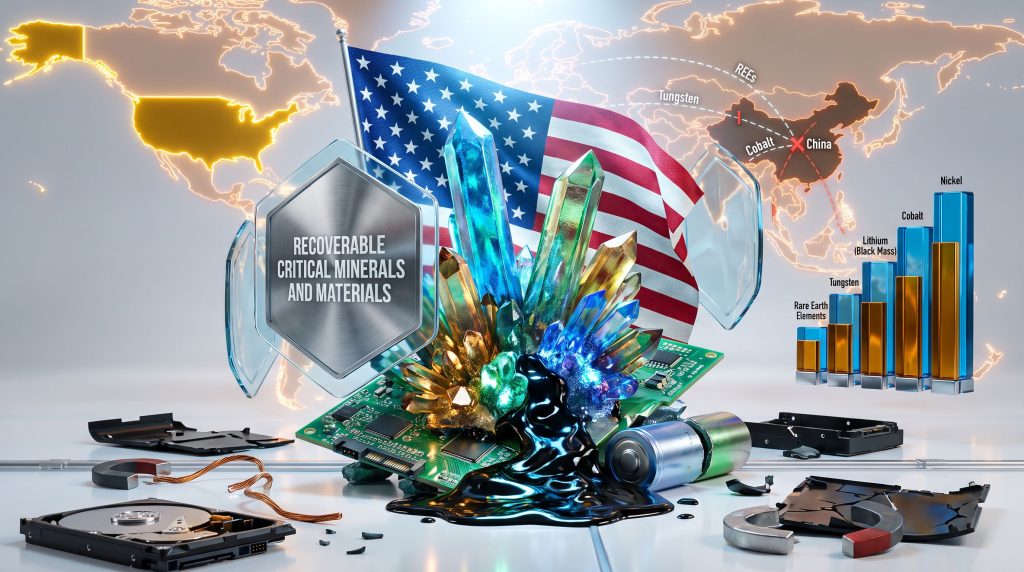
Most people picture critical mineral security as a mining problem, something solved by digging more holes in the ground and pulling raw ore from the earth. The reality operating beneath that assumption is far more complex and, in many ways, more urgent. The United States is sitting atop vast quantities of strategically vital materials right now, locked inside discarded smartphones, spent electric vehicle battery packs, decommissioned military electronics, and end-of-life wind turbine components. The question driving Washington's most consequential Trump critical minerals export curbs in 2026 is not where to find these materials, but how to stop them from leaving the country before they can be recovered.
On July 30, 2026, President Donald Trump signed a presidential determination invoking the Defense Production Act to grant the Commerce Secretary authority to implement export restrictions on recoverable critical minerals and materials, known as CMMs, embedded within industrial scrap, electronic waste, and spent energy storage products. The move signals a fundamental reframing of how the U.S. conceptualises its domestic mineral inventory, treating finished goods not as end products but as unmined reserves.
When big ASX news breaks, our subscribers know first
Understanding the Scale of U.S. Mineral Vulnerability
To appreciate why Trump critical minerals export curbs have become a central pillar of national security policy, it helps to understand just how structurally exposed the United States has become across multiple material categories simultaneously.
| Mineral/Material | Primary Use | U.S. Import Dependence | Dominant Supplier |
|---|---|---|---|
| Rare Earth Elements | Defense, EVs, semiconductors | High | China |
| Tungsten | Military hardware, cutting tools | Very High | China |
| Lithium (Black Mass) | EV batteries, energy storage | Moderate-High | China/Chile |
| Cobalt | Battery cathodes, aerospace | High | DRC/China |
| Processed REE Compounds | Permanent magnets, electronics | Extremely High | China |
| Nickel | Naval vessels, battery cathodes | Moderate-High | Indonesia/Russia |
The deeper problem is not simply raw material access. The United States possesses meaningful geological endowments of several of these elements, yet it lacks the mid-stream processing and refining infrastructure needed to convert ore or recovered scrap into usable industrial inputs. China, by contrast, has spent decades building dominant positions not just in mining but across the entire value chain, from ore extraction through chemical separation to the production of finished components like neodymium-iron-boron permanent magnets used in guided munitions and electric motors.
Critical structural insight: The U.S. processing gap is arguably more dangerous than its mining gap. A country can import ore and process it domestically. A country that cannot process materials at all is dependent at every stage of the supply chain, regardless of what lies under its soil.
This is precisely why the July 2026 DPA determination focuses on recoverable materials rather than virgin ore. The logic is that the U.S. already has physical possession of substantial CMM quantities in the form of products reaching end-of-life. Allowing those materials to be exported as scrap or e-waste before domestic processors can reclaim them represents a compounding strategic loss.
The Defense Production Act as a Supply Chain Instrument
A Cold War Statute Repurposed for 21st-Century Resource Competition
The Defense Production Act was enacted in 1950 during the Korean War, designed to give the executive branch sweeping authority to mobilise industrial capacity for national defense without waiting for congressional legislation. For most of its history, it was invoked sparingly and in acute emergency contexts. Furthermore, the Defense Production Act and critical minerals policy landscape has evolved considerably in recent years.
That calculus has shifted dramatically. The Biden administration used DPA authority to direct domestic production of solar panels, heat pumps, grid transformers, and fuel cells. The Trump administration has now extended that precedent into critical mineral supply chain management, using it to restrict outbound material flows rather than simply stimulate inbound production.
What the DPA specifically empowers in this context includes:
- Unilateral presidential authority to direct private-sector production and resource allocation
- Delegation of rulemaking authority to cabinet secretaries, in this case the Commerce Secretary, to design and enforce specific export licensing regimes
- The ability to classify industrial waste streams as strategic national security assets subject to federal oversight
- Compulsion of private-sector participation without requiring congressional approval or judicial pre-clearance
Crucially, the July 2026 order operates in parallel with, but is legally distinct from, a separate Section 232 proclamation issued earlier in 2026 targeting the import side of the mineral equation through tariffs and price floors on processed critical minerals entering the U.S. Together, these instruments form a two-sided policy architecture: keep recoverable materials in, and make it more expensive to remain dependent on foreign processed inputs.
China's Export Control Playbook and the Escalation Sequence
How Beijing Turned Rare Earths into Geopolitical Leverage
The context for Trump critical minerals export curbs cannot be understood without tracing China's own strategic escalation. Following U.S. tariff increases targeting Chinese goods, Beijing imposed rare earth export restrictions on a range of other strategic materials, creating acute shortages for American manufacturers that depend on these inputs for everything from consumer electronics to precision-guided munitions.
Reports from 2025 and 2026 documented some specialty minerals becoming effectively unobtainable for certain U.S. industrial buyers in the weeks following Chinese countermeasures. According to Reuters reporting on China's retaliatory measures, the disruption was significant enough to accelerate diplomatic engagement, ultimately producing a broader U.S.-China trade agreement that partially eased restrictions in exchange for tariff relief.
However, the Trump administration drew a pointed lesson from this episode: a bilateral trade deal with a strategic competitor is not a substitute for structural supply chain independence. Even with the detente in place, the underlying dependency architecture remained intact. China retained the processing infrastructure, the refinery capacity, and the market share across the rare earth value chain that made its export controls so damaging in the first place.
Speculative but increasingly discussed within industry circles: Some analysts believe China's 2025 rare earth export controls were deliberately calibrated to cause visible but not catastrophic disruption, functioning more as a demonstration of leverage than a full economic weapon. The implication is that Beijing retains the capacity for a significantly more severe response if strategic competition intensifies, a risk that U.S. policymakers appear to be taking seriously.
Which Materials and Industries Face the Most Direct Exposure
The Recoverable Resource Landscape
The materials targeted by the DPA determination share a common characteristic: they are present in significant concentrations within end-of-life products already circulating within the U.S. economy. This distinguishes them from virgin ore, which requires geological discovery and extraction. The strategic opportunity, and the policy challenge, lies in capturing these materials before they exit the domestic supply chain.
| Material | Recoverable Sources | Industrial Criticality | Defense Application |
|---|---|---|---|
| Rare Earth Elements | Permanent magnets, hard drives, wind turbines | Extremely High | Guided munitions, radar, sonar |
| Tungsten | Electronic scrap, cutting tool waste | Very High | Armor-piercing rounds, aerospace |
| Lithium (Black Mass) | Spent EV and consumer batteries | High | Energy storage, vehicle propulsion |
| Cobalt | Battery packs, aerospace alloy scrap | High | Jet engines, satellite components |
| Nickel | Stainless steel scrap, battery cathodes | Moderate-High | Naval vessels, advanced batteries |
Industries facing the most significant regulatory recalibration under this framework include:
- Electronics recyclers and e-waste processors, who may find their export channels for scrap subject to new Commerce Department licensing requirements
- Spent battery collectors and black mass producers, particularly those currently shipping lithium-ion black mass to South Korean and Japanese processors for hydrometallurgical treatment
- Defense contractors, who stand to benefit from improved domestic access to recovered rare earth elements for magnet and sensor manufacturing
- EV and battery manufacturers, who may gain feedstock advantages if domestic black mass processing capacity scales to absorb retained material
Operational warning for businesses: Companies currently exporting e-waste, spent batteries, or any scrap containing recoverable critical minerals should begin evaluating their compliance posture now. As Commerce develops specific licensing rules under the DPA determination, export channels that currently operate without restriction may require new authorisations.
The Infrastructure Gap: Retention Without Processing Is Not a Strategy
Why Keeping Materials Inside U.S. Borders Is Only Half the Problem
One of the most underappreciated dimensions of the Trump critical minerals export curbs debate is the distinction between material retention and material utilisation. Restricting exports of recoverable CMMs is a necessary but not sufficient condition for supply chain independence. Without corresponding investment in domestic processing and refining infrastructure, retained scrap simply accumulates rather than entering productive supply chains.
The U.S. currently lacks adequate hydrometallurgical processing capacity for several key recovered material streams. The battery recycling market dynamics further illustrate why black mass from lithium-ion batteries has historically been exported to Asian processors equipped with the chemical separation facilities needed to recover battery-grade lithium, cobalt, and nickel. Building equivalent U.S. capacity requires capital investment measured in the hundreds of millions of dollars per facility, with multi-year construction and permitting timelines.
This creates a near-term bottleneck risk: if export restrictions take effect before domestic processing capacity scales to absorb diverted material, the result could be a domestic surplus of unprocessed scrap and a simultaneous shortage of refined inputs, precisely the opposite of the policy's intended outcome.
The next major ASX story will hit our subscribers first
Comparing the DPA Approach to Alternative Policy Instruments
| Policy Mechanism | Speed | Durability | Scope | Congressional Approval |
|---|---|---|---|---|
| DPA Presidential Determination | Fast | Low-Medium | Targeted | No |
| Section 232 Proclamation | Medium | Medium | Broad | No |
| Congressional Legislation | Slow | High | Comprehensive | Yes |
| International Trade Agreement | Slow | High | Negotiated | Partial |
The fundamental trade-off embedded in DPA-based mineral policy is speed versus durability. Executive action can be implemented within months and adjusted or reversed without legislative consent. This makes it a powerful tool for rapid supply chain intervention but a poor foundation for the long-term industrial investment decisions that domestic processing infrastructure requires.
Investors and operators considering capital commitments to U.S. battery recycling, rare earth separation, or hydrometallurgical processing facilities face a genuine policy risk: the regulatory framework underpinning their business case could be modified or dismantled by a subsequent administration without congressional action.
Three Scenarios for U.S. Critical Mineral Positioning Through 2030
Scenario A: Accelerated Domestic Build-Out
DPA authority catalyses meaningful private investment in recycling and processing infrastructure. Export restrictions create feedstock security for domestic refiners. Within five years, U.S. import dependency for select rare earth compounds and battery materials measurably decreases. This scenario requires both policy consistency and significant capital mobilisation, and draws on lessons from critical mineral production wartime powers applied in earlier policy periods.
Scenario B: Policy Fragmentation
Rulemaking delays, legal challenges from affected industries, and friction with allied trading partners slow implementation. Export curbs create diplomatic tension without delivering supply chain benefits. Processing bottlenecks emerge as retained scrap lacks domestic outlet. The policy is partially unwound or fails to achieve material impact before the next electoral cycle.
Scenario C: Negotiated Multilateral Framework
U.S. export retention policy becomes leverage for new allied mineral agreements with partners including Japan, South Korea, Australia, and EU member states. A distributed supply network emerges that reduces collective dependence on Chinese processing without closing off allied trade flows entirely. This outcome mirrors elements of the EU's Critical Raw Materials Act approach, which prioritises diversification over pure domestic self-sufficiency. Indeed, America's rare earth supply chain resilience will be central to whether this scenario becomes achievable.
Disclaimer: The scenarios above represent analytical projections based on publicly available policy information and structural market conditions. They do not constitute investment advice. Investors should conduct independent due diligence before making decisions based on policy trajectory assumptions.
What Comes Next: Rulemaking, Compliance, and Market Positioning
The July 30, 2026 presidential determination is an enabling instrument, not a fully operational regulatory regime. The Commerce Department must now develop specific rules governing which materials require export licences, what the licensing criteria will be, and how enforcement will operate. This rulemaking process typically takes months and involves public comment periods during which affected industries can submit input.
For market participants, the practical implications break down across several dimensions:
- Compliance preparation: Businesses in the e-waste, battery recycling, and scrap sectors should begin mapping their material flows against the CMM categories identified in the White House fact sheet
- Supply chain repositioning: Domestic processors with existing or planned hydrometallurgical capacity are positioned to benefit from feedstock retention, provided rulemaking timelines align with their operational scaling
- Allied market dynamics: Trading partners in Asia and Europe that currently import U.S.-sourced recoverable materials will be watching rulemaking closely and may pursue countermeasures or alternative sourcing arrangements
- Investment signalling: The DPA determination functions as a policy signal to private capital markets, even before specific rules take effect, potentially accelerating investment decisions in domestic processing infrastructure
The deeper strategic question underlying all of these dynamics is whether executive-order-based mineral policy, however well-designed, can substitute for the comprehensive legislative framework and sustained public investment that genuine critical mineral independence demands. Analysis from the CSIS highlights that the answer, based on historical precedent and the structural realities of refinery economics, is that it cannot do so alone. What it can do is create the conditions, the regulatory incentives, the market signals, and the supply chain pressure, that make private-sector investment in domestic processing capacity a rational commercial decision rather than a speculative bet.
Whether that bet pays off will depend as much on implementation quality and policy continuity as on the strategic logic of the determination itself.
Want to Track the ASX Stocks Positioned to Benefit From Critical Mineral Supply Chain Shifts?
Discovery Alert's proprietary Discovery IQ model delivers real-time alerts on significant ASX mineral discoveries — instantly translating complex data across 30+ commodities into actionable insights for both short-term traders and long-term investors. Explore historic discoveries and their market returns on Discovery Alert's dedicated discoveries page, or start your 14-day free trial today to position yourself ahead of the next major critical mineral announcement.