June 15, 2026
What Are the Immediate Economic Implications of Trump's European Tariff Strategy?
Market volatility surged dramatically as Trump tariff threats against Europe triggered widespread risk aversion across global financial markets. The VIX volatility index climbed above the critical 20 threshold for the first time since November 2025, signaling heightened investor uncertainty about policy direction and economic stability. This metric serves as a key barometer for market stress, with levels above 20 historically indicating periods of significant financial turbulence.
European equity markets experienced sharp declines, with the STOXX 600 index dropping 1.2% in a single session as investors reassessed exposure to trade-sensitive sectors. The FTSE 100 suffered its steepest decline since November, falling more than 1% as traders dumped risk assets amid escalating policy uncertainty. These movements reflect more than temporary volatility, representing fundamental reassessment of risk premiums across international markets.
Furthermore, the trump tariff implications extend far beyond immediate market reactions. The complex interplay between trade policy uncertainty and capital allocation decisions creates cascading effects throughout the global financial system.
Currency Markets Signal Policy Credibility Concerns
The US dollar index weakened for consecutive sessions as Trump tariff threats against Europe undermined confidence in American policy consistency. Sterling and the Swiss franc gained ground against the greenback, indicating capital flows towards currencies perceived as more stable amid the uncertainty. This dollar weakness contradicts typical patterns where US policy aggression strengthens the currency through safe-haven demand.
Gold prices surged above $4,700 per ounce to establish fresh record highs, demonstrating classic flight-to-safety behaviour when traditional assets face simultaneous pressure. The record-high gold prices reflect investors seeking assets uncorrelated with policy-dependent securities during periods of heightened geopolitical tension.
Bond Market Transmission Mechanisms
The global bond selloff initiated by Japanese Government Bond weakness created cascading effects across developed market yield curves. UK, European, and US yields pushed higher in sympathy with Japan's fiscal concerns, highlighting the interconnected nature of sovereign debt markets in today's financial system.
Higher yields directly impact equity valuations through present-value calculations, making future earnings less valuable in today's terms. This mechanical relationship between fixed income and equity markets amplifies policy uncertainty effects beyond their direct sectoral impacts.
Sectoral Vulnerability Assessment
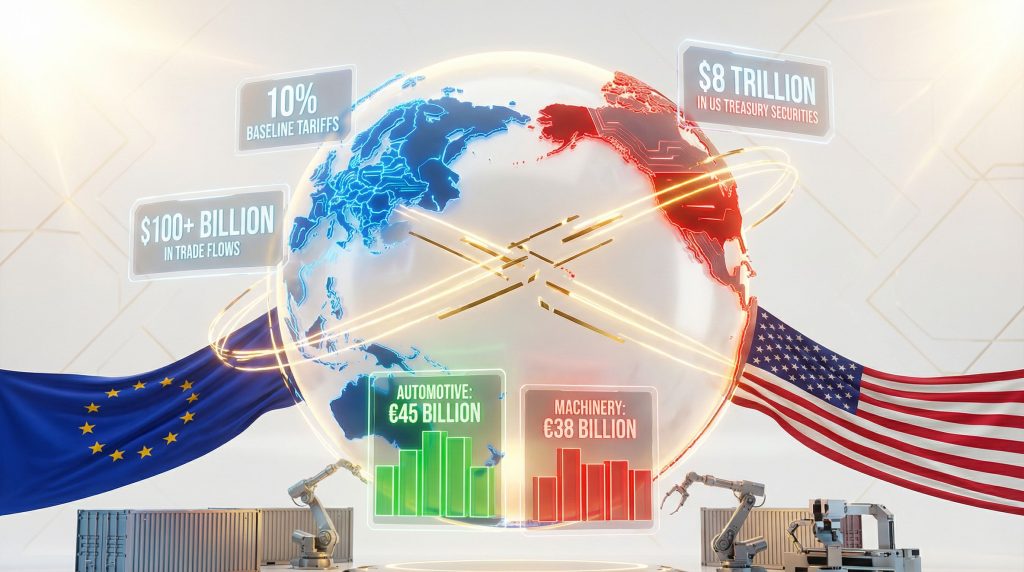
Manufacturing industries face immediate disruption risks from potential tariff implementation, with automotive and machinery sectors showing particular vulnerability due to integrated transatlantic supply chains. These industries depend on just-in-time inventory systems that struggle to absorb sudden cost increases or sourcing disruptions.
| Sector | Estimated Exposure | Vulnerability Level | Substitution Difficulty |
|---|---|---|---|
| Automotive | High | Critical | Medium |
| Machinery | High | Critical | High |
| Chemicals | Medium | Moderate | Medium |
| Pharmaceuticals | Medium | Low | High |
Energy sector implications extend beyond direct trade to encompass broader resource competition dynamics. European dependence on US liquefied natural gas has created strategic vulnerabilities that trade policy could exploit, particularly given ongoing diversification efforts away from Russian energy supplies.
When big ASX news breaks, our subscribers know first
How Might EU Anti-Coercion Mechanisms Counter US Trade Pressure?
The European Union developed comprehensive defensive frameworks specifically designed to counter economic coercion from other powers. The Anti-Coercion Instrument represents the bloc's most sophisticated tool for responding to trade weaponisation, incorporating multiple response channels that activate automatically when predetermined thresholds are crossed.
Market Access Restrictions and Strategic Targeting
EU retaliation capabilities focus on leveraging Europe's substantial internal market worth approximately €2 trillion annually to exclude American companies from government contracts and infrastructure projects. This approach targets US corporate interests directly rather than relying solely on traditional tariff measures.
Public procurement bans limit American corporate participation in sectors where European governments maintain significant purchasing power, including defence, infrastructure, and technology services. These restrictions operate within World Trade Organisation frameworks while maximising economic impact on US commercial interests.
Investment limitations constrain US capital flows into strategic European sectors, particularly those involving critical technologies or infrastructure. These measures complement procurement restrictions by limiting American firms' ability to establish European operations that might circumvent other restrictions.
Financial Leverage Through Debt Holdings
European institutional investors hold substantial positions in US Treasury securities, providing significant leverage during bilateral negotiations. The scale of these holdings creates mutual vulnerability dynamics where both sides face potential financial disruption from escalating tensions.
Interest rate sensitivity affects both European holdings of US debt and American investments in European markets. When sovereign yield curves shift due to policy uncertainty, cross-border portfolio adjustments can amplify market volatility beyond the direct trade policy impacts.
Automatic Activation Mechanisms
The Anti-Coercion Instrument incorporates trigger mechanisms that enable immediate proportional responses without requiring lengthy political negotiation amongst 27 member states. These automatic features distinguish European defensive capabilities from previous ad hoc retaliation approaches.
February 2026 represents a critical timeline for these mechanisms, as predetermined thresholds could activate coordinated responses across the European bloc. The coordination aspect multiplies the economic impact of individual national measures while maintaining legal compliance with international trade law.
What Are the Geopolitical Drivers Behind This Trade Confrontation?
Arctic resource competition underlies much of the current tension, with Greenland's mineral wealth representing strategic assets critical for technology manufacturing and defence applications. Climate change-driven ice recession has opened previously inaccessible deposits of rare earth elements, creating new geopolitical pressure points.
However, the broader implications suggest this confrontation stems from dangerous escalation patterns that European leaders fear could destabilise global trade architecture. The trade war global impact demonstrates how bilateral tensions quickly spread throughout interconnected economic systems.
Strategic Resource Competition Dynamics
Greenland's geographic position controls access to new Arctic shipping routes that reduce transit times between Asia and Europe by approximately 40% compared to traditional Suez Canal routing. This strategic location combines resource wealth with transportation advantages, elevating its importance in global power competition.
Chinese Arctic expansion concerns centre on Beijing's self-designation as a "near-Arctic state" and its inclusion of Arctic development in strategic planning initiatives. Infrastructure investments and research presence demonstrate sustained Chinese commitment to Arctic engagement despite lacking territorial claims.
Russian Arctic militarisation involves icebreaker fleets, military installations, and resource development projects that create security concerns for NATO members. The combination of military positioning and resource extraction capabilities represents a multifaceted challenge to Western strategic interests.
Alliance Architecture Under Stress
Transatlantic security relationships face unprecedented strain when economic coercion targets alliance partners. NATO's Article 5 mutual defence provisions were designed for military aggression scenarios rather than economic warfare between member states, creating legal and political ambiguity.
Defence spending pressures intensify during trade conflicts as European nations must balance military commitments with economic retaliation against their primary security partner. This contradiction highlights fundamental tensions in modern alliance structures.
Intelligence sharing relationships experience stress when commercial competition affects national security cooperation. Technology transfer restrictions and trade disputes can undermine information sharing that underpins collective defence arrangements.
Which Economic Sectors Face the Greatest Disruption Risk?
Manufacturing sectors demonstrate the highest vulnerability to trade disruption due to complex supply chain integration spanning multiple continents. Automotive production exemplifies this vulnerability, with components crossing borders multiple times during assembly processes that tariffs impact markets would severely disrupt.
Supply Chain Integration Complexity
Just-in-Time inventory systems that modern manufacturing depends on cannot easily absorb sudden tariff-induced cost increases. German, French, and Italian automotive manufacturers source specialised semiconductors, rare earth elements, and precision components from US suppliers integrated into production schedules planned months in advance.
Chemical sector disruptions affect agricultural inputs through phosphate, potash, and specialised agrochemical dependencies. These industrial inputs support European food production systems, creating potential cascade effects beyond manufacturing into agricultural security.
Technology Sector Dependencies
Semiconductor design and manufacturing partnerships between US and European firms create bilateral vulnerabilities that Trump tariff threats against Europe would severely impact. These relationships involve intellectual property sharing, joint development programmes, and integrated production networks difficult to quickly restructure.
Artificial intelligence development collaborations face disruption risks from trade restrictions that could fragment research ecosystems built on transatlantic cooperation. Quantum computing initiatives and space technology programmes demonstrate similar integration patterns vulnerable to policy changes.
Energy Transition Implications
Renewable technology supply chains depend on US components for wind turbines, solar installations, and energy storage systems critical for European climate objectives. Trade disruption could delay decarbonisation efforts whilst forcing costly supply chain reconfigurations.
Critical minerals sourcing for renewable energy technologies creates strategic dependencies that trade conflicts could weaponise. Lithium, cobalt, and rare earth processing capabilities concentrated in specific regions become leverage points during trade disputes.
How Will Central Bank Policies Adapt to Trade War Pressures?
Central bank policy faces unprecedented challenges when trade wars create simultaneous inflationary pressures and economic disruption. Traditional monetary policy tools struggle to address supply-side inflation that tariffs create without causing significant employment losses through demand destruction.
Federal Reserve Dilemma
Inflation expectations management becomes critically complex when tariffs drive consumer price increases that monetary policy cannot directly address. The Federal Reserve cannot eliminate supply-side price shocks through interest rate adjustments without creating broader economic damage.
Dollar strength implications for global liquidity create feedback loops where strong currency policy undermines domestic manufacturing competitiveness. This tension between monetary policy effectiveness and industrial policy objectives complicates Federal Reserve decision-making during trade conflicts.
European Central Bank Response Framework
Exchange rate intervention possibilities expand when trade policy creates currency volatility that threatens price stability. The European Central Bank's mandate permits intervention to prevent excessive exchange rate movements that could amplify trade disruption effects.
Financial fragmentation risks across eurozone members increase during external shocks that affect peripheral economies differently than core nations. Italy, Spain, Portugal, and Greece may experience widening sovereign bond yield spreads relative to Germany when trade uncertainty combines with existing fiscal concerns.
Credit conditions for export-dependent industries require targeted support when global trade disruption threatens employment in specific sectors. Quantitative easing adjustments may focus on corporate bond markets supporting affected industries rather than broad-based stimulus measures.
Bank of England Brexit-Plus Scenarios
Sterling volatility management becomes more complex when trade wars add uncertainty to existing Brexit-related economic adjustments. The combination of European Union relationship challenges and US trade threats creates multiple sources of currency instability.
Northern Ireland protocol complications intersect with US trade policy in ways that could destabilise the delicate arrangements governing Irish border trade. Economic disruption from multiple sources could undermine political agreements that depend on economic stability.
What Long-Term Structural Changes Could Emerge?
Supply chain regionalisation trends accelerate dramatically during trade conflicts as companies prioritise security over efficiency in sourcing decisions. Near-shoring and friend-shoring strategies gain momentum across industries seeking to reduce exposure to policy volatility.
In addition, the emergence of a multipolar global economy reflects how sustained trade conflicts fragment established economic relationships. This structural transformation affects not only trade flows but fundamental monetary and financial architectures.
Manufacturing Reshoring Dynamics
Investment patterns shift towards domestic production capacity as companies build redundancy into supply chains previously optimised for cost minimisation. This transformation requires substantial capital investment and timeline adjustments that reshape industrial location decisions.
Inventory management strategies evolve from just-in-time efficiency towards resilience-focused approaches that maintain larger buffer stocks. These changes increase working capital requirements whilst reducing vulnerability to supply disruption during policy conflicts.
Digital Economy Fragmentation
Data localisation requirements expand globally as governments assert sovereignty over information flows during trade disputes. Cloud computing services face increasing restrictions as digital infrastructure becomes strategically important during geopolitical tensions.
Financial services regulatory fragmentation accelerates when trade wars undermine cooperative regulatory frameworks. Banking, insurance, and investment services face increasing jurisdictional complexity as governments prioritise domestic control over market integration.
Multilateral Institution Reform Pressures
World Trade Organisation modernisation becomes essential as unilateral trade actions undermine existing dispute resolution mechanisms. The organisation's inability to address current policy approaches forces fundamental reforms or potential irrelevance.
G7 and G20 effectiveness diminishes when member states engage in direct economic conflicts that undermine multilateral cooperation. These institutions struggle to maintain relevance when their largest members pursue contradictory policies.
The next major ASX story will hit our subscribers first
How Should Investors Position for Trade War Scenarios?
Defensive asset allocation strategies gain importance during periods of sustained trade policy uncertainty. Gold and precious metals provide currency hedge characteristics when multiple major currencies face policy-related volatility simultaneously.
Safe Haven Asset Performance
Government bonds from neutral countries offer portfolio protection when both US and European debt markets experience policy-related stress. Swiss, Canadian, and Australian sovereign bonds historically provide stability during bilateral trade conflicts between other major powers.
Utility stocks with domestic market focus provide stable dividend yields during periods when international trade disruption affects growth-oriented sectors. These defensive characteristics become valuable when policy uncertainty creates sustained market volatility.
Sector Rotation Opportunities
Defence contractors benefit from increased spending as geopolitical tensions escalate beyond trade policy into broader security concerns. Military procurement acceleration often accompanies trade conflicts as nations reassess strategic vulnerabilities.
Domestic infrastructure investments receive priority when governments focus on reducing foreign dependencies. Transportation, telecommunications, and energy infrastructure projects gain political support during periods of economic nationalism.
Geographic Diversification Imperatives
Emerging markets less exposed to US-European trade tensions may benefit from investment flows seeking alternatives to developed market volatility. ASEAN economies, in particular, could gain from trade diversion effects when traditional routes face disruption.
African nations offering alternative supply sources attract investment when companies diversify away from traditional supplier relationships. Resource extraction and manufacturing partnerships gain strategic value during supply chain fragmentation periods.
What Are the Potential Resolution Pathways?
Diplomatic negotiation scenarios require face-saving compromises that allow both sides to claim victory whilst de-escalating economic tensions. Phased implementation timelines provide adjustment periods that reduce immediate market disruption whilst addressing underlying policy objectives.
Consequently, European officials increasingly warn about the dangerous precedent these Trump tariff threats against Europe set for international commerce rules. The precedent could fundamentally alter how nations conduct trade policy globally.
Economic Pressure Points for De-escalation
Corporate lobbying from affected multinational companies creates powerful incentives for policy moderation as businesses quantify trade war costs. American and European firms with significant cross-border operations mobilise political influence to prevent sustained disruption.
Consumer price increases create domestic political pressure when tariff costs translate into higher retail prices for everyday goods. Political sustainability of trade wars diminishes when voters experience direct economic impact through inflation.
Financial market instability forces policy reconsideration when sustained volatility threatens broader economic stability. Central bank concerns about financial system resilience can influence political decision-making during extended market stress periods.
Timeline Considerations and Critical Dates
February 2026 represents the initial implementation deadline that could trigger automatic European retaliation mechanisms. This timeline creates pressure for negotiated solutions before irreversible policy escalation begins.
June 2026 marks potential escalation thresholds where higher tariff rates could activate additional defensive measures. The six-month window between these dates provides opportunity for diplomatic intervention whilst maintaining credible policy threats.
2026 midterm elections in the United States influence the political sustainability of sustained trade conflicts. Electoral considerations may moderate policy approaches as domestic economic impacts become apparent to voters.
Disclaimer: This analysis contains speculative elements regarding future trade policy developments and market responses. Actual policy implementation may differ from outlined scenarios, and market reactions remain subject to numerous variables beyond trade policy considerations. Investment decisions should not rely solely on trade war speculation without considering broader economic and financial factors.
Looking to Navigate Market Volatility from Global Trade Tensions?
Discovery Alert's proprietary Discovery IQ model provides real-time alerts on significant ASX mineral discoveries, helping investors identify opportunities that can thrive even during global economic uncertainty. Start your 30-day free trial today to gain actionable insights that could position your portfolio ahead of market volatility driven by geopolitical tensions.