July 10, 2026
The World's Most Fragile Corridor: Understanding the Global Stakes of the Trump Hormuz Blockade
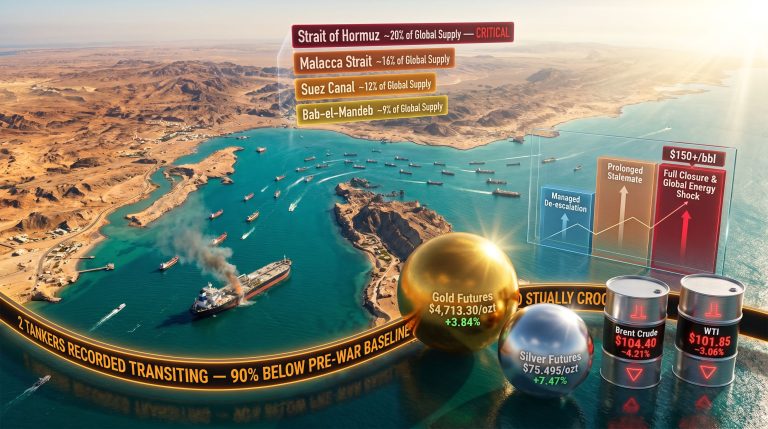
Global energy markets have always carried a hidden vulnerability: the extraordinary concentration of crude oil and liquefied natural gas flows through a handful of narrow maritime passages. Of all these chokepoints, none has historically generated more anxiety among energy security analysts than the Strait of Hormuz. The Trump Hormuz blockade has brought this vulnerability into sharp focus. At its narrowest point, this passage measures roughly 21 nautical miles across, yet it functions as the circulatory valve for a disproportionate share of the world's hydrocarbon trade. When that valve closes, even partially, the economic consequences radiate outward with remarkable speed.
What is unfolding in April 2026 is not a partial closure. It is, for the first time in modern shipping history, a near-total freeze of one of the planet's most critical energy arteries, shaped by the intersection of US naval strategy, Iranian asymmetric warfare, and a diplomatic deadlock with no obvious resolution in sight.
When big ASX news breaks, our subscribers know first
The Strait of Hormuz: Why No Alternative Exists at Comparable Scale
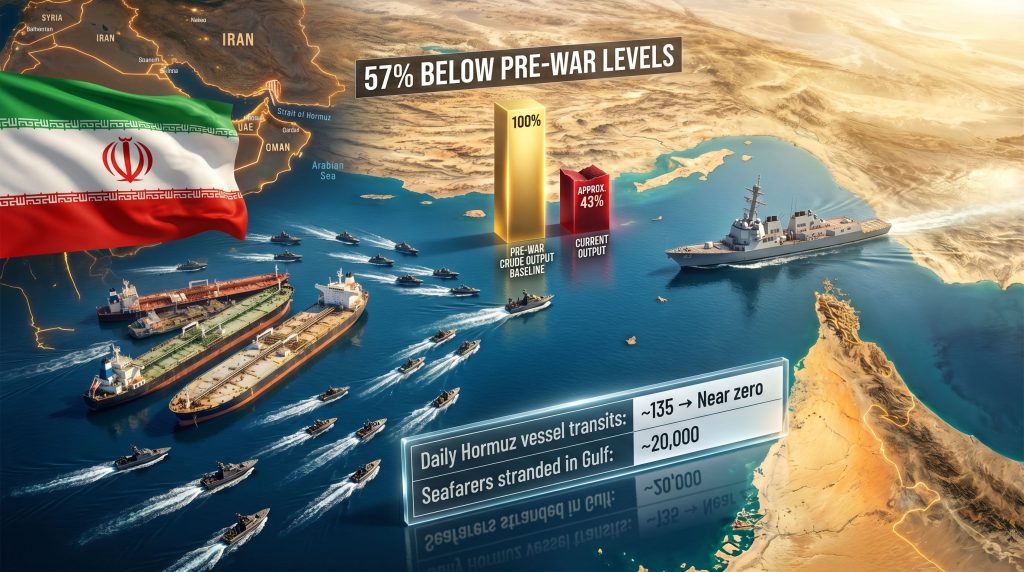
The geography of the Persian Gulf creates an inherent structural problem for global energy logistics. Every barrel of crude and every cargo of LNG produced by Saudi Arabia, the UAE, Kuwait, Iraq, and Iran must pass through the same bottleneck to reach open ocean. Under peacetime conditions, approximately 135 vessel transits per day moved through this corridor, carrying crude oil, refined products, and liquefied natural gas destined primarily for Asian import markets.
The absence of viable large-scale alternatives compounds every disruption scenario. Furthermore, the LNG supply outlook for Asian buyers becomes increasingly precarious as each week of closure passes:
- The Cape of Good Hope reroute adds approximately 10 to 14 days of additional voyage time per journey, along with substantially higher fuel and crew costs, rendering it economically prohibitive for time-sensitive cargoes.
- Pipeline alternatives within the Gulf region carry limited spare capacity and face their own political and infrastructure constraints, particularly during active conflict conditions.
- LNG terminal diversification across alternative supply basins cannot absorb displaced Gulf volumes within any operationally meaningful timeframe.
The result is a market structure where concentration risk is not merely theoretical but actively decisive. When the strait closes, supply does not reroute smoothly; it simply disappears from the market.
From Strikes to Standstill: How the Crisis Escalated Over Eight Weeks
Understanding the current situation requires tracing the sequence of events that brought global shipping to this point. The disruption did not emerge suddenly. It built through a recognisable escalation arc that progressively narrowed the options available to both sides.
The timeline unfolded as follows:
- Late February 2026: US and Israeli military strikes on Iran triggered an immediate slowdown in commercial vessel transits through the strait, as operators began assessing the risk environment.
- Early April 2026: Daily transit volumes fell toward near-zero levels, an extraordinary departure from the 135-vessel peacetime benchmark that had held for decades.
- Mid-April 2026: A tentative ceasefire created brief optimism. A.P. Moller-Maersk, the world's second-largest container liner, publicly indicated it was evaluating transit opportunities. On April 11, three supertankers successfully completed non-Iranian oil exits, representing the largest single-day movement of commercial vessels since hostilities began.
- Late April 2026: Frustrated by slow diplomatic progress, the Trump administration announced a formal naval blockade targeting Iran-linked vessels. Rather than compelling Iranian concessions, this move prompted Iran to intensify its own strait control operations, collapsing the fragile optimism generated by the earlier ceasefire.
The escalation pattern here reflects a strategic miscalculation familiar from economic coercion theory: pressure applied without a credible off-ramp tends to harden the target's resistance rather than induce compliance.
What the Trump Hormuz Blockade Actually Does and Where It Operates
The Trump Hormuz blockade is not a passive interdiction cordon positioned at the entrance of the strait itself. Its operational geography is substantially broader, extending across the Arabian Sea and into waters east of Sri Lanka, thousands of miles from the Persian Gulf. US Navy vessels have intercepted and boarded Iran-linked tankers across this expanded theatre, including documented cases where vessels were boarded in the Arabian Sea within 24 hours of receiving US sanctions designations.
The mechanics of the operation involve several layered steps:
- Target identification through a combination of AIS tracking, satellite surveillance, and OFAC sanctions designations.
- Naval interception in international waters, with boarding teams conducting cargo verification.
- Seizure or diversion of flagged cargoes, with vessels detained or redirected depending on the nature of the cargo and ownership structure.
Secretary of Defense Pete Hegseth has publicly committed to maintaining the blockade for as long as operationally necessary. The operation has also been amplified through Department of Defense social media content, suggesting the campaign carries a deliberate public relations dimension alongside its tactical objectives.
The Compliance Problem: Why Iran Has Not Simply Stopped
One of the least-discussed aspects of the Trump Hormuz blockade is the gap between its stated intent and its measurable outcomes. Iran has spent years constructing sanctions-resilience mechanisms that reduce its vulnerability to any single point of economic pressure. These include:
- Shadow fleet operations using vessels with opaque beneficial ownership structures that complicate OFAC designation processes.
- Ship-to-ship transfer arrangements that move cargoes between sanctioned and non-sanctioned vessels in international waters, breaking the traceability chain.
- Alternative payment systems that operate outside conventional US dollar-denominated banking infrastructure, reducing exposure to financial sanctions.
- Diversified revenue streams extending beyond crude oil exports to petrochemicals, minerals, and other non-oil economic activity.
Rachel Ziemba, Senior Fellow at the Center for a New American Security, has assessed that while the blockade was partly designed to neutralise Iran's leverage over the strait, Iran retains sufficient financial space and near-term revenue to sustain its current posture. This assessment aligns with Goldman Sachs research noting that Persian Gulf crude output has fallen approximately 57% below pre-war levels, a figure that reflects the combined disruption of strikes, Iranian production decisions, and shipping paralysis, rather than the blockade alone.
Iran's Asymmetric Response and the Volatility Paradox
Iran's counter-strategy relies on what industry observers have labelled its mosquito fleet, composed of Islamic Revolutionary Guard Corps gunboat formations capable of rapid, unpredictable manoeuvring against commercial shipping. The strategic logic of this approach exploits the mismatch between large commercial vessels and small, fast attack craft: a single gunboat encounter can neutralise a supertanker carrying hundreds of millions of dollars in cargo.
The introduction of the US blockade into this already volatile environment has produced a counterintuitive outcome. Rather than deterring Iranian gunboat activity, the blockade appears to have intensified it. Consequently, the oil price shock reverberating through global markets continues to deepen with no near-term floor in sight.
Rajalingam Subramaniam, CEO of Fleet Management Limited, whose company has more than 400 seafarers currently trapped inside the Persian Gulf, has described the blockade as expanding the risk perimeter for commercial vessels rather than reducing it. The concurrent presence of US warships conducting interdiction and unpredictable IRGC gunboats enforcing Iranian control has created a dual-threat environment that vessel operators have no reliable framework for navigating.
The volatility paradox at the heart of the Trump Hormuz blockade is this: a strategy designed to reassert US naval dominance over a critical waterway may have inadvertently given Iran a more defensible justification for keeping that waterway closed.
Iran's Foreign Minister Abbas Araghchi announced a strait reopening during the peak of diplomatic engagement, but when the Trump administration declined to reciprocate with any modification of the blockade, the gesture collapsed. What followed was a chaotic sequence of vessel attacks, seizures, and renewed closures that illustrated how fragile any unilateral de-escalation gesture remains without mutually verified compliance mechanisms.
The Economic Damage: Quantifying a Supply Shock Without Historical Precedent
The economic consequences of the Hormuz disruption are cascading across multiple commodity markets simultaneously, with effects that financial analysts expect to persist well beyond any near-term diplomatic resolution.
| Indicator | Pre-War Baseline | Current Status (April 2026) |
|---|---|---|
| Daily Hormuz vessel transits | ~135 | Near zero |
| Persian Gulf crude output | 100% | ~43% of pre-war levels |
| Timeline to full normalisation | Standard operations | Months post-reopening at minimum |
| Seafarers stranded in the Gulf | Negligible | ~20,000 |
| Days of additional voyage via Cape of Good Hope | 0 additional | 10–14 additional days |
Sources: Goldman Sachs research note (Daan Struyven et al.), Fleet Management Limited, Bloomberg reporting, April 26, 2026
The sectoral damage extends well beyond crude oil markets. In addition, the broader oil market impact is compounding pre-existing pressures across several commodity categories:
- Natural gas: Demand destruction in Asian LNG import markets is already underway, with buyers reducing consumption and seeking alternative supply sources amid price spikes and physical supply constraints.
- Fertilizers: Gulf-derived feedstocks for nitrogen fertilizer production face prolonged shortages, with supply disruptions projected to affect agricultural input costs through the remainder of 2026 and into 2027.
- Food production: The downstream effect of fertilizer scarcity will feed into agricultural output costs globally, with import-dependent lower-income economies facing the sharpest exposure.
- Manufacturing and logistics: For Asia's export-oriented economies, the compounding effect of energy price inflation feeding into manufacturing input costs, freight rates, and consumer price indices creates a multi-channel inflationary shock.
Goldman Sachs analysts including Daan Struyven have assessed that even a full reopening of the strait would not guarantee rapid supply normalisation, warning that recovery could prove only partial following a closure of this duration.
The next major ASX story will hit our subscribers first
Three Scenarios: How the Hormuz Crisis Could Resolve
Shipping industry leadership and financial analysts have broadly converged on a base case that assumes prolonged disruption rather than rapid resolution. Jotaro Tamura, President and CEO of Mitsui O.S.K. Lines Ltd., speaking in Singapore after more than seven weeks of sustained disruption, framed the shift in industry expectations plainly: the realistic assumption is now that resolution will take considerable time, and the world should not expect a return to pre-crisis operational norms.
Scenario 1: Rapid Diplomatic Resolution (Low Probability)
A comprehensive ceasefire agreement is reached, with both the US blockade and Iranian gunboat operations suspended under mutually verified terms. The strait reopens within weeks, with partial supply recovery achievable over two to three months and full normalisation possible within six months. This scenario requires a third-party mediation framework with sufficient credibility and leverage, which does not currently appear to be in place.
Scenario 2: Prolonged Stalemate with Managed Workarounds (Base Case)
The conflict continues without formal resolution. Individual shipping carriers secure bilateral safe-passage arrangements similar to those that briefly emerged in early April. Sporadic transits resume for select operators while Iranian state vessels continue limited oil movements. Supply recovery remains structurally incomplete, elevated energy prices persist for 12 months or longer, and war risk insurance premiums for Gulf-transiting vessels become a permanent embedded cost in global energy pricing.
Scenario 3: Escalation and Extended Closure (Tail Risk)
Mine-laying operations or a direct naval engagement between US and Iranian forces triggers an extended closure that forces full supply chain rerouting through the Cape of Good Hope alternative. This scenario adds 10 to 14 days of additional voyage time per transit and imposes structural cost increases across the entire global shipping network. Recovery would be measured in years rather than months, with lasting consequences for energy infrastructure investment patterns globally.
The Human Crisis: 20,000 Seafarers Without a Path Out
Behind every market data point is a human dimension that financial analysis frequently underweights. Approximately 20,000 maritime workers are currently aboard vessels trapped inside the Persian Gulf, unable to transit the strait under any combination of currently available arrangements.
Shipping operators have implemented operational welfare measures including daily communication check-ins, psychological counselling services, and careful monitoring of food and water provisions. Some companies have managed crew rotations as contracts reached their expiry dates, though replacing personnel in an active conflict zone carries both logistical complexity and significant financial cost.
The International Maritime Organization has developed evacuation contingency frameworks alongside individual company plans. Without a verified cessation of hostilities, however, these frameworks have no practical activation pathway.
Alexander Saverys, CEO of CMB.TECH, has stated clearly that the shipping industry currently has no reassurance whatsoever from governments regarding safe passage. The only reassurance that will carry operational meaning, in his assessment, is direct evidence that vessels can transit the strait safely and on a sustainable basis, not diplomatic statements or unilateral announcements from either party.
This human dimension creates a secondary pressure on the diplomatic timeline. Every week of sustained closure increases crew welfare risks, elevates the psychological burden on stranded seafarers, and raises the reputational and legal exposure of shipping companies operating under force majeure conditions.
The Diplomatic Deadlock: Why a Deal Remains Structurally Difficult
The core obstacle to resolution is a sequencing impasse that neither side has shown willingness to break. Iran offered to reopen the strait, a gesture that in conventional diplomatic logic would warrant a reciprocal US concession. The Trump administration declined to modify the blockade in response, interpreting the Iranian offer as a signal of weakness rather than an opening for negotiated de-escalation.
The structural difficulty runs deeper than tactical sequencing. The dispute sits at the intersection of three overlapping negotiating tracks: the US naval blockade, Iranian strait control, and the broader nuclear diplomacy that has remained unresolved for decades. However, the US-China trade war adds yet another dimension of complexity, as Beijing's energy import dependency makes it a deeply invested but largely silent stakeholder in any resolution framework.
Each track contains domestic political constituencies on both sides with strong incentives to resist compromise. Iran's leadership is publicly described by Trump himself as seriously fractured, with hardline factions in Tehran resistant to any arrangement that could be characterised domestically as capitulation. A Cabinet-level emergency review convened following Iran's strait reopening announcement has reportedly examined whether to maintain the blockade or pursue calibrated de-escalation, without producing a publicly disclosed change in posture.
What the Hormuz Crisis Reveals About Global Energy Infrastructure Resilience
The events of the past eight weeks have exposed structural vulnerabilities in global energy supply chains that years of stability had allowed markets to price out of risk assessments. The concentration of so much hydrocarbon trade through a single 21-nautical-mile passage represents a systemic fragility that no amount of strategic petroleum reserve drawdown can fully offset in a prolonged closure scenario.
Several longer-term structural consequences are already becoming visible. Furthermore, the broader pattern of geopolitical trade tensions amplifies each of these dynamics, making near-term stabilisation even more challenging:
- War risk insurance repricing: Premium structures for Gulf-transiting vessels are undergoing fundamental recalibration, embedding a geopolitical conflict premium that is unlikely to fully unwind even after the current crisis resolves.
- Alternative infrastructure investment: Accelerating interest in pipeline diversification, LNG terminal capacity expansion outside the Gulf region, and strategic reserve buildouts in import-dependent economies.
- Bilateral safe-passage frameworks: The model that briefly emerged in early April, where individual carriers secured direct arrangements for transit, suggests an emerging layer of geopolitical negotiation in global shipping that could become structurally permanent.
- Shipping route economics: The Cape of Good Hope alternative, while costly, is being modelled more seriously by charterers and insurers as a baseline planning assumption rather than an emergency fallback.
The Hormuz crisis of 2026 will likely be studied for years as a case study in how energy market concentration risk, geopolitical escalation dynamics, and the limits of maximum-pressure coercion interact under real-world conditions.
For energy market participants, the lesson being written in real time is that chokepoint risk is not merely a scenario in a stress test. It is an active determinant of physical supply availability, price formation, and the long-term economics of global energy infrastructure investment. Bloomberg's analysis of the double blockade confirms that hope for economic normalisation is dimming considerably with each passing week.
This article is based on publicly available reporting and industry analysis as of April 26, 2026. It contains forward-looking assessments and scenario projections that involve inherent uncertainty. Nothing in this article constitutes financial or investment advice. Readers should conduct independent due diligence before making decisions based on information contained herein.
Want to Track the Investment Opportunities Emerging From Global Energy Disruptions?
Discovery Alert's proprietary Discovery IQ model delivers real-time alerts on significant ASX mineral discoveries, instantly translating complex market data into actionable insights for both short-term traders and long-term investors — explore historic discoveries and their exceptional returns to understand the scale of opportunity, then begin your 14-day free trial at Discovery Alert to position yourself ahead of the next major market move.