June 23, 2026
The Strait of Hormuz as a Systemic Risk: Why One Waterway Can Destabilise the Global Economy
Every decade or so, global energy markets are reminded of a structural vulnerability that no amount of financial hedging or diplomatic goodwill can fully neutralise. The Strait of Hormuz, a sliver of navigable water separating Iran from the Arabian Peninsula, sits at the intersection of geography and geopolitics in a way that no other maritime corridor does. When tension rises around this waterway, the consequences are not confined to oil traders or tanker operators. They ripple outward through fuel costs, food supply chains, industrial inputs, and government fiscal positions across dozens of countries simultaneously.
The Trump Iran blockade oil prices relationship that has dominated energy market headlines in late April 2026 is, in one sense, simply the latest chapter in a long story. However, the specific configuration of this crisis carries characteristics that distinguish it from prior disruptions and that warrant careful, systematic analysis.
When big ASX news breaks, our subscribers know first
Understanding the U.S. Naval Blockade and What Makes It Different
The U.S. decision to impose a naval blockade on Iranian ports marks a meaningful departure from the toolkit that Washington has historically deployed against Tehran. For decades, the primary instruments of economic pressure were financial sanctions, export controls, and secondary sanctions targeting third-party entities that conducted business with Iran. These tools operated through the global banking system, insurance markets, and corporate compliance frameworks. They were effective but diffuse, and they left physical shipping flows partially intact.
A naval blockade operates through a fundamentally different mechanism. Rather than making transactions costly or legally risky, it physically restricts the movement of vessels. The distinction is significant: sanctions can be evaded through creative financial structuring or willing intermediaries, whereas a naval interdiction creates a physical checkpoint that cannot be circumvented simply by routing payments through a different jurisdiction.
President Trump, speaking to Axios, made clear that he views this physical dimension as the blockade's core strategic advantage over alternative measures, including direct military strikes on Iranian territory. His reasoning centres on economic attrition: restricting Iran's ability to export oil and import essential goods maximises financial pressure while avoiding the escalatory risks that come with attacking sovereign infrastructure on Iranian soil.
According to reporting from Le Monde on April 30, 2026, Trump stated that the naval action was more effective than bombing and indicated the blockade could persist for months — a signal the oil market absorbed immediately. Tehran's response has been to leverage the one asymmetric card it holds: control over access to the Strait of Hormuz. Iran has stated that any diplomatic resolution is contingent on the blockade being lifted first, creating a structural negotiating deadlock where neither side has an obvious incentive to move first.
Why the Strait of Hormuz Cannot Be Replicated or Bypassed Cheaply
The Strait of Hormuz's strategic importance derives from the combination of its geographic position and the lack of cost-effective alternatives for the volume of energy it handles. The strait connects the Persian Gulf to the Gulf of Oman and the broader Arabian Sea, providing the primary maritime exit route for crude oil and liquefied natural gas exports from Saudi Arabia, Iraq, Kuwait, the United Arab Emirates, and Iran itself.
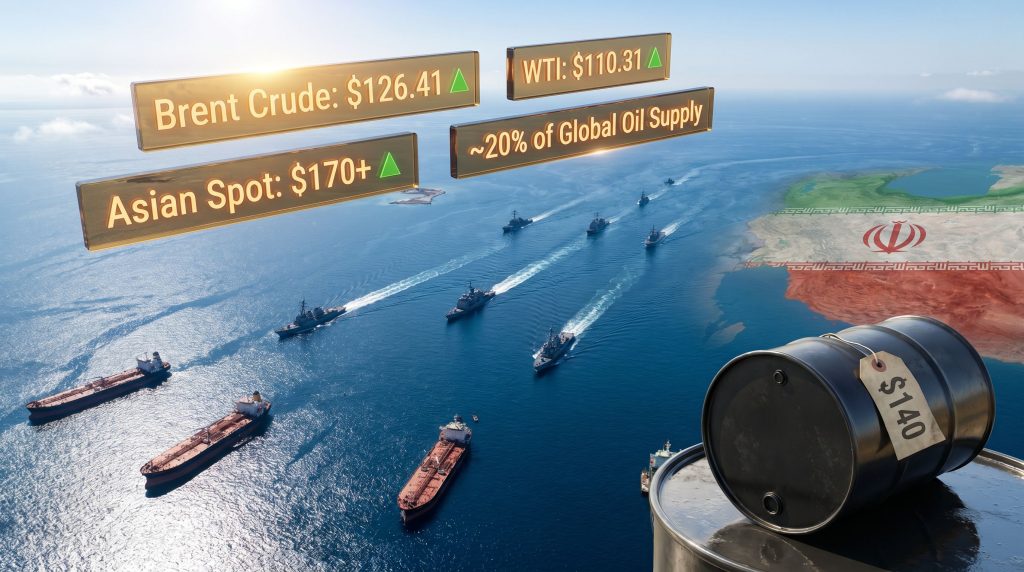
Under normal operating conditions, approximately one-fifth of global oil supply transits this waterway, as confirmed by Arab News reporting citing established energy flow data (Arab News, April 30, 2026). No other single maritime chokepoint carries a comparable share of global energy trade. Furthermore, disruptions here inevitably affect global LNG supply chains, compounding pressure on energy markets well beyond crude oil alone.
Alternative routing options exist but come with substantial cost penalties:
- The Saudi East-West pipeline can carry some crude to Red Sea terminals, but its capacity is insufficient to absorb full Persian Gulf export volumes
- The Suez Canal and SUMED pipeline offer partial diversion capacity for certain cargo types moving toward European markets
- Routing tankers around the Cape of Good Hope adds approximately 10 to 14 days to voyage times, substantially increasing per-barrel delivery costs and tying up vessel capacity for longer periods
- Overland routes through regional territories are logistically complex and not configured for the scale of volume involved
The absence of a ready substitute is precisely what makes Hormuz disruptions so acute. When throughput falls, there is no equivalent capacity waiting to absorb the shortfall.
How Oil Prices Have Responded to the Trump Iran Blockade
The market's reaction to Trump's blockade-duration warning was immediate and pronounced. According to Arab News (April 30, 2026), oil benchmarks surged to their highest levels in more than four years following his comments. This oil price rally caught many market participants off guard, given the already elevated baseline from earlier geopolitical tensions.
| Benchmark | Pre-Blockade Level | Post-Announcement Level | Movement |
|---|---|---|---|
| Brent Crude (June Delivery) | ~$118 per barrel | $126.41 | More than +7% |
| West Texas Intermediate (WTI) | ~$107 per barrel | $110.31 | Approximately +3% |
The divergence between Brent's roughly 7% surge and WTI's approximately 3% gain reflects a structural difference in regional exposure. Brent is the global benchmark most directly priced on seaborne crude flows from the Middle East and North Sea, making it more sensitive to Persian Gulf supply disruptions. WTI, which is priced on U.S. domestic crude production, benefits from the fact that the United States is a net oil producer and is relatively less dependent on imports transiting the Strait of Hormuz than European or Asian buyers.
Arab News noted that both benchmarks partially pared their initial gains during the same trading session, illustrating the inherent volatility of markets processing geopolitical uncertainty in real time (Arab News, April 30, 2026). Intraday pullbacks of this kind are characteristic of supply shock events where traders simultaneously price in the disruption scenario and maintain some probability weighting for a near-term diplomatic resolution.
Market Mechanics Note: During acute supply uncertainty events, futures contract pricing tends to overshoot physical market realities in the short term. The subsequent partial retracement does not signal a reversal of market concern; it typically reflects position-taking adjustments and profit realisation by short-term traders rather than a fundamental reassessment of supply risk.
The Physical Market Premium: Where the Real Stress Shows Up
Futures benchmark movements, while widely reported, often understate the stress visible in physical crude markets. Physical spot transactions, which involve the purchase of actual barrels for near-term delivery, were already trading at elevated levels before the blockade announcement as Persian Gulf export volumes declined. The premium between physical spot prices and front-month futures contracts widened substantially as buyers competed for barrels outside the affected corridor.
Asian markets face the most acute exposure given their structural reliance on Persian Gulf crude. Buyers in China, Japan, South Korea, and India collectively import an enormous share of their crude oil requirements from Gulf producers, and their alternative supply sources are more limited and more expensive than those available to European or U.S. buyers.
Disclaimer: Specific physical spot price figures referenced in some market commentary have not been independently verified against confirmed trade data and should be treated as indicative rather than confirmed transaction records.
Consumer Fuel Prices: The Transmission from Barrel to Bowser
The pathway from crude oil benchmark movements to retail fuel prices involves multiple steps, each of which introduces its own timing lag and cost amplification. Crude is refined into petroleum products including gasoline, diesel, jet fuel, and heating oil, with each product facing its own supply and demand balance that can diverge significantly from crude market dynamics.
U.S. consumers had already been experiencing elevated fuel costs in the period preceding the escalation, with gasoline prices having pulled back modestly from earlier highs before the blockade announcement reversed that trend. Diesel prices, which are particularly sensitive to freight and agricultural sector demand, had remained stubbornly elevated.
The diesel and jet fuel markets carry a particular vulnerability in Hormuz disruption scenarios that deserves specific attention:
- Refined product exports from Persian Gulf refineries are a meaningful component of Asian fuel supply
- Unlike crude oil, which can sometimes be partially rerouted through alternative corridors, refined products face tighter routing constraints due to the specific terminal infrastructure required for discharge
- Refinery scheduling operates on longer time horizons than crude procurement, meaning supply responses to disruptions take longer to materialise
- War risk insurance premium escalation affects product tankers and crude tankers differently, with product carriers sometimes facing steeper incremental costs
Important Note for Consumers: The inflationary impact of a Hormuz disruption on diesel and jet fuel prices tends to persist longer than the disruption itself. Even after physical supply flows normalise, refinery scheduling adjustments, rebuilt inventory cycles, and recalibrated insurance premiums keep product prices elevated for weeks to months beyond the point of resolution.
The Broader Commodity Footprint of a Hormuz Disruption
Energy market observers sometimes underestimate the degree to which a Persian Gulf supply shock transmits into non-energy commodity markets. The most direct transmission pathway runs through petrochemical feedstocks, agricultural inputs, and industrial gases. In addition, commodity market volatility tends to intensify as traders reprice risk across correlated asset classes simultaneously.
Natural gas, which is co-produced with oil across much of the Persian Gulf region, is the primary feedstock for ammonia production, which in turn is the foundation of nitrogen-based fertilisers. Any sustained restriction on Persian Gulf energy exports therefore creates upstream pressure on fertiliser supply chains, which then transmits into agricultural production costs.
The Syria trade route question has emerged as one area of active analytical interest. Arab News has published reporting examining whether overland corridors through Syria could provide a partial substitute for blocked Hormuz maritime flows, though the practicality of such routes at commercial scale remains highly uncertain given infrastructure constraints and ongoing regional instability.
Similarly, Arab News reporting has noted the crisis's disruption to global sugar supplies through the Strait of Hormuz, illustrating that the commodity footprint extends well beyond crude oil and its direct derivatives (Arab News, April 29, 2026).
The next major ASX story will hit our subscribers first
Escalation Pathways and Scenario Analysis
Trump's public statement that the blockade could persist for months is not simply a rhetorical flourish. It carries specific market signalling weight because it establishes an administration expectation around duration that the oil market must price into forward contracts. When a sitting U.S. president explicitly describes a supply disruption as potentially lasting months, futures curves will price in sustained tightness rather than a near-term normalisation.
The three primary scenarios that energy risk analysts typically model for a conflict of this nature involve meaningfully different price trajectories:
| Scenario | Estimated Duration | Price Trajectory | Broader Economic Impact |
|---|---|---|---|
| Diplomatic breakthrough | 2 to 6 weeks | Partial retreat from highs | Temporary inflation spike |
| Prolonged stalemate | 3 to 6 months | Sustained elevated benchmarks | Significant recession risk |
| Infrastructure escalation | Open-ended | Potential for extreme price spikes | Systemic energy market disruption |
Disclaimer: The above scenario modelling represents analytical frameworks commonly applied in geopolitical risk assessment and does not constitute a forecast or investment recommendation. Actual outcomes will depend on diplomatic, military, and economic factors that are inherently unpredictable.
Iran's structural negotiating position complicates resolution timelines. Tehran has consistently maintained that the blockade must end before substantive talks can proceed, which creates a sequencing problem: Washington wants concessions before lifting pressure, while Tehran insists on pressure removal as a precondition for engagement. This type of deadlock tends to persist longer than either party initially anticipates.
How Global Energy Markets Are Adjusting
The shipping and insurance industries are among the first non-energy sectors to absorb the financial consequences of a Hormuz disruption. War risk insurance premiums for tankers operating in or near the Persian Gulf escalate rapidly when conflict risk is elevated, adding directly to per-barrel delivery costs. Major shipping operators typically establish voluntary avoidance zones around contested areas, which reduces available vessel capacity for Gulf cargo and pushes freight rates higher across the board.
For Gulf Cooperation Council producers outside Iran, notably Saudi Arabia and the UAE, the situation creates a complex strategic calculation. Higher crude prices improve fiscal revenues, but the producers themselves face logistical complications if Hormuz access is genuinely restricted, since their own export infrastructure depends on the same waterway.
Strategic Petroleum Reserve releases by IEA member nations represent one policy lever available to dampen the immediate price impact of a supply disruption, though their effectiveness is constrained by reserve volumes and the pace at which physical barrels can be released into commercial supply chains. Reserve releases address the symptom rather than the underlying supply restriction.
Consequently, gold safe-haven demand has also intensified as institutional investors seek refuge from the currency and equity market volatility that typically accompanies extended energy crises of this nature.
Historical Context: How the 2026 Crisis Compares to Prior Supply Shocks
Energy markets have navigated major supply disruptions before, and historical precedents offer useful context for understanding both the potential scale of impact and the eventual resolution mechanisms.
| Event | Year | Approximate Price Impact | Approximate Duration | Resolution Mechanism |
|---|---|---|---|---|
| Arab Oil Embargo | 1973 | Roughly 300% price increase | Approximately 6 months | Political negotiation |
| Iranian Revolution Shock | 1979 | Roughly 150% price increase | Approximately 12 months | Market rebalancing |
| Gulf War Disruption | 1990 to 1991 | Approximately 70% spike | Approximately 6 months | Military resolution |
| Russia-Ukraine Energy Shock | 2022 | Approximately 60% spike (European gas) | 18 months or more | Demand destruction and diversification |
| Iran Naval Blockade | 2026 | More than 7% (early stage) | Months projected per Trump statement | Under active negotiation |
Note: Historical price impact figures are drawn from established energy economics literature and EIA historical data. The 2026 event data reflects confirmed market movements as reported by Arab News (April 30, 2026). Percentage comparisons across different eras require caution given differences in base price levels, market structure, and global economic context.
What distinguishes the current situation from several historical precedents is the simultaneous disruption across multiple commodity classes and the degree to which global supply chains have become interdependent in ways that did not exist during the 1973 or 1979 events. Furthermore, the trade war oil markets dynamic has added a layer of complexity, as pre-existing tariff regimes have already strained supply chain resilience heading into this crisis. The transmission speed from energy supply shock to consumer price impact is now faster than in prior cycles due to reduced inventory buffers and lean supply chain management practices adopted widely since the early 2000s.
Investment and Market Positioning Implications
For market participants, sustained oil price elevation above key threshold levels creates a predictable pattern of sector rotation that has been observed across previous energy supply shocks. Upstream oil producers with production located outside the affected region typically benefit directly from higher benchmark prices without facing the same supply disruption risks as Persian Gulf operators.
Downstream refiners face a more complex dynamic. While crude input costs rise, refinery margin expansion during supply shock periods can partially offset this through elevated product crack spreads, particularly for diesel and jet fuel. Airlines and freight-intensive industries face the most direct margin compression from elevated jet fuel and diesel costs.
Currency markets also respond systematically to Middle East energy crises. Petrodollar recycling dynamics shift as Gulf producer revenues increase, while emerging market economies that are significant net oil importers face currency depreciation pressure as their import bills expand. The U.S. dollar tends to attract safe-haven flows during periods of elevated geopolitical uncertainty, which creates additional headwinds for commodity-importing economies carrying dollar-denominated debt.
Investor Consideration: Energy supply shock events historically reward early positioning in upstream producers and inflation-linked instruments while penalising transport-intensive sectors with limited ability to pass through fuel cost increases. However, the geopolitical resolution timeline remains the dominant variable, and premature positioning for normalisation has been a costly error in prior prolonged disruption cycles.
The longer-term structural question the current crisis raises is whether sustained elevated oil prices will materially accelerate investment allocation toward energy transition technologies and non-Hormuz supply infrastructure. As Channel News Asia has reported, market participants and policymakers alike are already reassessing their exposure to Hormuz-dependent energy flows, with the Trump Iran blockade oil prices dynamic forcing a reckoning that many had deferred. At crude prices persistently above $120 per barrel, the economic calculus for alternative energy investment shifts meaningfully, potentially bringing forward investment timelines that might otherwise have extended well into the next decade.
Disclaimer: This article is intended for informational and analytical purposes only. Nothing contained herein constitutes financial or investment advice. Energy price forecasts and geopolitical scenario projections involve significant uncertainty and actual outcomes may differ materially from any projections discussed. Readers should seek independent financial advice before making investment decisions.
Want to Stay Ahead of ASX Commodity Opportunities Driven by Global Energy Shocks?
When geopolitical crises like the Hormuz blockade ripple through commodity markets, timing is everything — Discovery Alert's proprietary Discovery IQ model delivers real-time alerts on significant ASX mineral discoveries, instantly translating complex market conditions into actionable investment opportunities before the broader market catches up. Explore historic discoveries and their extraordinary returns to understand the potential, then begin your 14-day free trial today to position yourself ahead of the next major market move.