May 15, 2026
When a Narrow Strait Holds the World's Energy Markets Hostage
Few geographic features carry as much economic weight as a body of water measuring roughly 21 miles at its narrowest point. The Strait of Hormuz sits between Iran and Oman, connecting the Persian Gulf to the Gulf of Oman and beyond to global shipping routes. For decades, energy analysts have identified it as the single most consequential maritime chokepoint on the planet. Not because of its size, but because of what flows through it every day: approximately one-fifth of the world's entire petroleum supply.
Understanding the current surge in Trump Iran oil prices requires grasping this geography first. When political tensions rise between Washington and Tehran, the Strait becomes something far more than a shipping lane. It transforms into a pressure valve for the entire global energy system, with the potential to release or contain enormous economic force depending on the diplomatic temperature in any given week.
When big ASX news breaks, our subscribers know first
The Strait of Hormuz: More Than a Map Reference
Why 21 Miles Can Shift Billions of Dollars in Market Value
Before the current conflict escalation, the Strait operated as a continuous pipeline of maritime traffic, processing approximately 140 vessels per day through its navigable channels. That throughput represented the physical delivery mechanism for crude oil and liquefied natural gas bound for refineries across Asia, Europe, and beyond. Oil price movements in this region have long been a barometer of broader geopolitical stability.
As of May 15, 2026, Iran's Revolutionary Guards confirmed that roughly 30 vessels had crossed the Strait since Wednesday evening. That figure represents approximately 21% of pre-conflict baseline traffic, meaning the chokepoint was operating at less than a quarter of its normal capacity.
The implications of this disruption extend well beyond simple mathematics:
- Tanker operators face dramatically elevated insurance premiums for any vessel transiting the corridor
- Cargo owners must choose between accepting delivery uncertainty or rerouting shipments via the Cape of Good Hope, adding weeks and significant cost
- Refineries dependent on Gulf crude face feedstock scheduling disruptions that compound over time
- Shipping companies are reluctant to commit vessels without clarity on military and security conditions
Even the partial restoration of vessel traffic from near-zero to 30 ships daily produced measurable stabilisation in intraday price volatility. However, as Yang An, analyst at Haitong Futures, noted, ships passing through the strait eased some market concerns but not enough to reverse the overarching trend driven by constrained supply conditions. (Economic Times, May 15, 2026)
Vessel Incidents That Amplify the Risk Premium
The abstract threat of Hormuz disruption became concrete through two specific incidents in the days preceding the May 15 market session. Furthermore, each incident reinforced trader anxieties already elevated by diplomatic stalemate:
- A commercial vessel reported seized by Iranian personnel near UAE waters, subsequently redirected toward Iranian territorial control
- An Indian-flagged cargo ship carrying livestock from Africa to the UAE was sunk on Wednesday in waters off the Omani coast
Each incident functions as a data point that tanker operators, cargo underwriters, and institutional commodity traders incorporate into their risk models. The cumulative effect is a sustained elevation of the so-called tanker risk premium, which feeds directly into physical crude pricing regardless of what benchmark futures contracts are doing on any given morning. For a detailed examination of how geopolitical trade tensions shape these dynamics, the broader context is equally instructive.
What Trump's Statements Are Actually Signalling to Markets
Decoding Executive Impatience as a Market Variable
On Thursday evening, May 14, 2026, President Donald Trump appeared in a Fox News interview and communicated that his tolerance for the current diplomatic standstill was approaching its limit. He made clear that Iran should move toward a deal and that his patience was running thin. (Economic Times, May 15, 2026)
To casual observers, this reads as political rhetoric. To commodity markets, however, it functions as probabilistic information about future policy states. Traders and risk managers assign probability weights to various escalation scenarios, and presidential statements that signal frustration with the pace of diplomacy shift those probabilities in a specific direction:
- Higher likelihood of sanctions intensification targeting Iranian crude exports
- Elevated probability of secondary sanctions pressure on Chinese buyers of Iranian oil
- Increased tail risk of coercive military posturing in or near the Persian Gulf
- Reduced probability of a near-term diplomatic resolution that restores market confidence
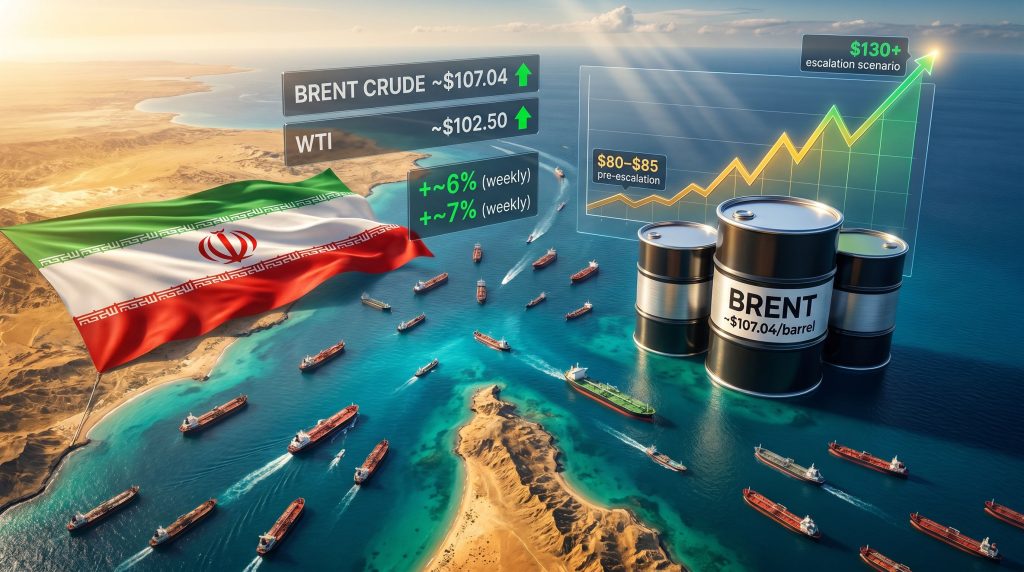
The market's response was immediate. Brent crude futures rose $1.32 per barrel, or 1.25%, to $107.04 by 0425 GMT on May 15, 2026, while US West Texas Intermediate climbed $1.33, or 1.31%, to $102.50 following Trump's comments. (Economic Times, May 15, 2026) For further context on how the oil market impact of such statements has evolved, the pattern is consistent with prior escalation cycles.
The Beijing Summit's Absence of Resolution
Simultaneously, President Trump and Chinese President Xi Jinping were concluding a two-day state visit, with a Friday meeting scheduled to wrap up proceedings. Market participants had been monitoring this diplomatic engagement closely for any coordinated signal on Iran policy.
Vandana Hari, founder of oil market analysis firm Vanda Insights, explained that with the Beijing summit failing to deliver any Iran breakthrough, market attention returned to the deadlock and the near-blockaded Strait, with the tail risk of renewed military escalation coming back into focus. (Economic Times, May 15, 2026)
The White House did confirm that Trump and Xi reached agreement on the importance of keeping shipping lanes open, and Trump noted publicly that China expressed interest in purchasing US crude oil. However, these statements fell well short of the coordinated diplomatic framework that markets had been pricing as a potential de-escalation catalyst. You can follow Trump's latest comments on oil and how they continue to move markets in real time.
China's Structural Role in the Trump Iran Oil Equation
Why Beijing Is Both a Stabilising and Complicating Factor
China occupies a uniquely complex position in the Iran oil market architecture. As the dominant buyer of sanctioned Iranian crude, China has absorbed export volumes that would otherwise be effectively shut out of global commerce due to US restrictions. This purchasing relationship gives Tehran a revenue lifeline that partially insulates Iranian policy from the full impact of Western sanctions pressure.
Yet China also has powerful economic reasons to want the Strait of Hormuz functioning normally. A significant share of Chinese energy imports transit this corridor, meaning prolonged disruption would harm Chinese industrial and economic activity just as surely as it would harm other importing nations. In addition, the OPEC market influence on supply discipline further complicates how these geopolitical pressures translate into physical barrel availability.
US Trade Representative Jamieson Greer captured this dynamic in a Bloomberg interview on Friday morning, noting that China was approaching its Iranian engagement pragmatically and that maintaining open Strait access was genuinely important to Beijing's economic interests. (Economic Times, May 15, 2026)
| Geopolitical Actor | Position on Hormuz | Crude Market Impact |
|---|---|---|
| United States | Demands open shipping lanes; escalating pressure on Iran | Bullish signal if sanctions tighten |
| China | Pragmatic; economically reliant on open Hormuz | Moderating influence, but limited diplomatic leverage |
| Iran | Controls access; using Hormuz as negotiating leverage | Direct supply disruption risk |
| UAE / India | Directly exposed to vessel incidents | Freight and insurance cost escalation |
The Energy Trade Lever Hidden in the Summit
One underappreciated detail from the Trump-Xi summit is the mention of China potentially purchasing US crude oil. If Washington can redirect Chinese energy demand toward American barrels, it theoretically reduces Beijing's strategic dependence on Iranian production. A China less reliant on Iranian crude would have less incentive to resist US pressure campaigns targeting Tehran's oil revenues, potentially undermining Iran's primary revenue stabiliser.
This represents a sophisticated, if speculative, diplomatic play: use energy trade incentives to reshape the buyer relationships that sustain Iranian export revenue, rather than relying solely on direct sanctions enforcement. Whether this calculation materialises into actual policy remains uncertain, but commodity traders are aware of the structural implication.
Tight Supply: The Foundation Beneath the Geopolitical Structure
Why the Market Lacks an Absorption Buffer
A critical dimension of the current Trump Iran oil price dynamic that receives insufficient attention is the condition of underlying supply fundamentals independent of geopolitics. Yang An's observation that tight supply remains the primary oil price driver points to something structurally important: the geopolitical risk premium is not operating in a market with comfortable inventory buffers and spare production capacity. It is operating in a market already stretched thin.
OPEC+ production discipline has maintained a supply-demand balance that leaves minimal room for unexpected disruption. Consequently, this structural tightness means that each incremental piece of negative geopolitical news carries greater price weight than it would in a well-supplied market. The physics of this situation are straightforward: a taut rubber band breaks more easily than a slack one.
The practical consequence is that even partial Hormuz disruption has an outsized pricing effect. In a market with a 3-4 million barrel per day surplus and full storage facilities, a temporary reduction in Hormuz throughput might produce a modest spike followed by rapid reversion. In the current environment, the market has no such cushion.
Historical Context: Three Episodes That Define Market Expectations
Market participants carry institutional memory of how prior US-Iran escalations unfolded. Three precedents shape current risk pricing, and the crude oil geopolitics of each episode continue to inform how analysts interpret today's signals:
1. The 2019 Strait of Hormuz Tanker Incidents
Iranian seizure of a British-flagged tanker triggered a sharp but temporary crude price spike. Brent rose approximately 4% within 48 hours before partially retracing as diplomatic engagement resumed. No sustained physical blockade materialised.
2. The January 2020 Soleimani Strike
Overnight Brent surged more than 4% following the US airstrike. Markets reversed within a week as Iran's retaliatory response remained calibrated to avoid triggering full military escalation. The episode demonstrated that even high-profile strikes could be absorbed if escalation remained contained.
3. The 2018-2019 Maximum Pressure Sanctions Campaign
Iranian crude exports fell from approximately 2.5 million barrels per day to below 500,000 barrels per day during peak enforcement. Saudi Arabia and the UAE absorbed part of the supply shock through production increases, a buffer that may be considerably less available under current OPEC+ coordination frameworks.
The current episode is distinguished from all three predecessors by the simultaneous presence of actual physical disruption to Hormuz transit at a scale not seen in prior escalation events, occurring against a backdrop of supply tightness that eliminates the traditional market buffers.
Downstream Economic Consequences of Sustained Triple-Digit Crude
How Price Shocks Propagate Through the Global Economy
When Brent crude sustains above $100 per barrel, the price signal does not remain contained within the energy sector. It propagates through the broader economic system in sequential waves:
| Sector | Impact of Sustained $100+ Brent | Timeframe |
|---|---|---|
| Aviation | Fuel surcharges and margin compression | Immediate (weeks) |
| Shipping and Logistics | Rate escalation and rerouting costs | Immediate to short-term |
| Manufacturing | Input cost inflation across energy-intensive processes | Short to medium-term |
| Consumer Goods | Retail price pass-through as logistics costs rise | Medium-term |
| Emerging Market Economies | Currency pressure and import bill expansion | Medium to long-term |
For central banks in oil-importing economies, sustained elevated crude prices create a genuine policy dilemma. Energy-driven inflation cannot be easily addressed through interest rate adjustments without simultaneously suppressing economic growth. The European Central Bank and various Asian monetary authorities face this constraint acutely.
US equity markets have thus far demonstrated relative resilience, partly because domestic shale production provides a natural hedge against import-price shocks for American industrial consumers, and partly because elevated crude prices directly benefit the energy sector stocks that comprise a meaningful share of major US indices. Reuters has also reported on the latest developments as the situation continues to evolve.
The next major ASX story will hit our subscribers first
Scenario Modelling: Four Possible Price Trajectories
Where Trump Iran Oil Prices Go From Here
The range of plausible outcomes from the current standoff is unusually wide, reflecting genuine uncertainty about the diplomatic and military trajectory. Four distinct scenarios capture the probability distribution that sophisticated commodity traders are currently pricing:
| Scenario | Trigger Condition | Brent Price Implication |
|---|---|---|
| Full Diplomatic Resolution | Verified nuclear or ceasefire agreement; Hormuz fully reopened | Correction toward $80-$85 per barrel |
| Prolonged Stalemate | No deal, no escalation; partial Hormuz access maintained | Range-bound $95-$105 per barrel |
| Sanctions Intensification | US secondary sanctions on Iranian crude buyers including China | Potential push toward $110-$120 per barrel |
| Military Escalation | Direct US or allied military engagement; Hormuz blockade | Extreme upside risk; $130+ per barrel modelled |
Disclaimer: Price scenarios represent analytical modelling based on current market conditions and historical precedents. They do not constitute financial advice or reliable predictions of future commodity prices. Geopolitical developments are inherently unpredictable and actual outcomes may differ materially from any modelled scenario.
Conditions Required for a Material Price Decline
For Brent to retrace meaningfully from current levels, multiple conditions would ideally need to converge:
- A credible and verifiable diplomatic agreement between Washington and Tehran, with international monitoring mechanisms
- Confirmed Hormuz vessel transit returning toward the pre-conflict baseline of 140 vessels per day
- A coordinated OPEC+ production increase signalling supply adequacy to physical markets
- Tangible evidence of Chinese diplomatic mediation producing a framework for de-escalation rather than simply affirming the importance of open shipping lanes
The absence of any one of these conditions likely keeps prices elevated. Furthermore, the absence of all four, combined with any additional military incident or vessel seizure, pushes the distribution toward the higher scenario outcomes.
Frequently Asked Questions on Trump, Iran, and Oil Prices
Why Do Trump's Public Statements About Iran Move Oil Markets?
Presidential statements signal probable future policy directions. When Trump expresses diminishing patience, commodity markets interpret this as an elevated probability of escalatory action, whether through tightened sanctions, diplomatic ultimatums, or military posturing. Each of these potential actions carries supply disruption implications that traders price into forward curves immediately.
What Makes the Strait of Hormuz So Critical to Global Energy Markets?
Approximately 20-21% of global petroleum supply transits this narrow maritime corridor daily. Under normal conditions, roughly 140 vessels pass through every day. Any credible disruption to this flow, whether through vessel seizures, military activity, or blockade, immediately transmits upward pressure to Brent and WTI benchmarks and ripples through freight markets, insurance pricing, and refinery scheduling globally.
Does China's Relationship With Iran Affect Global Oil Prices?
Significantly. China functions as the primary absorber of sanctioned Iranian crude. If US pressure successfully reduces Chinese purchases of Iranian oil, Tehran loses its principal revenue stream, which could either accelerate a diplomatic deal or alternatively incentivise Iran to escalate Hormuz disruptions as a coercive pressure tactic. Either outcome carries commodity market implications.
How Do Current Conditions Differ From Past US-Iran Escalation Episodes?
Prior episodes, including the 2019 tanker seizures and the 2020 Soleimani strike, produced sharp initial price spikes that partially retraced within days as full military escalation was avoided. The current episode is distinct in combining actual, sustained physical disruption to Hormuz transit with an underlying supply environment that lacks the buffer capacity available during prior crises.
What Would It Take for Oil Prices to Fall Materially From Current Levels?
A verified diplomatic agreement, confirmed restoration of near-baseline Hormuz vessel traffic, a coordinated OPEC+ supply response, or credible Chinese diplomatic mediation producing tangible de-escalation would each represent meaningful downside catalysts. In the absence of these developments, the structural floor beneath crude prices remains elevated.
Key Market Takeaways
The convergence of diplomatic stalemate, physical Strait disruption, and pre-existing supply tightness has produced a crude price environment that is unusually resistant to partial positive developments. The key points investors and market observers should carry forward:
- Brent crude has gained approximately 6% in a single week and WTI approximately 7%, driven by the compound effect of geopolitical risk layering onto structural supply constraints
- The Strait of Hormuz is operating at roughly 21% of pre-conflict vessel throughput, representing a structural rather than temporary disruption to global energy logistics
- The Trump-Xi summit produced agreement on the principle of open shipping lanes but delivered no Iran breakthrough, removing a key potential de-escalation catalyst that markets had partially priced
- Tight underlying supply fundamentals mean the market has minimal capacity to absorb further disruption without additional price appreciation
- Four distinct price scenarios range from a correction toward $80-$85 per barrel on full diplomatic resolution to extreme upside above $130 per barrel in a military escalation outcome, with two intermediate scenarios dominating the probability distribution under current conditions
This article is for informational purposes only and does not constitute financial or investment advice. Commodity price forecasts involve significant uncertainty and readers should consult qualified financial professionals before making any investment decisions based on geopolitical or energy market analysis.
Want to Capitalise on the Next Major Resource Discovery Before the Market Catches On?
While geopolitical tensions reshape global energy markets, Discovery Alert's proprietary Discovery IQ model delivers real-time ASX mineral discovery alerts, instantly transforming complex resource data into actionable investment insights for both short-term traders and long-term investors. Explore historic discoveries and their extraordinary returns to understand the opportunity, then begin your 14-day free trial to secure your edge ahead of the broader market.