June 9, 2026
When Oil Markets Become a National Security Problem
Global commodity markets have always been sensitive to geopolitical risk. Crude oil, in particular, functions as a real-time barometer of conflict probability, shipping disruption likelihood, and diplomatic stability across the Middle East. However, the architecture of how presidential communications intersect with futures market mechanics has rarely been tested in the way it is being examined today.
When a single social media post from the White House can erase a double-digit percentage from benchmark crude prices within seconds, the value of advance knowledge is not merely financial. It becomes a question of whether the integrity of one of the world's most important commodity markets has been structurally compromised.
That is the core tension at the heart of the Trump Iran oil trades investigation, a federal inquiry examining whether traders systematically exploited advance knowledge of presidential announcements to build billions of dollars in short positions on oil derivatives before prices collapsed.
When big ASX news breaks, our subscribers know first
What the Trade Data Actually Reveals
The numbers at the centre of this investigation are striking not because of their size alone, but because of their consistency. According to Reuters reporting published May 9, 2026, traders, market experts, and analysis of exchange data identified a series of short positions across multiple fuel derivatives that appeared immediately before significant U.S.-Iran policy announcements by President Trump.
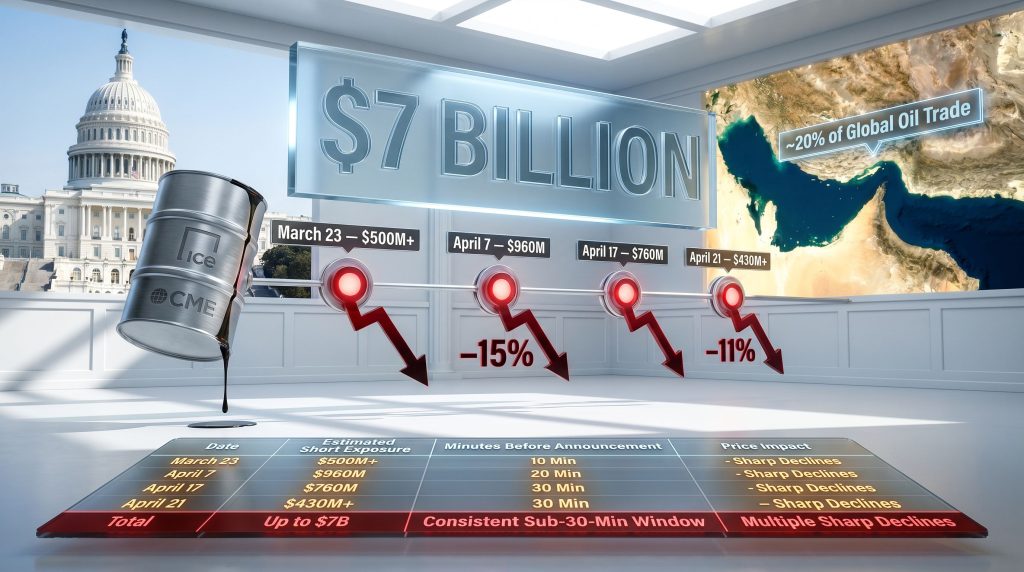
The total exposure across all identified events reached as much as $7 billion, spread across both the Intercontinental Exchange (ICE) and the Chicago Mercantile Exchange (CME). This figure substantially exceeded the earlier reported amount of $2.6 billion that had already prompted an internal White House response warning staff against leveraging nonpublic information for personal financial gain.
The instruments involved were not limited to a single contract. Furthermore, the trades encompassed short positions across:
- ICE crude futures
- CME crude futures
- Diesel futures
- Gasoline futures
This multi-product breadth signals a sophisticated approach rather than a single opportunistic bet. Covering multiple fuel derivatives simultaneously requires either deep market knowledge or deliberate strategy, and potentially both. Understanding the broader crude oil price trends helps contextualise just how dramatically these movements diverged from normal market behaviour.
A Chronological Map of Four Critical Events
What makes the Trump Iran oil trades investigation particularly compelling from a regulatory standpoint is not any single trade in isolation. It is the repeating pattern across four separate events within a compressed timeframe between March and April 2026.
| Date | Event | Estimated Exposure | Timing Before Announcement | Reported Price Impact |
|---|---|---|---|---|
| March 23, 2026 | Trump announces delay to Iranian infrastructure strikes | Significant short clustering | Minutes prior | Oil price decline |
| April 7, 2026 | Trump declares temporary ceasefire with Iran | ~$960 million | Hours prior | Up to -15% ICE Brent |
| April 17, 2026 | Iranian officials and Trump discuss Strait of Hormuz reopening | ~$760 million | ~20 minutes prior | Up to -11% |
| April 21, 2026 | Trump extends ceasefire arrangement | $430 million+ | ~15 minutes prior | Oil price decline |
The March 23 event was the first to alert market surveillance teams. Traders identified unusual positioning minutes before Trump posted on Truth Social announcing a delay to threatened strikes on Iranian power infrastructure, after which oil prices fell. The same blueprint played out three more times with escalating scrutiny from investigators.
The April 7 event marked the point at which the inquiry shifted from a market anomaly to a potential insider-trading investigation. A price drop of as much as 15% in ICE Brent futures following a ceasefire announcement, preceded by nearly $960 million in short positioning, carried a magnitude that was difficult to attribute solely to coincidence.
The expansion from $2.6 billion to $7 billion in identified exposure as the investigation has developed suggests investigators may be uncovering a broader network of coordinated positions rather than isolated opportunistic trades, according to Reuters analysis of exchange data.
Why Truth Social Changed the Risk Calculus for Commodity Traders
A structural feature of this investigation that sets it apart from conventional market manipulation cases is the role of social media as the primary presidential communication channel. When major policy decisions bypass traditional press briefing sequences and land directly on a social platform, the time gap between decision and public disclosure compresses dramatically.
In conventional government communications, a formal press briefing creates a wider window where multiple staffers, communications personnel, and external advisors become aware of upcoming announcements. With direct Truth Social posts, that awareness pool theoretically narrows but simultaneously becomes more valuable. Whoever possesses advance knowledge even minutes before a presidential post carries an asymmetric information advantage that translates immediately into financial opportunity in a market driven by algorithmic reaction.
Quantitative trading systems respond to published announcements within milliseconds. A short position established fifteen to twenty minutes before an announcement capturing the full magnitude of a price decline represents a fundamentally different risk-reward profile than a position established after publication. Consequently, this mechanism explains why sub-30-minute positioning windows appear consistently across all four events in the Trump Iran oil trades investigation.
The Regulatory Architecture Now Under Pressure
Three institutional layers are currently engaged with this investigation, according to sources cited in Reuters reporting.
The U.S. Commodity Futures Trading Commission (CFTC) is the primary regulatory body with jurisdiction over derivatives markets where the trades were executed. A person familiar with the matter confirmed an active CFTC investigation as of April 2026, though the CFTC had not officially confirmed the probe as of the Reuters reporting date of May 9, 2026.
The Chicago Mercantile Exchange (CME) is conducting its own internal review. A source familiar with the matter confirmed CME's investigation to Reuters. Both CME and ICE declined to issue public comment when contacted.
The Department of Justice (DOJ) involvement, as reported by Forbes, would represent an escalation from civil regulatory enforcement to potential criminal liability territory, though this requires additional verification from official sources before being treated as confirmed.
What Investigators Must Establish
Market timing data alone does not constitute proof of wrongdoing. To build a viable enforcement case, investigators face a multi-layered evidentiary challenge:
- Identity: Establishing who placed the trades and whether those entities are subject to U.S. jurisdiction
- Information access: Demonstrating that the trading parties had access to material nonpublic information before each announcement
- Knowledge: Proving the traders understood the information was nonpublic and acted on it deliberately
- Source of information: Tracing how and from whom the advance knowledge was obtained
As of the Reuters reporting date, it could not be established who placed the bets or whether they originated within the United States or elsewhere. This jurisdictional ambiguity adds substantial complexity to any enforcement pathway.
Iran, Oil Supply Architecture, and Why Every Word Moves Prices
To understand why Trump's announcements on Iran carried such immediate and severe price implications, it is necessary to understand Iran's structural position in global oil markets. In addition, the oil geopolitical risk factors specific to the Middle East have long made this region a flashpoint for commodity price volatility.
Iran holds approximately 9% of the world's proven crude oil reserves and is an OPEC member with production capacity that registers meaningfully in global supply calculations. OPEC's influence on oil pricing is well-established, but Iran's strategic geography adds another dimension entirely. More critically, the Strait of Hormuz, which borders Iranian territorial waters, handles approximately 20% of global oil trade by volume.
Any credible signal of military escalation in that corridor triggers an immediate risk premium in crude pricing. Conversely, any credible de-escalation signal removes that premium. This is the precise transmission mechanism exploited in each of the four events under investigation.
De-escalation signals in the U.S.-Iran relationship do not merely shift sentiment. They remove a specific, quantifiable risk premium from benchmark crude prices that algorithmic trading systems re-price within seconds of public announcement.
The involvement of Iranian Foreign Minister Abbas Araghchi's April 17 statement regarding the Strait of Hormuz also introduces a cross-jurisdictional dimension that significantly complicates the investigation. If foreign government officials or foreign-based entities were part of the information chain, U.S. regulatory reach faces treaty-dependent limitations.
The next major ASX story will hit our subscribers first
The White House Memo: An Internal Warning That Became Evidence
One of the most consequential details in this investigation is the timing of an internal White House memorandum. Issued on March 24, 2026, one day after the first suspicious trade cluster on March 23, the memo warned administration staff against using nonpublic information related to Iran policy for personal financial gain.
The speed of this response is significant. It suggests that within a 24-hour window of the first anomalous trade event, internal awareness existed that policy information may have been transmitted to parties who used it for market advantage. The memo itself has transitioned from an internal compliance communication to a material piece of evidence in establishing what the administration knew and when.
Who Could Theoretically Have Possessed Advance Knowledge
The investigation has not publicly identified any individuals or entities. However, the categories of personnel who would theoretically have had access to advance policy decisions include:
- Senior White House staff and National Security Council members briefed on diplomatic communications
- Intelligence community personnel with access to U.S.-Iran negotiation timelines
- Diplomatic intermediaries involved in back-channel communications
- Foreign counterparts with knowledge of announcement scheduling
It is critical to note that no individuals have been identified, named, charged, or publicly connected to the trades as of the date of this reporting.
How This Case Differs From Standard CFTC Enforcement
The Trump Iran oil trades investigation is structurally novel in ways that matter for how investigators approach it and how markets should interpret its implications. For instance, the trade war impact on oil prices has previously demonstrated how politically driven signals can move commodity markets, yet this case introduces an entirely different layer of alleged exploitation.
| Dimension | Trump Iran Oil Investigation | Typical CFTC Enforcement Case |
|---|---|---|
| Information source | Presidential social media announcements | Corporate earnings, OPEC decisions, government crop reports |
| Markets affected | Global crude, diesel, gasoline futures | Typically a single commodity |
| Jurisdictional complexity | Potentially international | Usually domestic |
| Exchanges involved | ICE + CME multi-product | Generally single exchange |
| Estimated exposure | Up to $7 billion | Typically under $1 billion |
| Institutional response | CFTC + CME (+ potential DOJ) | Usually CFTC alone |
Historical CFTC enforcement has addressed spoofing, front-running, and benchmark manipulation. Geopolitical MNPI cases in commodity markets are comparatively rare, and the closest precedents involve trading ahead of government crop reports or OPEC production data using leaked information.
What distinguishes the current case is that the alleged information advantage derives from presidential social media activity rather than from traditional regulatory or corporate disclosure channels. That novelty raises questions that existing enforcement frameworks were not designed to answer cleanly.
What Market Integrity Requires Going Forward
The credibility of U.S. commodity futures markets rests on a foundational assumption: all participants operate with equivalent access to publicly available information. The US-China trade war oil prices saga already demonstrated how geopolitical tensions can create market dislocations, and this investigation raises similarly profound structural integrity concerns.
If systematic exploitation of executive communication channels can be demonstrated, the structural integrity implications extend beyond a single enforcement action. International participants in U.S. commodity futures markets, including sovereign wealth funds, national oil companies, and global institutional hedgers, rely on the assumption that U.S. exchange integrity is maintained.
The investigation also raises broader structural questions that regulators and policymakers will need to address regardless of its outcome:
- Should presidential communications that move commodity markets carry pre-disclosure blackout obligations analogous to corporate earnings blackout windows?
- Does current CFTC surveillance infrastructure have sufficient real-time capacity to detect and respond to geopolitically driven MNPI exploitation?
- How should enforcement proceed when trades originate in foreign jurisdictions beyond direct U.S. regulatory reach?
These are not questions the investigation will resolve on its own. However, the scale and consistency of what has been identified in the exchange data ensures that regulators, exchanges, and policymakers will be forced to confront them.
What Comes Next: Three Investigative Pathways
The investigation could develop along several distinct trajectories, each carrying different legal and market implications.
Pathway One: Trades linked to identifiable U.S.-based actors. If investigators successfully connect the positions to individuals or entities with demonstrable access to White House communications and U.S. jurisdictional exposure, the pathway to criminal or civil enforcement becomes substantially clearer. This scenario carries the most significant institutional and political consequences given the proximity to executive branch decision-making.
Pathway Two: Trades traced to foreign-based entities. If the trades originated outside U.S. jurisdiction, enforcement depends heavily on Mutual Legal Assistance Treaties and international regulatory cooperation. This scenario elevates the national security dimensions of the inquiry considerably, potentially drawing in intelligence community involvement beyond standard market regulation.
Pathway Three: Insufficient evidence of MNPI. If investigators cannot establish the direct link between the trades and access to nonpublic information, the case may conclude without charges. However, even this outcome is unlikely to end the conversation about structural reforms to how presidential communications interact with commodity market surveillance requirements.
Disclaimer: This article is based on Reuters reporting published May 9, 2026, via Energy Economics Times, and does not constitute legal, financial, or investment advice. The investigation is ongoing. No individuals or entities have been charged or formally identified in connection with the trades described. All statistics and characterisations are drawn from the cited source material. Forward-looking statements and scenario projections are analytical in nature and should not be treated as predictions of investigative outcomes.
Want to Stay Ahead of Significant Market-Moving Discoveries on the ASX?
While geopolitical events continue to reshape commodity markets globally, Discovery Alert's proprietary Discovery IQ model delivers real-time notifications on significant ASX mineral discoveries, transforming complex market data into clear, actionable insights for investors at every experience level. Explore historic examples of major mineral discoveries and their market returns on Discovery Alert's dedicated discoveries page, and begin your 14-day free trial today to position yourself ahead of the next significant market opportunity.