June 12, 2026
Coercive Diplomacy and the Persian Gulf: Why Oil Markets Can Never Ignore Washington's Pressure Playbook
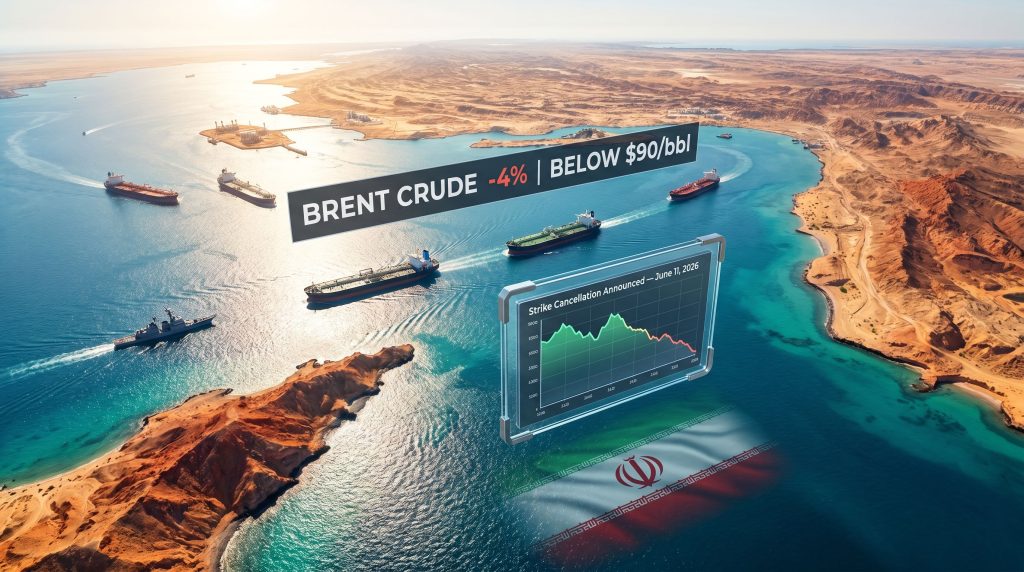
Global energy markets have long understood one uncomfortable truth: the Persian Gulf is not simply an oil-producing region. It is a pressure system, perpetually calibrated between diplomatic tension and the ever-present possibility of kinetic conflict. When that system shifts, crude prices move first and ask questions later. Trump reverses course on Iran strikes and the events of June 11, 2026 offered yet another demonstration of this dynamic, as the decision to walk back planned military action sent Brent crude into a sharp intraday decline, resetting the geopolitical risk premium embedded in oil pricing almost instantaneously.
Understanding why this matters requires looking beyond the headline and examining the structural mechanics of how coercive diplomacy, energy infrastructure vulnerability, and maritime chokepoint risk interact to shape global oil market behaviour. Furthermore, crude oil price trends have become increasingly sensitive to these geopolitical signals, making it essential to track both diplomatic and military developments simultaneously.
When big ASX news breaks, our subscribers know first
The Anatomy of a Presidential Reversal
Escalation, Withdrawal, and the Logic of Maximum Pressure
On June 11, 2026, President Donald Trump announced via a direct public statement that planned military strikes against Iran had been cancelled. The rationale provided centred on the advancement of diplomatic discussions to senior levels of Iranian leadership and the conceptual endorsement of a negotiating framework by a broad coalition of regional stakeholders. Those stakeholders included Saudi Arabia, the UAE, Israel, Qatar, Turkey, Pakistan, Bahrain, Kuwait, Jordan, and Egypt.
Critically, Iran itself was absent from this list. Iran's semi-official Fars news agency indicated the country had not approved any deal text, leaving the diplomatic architecture in a state of acknowledged incompleteness. The cancellation of strikes came within hours of Trump having raised the explicit possibility of targeting Iranian energy infrastructure, including Kharg Island, the country's primary crude oil export terminal.
This is not a one-off pattern. In 2019, a retaliatory strike against Iranian targets was halted approximately ten minutes before execution after casualty projections were presented to the president, with the decision framed around proportionality concerns. What has emerged across multiple Iran standoffs is a coherent, if deliberately unpredictable, strategic posture: the credible threat of overwhelming force is maintained and broadcast publicly, while diplomatic off-ramps are simultaneously preserved. Military action functions as a negotiating instrument rather than an operational objective.
Coercive diplomacy of this kind depends on one critical ingredient: the adversary must genuinely believe force is possible. Once that belief erodes, the leverage disappears. Trump's documented willingness to authorise strikes right up to the point of execution is, paradoxically, what gives the diplomatic reversals their weight.
The tension between advisors historically favouring escalatory postures and a president who consistently selects negotiated exits reflects a deeper strategic preference for economic and diplomatic pressure over sustained military engagement. This preference has significant implications for how energy markets should model future risk scenarios in the region, particularly in light of broader oil market disruption caused by geopolitical brinkmanship.
Kharg Island: The Pressure Point That Moves Oil Markets
Why a Single Facility Commands Global Attention
Kharg Island sits in the northern Persian Gulf and functions as the nerve centre of Iran's petroleum export system. The island is responsible for processing and loading the overwhelming majority of Iran's crude oil exports, making it one of the most consequential pieces of energy infrastructure in the world. Disrupting or destroying it would not merely damage Iran's export revenues; it would pull a meaningful volume of crude from global supply chains with near-immediate effect.
This strategic significance has historical precedent. During the Iran-Iraq War of the 1980s, Kharg Island was subjected to repeated aerial bombardment as Iraq sought to cripple Iranian oil revenues. The island demonstrated resilience, but the experience highlighted how infrastructure concentration creates asymmetric vulnerability. A single well-targeted strike on the right loading terminals or pumping infrastructure could impose disproportionate supply damage relative to the military effort required.
The mere mention of Kharg Island as a potential target in Trump's pre-reversal statements was sufficient to keep a substantial risk premium embedded in crude prices. When the strike was cancelled and diplomatic signals emerged, the market response was immediate:
| Market Event | Brent Crude Movement | Market Interpretation |
|---|---|---|
| Strike threats escalated against energy infrastructure | Risk premium elevated | Supply disruption probability priced in |
| Strike cancellation announced on June 11, 2026 | Approximately 4% decline, below $90/bbl | Diplomatic progress partially priced in |
| Iran declines to confirm any agreed deal text | Residual uncertainty sustained | Cautious positioning maintained |
The speed of that ~4% price correction is instructive. It reflects just how precisely calibrated modern energy markets are to geopolitical inputs, and how efficiently risk premiums are built and dismantled when the threat environment shifts.
The Strait of Hormuz: A Chokepoint That Cannot Be Ignored
Maritime Risk and the Mathematics of Global Oil Flow
The Strait of Hormuz represents the single most consequential maritime passage in the global energy system. Roughly 20% of the world's total petroleum liquids, and a substantial proportion of global LNG trade, transits this narrow waterway connecting the Persian Gulf to the Gulf of Oman and the broader Indian Ocean. There is no viable alternative route for the landlocked Gulf producers to move the volumes the global economy depends on.
Iran declared on Wednesday of that week that the strait would remain closed to vessel traffic, a statement the United States contested by maintaining that commercial shipping continued to transit the region. This competing narrative reflects the deliberate ambiguity that characterises Persian Gulf escalation cycles: neither full closure nor full normalcy, but a contested operational environment that keeps market participants uncertain.
Several dynamics compounded this uncertainty:
- The U.S. naval blockade of Iran remained active following the strike cancellation, with the administration explicitly stating it would continue until any agreement reached formal finalisation.
- Tanker traffic through the strait showed incremental improvement in the weeks prior to the announcement, but vessel movements remained measurably below pre-conflict baselines.
- Analysts flagged that a sustained disruption scenario would accelerate drawdowns on both strategic petroleum reserves and commercial inventories, tightening the global supply buffer available to absorb further shocks.
If the strait were to experience even a partial operational closure over an extended period, the resulting supply shock would move simultaneously through crude benchmarks, refining margins, LNG spot contracts, and downstream fuel costs across Asia, Europe, and North America. The interconnectedness of these markets means the damage would not be contained to the immediate region.
The Blockade Variable: Sustained Leverage with Sustained Risk
One underappreciated aspect of the current situation is that the naval blockade, even in the absence of active military strikes, itself constitutes a form of economic warfare. Restricting Iran's ability to export crude oil through naval interdiction or insurance market pressure achieves supply disruption goals without the escalatory optics of kinetic action. For energy markets, however, the blockade's continuation means the risk premium does not fully evaporate even when strike threats recede. There is a floor beneath which geopolitical risk pricing cannot fall while the blockade persists.
Regional Power Dynamics and the Fragility of Ceasefire Architecture
Who Sits at the Table and What They Want
The June 2026 escalation cycle followed the collapse of a two-month ceasefire earlier the same week, a development that underscores a recurring structural problem in Persian Gulf diplomacy: pauses in hostilities that lack binding enforcement mechanisms are inherently fragile. Qatar's continued role as a regional mediator reflects both its geographic positioning and its unique channel access to multiple parties simultaneously, a role it has refined through years of navigating the region's competing interests.
The alignment of Gulf Cooperation Council members alongside Turkey, Pakistan, Jordan, and Egypt around a conceptual framework signals a broad regional preference for de-escalation. This is not purely altruistic. Saudi Arabia strategy and the UAE's interests, as major crude producers and OPEC+ members, create a direct economic stake in preventing supply disruptions that could destabilise the production frameworks they have worked to build. Volatility that pushes prices sharply higher in the short term may benefit revenue-per-barrel calculations, but it also accelerates demand destruction and alternative energy investment in consuming nations.
Israel's inclusion in the framework introduces a distinct and more complex security calculus. Its concerns extend well beyond oil prices to encompass Iranian nuclear development trajectories and proxy military activity across the region. Consequently, any durable agreement must address conditions that go considerably beyond what an energy-focused negotiation framework might naturally cover.
How Oil Markets Price an Unresolved Standoff
Probability Distributions, Not Binary Outcomes
A critical insight for anyone attempting to understand oil price behaviour during geopolitical standoffs is that markets do not price binary outcomes. They price probability distributions across a range of scenarios, continuously adjusting that distribution as new information arrives. Each diplomatic statement, shipping data release, and political development shifts the weighting across possible futures. In addition, geopolitical trade tensions of this nature create compounding layers of uncertainty that resist simple resolution.
In the current environment, three broad trajectories define the scenario space:
| Scenario | Near-Term Probability Assessment | Oil Market Implication |
|---|---|---|
| Full diplomatic resolution with binding bilateral agreement | Lower probability given Iran's non-confirmation of deal text | Significant downward pressure on crude; risk premium substantially unwound |
| Prolonged negotiation with partial de-escalation | Most probable near-term trajectory | Moderate price stabilisation; Hormuz traffic gradually normalises |
| Breakdown of talks and renewed military threats | Tail risk scenario | Sharp upward price spike; potential challenge of $100+/bbl price levels |
The middle scenario, prolonged ambiguity with incremental progress, is the hardest for market participants to position around. It produces sustained volatility rather than directional clarity, which is itself a market condition with real costs for hedgers, refiners, and producers trying to make capital allocation decisions.
Inventory Buffers and the Forward Curve
Analysts monitoring the situation have consistently flagged that the combination of below-normal tanker traffic, active naval blockade conditions, and unresolved diplomatic status keeps upside price risk elevated even when active military engagement appears to have been avoided. OPEC market influence becomes an increasingly critical variable in this environment. If Hormuz disruption were to escalate, the capacity of Gulf producers outside Iran to compensate would be tested against the actual volumes removed from the market.
The forward curve behaviour in this environment is particularly telling. Near-term contracts price the immediate risk premium, while longer-dated contracts reflect market assumptions about the probability and duration of any resolution. The current shape of the curve reflects genuine uncertainty rather than consensus around any single outcome.
The next major ASX story will hit our subscribers first
Key Variables to Monitor as Negotiations Evolve
For market participants and policy observers tracking this situation, several data points will prove most revealing in the coming weeks:
- Iran's formal response to the proposed deal framework and whether any binding text is agreed upon.
- Tanker traffic volumes through the Strait of Hormuz measured against pre-conflict baselines, available through shipping analytics platforms.
- Brent crude price movements and the implied risk premium relative to fundamental supply-demand balances.
- The status of the U.S. naval blockade and any conditions attached to its potential removal.
- Statements from Qatar and other regional mediators regarding the substantive progress of negotiations.
- Iranian domestic political signals, which often indicate the level of flexibility Tehran's leadership has to conclude any deal without triggering internal opposition.
Disclaimer: This article contains forward-looking analysis and scenario projections based on publicly available information as of the date of publication. Oil price forecasts and geopolitical outcome assessments are inherently speculative. Nothing in this article constitutes financial or investment advice. Readers should conduct their own research and consult qualified advisors before making any investment decisions.
The Deeper Lesson: Energy Security in an Age of Coercive Diplomacy
The June 2026 episode reinforces a structural reality that energy markets have confronted repeatedly across decades of Persian Gulf tension: it is not only actual conflict that creates supply risk, but the sustained possibility of conflict. Trump reverses course on Iran strikes in ways that echo previous standoffs, and as long as the underlying drivers of U.S.-Iran tension remain unresolved, each diplomatic pause carries within it the seeds of the next escalation cycle.
For the global energy system, the critical question is not whether strikes occurred on a given evening in June 2026. It is whether the mechanisms producing repeated confrontations between Washington and Tehran are trending toward genuine structural resolution or simply entering another cyclical pause. The answer to that question will define the risk environment for Persian Gulf energy flows, and by extension for global crude pricing, for years to come.
For ongoing reporting and upstream industry analysis covering Middle East energy developments and geopolitical risk assessments, World Oil provides detailed coverage at worldoil.com.
Want to Stay Ahead of the Next Major Mineral Discovery Before the Market Moves?
While geopolitical risk premiums reshape crude benchmarks overnight, Discovery Alert's proprietary Discovery IQ model monitors ASX announcements in real time — instantly identifying significant mineral discoveries and translating complex data into actionable opportunities for both traders and long-term investors. Explore historic discoveries and their remarkable returns, then begin your 14-day free trial at Discovery Alert to position yourself ahead of the market.