June 12, 2026
The Architecture of Ambition: How Trump's Nuclear Executive Orders Are Reshaping U.S. Energy Policy
Few sectors in the American economy have undergone as concentrated a policy transformation as nuclear energy over the past twelve months. While energy transitions typically unfold across legislative cycles, court rulings, and multi-agency rulemakings spanning years or even decades, the executive order package signed in May 2025 compressed that institutional timeline dramatically. The result is a policy environment that is simultaneously the most ambitious, the most contested, and the most consequential for nuclear energy since the era of the Atomic Energy Act.
Evaluating Trump's nuclear executive orders one year later requires looking beyond the headline announcements and examining how federal agencies have actually responded, where execution gaps remain wide, and whether the structural foundations being laid today can support the 400 GW ambition that sits at the centre of EO 14302.
When big ASX news breaks, our subscribers know first
Four Executive Orders, One Strategic Vision
Why Executive Action Rather Than Legislation?
The administration's choice to advance nuclear policy through executive orders rather than waiting for congressional legislation was deliberate. Executive orders allow for immediate agency-level directives, compressed timelines, and the ability to reframe institutional priorities without the friction of the legislative process. In a sector where regulatory inertia had historically been the dominant force, this approach represented a calculated bet that agency behaviour could be reshaped from the top down.
The four orders collectively address every major constraint that has held back nuclear development in the United States: regulatory complexity at the Nuclear Regulatory Commission, the absence of federal demonstration reactor infrastructure, the severe atrophy of the domestic fuel supply chain, and the lack of nuclear deployment pathways for defence applications.
The Four-Order Framework at a Glance
| Executive Order | Primary Agency | Core Mandate | Key Deadline |
|---|---|---|---|
| EO 14300 | Nuclear Regulatory Commission | Wholesale regulatory reform and licensing streamlining | 18-month rulemaking review |
| EO 14301 | Department of Energy | Three demonstration reactors to reach criticality | July 4, 2026 |
| EO 14302 | DOE and Industry | Quadruple U.S. nuclear capacity; rebuild fuel supply chain | 25-year horizon (2050) |
| EO 14299 | Department of Defense | Microreactor deployment at military installations | 2030 target |
Together, these orders position nuclear energy at the intersection of national security, energy independence, AI infrastructure demand, and export competitiveness. That multi-domain framing is itself strategically significant: it creates broader political coalitions and insulates nuclear policy from being categorised purely as an energy or environmental issue. Furthermore, the US mineral production executive order context reinforces how the administration has embedded nuclear strategy within a broader national security framework.
The NRC's Regulatory Transformation: Velocity, Risk, and Controversy
The Scale of What Is Being Attempted
The Nuclear Regulatory Commission is not an agency known for rapid institutional change. Its historical rulemaking output runs between three and six rulemakings per year, reflecting the deliberative, safety-first culture that has defined the agency since its creation. Against that backdrop, the scope of what EO 14300 has triggered is genuinely extraordinary.
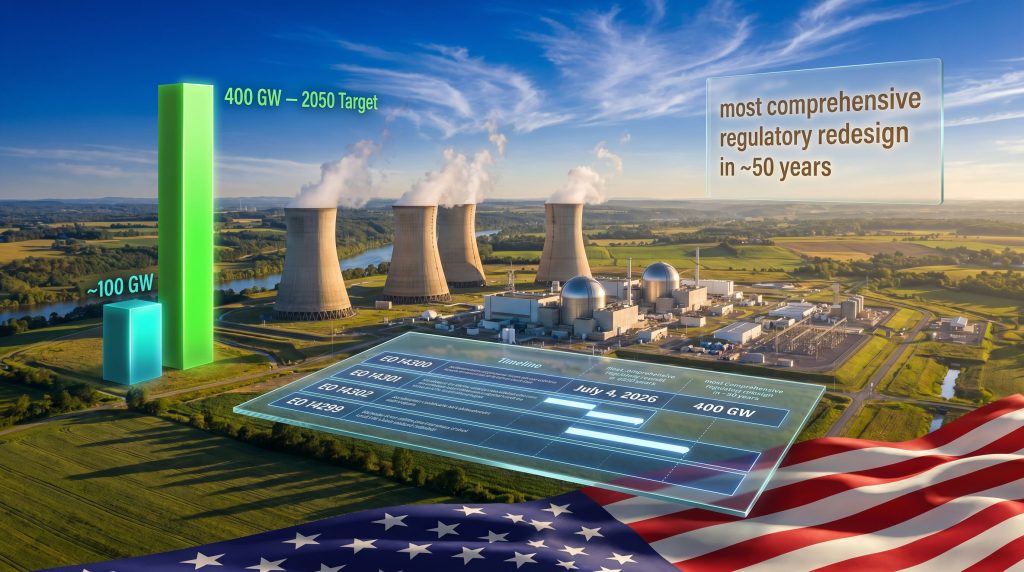
As of May 2026, the NRC has 33 active rulemakings simultaneously in progress. Work that would ordinarily require five to seven years is being compressed into approximately two years. NRC Chairman Ho Nieh has described EO 14300 as the catalyst for the most comprehensive redesign of the agency's regulatory framework in nearly fifty years, building on the legislative foundation established by the ADVANCE Act, which passed with strong bipartisan support in 2024.
Concrete milestones delivered in the first twelve months include:
- Construction permit issued for TerraPower's Natrium power plant in Kemmerer, Wyoming
- Operating licence for the Robinson nuclear power plant renewed in under 12 months
- Five final rules finalised across the rulemaking review
- Seven proposed rules published out of a planned set of 27
- The NRC has already updated its schedule acknowledging that some final rules will extend beyond the original 18-month window
The Efficiency-Safety Debate
The acceleration in rulemaking has generated a genuine and important debate about whether speed and safety are compatible in nuclear regulation. The Nuclear Energy Institute's president and CEO, Maria Korsnick, has argued publicly that efficiency and safety are not opposing forces. Her position is that keeping NRC reviews focused on the factors most directly relevant to protecting workers and the public is what genuine safety optimisation looks like.
The high-profile reviews for TerraPower's Natrium reactor and Kairos Power's Hermes demonstration reactors are being completed at unprecedented speed without compromising safety standards. For a detailed breakdown of key takeaways from Trump's nuclear executive orders, the Department of Energy has published a comprehensive overview of what each order directs federal agencies to achieve.
NRC Chairman Nieh has reinforced this framing, noting that the underlying technical work embedded in the current rulemaking sprint had in many cases been under discussion within the agency for years before EO 14300 was signed. The order, in his framing, accelerated the finalisation of ideas already under development rather than forcing entirely new and untested regulatory concepts into the rulemaking pipeline.
A research group at the University of Illinois-Urbana-Champaign has offered a more cautious perspective, arguing that the most durable path forward involves an explicitly risk-informed approach that integrates cost-benefit analysis with systematic treatment of uncertainty. Their concern is that the executive orders have layered additional institutional uncertainty onto an agency already navigating rapidly shifting legal environments around agency discretion and independence.
Emily Caffrey, assistant professor of health physics at the University of Alabama-Birmingham, has framed the durability question clearly: the momentum toward licensing reform predates the executive orders, having been building through the ADVANCE Act and years of industry advocacy. Whether the changes prove lasting depends less on the orders themselves and more on whether the NRC's regulatory culture genuinely shifts and whether Congress remains engaged after the current political moment passes.
Transparency and Institutional Independence: The Governance Fault Line
Perhaps the most sensitive dimension of the NRC's transformation over the past year involves questions of transparency and institutional independence. Two specific developments have drawn sustained attention from the expert community.
The first is the firing of then-NRC Commissioner Christopher Hanson, which prompted concern among observers about the degree to which the commission's independence from executive branch direction can be maintained under the current policy environment.
The second is the NRC's movement away from publishing all commission votes for certain categories of activity, a practice that has historically been central to the agency's public accountability model. Patrick White of the Clean Air Task Force raised this concern directly at a May 2026 Senate subcommittee hearing, arguing that transparency and independence are prerequisites for good regulatory outcomes, not optional features.
Paul Dickman, a retired senior policy fellow at Argonne National Laboratory, has noted that the NRC's status as a globally recognised leader in nuclear safety is inseparable from its track record of transparent review processes. Any procedural changes that limit public access to agency deliberations or obscure the basis for commission decisions carry real risk to that institutional credibility.
The proposed rule to create a streamlined licensing pathway for reactors already approved by the DOE and DOD has added another layer to this debate, with some analysts questioning whether such coordination represents efficient inter-agency alignment or an encroachment on the NRC's independent regulatory mandate. Consequently, the White House executive order reforming the NRC itself makes clear that the administration views regulatory independence and accelerated reform as compatible objectives.
The DOE's Execution Track: From Pilot Programme to Permanent Infrastructure
The Reactor Pilot Programme and Its Institutionalisation
EO 14301's mandate for three demonstration reactors to reach criticality by July 4, 2026, set off one of the most closely tracked industrial races in recent U.S. energy history. The American Nuclear Society's Nuclear Newswire has published more than twenty dedicated reports tracking the programme's progress.
The most significant structural development came in March 2026, when the DOE announced that both the Reactor Pilot Programme and the parallel Fuel Line Pilot Programme would be absorbed into the Nuclear Energy Launch Pad, a permanent authorisation pathway modelled on the pilot programmes but available to developers of nuclear-related technology on an ongoing basis rather than terminating at the July 4 deadline. This institutionalisation effectively resolves the uncertainty that had surrounded what would happen to the programme after its original deadline passed.
The Fuel Supply Chain: The Critical Path Constraint
Alongside the reactor pilot programme, EO 14301 triggered a parallel initiative to build new DOE-authorised fuel cycle facilities. Four companies have been selected for fast-tracked fuel cycle facility development under this programme.
The fuel supply chain question is arguably the most technically constrained bottleneck in the entire advanced reactor buildout. Most next-generation reactor designs require High-Assay Low-Enriched Uranium (HALEU), a fuel type enriched to between 5% and 20% U-235, significantly higher than the enrichment levels used in conventional light-water reactors. The domestic HALEU supply infrastructure is currently far too limited to support the reactor deployment ambitions embedded in EO 14302.
New enrichment facilities require capital investment measured in billions of dollars and construction timelines measured in years, meaning that fuel supply constraints may ultimately pace the entire advanced reactor programme regardless of how quickly reactor designs are licensed. In addition, uranium supply challenges in 2025 continue to compound the structural difficulty of meeting advanced reactor fuel demands at scale.
DOD Microreactor Deployment: The Longer Timeline
EO 14299 has generated progress on the defence side of the nuclear equation, though at a slower pace than the civilian reactor programmes. Nine Army sites have been identified as candidates for microreactor deployment by 2030. The strategic rationale centres on energy resilience: military installations that depend on grid power represent a vulnerability, and small modular and microreactor units could provide energy independence for both domestic bases and potentially forward-operating environments in the future.
EO 14302 and the Industrial Base: Rebuilding From a Severely Atrophied Baseline
What "Severely Atrophied" Actually Means
The language used by Sven Bader of the Electric Power Research Institute to describe the current state of the U.S. nuclear fuel cycle infrastructure captures a structural reality that often gets lost in discussions focused on reactor designs and licensing timelines. Decades of low uranium prices, utility consolidation, and policy indifference allowed the domestic enrichment, conversion, and fuel fabrication industries to contract dramatically. The United States currently relies heavily on imported nuclear fuel services for its existing fleet.
EO 14302's response to this involves:
- Providing financial support for new domestic enrichment facilities
- Offering feedstock materials to enable fuel fabrication demonstrations for advanced reactor designs
- Soliciting state interest in Nuclear Lifecycle Innovation Campuses, which are conceived as integrated hubs combining enrichment, fabrication, and potentially waste management functions
ANS past president Steve Nesbit has noted that EO 14302 explicitly recognises the need for statutory changes to enable a new direction for the back end of the fuel cycle. As of mid-2026, however, no specific legislative proposals have been formally introduced by the administration to support that policy direction, although industry sources suggest proposals may be forthcoming. However, the uranium market dynamics heading into 2025 illustrate why rebuilding domestic fuel infrastructure has become a matter of both economic and strategic urgency.
Is the 400 GW Target Achievable?
| Milestone | Target | Status as of May 2026 |
|---|---|---|
| U.S. nuclear capacity baseline (2024) | ~100 GW | Established |
| Net new capacity needed by 2050 | +300 GW | Policy framework only |
| Large reactors under construction by 2030 | 10 | Pre-construction/permitting phase |
| Fleet uprates to existing plants | ~5 GW | Under evaluation |
| Total capacity target by 2050 | 400 GW | Long-term ambition; high execution risk |
The gap between the 400 GW target and current execution capacity is the defining challenge of EO 14302. No new large-scale reactors have broken ground under the framework yet, and the financing mechanisms required to underwrite construction of nuclear plants in a deregulated electricity market remain unresolved. Long-term nuclear waste disposal policy has not advanced materially, which Nesbit identifies as one of the two largest unresolved questions alongside project financing.
Nuclear, AI, and the Demand-Side Reframing
Why the Administration Linked Nuclear to Data Centre Growth
One of the more strategically sophisticated elements of the EO package is the explicit linkage between nuclear energy expansion and the electricity demand profile created by artificial intelligence infrastructure. Data centres and high-performance computing clusters require continuous, high-density baseload power that cannot be reliably served by intermittent renewable sources. By positioning nuclear as the natural infrastructure layer beneath AI growth, the administration has recruited a powerful and well-funded private sector constituency into the pro-nuclear coalition.
This framing has already begun to reshape power purchase agreement structures, with hyperscale technology companies exploring long-term nuclear offtake arrangements that could provide the revenue certainty needed to underwrite new reactor construction financing.
Nuclear as a Geopolitical Tool
Beyond the domestic demand story, the EO package signals a more assertive U.S. posture in global reactor markets. Reactor export competition has intensified significantly over the past decade, and allied nations seeking to reduce energy dependence on geopolitically problematic fuel suppliers represent a substantial potential market for U.S. reactor technology, fuel services, and operational expertise.
The acceleration of domestic advanced reactor development creates the demonstrated track record and available technology inventory that export competitiveness requires. Furthermore, the US Senate ban on Russian uranium imports has reinforced the urgency of establishing a self-sufficient domestic fuel infrastructure to support both domestic and export ambitions.
The next major ASX story will hit our subscribers first
One Year On: An Honest Implementation Audit
What Has Materially Changed
Of approximately 30 discrete tasks embedded across the four executive orders, with deadlines ranging from one month to twenty-five years, roughly 20 were due within the first twelve months. Expert assessments from within the industry indicate meaningful progress on DOE-facing deliverables and genuine institutional transformation at the NRC.
The areas of material change include:
- Federal policy direction has shifted from broadly supportive to actively accelerated, with nuclear now treated as a core industrial and national security priority
- The NRC is undergoing its most comprehensive regulatory redesign in approximately fifty years
- The DOE's Reactor Pilot Programme has been institutionalised into a permanent framework through the Nuclear Energy Launch Pad
- Advanced reactor developers including TerraPower and Kairos Power are receiving regulatory attention at speeds previously not seen in the U.S. licensing system
What Remains Unresolved
The list of unresolved issues is equally important for anyone assessing the durability of this policy transformation:
- No specific legislative proposals have been introduced to address the back-end fuel cycle policy direction
- The domestic HALEU supply chain remains structurally inadequate relative to advanced reactor deployment ambitions
- Long-term nuclear waste disposal policy has not advanced materially
- Financing structures for new large-scale reactor construction remain undefined
- The sustainability of reform momentum beyond the current political cycle is the central open question
Moreover, the recent six-year high in US uranium production offers a modestly encouraging signal, but it remains far below the output levels required to underpin the fuel chain ambitions of EO 14302.
Steve Nesbit, ANS past president for 2021-2022, has captured the essential uncertainty with precision: the four May 2025 executive orders provided a welcome and genuine bias toward action, with many initiatives now underway as a result. Whether that activity translates into real, sustainable progress over the coming decades remains the defining question for the U.S. nuclear industry.
Frequently Asked Questions: Trump's Nuclear Executive Orders One Year Later
What did the four nuclear executive orders actually do?
The four orders addressed distinct but interconnected challenges. EO 14300 directed the NRC to undertake comprehensive regulatory reform. EO 14301 mandated DOE collaboration with private industry to bring three demonstration reactors to criticality by July 4, 2026. EO 14302 set the 25-year goal of quadrupling U.S. nuclear capacity while rebuilding the domestic fuel supply chain. EO 14299 directed the Department of Defense to pursue microreactor deployment at military installations by 2030.
Has regulatory reform made nuclear energy less safe?
The NRC and the Nuclear Energy Institute's leadership have both argued that efficiency and safety are complementary rather than competing objectives. The NRC Chairman has stated that the technical content being embedded in accelerated rulemakings had been under development within the agency for years before the executive order was signed. Academic researchers have raised questions about the risks of compressed timelines, but the primary concern from that community relates to institutional uncertainty rather than specific safety degradation.
What is the Nuclear Energy Launch Pad?
The Nuclear Energy Launch Pad is a permanent DOE authorisation pathway announced in March 2026 that replaced the time-limited Reactor Pilot Programme and Fuel Line Pilot Programme initiated under EO 14301. It provides an ongoing authorisation mechanism for developers of nuclear reactor technology and fuel cycle facilities, removing the uncertainty associated with the original July 4, 2026 deadline.
What is HALEU and why does the supply chain matter?
High-Assay Low-Enriched Uranium (HALEU) is enriched to between 5% and 20% U-235, making it the fuel type required by most advanced reactor designs currently in development. The United States currently lacks sufficient domestic HALEU enrichment capacity to support the deployment ambitions outlined in EO 14302, making new enrichment investment a critical path item for the entire advanced reactor programme.
Are there legitimate concerns about NRC independence?
Yes, and they are being raised by credible voices. The firing of a sitting NRC commissioner, combined with the agency's reduced transparency around commission votes for certain activities, has generated concern among regulatory experts, advocacy organisations, and academic researchers. The core argument is that the NRC's global credibility as a safety regulator depends directly on its independence and the accessibility of its deliberative processes to public scrutiny.
Readers seeking further technical depth on U.S. nuclear policy developments and executive-level nuclear governance can explore related coverage published by the American Nuclear Society's Nuclear Newswire at ans.org/news, which has tracked the reactor pilot programme and NRC reform process across more than 20 dedicated reports. The ANS 2026 Annual Conference will also host a dedicated technical session evaluating progress across all four executive orders.
This article contains forward-looking assessments based on publicly available expert commentary and policy analysis as of May 2026. Statements about future capacity targets, regulatory timelines, and programme outcomes involve inherent uncertainty and should not be construed as definitive forecasts. Policy environments can shift materially across political cycles, and execution risk remains high across multiple dimensions of the 400 GW buildout ambition.
Want to Stay Ahead of the Mineral Discoveries Driving the Energy Transition?
The nuclear buildout outlined in these executive orders — from HALEU fuel chains to advanced reactor deployment — depends heavily on securing critical minerals at scale, and significant ASX discoveries in uranium and related commodities are already emerging in response. Discovery Alert's proprietary Discovery IQ model delivers real-time alerts the moment significant ASX mineral discoveries are announced, translating complex geological data into actionable investment insights — explore the historic returns major discoveries have generated and begin a 14-day free trial to position yourself ahead of the broader market.