August 1, 2026
The Invisible Chokepoint Threatening America's Energy Foundation
Every major energy crisis in modern history shares a common thread: the vulnerability was visible long before it became a crisis. Oil embargoes, natural gas price shocks, and coal supply disruptions all followed the same pattern of accumulated complacency meeting sudden geopolitical reality. Today, the US nuclear fuel supply chain is exhibiting precisely those warning signs, yet it receives a fraction of the policy attention directed at oil and gas security.
Nuclear power quietly underpins approximately 20% of total US electricity generation, operating around the clock regardless of weather conditions or seasonal demand swings. It is the backbone of baseload reliability in a grid increasingly stressed by electrification, data centre expansion, and the intermittent nature of renewable sources. Yet the industrial infrastructure required to keep those reactors fuelled is, in structural terms, one of the most fragile segments of the entire US energy system.
Understanding why requires looking beyond the reactor itself and into the multi-stage industrial process that transforms raw uranium ore into reactor-ready fuel.
When big ASX news breaks, our subscribers know first
How the Nuclear Fuel Cycle Actually Works
The nuclear fuel cycle is not a single industrial process but a sequence of five discrete stages, each representing a distinct point where disruption can cascade forward and backward through the system.
| Fuel Cycle Stage | Core Function | Current US Domestic Capacity |
|---|---|---|
| Uranium Mining and Milling | Extraction and concentration of U₃O₈ | Critically underdeveloped |
| Conversion (UF₆) | Chemical transformation for enrichment readiness | Limited domestic capacity |
| Enrichment (LEU/HALEU) | Increasing U-235 concentration for reactor use | Single domestic commercial operator |
| Fuel Fabrication | Assembly of enriched uranium into fuel rods | Moderate, import-dependent inputs |
| Spent Fuel Reprocessing | Recovery and recycling of usable isotopes | Largely inactive in the US |
What makes this supply chain categorically different from oil is the depth of transformation required at each stage. Crude oil, once extracted, can be refined relatively quickly. Uranium, however, must pass through chemically complex, energy-intensive, and highly regulated processes before it can power a reactor. For a broader overview of how this works in practice, the nuclear fuel cycle overview from the World Nuclear Association provides useful context on each stage and its dependencies.
Each stage requires specialised industrial infrastructure that takes years, not months, to build or rebuild.
"The nuclear fuel cycle functions more like a precision manufacturing pipeline than a commodity supply chain. A constraint at any single stage does not just slow output at that point; it stops the entire downstream sequence."
What the Import Numbers Reveal About US Vulnerability
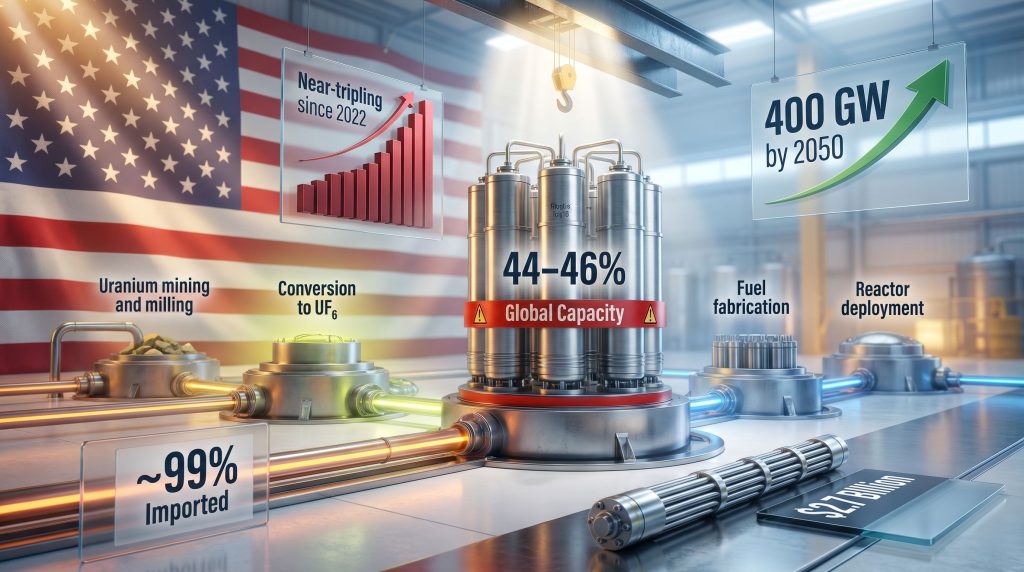
The scale of US dependence on foreign uranium is striking when examined against consumption data. According to EIA procurement reports, domestic uranium production in 2023 accounted for less than 1% of national consumption, with US nuclear generators consuming approximately 32 million pounds of imported uranium concentrate (U₃O₈) against negligible domestic output.
This near-total reliance on foreign uranium concentrate is not a recent development. It reflects several decades of domestic production decline driven by persistently low uranium prices and the absence of sustained policy support for mining infrastructure. As foreign state-owned producers offered enriched uranium at prices that domestic operators could not match, the US progressively exited the upstream fuel cycle.
The enrichment layer compounds this vulnerability further. Russia currently controls an estimated 44 to 46% of global uranium enrichment capacity, making it the world's dominant enrichment provider by a significant margin. Historically, Russian state-owned suppliers have provided approximately 20 to 25% of the enriched uranium consumed by US reactors, a dependency that accumulated quietly over years of price-driven procurement decisions.
"The enrichment price signal since early 2022 is not a temporary market anomaly. It reflects a structural repricing of geopolitical risk that is unlikely to reverse as Russian import restrictions progressively tighten and allied enrichment alternatives remain constrained."
Uranium enrichment prices have experienced a near-tripling since early 2022, driven initially by geopolitical disruption following Russia's invasion of Ukraine and subsequently by market anticipation of the formal import ban. These developments are closely tied to broader uranium market volatility that has reshaped procurement strategies across the sector. Analysts broadly expect further price escalation as the 2028 waiver expiration approaches and demand from both existing and new reactor projects continues to grow.
These costs ultimately transmit through utility operating expenses and into residential and commercial electricity bills, though the nuclear fuel cost transmission mechanism operates over longer timeframes than natural gas due to multi-year contracting structures.
The Policy Inflection: Russia's Ban and What It Means Long-Term
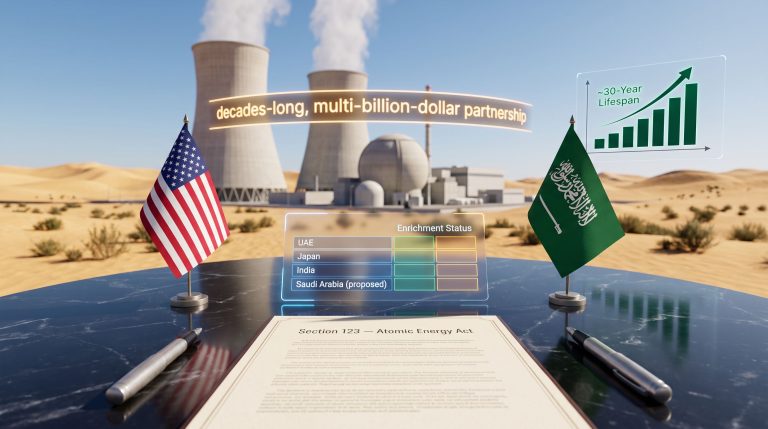
The US enacted a formal prohibition on Russian uranium product imports commencing August 2024, establishing a policy framework with limited waiver authority available through January 1, 2028. The Department of Energy has framed the policy horizon as extending through December 31, 2040, signalling that this is a deliberate, long-term structural market realignment rather than a short-term trade measure.
| Policy Milestone | Date |
|---|---|
| Russian uranium import ban enacted | August 2024 |
| Limited waiver authority expires | January 1, 2028 |
| DOE full ban policy horizon | December 31, 2040 |
The Russian uranium import ban creates simultaneous disruption and opportunity. Utilities must urgently diversify their procurement away from Russian suppliers, while domestic producers and enrichers gain a structurally protected window to rebuild capacity. The critical question is whether the investment cycle required to develop meaningful alternative supply can keep pace with the procurement urgency utilities now face.
Federal investment is moving to address this gap. The Department of Energy has committed $2.7 billion to support domestic Low-Enriched Uranium (LEU) and High-Assay Low-Enriched Uranium (HALEU) infrastructure development. In January 2026, DOE finalised a $900 million task order with Orano Federal Services to expand LEU production capacity within the US over a ten-year horizon. DOE has also designated six companies for enrichment-related development work, reflecting a deliberate effort to diversify the domestic enrichment base beyond a single operator.
The Centrifuge Problem: A Second-Order Risk Few Are Discussing
Beyond the well-documented Russian enrichment dependency lies a less widely understood but equally serious vulnerability: the centrifuge concentration risk embedded within the non-Russian enrichment sector itself.
European-owned enrichment companies, which supply the large majority of non-Russian enriched uranium to US reactors, source their centrifuge technology from a single European manufacturer. This creates a critical second-order supply chain risk: even the alternative to Russian enrichment is exposed to a manufacturing bottleneck that could constrain capacity expansion precisely when demand is accelerating most rapidly.
The practical implication of this concentration is significant. If centrifuge manufacturing capacity faces constraints during a period of rapid nuclear fleet expansion globally, enrichment delivery timelines could extend by years rather than months. This would compress the available window for utilities to secure adequate fuel contracts and could create spot market price spikes that dwarf the already substantial price increases observed since 2022.
Rebuilding a domestic centrifuge manufacturing capability is therefore not merely an enrichment issue. It is a supply chain resilience issue that operates one level below the enrichment capacity discussion and receives far less policy and investment attention than it warrants. Current efforts to scale centrifuge manufacturing using an exclusively domestic supply chain represent a critical but long-horizon undertaking.
HALEU: The Advanced Reactor Constraint That Policy Cannot Easily Solve
While LEU supply challenges receive substantial attention in nuclear fuel policy discussions, the HALEU constraint may ultimately prove the more consequential bottleneck for the long-term trajectory of the US nuclear fuel supply chain.
High-Assay Low-Enriched Uranium refers to uranium enriched to between 5% and 20% U-235 concentration, compared to the approximately 3 to 5% enrichment level used in conventional light-water reactors. Most next-generation reactor designs, including the majority of small modular reactor (SMR) concepts currently in development, require HALEU rather than standard LEU fuel.
This matters considerably because the entire advanced nuclear deployment agenda, including the ambitious presidential target of quadrupling US nuclear capacity to approximately 400 GW by 2050, is premised on these advanced reactor technologies.
The problem is stark: Russia currently operates the only commercial-scale HALEU production facility in the world. No credible non-Russian commercial HALEU supply chain yet exists. This creates a hard physical constraint on advanced nuclear timelines that policy ambition and capital investment cannot resolve quickly.
The gap between where HALEU supply stands today and where it needs to be to support even a modest advanced reactor buildout represents one of the most underappreciated risks in energy infrastructure planning. Pre-commercial HALEU development programmes exist within the US, but the pathway from pre-commercial demonstration to commercial-scale production is measured in decades, not years.
The next major ASX story will hit our subscribers first
Mapping the Full Spectrum of Supply Chain Vulnerabilities
A comprehensive assessment of the US nuclear fuel supply chain reveals pressure points at every stage, not just enrichment. Furthermore, understanding these uranium supply challenges in their entirety is essential for shaping effective policy responses.
Upstream vulnerabilities include:
- Uranium mining in the US has declined to near-negligible levels relative to national consumption, with decades of low prices and limited investment leaving the domestic mining sector structurally weakened
- Conversion capacity, the intermediate processing step that transforms uranium concentrate into enrichment-ready uranium hexafluoride (UF₆), is similarly constrained, with limited domestic facilities capable of handling national-scale throughput
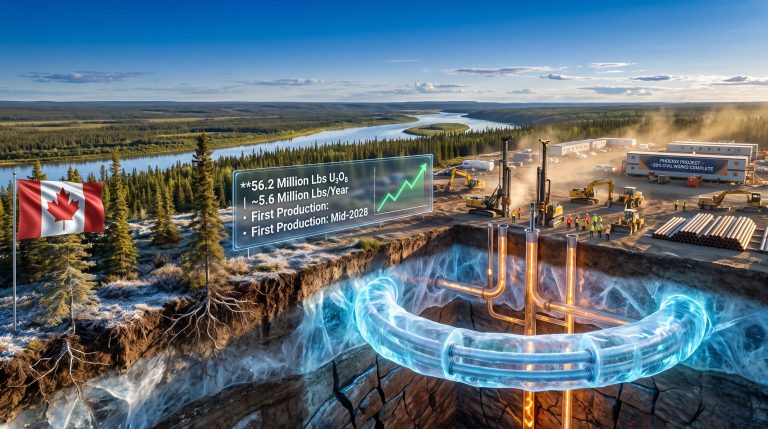
- Canada and Kazakhstan currently supply the overwhelming majority of the uranium concentrate that US reactors actually consume, creating a geographic concentration of upstream supply that, while currently stable, introduces its own dependency risks
Midstream vulnerabilities include:
- A single US-based commercial enrichment operator representing the entirety of domestic enrichment capability
- European enrichment alternatives exposed to single-manufacturer centrifuge dependency
- No commercial-scale HALEU production capability outside Russia
Downstream vulnerabilities include:
- Fuel fabrication capacity that is moderate but relies on import-dependent inputs
- A US spent fuel reprocessing capability that is largely inactive, forgoing the fuel cycle extension and waste reduction benefits that France and other nations derive from commercial reprocessing programmes
Three Scenarios for Supply Chain Reconstruction
Given the structural depth of these vulnerabilities, analysts and policymakers face a genuine range of outcomes depending on the pace and coherence of the investment response.
Scenario 1: Incremental Domestic Expansion (Base Case)
Federal investment supports gradual enrichment capacity growth through existing operators and DOE-designated partners. The Russian import ban drives utility procurement diversification toward European and Canadian sources. Meaningful domestic enrichment self-sufficiency remains approximately 10 to 15 years away. This pace carries the risk of being insufficient to support aggressive nuclear expansion targets, particularly for advanced reactor fuel.
Scenario 2: Accelerated Industrial Policy (Optimistic Case)
Congress sustains multi-decade funding across the full fuel cycle, including mining incentives, conversion plant construction, and domestic centrifuge manufacturing scale-up. Coordinated allied engagement with Canada, Australia, France, and the UK creates a diversified non-Russian enrichment ecosystem. Material supply chain resilience could be achievable within 7 to 10 years. Capital intensity, permitting timelines, and workforce development remain execution constraints.
Scenario 3: Stagnation and Continued Import Reliance (Downside Case)
Policy momentum stalls, private capital remains hesitant without long-term offtake guarantees, and domestic capacity growth consistently lags demand. Advanced reactor deployment is constrained by HALEU unavailability. Domestic supply chain adequacy remains 15 to 20 or more years away. Prolonged geopolitical exposure and consumer price volatility characterise this outcome.
Disclaimer: Scenario projections represent analytical frameworks based on current policy trajectories and investment trends. They are not forecasts and should not be relied upon as predictions of specific market or policy outcomes.
The Allied Dimension: Why No Single Nation Can Solve This Alone
No single allied nation currently possesses full-spectrum enrichment capacity capable of replacing Russian supply at scale. The most credible pathway to building a resilient non-Russian enrichment ecosystem therefore requires coordinated action across multiple jurisdictions.
Australia holds approximately 28% of the world's known uranium reserves, positioning it as a critical upstream partner in any allied fuel cycle strategy, though it currently lacks domestic enrichment infrastructure. Canada is a major uranium producer and conversion capacity holder. France operates the world's most advanced commercial spent fuel reprocessing programme and holds significant enrichment expertise through the Orano group.
A coordinated framework across these partners, alongside sustained US domestic investment, represents the most realistic architecture for genuine supply chain resilience. The economic opportunity embedded in this reconstruction extends beyond energy security: a rebuilt domestic nuclear fuel industrial base would generate long-term skilled employment, reduce consumer exposure to geopolitical price shocks, and position the US as a credible nuclear fuel supplier to allied nations expanding their own fleets.
Comparative Cost Exposure Across Generation Sources
Understanding the nuclear fuel supply chain challenge also requires situating it within the broader generation cost landscape.
| Generation Source | Fuel Cost Volatility | Geopolitical Exposure | Domestic Supply Control |
|---|---|---|---|
| Nuclear (current state) | Moderate and rising | High, enrichment dependency | Low |
| Natural Gas | High | Moderate | Moderate to High |
| Coal | Moderate | Low to Moderate | High |
| Solar and Wind | None, fuel-free | Low, equipment supply chain | Variable |
| Nuclear (post-rebuild scenario) | Low | Low | High |
The table highlights a counterintuitive reality: nuclear power, often cited as a stable baseload source insulated from fuel price volatility, currently carries substantial geopolitical exposure due to enrichment dependency. A successfully rebuilt domestic fuel cycle would invert this profile entirely, delivering the low fuel cost volatility and high domestic control that nuclear's physical characteristics inherently support.
Investment and Infrastructure Priorities: A Forward-Looking Framework
| Priority Area | Current Status | Investment Horizon | Strategic Importance |
|---|---|---|---|
| Domestic Uranium Mining | Near-negligible | 5 to 10 years | High |
| Conversion Capacity (UF₆) | Limited | 5 to 8 years | High |
| LEU Enrichment Expansion | Early-stage growth | 7 to 12 years | Critical |
| HALEU Production Infrastructure | Pre-commercial | 8 to 15 years | Critical |
| Centrifuge Manufacturing (Domestic) | Early-stage | 5 to 10 years | High |
| Fuel Fabrication Capacity | Moderate | 3 to 7 years | Medium to High |
| Spent Fuel Reprocessing | Inactive | 15 to 25 years | Medium |
In addition, the broader uranium market dynamics shaping these investment timelines suggest that early movers in enrichment and conversion infrastructure will enjoy significant competitive and strategic advantages in the years ahead.
Frequently Asked Questions: US Nuclear Fuel Supply Chain
Why does the US import nearly all of its uranium concentrate?
Domestic uranium mining became economically uncompetitive over several decades as global uranium prices declined and foreign state-owned producers supplied enriched uranium at lower costs. The result is a near-complete dependence on imported uranium concentrate, with domestic production accounting for less than 1% of national consumption in recent years, according to EIA data. However, the US uranium production rebound now underway signals that policy and price incentives are beginning to reverse this long-term trend.
What is HALEU and why does it matter for advanced reactors?
High-Assay Low-Enriched Uranium is uranium enriched to between 5% and 20% U-235 concentration. Most next-generation reactor designs, including many SMR concepts, require HALEU rather than the standard lower-enriched fuel used in conventional light-water reactors. The absence of a commercial-scale non-Russian HALEU supply chain is currently one of the most significant physical constraints on advanced nuclear deployment timelines globally.
When do Russian uranium import restrictions take full effect?
The ban on Russian uranium imports commenced in August 2024, with limited waiver provisions available through January 1, 2028. The DOE has framed the full policy horizon as extending through 2040, establishing a long-term structural incentive for domestic and allied enrichment capacity development.
How significantly have uranium enrichment prices changed since 2022?
Uranium enrichment prices have approximately tripled since early 2022, reflecting market anticipation of Russian supply disruption, geopolitical risk repricing, and tightening global enrichment capacity. Furthermore, additional price pressure is broadly expected as the 2028 waiver expiration approaches and demand from both existing and new reactor projects continues to grow.
Can the US realistically achieve nuclear fuel self-sufficiency?
Full self-sufficiency across all fuel cycle stages would require sustained multi-decade investment in uranium mining, conversion, enrichment, and fabrication infrastructure. While complete self-sufficiency may not be the optimal policy objective, allied supply diversification combined with meaningful domestic enrichment capability would deliver comparable security benefits. Rebuilding enrichment capacity is broadly identified as the foundational priority, with HALEU production representing the most acute longer-term challenge.
The Strategic Imperative: Key Takeaways
Summary of critical findings:
- US uranium concentrate import dependency stands at approximately 99%, with domestic production below 1% of national consumption
- Russian suppliers have historically provided 20 to 25% of US enriched uranium, with Russia controlling roughly 44 to 46% of global enrichment capacity
- Enrichment prices have nearly tripled since 2022, with further escalation anticipated ahead of the 2028 waiver expiration
- The Russian import ban creates a structural market realignment extending to 2040
- Federal investment of $2.7 billion targets domestic LEU and HALEU infrastructure, including a $900 million Orano task order as the largest single enrichment commitment to date
- Presidential targets of 400 GW nuclear capacity by 2050 require proportional fuel cycle expansion that current domestic infrastructure cannot support
- HALEU supply remains the most acute constraint on advanced reactor commercialisation
- A single European centrifuge manufacturer supplying non-Russian enrichers represents a critical and underappreciated second-order vulnerability
Rebuilding the US nuclear fuel supply chain is not achievable by any single company, government agency, or allied nation acting independently. It requires coordinated action across uranium mining jurisdictions, conversion facility operators, enrichment technology developers, centrifuge manufacturers, fuel fabricators, and regulatory bodies across multiple countries. Consequently, the cost of inaction, measured in geopolitical exposure, consumer price volatility, and constrained clean energy options, grows with each year that the underlying structural vulnerabilities remain unaddressed.
Want to Track ASX Uranium Discoveries Before the Market Moves?
As the global nuclear fuel supply chain undergoes a structural realignment — driven by Russian import restrictions, surging enrichment prices, and aggressive capacity expansion targets — early identification of significant uranium discoveries on the ASX has never been more strategically valuable. Discovery Alert's proprietary Discovery IQ model delivers real-time alerts on significant ASX mineral discoveries, including uranium, turning complex exploration data into actionable investment insights — explore historic discovery returns on the dedicated discoveries page or begin your 14-day free trial today to position yourself ahead of the market.