June 9, 2026
The Strategic Vulnerability Hiding in Plain Sight: America's Uranium Enrichment Gap
For decades, the civilian nuclear fuel cycle has operated as an invisible infrastructure layer beneath America's electricity grid. Reactors generate roughly 20% of U.S. electricity and an even larger share of its carbon-free baseload power, yet the enriched uranium feeding those reactors has depended heavily on foreign suppliers, including, remarkably, Russia. That structural dependency has quietly persisted through geopolitical crises, sanctions regimes, and energy security debates, largely because rebuilding domestic enrichment capacity is extraordinarily capital-intensive, technically demanding, and subject to complex multi-year regulatory processes.
That calculus is now shifting. The Orano Project IKE accelerated NRC review, formally accepted in May 2026, signals something more significant than a single licensing event. It reflects the convergence of regulatory reform, energy security urgency, and proven technology in a way that could fundamentally reshape the domestic uranium enrichment landscape.
When big ASX news breaks, our subscribers know first
Understanding the Enrichment Gap: Why This Moment Matters
Uranium enrichment is a step most people never think about, yet it sits at the absolute centre of the nuclear fuel cycle. Natural uranium contains only about 0.7% of the fissile isotope uranium-235. To power a conventional light-water reactor, that concentration must be increased to roughly 3-5%, a process called enrichment. The dominant commercial method today is gas centrifuge technology, which spins uranium hexafluoride gas at extremely high speeds to separate isotopes by mass.
The United States currently has only one operating commercial enrichment facility: the Urenco USA plant in Eunice, New Mexico. That single facility is insufficient to meet the full enrichment needs of the U.S. reactor fleet. The gap is filled substantially by imports, and historically, Russia's state enrichment enterprise TENEX has been a major supplier of enriched uranium to American utilities — a dependency that became politically untenable following Russia's 2022 invasion of Ukraine.
Legislative action followed, including the Prohibiting Russian Uranium Imports Act, which created a framework to phase out Russian nuclear fuel purchases. However, understanding the broader ban on Russian uranium and its implications reveals that legislation creates demand for alternatives, not alternatives themselves. Building a commercial-scale enrichment facility capable of filling that gap requires years of planning, billions in capital, and a successful path through one of the world's most rigorous licensing regimes.
The enrichment output projected for Project IKE alone is estimated to be sufficient to fully replace the volume of enriched uranium the United States currently imports from Russia, making this a single infrastructure investment with outsized strategic implications.
Project IKE: Oak Ridge, Tennessee and a $5 Billion Commitment
What Is Being Built and By Whom
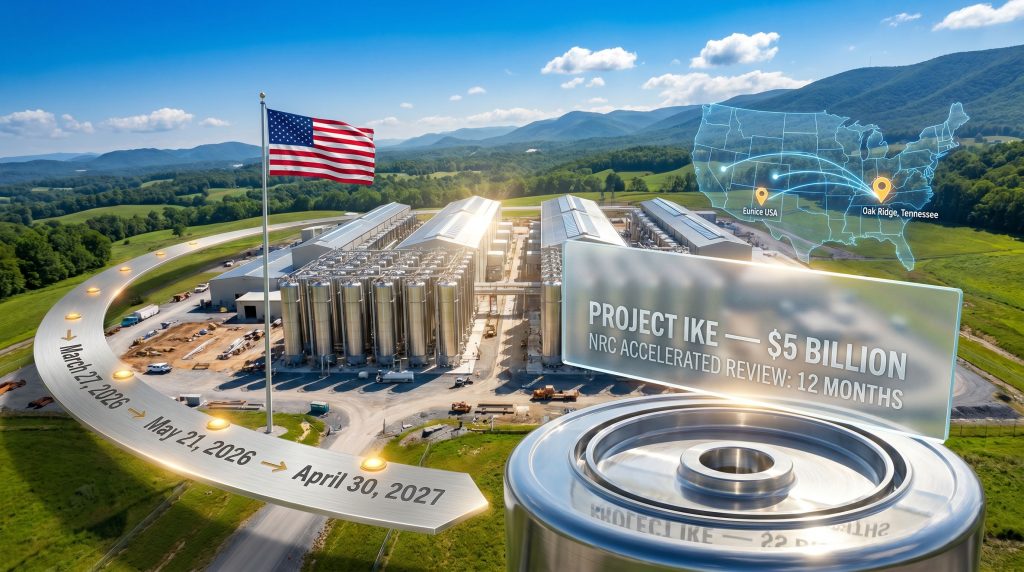
Orano Enrichment USA, the American subsidiary of French nuclear fuel cycle company Orano, is developing Project IKE as a large-scale gas centrifuge uranium enrichment plant in Oak Ridge, Tennessee. The facility carries a capital cost estimate of approximately $5 billion, placing it among the most significant industrial investments in Tennessee's modern economic history.
The choice of gas centrifuge technology is deliberate and rooted in demonstrated commercial performance. Centrifuge enrichment consumes far less electricity than the older gaseous diffusion method it replaced, making it both economically and environmentally superior at scale. The specific centrifuge design comes from Enrichment Technology Company (ETC), a joint venture between Orano and Urenco, two of the world's leading enrichment operators.
Why Oak Ridge Is Not an Arbitrary Choice
The site selection carries historical resonance that extends well beyond logistics. Oak Ridge was one of the three primary sites of the Manhattan Project, the wartime programme that first developed industrial-scale uranium processing in the United States. The Project IKE facility would occupy unused former Manhattan Project land, placing 21st-century centrifuge enrichment infrastructure on ground that was once home to electromagnetic isotope separation plants built in the 1940s.
Beyond symbolism, the Oak Ridge region offers tangible practical advantages:
- A deeply experienced nuclear industry workforce with generational familiarity with fuel cycle operations
- Proximity to established nuclear supply chain networks across East Tennessee
- Infrastructure and utility access suited to large-scale industrial development
- Institutional knowledge within the regional regulatory and permitting environment
The economic footprint projected for Project IKE includes more than 1,000 construction-phase jobs and approximately 300 permanent career positions, with further downstream effects expected throughout the East Tennessee industrial corridor.
The NRC Accelerated Review: How It Works and What It Means
From Submission to Acceptance: The Timeline So Far
The regulatory journey for Project IKE has followed a deliberate two-stage submission strategy. Orano filed its Environmental Report with the NRC in January 2026, establishing the environmental assessment foundation required under federal law. Furthermore, the full licence application followed on March 27, 2026, containing the detailed safety and engineering documentation required for a construction and operating licence decision.
The NRC formally accepted the application for review on May 21, 2026, committing to complete its technical assessment within 12 months, with a target completion date of April 30, 2027.
| Milestone | Date |
|---|---|
| Environmental Report submitted | January 2026 |
| Technical licence application submitted | March 27, 2026 |
| NRC formal acceptance of application | May 21, 2026 |
| Accelerated technical review begins | May 2026 |
| Estimated NRC review completion | April 30, 2027 |
| Construction licence decision (if review successful) | Mid-2027 (estimated) |
What the Technical Package Actually Contains
The technical submission is not a simple document. It encompasses a comprehensive suite of safety analyses required under NRC regulations for fuel cycle facilities, including:
- Integrated Safety Analysis covering hazard identification and risk characterisation
- Criticality safety evaluations assessing the risk of unintended nuclear chain reactions
- Chemical and fire safety assessments for uranium hexafluoride handling
- Process safety information documenting engineering controls and containment systems
- Security and safeguards materials addressing physical protection and nuclear material accounting
A 12-month review of this material is ambitious. Standard NRC timelines for complex fuel cycle facilities have historically run 24 to 36 months or longer. The compressed schedule reflects both the influence of the Eagle Rock precedent and the institutional changes now underway at the NRC.
Executive Order 14300 and the Regulatory Culture Shift
The accelerated timeline is directly linked to Executive Order 14300, signed by President Donald Trump, which directed the NRC to overhaul its licensing processes with greater emphasis on efficiency and commercial responsiveness. NRC Chairman Ho Nieh has described the agency's approach as delivering credible, predictable, and timely safety reviews as the mechanism through which the NRC supports American leadership in nuclear energy.
This represents a measurable shift in institutional culture. The NRC has historically been characterised by thoroughness over speed — a posture appropriate for a safety regulator but increasingly seen as misaligned with the urgency of domestic nuclear energy expansion. The Orano Project IKE accelerated NRC review is, in part, a test of whether that cultural change is operationally real.
The Eagle Rock Precedent: A Strategic Licensing Shortcut
One of the least-discussed but most consequential aspects of the Project IKE licensing strategy is its use of a prior approved facility as a regulatory reference point. The Eagle Rock Enrichment Facility, originally planned for Idaho Falls, Idaho, by Areva (Orano's predecessor), received an NRC construction and operating licence in 2011. The licence was voluntarily surrendered by the company in 2018 due to changed market conditions, not due to any safety finding.
Orano has committed to providing the NRC with a detailed crosswalk document formally comparing Project IKE's design, safety case, and operational parameters to the Eagle Rock application. The NRC has explicitly stated it will rely on the similarities between the two facilities to support scheduling efficiencies, whilst simultaneously confirming that a complete regulatory review will still be conducted.
The NRC has been clear that the accelerated schedule does not represent a reduction in review rigour. Every safety evaluation step will be completed. The efficiency gains derive entirely from established precedent and design similarity, not from bypassing any regulatory requirement.
This crosswalk strategy is a recognised and legitimate mechanism in nuclear licensing. It allows regulators to build on documented prior safety analyses rather than starting from first principles, provided the design similarities are genuine and substantiated. The risk is that material differences between the two facilities require fresh analysis that cannot be resolved quickly, potentially slipping the April 2027 target.
The Technology Foundation: ETC Centrifuges and Georges Besse 2
The centrifuge technology underpinning Project IKE is not theoretical or developmental. ETC's centrifuge design has been operating commercially at Orano's Georges Besse 2 facility in France for more than 15 years, providing an extensive operational data record covering performance, reliability, and safety behaviour under real-world commercial conditions.
That operational history does something important for the licensing process: it converts hypothetical safety assumptions into empirically supported claims. When Orano's licence application describes centrifuge performance characteristics, containment behaviour, or failure mode probabilities, those claims are backed by over a decade of continuous commercial operation rather than engineering models alone.
The Georges Besse 2 expansion is also currently undergoing a 30% capacity increase, and Orano has indicated that construction learnings from that expansion programme are being directly incorporated into Project IKE's planning and design. This parallel construction experience at a live facility provides a form of risk mitigation that purely greenfield projects lack.
The next major ASX story will hit our subscribers first
Key Risks That Could Affect the Project IKE Timeline
Regulatory and Review Risks
The 12-month review commitment is conditional, not unconditional. The NRC's acceptance documents make clear that the accelerated schedule assumes Orano provides timely and high-quality responses to any technical questions or requests for additional information. Scenarios that could extend the timeline include:
- Novel safety questions that fall outside the Eagle Rock precedent and require original analysis
- Inadequate or delayed applicant responses to NRC information requests
- NRC resource constraints or staffing limitations affecting review capacity
- Scope changes to the facility design that invalidate crosswalk comparisons
Construction and Capital Execution Risks
Licence approval is a prerequisite for construction, not the end of the challenge. A $5 billion construction programme in the current inflationary environment carries material cost escalation risk. Centrifuge manufacturing involves precision engineering and specialised supply chains through ETC that could become bottlenecked at scale. The gap between licence issuance and first enrichment operations is likely to span several years even under optimistic assumptions.
Market and Policy Risks
The commercial viability of Project IKE depends on long-term utility contracting behaviour and uranium market dynamics. Separative work units (SWUs), the standard measure of enrichment services, are priced on long-term contracts, and utilities must commit to purchase agreements years in advance to justify the capital investment. Policy continuity risk also exists: if the executive order framework driving NRC reform is modified, the regulatory momentum currently supporting the accelerated review could weaken.
What Project IKE Signals for the Broader Nuclear Fuel Cycle
The significance of the Orano Project IKE accelerated NRC review extends beyond a single facility. It is an indicator of whether the United States can credibly rebuild a full domestic nuclear fuel cycle — from conversion through enrichment to fabrication — in a timeframe relevant to its energy security needs.
The allied-nation context matters here. The UK, France, and other nuclear-capable partners are simultaneously investing in domestic enrichment and fuel cycle capacity. The geopolitical logic is consistent across jurisdictions: dependence on any single foreign supplier for a critical energy input is a vulnerability that energy security policy must address. Project IKE is the American expression of that logic, applied at commercial scale.
In addition, US uranium production is simultaneously reaching a six-year high, reinforcing the broader narrative of domestic fuel cycle resurgence. Consequently, the MOU Orano signed with a construction trade union ahead of licence approval signals genuine confidence in the regulatory timeline and readiness to mobilise construction resources rapidly once approval is secured. It is the kind of pre-positioning that companies undertake when they believe a regulatory outcome is likely, not merely possible.
Projects such as the Alta Mesa uranium project further illustrate how the entire upstream and downstream fuel cycle is being reinvigorated in parallel. Furthermore, the NRC's formal acceptance documents confirm that if the review is completed on schedule by April 2027, it will represent more than a milestone for a single project. It will demonstrate that U.S. nuclear licensing can operate at a pace compatible with commercial investment cycles — a proof of concept with implications for every other proposed fuel cycle facility currently in the development pipeline.
Disclaimer: This article is intended for informational purposes only and does not constitute financial or investment advice. Statements regarding project timelines, costs, and outputs are based on publicly available information and company disclosures. Forecasts and projections involve inherent uncertainty and actual outcomes may differ materially from those described. Readers should conduct their own due diligence before making any investment decisions.
Want to Stay Ahead of the Next Major Uranium Discovery on the ASX?
Discovery Alert's proprietary Discovery IQ model delivers real-time alerts on significant ASX mineral discoveries — including uranium — instantly translating complex data into actionable opportunities for traders and investors alike. Explore how historic mineral discoveries have generated substantial returns on Discovery Alert's dedicated discoveries page, and begin your 14-day free trial today to position yourself ahead of the market.