August 22, 2026
The Hidden Architecture of Oil Market Stability in a Conflict-Ridden World
Global energy markets have always been subject to geopolitical shocks, but the way those shocks are absorbed has changed dramatically over the past decade. In previous eras, a conflict threatening the Strait of Hormuz would have triggered weeks of sustained price escalation, emergency supply meetings, and widespread procurement panic. Today, something different is happening. A new layer of political risk management has emerged, and understanding how Indian refiners Trump put oil flowing through volatile supply chains requires examining this architecture carefully.
When big ASX news breaks, our subscribers know first
What the "Trump Put" Actually Means for Oil Markets
The phrase "Trump put" borrows deliberately from options market terminology. In financial markets, a "put" is a form of protection against downside risk. The so-called "Fed put" described the market's belief that the U.S. Federal Reserve would intervene to cushion severe market drawdowns. The Trump put applies the same logic to crude oil prices, encoding a market-wide belief that the current U.S. administration will act to prevent oil prices from rising to economically or politically damaging levels.
This belief is not simply speculative. It is grounded in observable behaviour. When Middle Eastern supply routes came under pressure in recent months and Brent crude threatened to breach $100 per barrel, the U.S. Treasury under Secretary Scott Bessent issued a limited, time-bound exemption permitting Indian refiners to continue accepting Russian crude shipments already at sea.
That 30-day window, running from March 5 to April 4, 2026, functioned as an emergency supply valve, demonstrating that sanctions architecture can be selectively relaxed when energy price stability is prioritised. Furthermore, the Russian oil sanctions landscape has proven far more flexible than many analysts initially anticipated.
The core principle at work is not that geopolitical pressure disappears, but that the administration has demonstrated a willingness to route supply around disruptions rather than allow prices to spiral unchecked ahead of politically sensitive domestic events.
The upcoming U.S. midterm elections create a structural ceiling on how much oil price pain the administration is likely to tolerate. Energy costs are one of the most directly felt economic variables for American households, and sustained crude price spikes have historically translated into negative electoral outcomes for the incumbent administration.
Brent Crude's Price Arc: From $72 to $84 and the Reasons It Stopped There
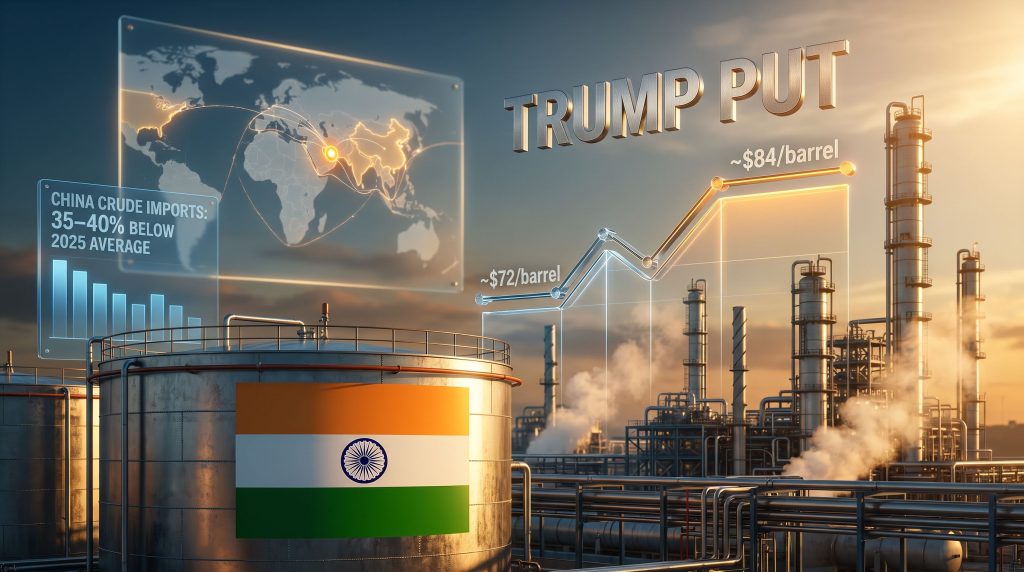
The resumption of U.S.-Iran hostilities in mid-2026 delivered a sharp and immediate jolt to global crude benchmarks. Crude oil price trends show that Brent climbed from approximately $72 per barrel to $84 per barrel in a compressed timeframe, a move of nearly 17% that reflected genuine supply risk. Yet despite continued attacks and ongoing disruptions to shipping through the Strait of Hormuz, prices stabilised near that $84 level rather than continuing their upward trajectory.
This stabilisation is not simply the market shrugging off geopolitical risk. It reflects a pricing-in of the Trump put itself: the market is assigning meaningful probability to administrative intervention that would prevent a sustained price breakout.
| Price Event | Brent Crude Level | Primary Driver |
|---|---|---|
| Pre-conflict baseline | ~$72/barrel | Subdued global demand, ample supply |
| Post-hostilities spike | ~$84/barrel | U.S.-Iran conflict resumption |
| Stabilisation level | ~$84/barrel | Market pricing in intervention probability |
| Tail risk scenario | $95-$100+/barrel | Chinese demand recovery + Hormuz disruption |
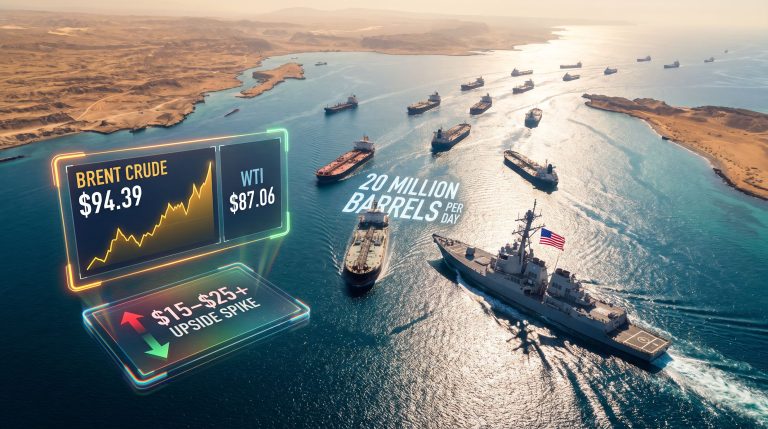
The Strait of Hormuz is not a peripheral concern in this analysis. Approximately 20% of globally traded oil transits through this narrow waterway, making it one of the most consequential geographic chokepoints in the world. Even partial disruptions to passage through the Strait have historically generated significant supply risk premiums in crude pricing.
India's Three-Pillar Supply Resilience Framework
Indian refiners are not relying on the Trump put alone. Their operational confidence rests on a combination of structural factors that provide genuine short-term insulation even if political intervention is delayed or absent.
1. Elevated Domestic Inventory Buffers
During the period of lower global crude prices earlier in 2026, Indian state refiners aggressively built domestic inventory positions. These above-average buffer stocks provide a meaningful runway before any external supply disruption translates into operational shortfalls.
2. Diversified Long-Term Supply Contracts
Indian refiners hold contracted supply agreements with producers across the Americas and Africa, reducing their dependence on any single regional corridor. This geographic diversification of supply sourcing means that disruptions concentrated in the Gulf region do not immediately cascade into procurement crises.
3. Redirected Russian Crude Volumes
Ukrainian strikes on Russian refinery infrastructure have created an unintended benefit for Indian buyers. Domestic Russian refinery outages have reduced internal consumption of crude, redirecting those volumes toward export markets. This has consequently increased the availability of competitively priced Russian crude accessible to Indian state refiners, even as diplomatic pressure from Washington has fluctuated.
It is worth noting that Indian state-owned refiners maintained their access to Russian crude throughout periods of elevated U.S. diplomatic pressure through third-party intermediary trading structures. This operational flexibility, refined over several years of navigating sanctions complexity, now underpins the procurement confidence that refinery executives are expressing publicly.
The China Variable: The Most Consequential Unknown in the Supply Equation
If there is one factor capable of rapidly dismantling India's comfortable supply position, it is a sharp recovery in Chinese crude demand. This is the variable that Indian refining executives are watching most closely, and with good reason.
China's crude oil imports fell for a fourth consecutive month in June 2026, with arrivals running 35 to 40 percent below the 2025 average. This sustained demand suppression has been a critical, if underappreciated, stabilising force in global oil markets. It has kept supply relatively loose, pricing competitive, and procurement conditions favourable for Asian buyers including India.
| Period | China Import Trend | Market Implication |
|---|---|---|
| March to June 2026 | Four consecutive monthly declines | Loose global supply, lower price pressure |
| Early July 2026 | Fuel export restrictions lifted | Higher refinery runs expected |
| Q3 2026 outlook | Potential demand rebound | Risk of global supply tightening |
| Estimated deviation | 35-40% below 2025 average | Key demand suppressor through H1 2026 |
The mechanics of this shift are important to understand. China lifted its fuel export restrictions in early July 2026 following the U.S.-Iran interim agreement reached in June. The removal of export restrictions is expected to incentivise Chinese refiners to increase throughput, which would in turn require higher crude import volumes. This sequential logic means that a demand recovery is not speculative — it is structurally implied by policy changes already in motion.
If Chinese crude buying rebounds sharply during Q3 2026 while Hormuz disruptions persist and Trump intervention is slower than markets expect, the conditions for a move toward $95 to $100 per barrel would be substantially in place.
How Trump Could Intervene If Prices Spiral
Market participants are not operating on vague hope. They are identifying specific mechanisms through which the administration could act to contain a price breakout. The toolkit includes several distinct levers:
-
Operational de-escalation: Pausing or scaling back military activity in the region, citing completed mission objectives, which would reduce the geopolitical risk premium embedded in crude pricing almost immediately.
-
Diplomatic signalling: Announcing progress toward a more durable Iran agreement, even without a concluded deal, would communicate reduced long-term supply risk and cool speculative positioning in oil futures markets.
-
Expanded sanctions relief: Broadening existing waiver mechanisms to increase physical supply volumes from previously restricted producers, directly addressing the fundamental supply side of the price equation.
A critical and often underappreciated insight here is that signalling de-escalation can be nearly as effective as actual supply increases. Oil futures markets are forward-looking, and a credible signal that supply conditions will improve in the near term can suppress the risk premium embedded in current prices without requiring any immediate physical change in supply flows.
The next major ASX story will hit our subscribers first
Scenario Analysis: Three Possible Pathways From Here
Scenario 1: Managed Stability (Base Case)
The administration deploys one or more of the levers above in response to price pressure. Chinese demand recovery is gradual rather than abrupt. Hormuz disruptions remain contained to partial interference rather than full closure. Under these conditions, Brent likely trades in a $80 to $90 per barrel range, Indian refiners maintain workable margins, and the Trump put functions as advertised.
Scenario 2: Demand-Led Tightening (Elevated Risk)
China's import volumes rebound sharply during Q3 2026 as refinery runs increase following the removal of fuel export restrictions. Hormuz disruptions persist at current levels. U.S. intervention materialises but arrives later than markets had priced. In this scenario, Brent tests the $95 to $100 per barrel range, Indian refiners face margin compression, and procurement costs rise meaningfully.
Scenario 3: Escalation Breakdown (Tail Risk)
The U.S.-Iran conflict intensifies beyond its current scope. Hormuz shipping becomes severely restricted. The administration's political calculus shifts away from economic stabilisation toward strategic objectives. In this tail risk scenario, Brent exceeds $100 per barrel, emergency waiver mechanisms are activated under crisis conditions, and global supply chain stress becomes widespread.
What Could Break the Trump Put Assumption
Any analytical framework built around policy intervention carries an inherent fragility: it assumes the intervening actor maintains both the willingness and the ability to act consistently. Several conditions could erode the Trump put's effectiveness.
-
Geopolitical objectives overriding economic ones: If the administration determines that sustained pressure on Iran or Russia serves strategic goals that outweigh the domestic cost of higher energy prices, the incentive to intervene weakens materially.
-
A prolonged Hormuz closure: Sanctions waivers and supply route adjustments have limits. If the Strait of Hormuz is severely disrupted for an extended period, no amount of political signalling can substitute for the physical loss of 20% of global oil supply transiting through a single chokepoint.
-
Market complacency amplifying the shock: The very stability that the Trump put has created may be encouraging insufficient hedging among Indian refiners. If the intervention fails or is delayed, markets priced for managed stability would face a sharp and disorderly repricing.
However, broader trade dynamics also complicate this picture. The US-China trade war has introduced additional layers of uncertainty into energy demand forecasting, while the wider trade war economic impact on global growth continues to suppress oil consumption projections across multiple regions.
| Risk Factor | Probability | Potential Price Impact |
|---|---|---|
| China demand recovery without intervention | Moderate-High | +$10 to $15/barrel |
| Prolonged Hormuz disruption | Low-Moderate | +$20 to $30/barrel |
| U.S. policy pivot away from supply stabilisation | Low | +$15 to $25/barrel |
| Full escalation scenario | Very Low | +$30 to $50/barrel |
Note: Price impact estimates are analytical projections based on historical supply shock precedents and current market conditions. They are not investment forecasts and should not be relied upon for financial decision-making.
The Deeper Strategic Problem India Needs to Confront
The current situation illuminates a structural vulnerability in India's energy security architecture that comfortable inventory levels and short-term waivers cannot resolve. India's refining sector is operationally sophisticated and has demonstrated remarkable adaptability in navigating a complex global sanctions environment.
In addition, the role of OPEC market influence continues to shape the broader supply backdrop within which Indian procurement decisions are made. That adaptability, however, has been exercised largely within a framework of dependency — first on Gulf producers, then on Russian crude, and now on the continued willingness of a U.S. administration to keep alternative supply routes open.
True energy security is not the same as supply continuity under favourable political conditions. It requires diversification deep enough to absorb supply shocks without relying on the intervention decisions of a foreign government. The Trump put, however effective in the current cycle, is not a strategic asset India controls. It is borrowed stability, contingent on another actor's domestic political calculus remaining aligned with India's supply needs.
The longer India's refining sector operates in comfort built on this borrowed stability, the greater the risk that the structural investment required for genuine supply independence is deferred. Accelerating long-term supply agreements with producers outside the political orbit of U.S. sanctions policy, deepening strategic petroleum reserves, and expanding refinery flexibility to process a wider range of crude grades are the kinds of measures that would reduce India's vulnerability to scenarios where the Trump put simply does not materialise.
Energy security built on another country's electoral calendar is not security. It is a temporary coincidence of interests that the next political cycle may not replicate.
For now, Indian refiners are watching Brent at $84, monitoring Chinese import data, and betting that the administration's domestic incentives remain aligned with their supply needs. That bet may well pay off in the near term. However, independent energy analysts at the Oxford Institute for Energy Studies have consistently cautioned that frameworks built on political intervention assumptions carry structural risks that only manifest when those interventions fail to arrive.
The conditions that make the Trump put credible today are neither permanent nor unconditional — and that is precisely why the analytical framework underpinning it deserves ongoing scrutiny.
This article contains forward-looking analysis, scenario projections, and market commentary. It is intended for informational purposes only and does not constitute financial or investment advice. Readers should conduct their own due diligence before making any investment or commercial decisions based on the information presented here.
Want Real-Time Alerts on the ASX Discoveries Driving Commodity Market Moves?
While geopolitical forces shape global oil dynamics, significant mineral discoveries on the ASX can generate equally compelling investment opportunities — and timing is everything. Discovery Alert's proprietary Discovery IQ model instantly identifies high-potential ASX mineral discoveries across more than 30 commodities, delivering actionable insights directly to subscribers before the broader market reacts. Explore historic discovery returns on Discovery Alert's dedicated discoveries page and begin a 14-day free trial to secure a genuine market-leading edge.