
August 6, 2026
The Race to Control Tomorrow's Most Strategic Metal
Few commodities sit at the intersection of industrial civilisation and military capability quite like tungsten. With a melting point higher than any other metal at 3,422 degrees Celsius, it is irreplaceable in applications ranging from armour-piercing ammunition to semiconductor interconnects. Unlike lithium or cobalt, which have attracted years of investor attention, tungsten has remained quietly essential, its supply chain vulnerabilities largely hidden from mainstream financial discourse. That silence is now breaking, and a major investment linked to the Trump family in Kazakhstan is forcing the conversation into the open.
The Trump sons tungsten project in Kazakhstan has emerged as one of the more consequential, and contested, critical mineral developments of 2025 and 2026. It combines geopolitical ambition, private capital from politically connected investors, and a deposit of extraordinary scale, raising questions that extend well beyond the mine site itself.
When big ASX news breaks, our subscribers know first
Why Tungsten Became the Quiet Crisis in Western Supply Chains
The Metal Nobody Talked About Until It Was Too Late
For decades, Western manufacturers accepted Chinese tungsten dominance as a commercial convenience rather than a strategic liability. China currently controls an estimated 80% or more of global tungsten processing capacity, according to data widely cited across industry and government sources. Its dominance extends from mine-mouth extraction through to the refined ammonium paratungstate and tungsten carbide powder stages that manufacturers actually purchase.
This processing concentration matters more than raw mine ownership. Even if tungsten ore were extracted elsewhere, refining it into usable industrial forms requires significant chemical infrastructure that Western supply chains have largely decommissioned over decades of cost optimisation. The result is a structural dependency that cannot be resolved quickly even with the best intentions. The strategic role of tungsten in modern economies has consequently become a focal point for policymakers across multiple Western governments.
Tungsten's criticality stems from a specific combination of properties that cannot be substituted:
- Its extreme melting point makes it essential in high-temperature aerospace and defence applications
- Its density and hardness make it the dominant material in cemented carbide cutting tools, which underpin global manufacturing productivity
- Its electrical resistance characteristics make it valuable in electronics, semiconductor deposition processes, and energy systems
- Its use in kinetic energy penetrators and armour systems gives it direct defence significance
The United States formally classifies tungsten as a critical mineral, a designation reflecting the combination of economic importance and supply chain risk. Furthermore, any significant disruption to Chinese tungsten exports, whether through trade policy, geopolitical escalation, or export controls, would create immediate downstream effects across defence contractors, toolmakers, and advanced electronics producers.
Kazakhstan's Positioning in the Critical Minerals Chess Game
Central Asia has re-emerged as a focus of Western mineral strategy precisely because it contains large, undeveloped deposits of multiple critical commodities while sitting geographically between competing great power interests. The broader critical minerals demand surge across Western nations has accelerated interest in exactly these kinds of underexplored jurisdictions.
Kazakhstan, in particular, possesses significant tungsten geology in its Karaganda region, a legacy of Soviet-era geological surveying that identified but never fully commercialised many of these resources. President Kassym-Jomart Tokayev has pursued a deliberate policy of attracting Western capital into Kazakhstan's resource sector, partly as a counterbalance to the country's historically close ties with both Russia and China. This creates a genuinely complex operating environment: Kazakhstan must balance economic partnerships with multiple powers while attempting to monetise its mineral wealth on favourable terms.
The Scale and Significance of the Kaz Resources Deposit
A Resource Number That Commands Attention
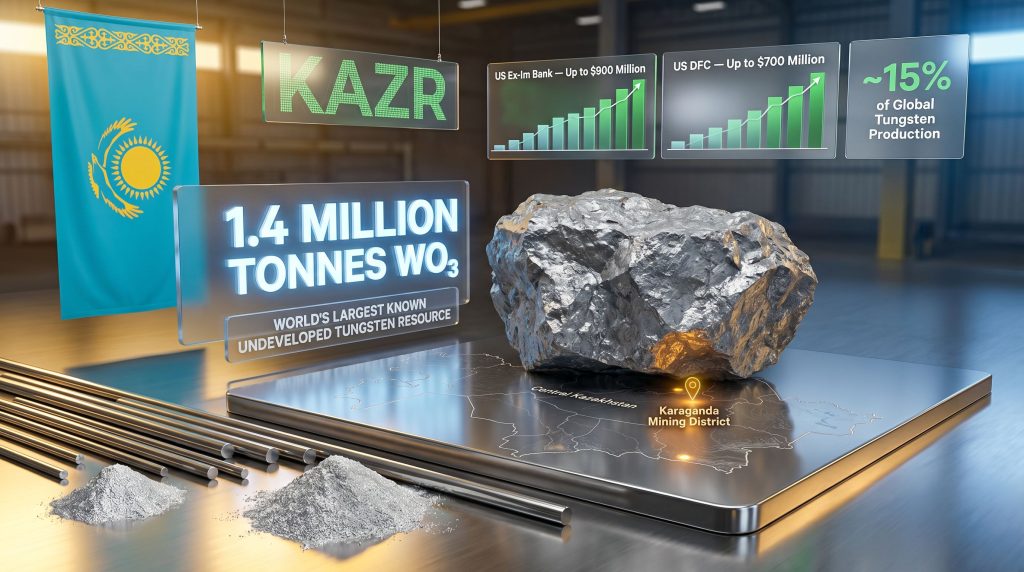
The Northern Katpar and Upper Kairakty deposits in Kazakhstan's Karaganda Mining District form the core asset of the newly created Kaz Resources entity. According to company-reported studies, the project holds a JORC-compliant mineral resource of 1.4 million tonnes of tungsten trioxide (WO₃), a figure that, if validated by independent assessment, would represent extraordinary scale for an undeveloped tungsten asset.
To contextualise this number:
| Metric | Detail |
|---|---|
| JORC Resource | 1.4 million tonnes WO₃ |
| Deposit Status | Undeveloped (greenfield) |
| Reported Global Comparison | Potentially exceeds 50% of China's stated WO₃ reserves per USGS reference data |
| Target Annual Output | ~12,000 tonnes |
| Global Production Share at Target | Approximately 15% of current global tungsten production |
| Location | Karaganda Mining District, Central Kazakhstan |
| Production Timeline | Approximately three years from 2025 project announcements |
Disclaimer: Resource estimates are drawn from company-reported studies. Independent verification by third-party qualified persons and formal JORC-compliant resource reports should be reviewed before drawing investment conclusions. The classification level of the resource (Measured, Indicated, or Inferred) and associated confidence intervals are material to assessing project risk.
What JORC Compliance Actually Signals
For investors unfamiliar with mining reporting standards, the JORC Code is the Joint Ore Reserves Committee framework developed in Australia and widely adopted as the international benchmark for transparent resource and reserve reporting. A JORC-compliant resource estimate requires:
- Assessment conducted by a Competent Person with relevant professional qualifications and experience
- Data collected, managed, and reported according to specified technical standards
- Classification into Measured, Indicated, or Inferred categories based on data density and geological confidence
- Public disclosure of the assumptions, methods, and limitations underpinning the estimate
JORC compliance is a baseline credibility threshold, not a guarantee of economic viability. Institutional investors typically look beyond the headline resource number to assess the classification breakdown, metallurgical recovery rates, cut-off grades used, and whether the estimate has been independently audited. None of these details are currently available from the source reporting on this project, and prospective investors should seek the full technical report before drawing conclusions.
Infrastructure Planning and Processing Complexity
The development plan reportedly includes two processing plants and a dedicated metallurgical facility within Kazakhstan. This is significant because tungsten processing is chemically complex, involving multiple stages from crushing and flotation concentration through to the production of ammonium paratungstate (APT), the primary tradeable intermediate form of refined tungsten.
Building this infrastructure within Kazakhstan rather than exporting raw ore represents a substantially higher capital commitment but also creates significantly more value within the host country, which likely factored into Kazakhstan's decision to award the project. Securing reliable tungsten offtake agreements with Western end-users will, however, be equally critical to the project's long-term commercial viability.
The Trump Family Investment: Structure, Timing, and Scrutiny
How the Investment Was Structured
According to reporting by the Financial Times, as cited by Reporte Minero, Donald Trump Jr. and Eric Trump utilised a special purpose vehicle to acquire stakes in Skyline Builders Group Holding Limited, which trades on Nasdaq under the ticker symbol SKBL. Skyline subsequently announced a merger with Cove Kaz Capital Group, the mining investment subsidiary of Cove Capital that holds the Kazakhstan project rights.
The merged entity creates Kaz Resources, planned to list on Nasdaq under the ticker KAZR, with the Trump family holding approximately 20% of the combined entity through their Skyline position. The investment was made in August 2025, preceding the formal public merger announcement.
The corporate layering is worth unpacking:
- Skyline Builders Group Holding Limited (SKBL): The Nasdaq-listed vehicle through which the Trump sons invested
- Cove Kaz Capital Group: The mining-focused subsidiary holding Kazakhstan project rights, which merges with Skyline
- Cove Capital: The broader US investment group that established Cove Kaz Capital and controls 70% of the joint venture
- Kaz Resources (KAZR): The newly created operating entity that will hold, develop, and list the tungsten project
- Tau-Ken Samruk: Kazakhstan's state mining company, holding the remaining 30% of the joint venture
A spokesperson for Donald Trump Jr. characterised the family's position as that of a passive investor, indicating no operational role or day-to-day involvement in project decision-making.
Why the August 2025 Timing Has Drawn Analytical Attention
The sequencing of events invites scrutiny that extends beyond the specifics of any single investment. The Trump sons invested in Skyline in August 2025. The Kazakhstan government awarded the project to Cove Kaz Capital in September 2025, reportedly over competing bids from Chinese and Russian entities. The formal joint venture agreement with Tau-Ken Samruk was concluded in November 2025. US government financing agencies subsequently indicated interest in providing up to $1.6 billion in combined support, against a total project development cost of $1.1 billion.
The convergence of politically connected private investment, a competitive government project award, and substantial public financing signals within a compressed timeframe raises structural governance questions that analysts and observers are right to examine, regardless of whether any direct coordination occurred or can be demonstrated.
This does not constitute evidence of impropriety. Political families investing in sectors that align with their administration's stated policy priorities is not inherently unlawful. However, the optics create a governance question that will follow this project through its development lifecycle and that investors should factor into their risk assessment of any future Nasdaq-listed Kaz Resources vehicle.
Joint Venture Architecture and the Role of Tau-Ken Samruk
Understanding the 70-30 Split
The joint venture structure, formalised in November 2025, gives Cove Capital 70% controlling interest alongside metal sales rights, while Tau-Ken Samruk, Kazakhstan's state-owned mining investment company, holds the remaining 30%. This is a common structure in jurisdictions where state participation is required or strategically preferred by the host government, and it serves multiple functions:
- It gives the Kazakhstani state direct economic participation in a major resource development
- It provides Cove Capital with a local partner that can navigate regulatory, permitting, and community relations processes
- It signals to the Kazakhstani government that the project is not simply extractive foreign capital but a genuine co-development arrangement
- The metal sales rights assigned to Cove represent a commercially significant advantage, as they determine who controls offtake and pricing relationships with end buyers
Tau-Ken Samruk is Kazakhstan's national mining company with a mandate to develop the country's mineral wealth, and its participation provides a degree of sovereign backing to the project's operational legitimacy within Kazakhstan.
The Geopolitical Significance of Bypassing Competing Bids
Reports indicate that the Kazakhstani government selected Cove Kaz Capital over competing proposals from Chinese and Russian interests. If accurate, this represents a deliberate strategic choice by Astana to orient a major mineral asset toward Western capital and supply chains. The growing importance of tungsten in defence and aerospace applications has made such supply chain realignments a priority for Western governments and their allies alike.
For Kazakhstan, such decisions carry significant diplomatic weight, as the country must balance its economic relationships with Russia (through shared Soviet-era infrastructure and the Eurasian Economic Union) and China (its largest trading partner) against growing engagement with Western investors and institutions. Whether this decision reflects a durable strategic realignment or a calculated tactical move to maximise leverage across multiple partners remains an open analytical question.
The Financing Picture: Public Money and Private Stakes
A Capital Stack That Exceeds the Project Cost
The financing signals around the Kaz Resources project are among its most striking features. Against an estimated total development cost of $1.1 billion, two US government-linked financing institutions have indicated potential support that together exceeds that figure:
| Financing Source | Commitment Type | Indicated Amount |
|---|---|---|
| US Export-Import Bank | Expressed interest | Up to $900 million |
| US International Development Finance Corporation (DFC) | Letters of intent | Up to $700 million |
| Combined Ceiling | Public financing signals | Up to $1.6 billion |
| Total Project Cost | Capital expenditure estimate | $1.1 billion |
Important distinction: Expressed interest and letters of intent from financing institutions are not binding commitments. They represent preliminary signals of potential participation, subject to feasibility assessment, credit evaluation, environmental and social due diligence, and formal board approval processes. Investors should not treat these as confirmed financing.
What Institutional Financing Interest Signals to the Market
When agencies like the Export-Import Bank and the DFC engage with a project at the letter of intent stage, it does convey a threshold of institutional seriousness. These bodies conduct their own independent due diligence and are not motivated by commercial profit in the same way private lenders are. Their participation, if formalised, would substantially de-risk the project for co-investors and reduce the overall cost of capital.
However, it also raises the governance question noted earlier: the same federal administration whose family members hold a private equity stake in the project would be overseeing the agencies responsible for public financing decisions. This structural conflict, even if managed through appropriate firewalls, creates reputational and regulatory exposure that sophisticated investors should factor into their analysis. The broader US critical minerals strategy provides the policy backdrop against which these financing decisions are being made.
The next major ASX story will hit our subscribers first
Market Impact: What 12,000 Tonnes of Kazakh Tungsten Would Mean
Reshaping Global Supply Dynamics
Current global tungsten production is dominated by China, with other meaningful producers including Vietnam, Russia, Bolivia, and Rwanda contributing at significantly smaller scale. If the Kaz Resources project achieves its stated target of 12,000 tonnes of annual production, this would represent approximately 15% of current global tungsten output, a supply addition of genuine market significance.
The downstream implications vary by sector:
| End-Use Sector | Primary Tungsten Application | Strategic Sensitivity |
|---|---|---|
| Defence and Aerospace | Armour-piercing projectiles, missile components, heat shields | Critical |
| Industrial Tooling | Cemented carbide cutting inserts, drill bits, mining tools | High |
| Energy Infrastructure | Electrical contacts, high-temperature heating elements | Moderate to High |
| Electronics and Semiconductors | Thin-film deposition targets, interconnects, contacts | Growing |
| Medical Technology | Radiation shielding, surgical instruments | Moderate |
For defence contractors in particular, a Western-aligned tungsten source with reliable offtake agreements would reduce dependence on spot market purchases or Chinese-refinery-processed material. This has procurement, security, and regulatory compliance implications across multiple NATO member defence supply chains.
The Processing Bottleneck Problem
A nuance that often escapes general coverage is that mining tungsten ore is only part of the challenge. The more significant bottleneck lies in processing. Even if Kaz Resources successfully extracts ore from Northern Katpar and Upper Kairakty, transforming that ore into commercially usable tungsten products requires chemical processing infrastructure that currently remains heavily concentrated in China.
The project's plan to develop processing and metallurgical facilities within Kazakhstan addresses this directly, but it also substantially increases execution complexity and capital requirements. Building greenfield processing capacity alongside greenfield mining operations is one of the highest-risk configurations in the mining development spectrum. Investors in any future Kaz Resources listing would, consequently, be buying exposure to both risks simultaneously.
Frequently Asked Questions
What exactly did Donald Trump Jr. and Eric Trump invest in?
They reportedly used a special purpose vehicle to acquire stakes in Skyline Builders Group Holding Limited (Nasdaq: SKBL), which has announced a merger with Cove Kaz Capital Group, the entity developing a large tungsten project in Kazakhstan. The merged company will become Kaz Resources, planned to list as KAZR on Nasdaq. Further detail on the deal structure is available through coverage at mining.com.
What is Kaz Resources and when will it list on Nasdaq?
Kaz Resources is the newly created operating entity formed through the merger of Skyline Builders and Cove Kaz Capital Group. A planned Nasdaq listing under the ticker KAZR has been announced, though specific listing dates and regulatory approval timelines have not been publicly confirmed in available source material.
How large is the Kazakhstan tungsten deposit compared to global reserves?
Company-reported JORC-compliant studies cite a resource of 1.4 million tonnes of tungsten trioxide. The project has been characterised as potentially the world's largest undeveloped tungsten resource. Independent verification of this ranking against other global undeveloped deposits would require cross-referencing USGS mineral commodity summaries and industry databases.
Is US government money directly funding the project?
Not at this stage. The US Export-Import Bank has expressed interest in financing up to $900 million and the DFC has issued letters of intent for up to $700 million. Both are preliminary signals, not binding commitments, and remain subject to full due diligence and formal approval processes.
When is first production expected?
Based on the project announcements made in 2025, the stated development timeline targets first production approximately three years from those announcements, suggesting a target of approximately 2028, subject to feasibility completion, permitting, financing, and construction milestones.
Does the Trump family investment create a legal conflict of interest?
This question remains subject to legal and ethical debate. No legal determination has been made based on available public information. The combination of private family investment and public institutional financing signals from agencies within the same administration creates structural governance concerns that ethicists, legal scholars, and political observers have begun examining. The family's characterisation of their role as passive investors is noted but does not resolve the structural question.
What Investors and Industry Observers Should Monitor
Key Milestone Triggers
For those tracking the Trump sons tungsten project in Kazakhstan, the following developments would represent material inflection points:
- Completion and public release of a full feasibility study, including capital cost estimates, operating cost projections, and metallurgical recovery data
- Formal Nasdaq listing of Kaz Resources (KAZR), including the prospectus disclosure of ownership structure, risk factors, and financial statements
- Binding financing agreements from the Ex-Im Bank or DFC, replacing current letters of intent
- Permitting milestones within Kazakhstan's regulatory framework
- Commencement of construction on processing and metallurgical facilities
- Any regulatory or ethics investigations arising from the political family investment dimension
The Broader Signal This Deal Sends
Whatever its eventual outcome, this project represents something more than a single mining transaction. It reflects the broader convergence of private capital, geopolitical strategy, and critical mineral competition that will define resource markets through the 2030s. Governments are increasingly willing to deploy public financing tools to secure strategic supply chains. Politically connected private capital is increasingly attracted to the same assets. And the gap between Western mineral security ambitions and actual production capacity remains enormous.
Whether Kaz Resources closes that gap, or becomes a case study in the governance risks of blending political and commercial interests, will be determined by milestones that are still years away.
This article is intended for informational purposes only and does not constitute financial, legal, or investment advice. All figures cited from company-reported studies should be independently verified. Resource estimates, financing indications, and production timelines involve material uncertainty. Readers should conduct their own due diligence before making any investment decisions. For ongoing coverage of global mining investment and critical mineral market developments, Reporte Minero provides mining industry news at reporteminero.cl.
Want to Be First When the Next Major Mineral Discovery Hits the ASX?
Discovery Alert's proprietary Discovery IQ model delivers real-time alerts the moment significant ASX mineral discoveries are announced, turning complex data across more than 30 commodities into clear, actionable opportunities for both short-term traders and long-term investors — explore historic discoveries and their returns to see what early positioning can mean, then start your 14-day free trial at Discovery Alert to secure your market-leading edge.