
May 13, 2026
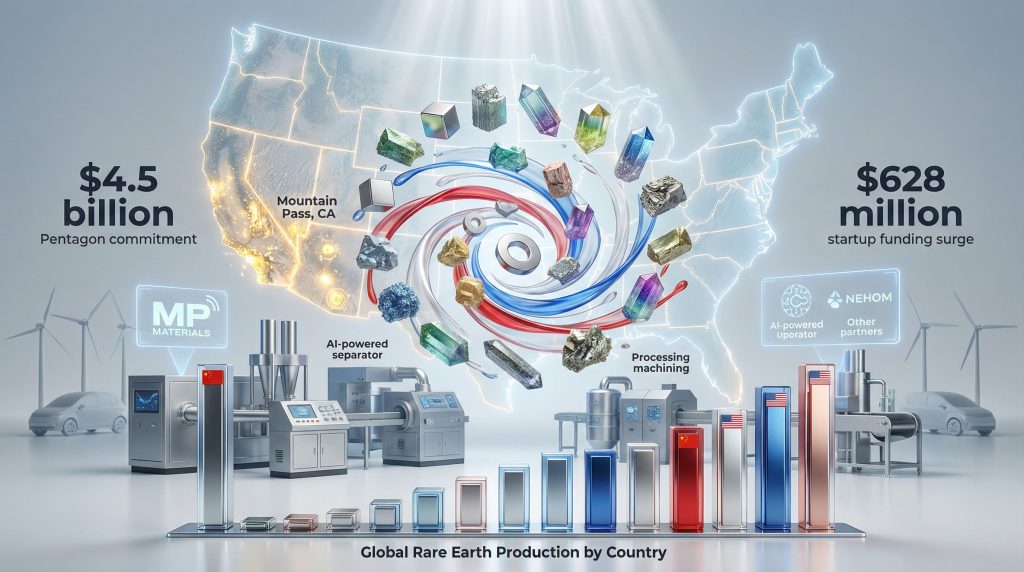
Trump's rare earth push represents a fundamental shift in America's approach to strategic mineral security, as the nation confronts unprecedented vulnerabilities in critical supply chains. Critical mineral dependencies have emerged as one of the most significant structural challenges facing advanced economies today, with these strategic materials underpinning everything from military defense systems to consumer electronics. However, their production remains dangerously concentrated in geographically unstable regions, creating systemic risks that demand immediate attention through comprehensive critical minerals energy security initiatives.
The current mineral security landscape reflects decades of supply chain optimisation for cost efficiency rather than strategic resilience. This optimisation has created systemic weaknesses that now demand comprehensive restructuring across multiple industrial sectors simultaneously.
Why Rare Earth Elements Form the Backbone of Modern Technology Infrastructure
The Seventeen Elements That Power Advanced Civilisation
Rare earth elements comprise seventeen metallic elements with unique magnetic, optical, and catalytic properties that cannot be replicated by alternative materials. These elements include lanthanum, cerium, praseodymium, neodymium, promethium, samarium, europium, gadolinium, terbium, dysprosium, holmium, erbium, thulium, ytterbium, lutetium, yttrium, and scandium.
Each element serves specific technological functions that make modern infrastructure possible. Neodymium creates the strongest permanent magnets known to science, essential for electric motor efficiency. Furthermore, europium produces the red phosphor that enables colour displays across billions of devices. Dysprosium maintains magnetic strength at high temperatures, critical for military applications and renewable energy systems.
Military applications demonstrate the strategic importance of these materials:
- F-35 fighter jets require 417 kilograms of rare earth elements per aircraft
- Missile guidance systems depend on samarium-cobalt magnets for precision targeting
- Radar systems utilise yttrium for signal processing capabilities
- Night vision equipment requires europium-activated phosphors
Consumer technology dependencies extend across the entire digital economy:
- 2.8 billion smartphones globally contain neodymium speakers and terbium displays
- Electric vehicles require 1-3 kilograms of rare earth permanent magnets per vehicle
- Wind turbines utilise 200-600 kilograms of neodymium per megawatt of capacity
- Data centres consume significant quantities through server cooling systems and storage drives
China's Strategic Market Positioning Creates Systemic Risk
Global rare earth production demonstrates extreme geographic concentration that creates vulnerability for importing nations. According to International Energy Agency data from October 2025, production statistics reveal the extent of this concentration:
| Country | Mining Output (2025) | Market Share | Processing Capacity |
|---|---|---|---|
| China | 620,000+ tons | 60% | 90%+ |
| United States | 67,000 tons | 6.5% | <5% |
| Myanmar | 45,000 tons | 4.4% | 0% |
| Australia | 41,000 tons | 4.0% | <2% |
| Thailand | 12,000 tons | 1.2% | 0% |
China's processing dominance exceeds its mining monopoly, controlling over 90% of global refining capacity. This processing bottleneck means that even minerals mined in other countries must typically be shipped to China for refinement before reaching end users.
Historical precedents demonstrate how supply concentration creates leverage opportunities. In 2010, China temporarily restricted rare earth exports to Japan during territorial disputes, causing prices to spike 3,000% within months. Similarly, restrictions applied to strategic materials in April 2025 following tariff disputes underscore the ongoing nature of this vulnerability.
The economic impact of supply disruptions cascades through multiple sectors simultaneously. Defense contractors face production delays, technology manufacturers experience component shortages, and renewable energy projects encounter cost escalations that threaten deployment timelines. Consequently, Trump's rare earth push has gained significant momentum as policymakers recognise these strategic vulnerabilities.
When big ASX news breaks, our subscribers know first
How Policy Architecture Reshapes Strategic Mineral Security
Federal Investment Mechanisms Target Supply Chain Diversification
Government intervention in strategic minerals markets represents a fundamental shift from market-based procurement toward national security prioritisation. This transition involves multiple coordinated policy tools designed to reduce import dependencies whilst building domestic production capabilities through enhanced critical minerals strategy frameworks.
The Defense Department's direct equity investment approach demonstrates unprecedented government participation in mining sector financing. The $400 million equity investment in MP Materials Corp. during July 2025 established a new model for federal mineral security funding. This investment structure provides both capital for expansion and strategic oversight of production priorities.
Price guarantee mechanisms address the fundamental challenge facing domestic producers: cost competitiveness against subsidised foreign suppliers. By establishing minimum price floors for strategic materials, government policy reduces investment risk whilst ensuring production viability during market downturns.
Key policy frameworks include:
- Strategic Materials Procurement Programme – Mandatory government purchasing quotas for domestically produced materials
- Allied Supply Chain Coordination – Bilateral agreements to develop alternative sources outside Chinese control
- Processing Infrastructure Development – Federal funding for separation and refining facilities
- Emergency Reserve Stockpiling – Strategic material accumulation for crisis scenarios through critical minerals reserve initiatives
Critical Minerals Proclamation Establishes New Trade Framework
The January 2026 critical minerals proclamation represents the most comprehensive trade policy restructuring in decades. This framework establishes negotiation deadlines with foreign suppliers whilst preparing alternative enforcement mechanisms. Additionally, the mining permits executive order streamlines domestic production approvals.
The 180-day negotiation timeline creates pressure for supply diversification agreements whilst maintaining flexibility for diplomatic solutions. Countries failing to meet supply security commitments face potential tariff escalation and quota restrictions.
Industry analysts note that federal support mechanisms are positioning rare earth startup investment as a safer bet for venture capitalists by reducing market volatility risk through price guarantees and supply chain coordination.
Enforcement mechanisms include graduated escalation procedures designed to encourage compliance whilst maintaining supply continuity. Initial measures focus on preferential domestic purchasing, followed by import licensing requirements, and ultimately comprehensive trade restrictions for non-cooperative suppliers.
Which Companies Are Capitalising on America's Mineral Renaissance
Venture Capital Surge Creates New Industry Leaders
Investment patterns in strategic minerals demonstrate the most dramatic sectoral reallocation of venture capital in recent history. PitchBook data reveals the scale of this transformation, with $628 million invested in U.S. rare earth startups during 2025, representing a 3,000% increase from 2024 levels. This unprecedented growth coincides with the broader critical minerals demand surge driving market expansion.
This funding surge accounts for 90% of global rare earth startup investment, indicating that capital is concentrating in domestic markets rather than diversifying internationally. The geographic concentration of investment reflects both policy incentives and risk assessment by institutional investors.
| Investment Category | 2025 Amount | Growth Rate | Market Share |
|---|---|---|---|
| U.S. Rare Earth Startups | $628 million | 3,000% | 90% |
| International Startups | $70 million | -15% | 10% |
| Government Co-Investment | $400 million | N/A | Strategic |
| Corporate Commitments | $500 million | N/A | Supply Security |
Phoenix Tailings Demonstrates Technological Independence
Phoenix Tailings represents a new category of mining companies focused on secondary resource recovery rather than primary extraction. The company's Series B funding round totalled $76 million with an additional $33 million raised in 2025, indicating strong investor confidence in recycling-based production models.
The company's New Hampshire facility operates with zero reliance on Chinese inputs, equipment, or technology, addressing a critical vulnerability in domestic supply chains. Current production capacity of 200 tons per year remains modest compared to global demand, but the facility produces terbium and dysprosium metals for defence sector customers.
Technical capabilities include:
- Heavy rare earth element separation from mining waste streams
- Defence-grade material specifications for classified applications
- Completely domestic supply chain from raw materials to finished products
- Scalable processing technology applicable to multiple mining regions
Corporate Supply Chains Pivot Toward Domestic Sources
Apple Inc.'s $500 million commitment to purchase rare earth products from MP Materials demonstrates how major technology companies are restructuring procurement strategies. This agreement, announced five days after the Pentagon's equity investment, indicates coordination between government policy and corporate supply security initiatives.
The timing suggests that federal investment provides confidence for private sector commitments, creating a multiplier effect where government funding attracts substantially larger corporate investments. This dynamic could accelerate domestic capacity building beyond what direct government investment alone could achieve.
Other corporate responses include:
- Defence contractors establishing preferred supplier relationships with domestic producers
- Technology manufacturers developing alternative product designs to reduce rare earth dependencies
- Automotive companies investigating recycling programmes for end-of-life vehicles
- Renewable energy developers securing long-term supply agreements
Investment Risk Assessment Reveals Market Dynamics
Venture capital investment patterns reveal both opportunities and concerns within the strategic minerals sector. Rajesh Swaminathan of Khosla Ventures examined several rare earth magnet startups during 2025 but declined to invest, citing the combination of companies being at very early stages whilst commanding super high valuations.
This valuation concern indicates potential market overheating, where policy support and strategic importance drive investment decisions beyond traditional financial metrics. However, Zachary Bogue of DCVC expressed confidence that recent advances in rare earth mining and processing technologies provide comfort that U.S. startups can catch up to established Chinese players.
Risk factors include:
- Technology Risk: Unproven separation and processing methods at commercial scale
- Market Risk: Potential oversupply if multiple projects succeed simultaneously
- Regulatory Risk: Changes in government support programmes affecting project viability
- Competition Risk: Chinese producers reducing prices to maintain market share
Economic Implications Transform Green Technology Deployment
Electric Vehicle Sector Faces Supply Chain Restructuring
Electric mobility applications accounted for 22% of U.S. rare earth permanent magnet demand in 2025, according to Benchmark Minerals data. This percentage represents the largest single application category, exceeding defence sector consumption of 12% and indicating the strategic importance of transportation electrification to mineral security.
The concentration of demand in electric vehicle motors creates both vulnerability and opportunity. Supply disruptions would directly impact EV production capabilities, potentially slowing transportation decarbonisation efforts. Conversely, domestic supply security could accelerate EV adoption by reducing cost volatility and ensuring production continuity.
Supply chain risk mitigation strategies employed by EV manufacturers include:
- Supplier Diversification: Contracting with multiple producers across different geographic regions
- Material Substitution Research: Developing alternative motor designs requiring different rare earth combinations
- Recycling Integration: Establishing end-of-life vehicle processing to recover materials
- Inventory Management: Strategic stockpiling of critical components during supply abundance
Cost Structure Analysis Reveals Competitiveness Challenges
Domestic rare earth production faces significant cost disadvantages compared to established Chinese suppliers. Phoenix Tailings and similar companies must overcome processing cost differentials estimated at 40-60% higher than Chinese equivalents, according to industry analysis.
However, total cost calculations must include supply security premiums, transportation costs, and potential tariff impacts. When factoring these additional considerations, domestic sourcing approaches cost parity under certain scenarios.
Alta Resource Technologies projects achieving cost-competitiveness against Chinese counterparts by 2027 through artificial intelligence and advanced biochemistry applications in mineral separation processes. This timeline suggests that technological innovation rather than scale alone may provide competitive advantages.
James Lindsay of Builders Vision contextualises rare earth security within broader climate transition requirements: green technology companies require supply chain stability to support energy transition objectives, making cost premiums acceptable for strategic security.
Long-Term Demand Projections Indicate Structural Growth
Energy transition requirements drive structural demand growth that exceeds current production capacity expansion plans. Wind turbine installations require 200-600 kilograms of rare earth materials per megawatt of capacity, whilst solar panel manufacturing consumes significant quantities of specialised elements.
Demand growth scenarios through 2035 include:
- Conservative Scenario: 8-12% annual growth driven by existing renewable energy commitments
- Accelerated Scenario: 15-20% annual growth from enhanced climate policies
- Transformation Scenario: 25-30% annual growth from comprehensive electrification programmes
These growth rates exceed planned production capacity expansion, indicating persistent supply constraints absent significant investment in new facilities. The gap between supply and demand creates both investment opportunities and strategic vulnerabilities.
Global Processing Capabilities Reveal Structural Dependencies
United States Processing Infrastructure Lags Production Capacity
Domestic mining output of approximately 67,000 tons of rare earth oxides in 2025 represents meaningful production capability, yet processing infrastructure remains inadequate to handle even this domestic supply. The majority of U.S.-mined materials require export to China for separation and refining before returning as finished products.
This processing gap creates inefficient export-import cycles where domestic raw materials leave the country only to return as value-added products at substantially higher costs. The round-trip transportation and processing fees effectively subsidise foreign industrial development whilst increasing domestic supply chain vulnerability.
| Processing Stage | U.S. Capacity | Chinese Capacity | Gap Analysis |
|---|---|---|---|
| Mining | 67,000 tons | 620,000+ tons | 10:1 ratio |
| Oxide Separation | <5,000 tons | 580,000 tons | 116:1 ratio |
| Metal Production | <2,000 tons | 520,000 tons | 260:1 ratio |
| Magnet Manufacturing | <1,000 tons | 480,000 tons | 480:1 ratio |
Heavy Rare Earth Element Production Presents Critical Gaps
Heavy rare earth elements including terbium and dysprosium demonstrate the most severe production inadequacies. Despite Phoenix Tailings' success in producing these materials for defence customers, Benchmark Minerals analysis indicates the United States has no domestic capacity to produce heavy rare earths at commercial scale.
Heavy rare earths command premium pricing due to their scarcity and specialised applications. Terbium prices typically exceed $1,200 per kilogram, whilst dysprosium trades above $400 per kilogram. These price levels justify investment in domestic production facilities, yet technical challenges in separation processes create barriers to rapid scaling.
Chinese dominance in heavy rare earth processing stems from decades of investment in specialised separation equipment and technical expertise. Replicating this capability requires both capital investment and workforce development in highly specialised chemical engineering applications.
Technology Innovation Addresses Processing Bottlenecks
Artificial intelligence applications in mineral separation represent potentially transformative processing improvements. Alta Resource Technologies leverages AI-enhanced separation techniques that could reduce processing costs whilst improving purity levels compared to conventional methods.
Biochemical processing advances offer alternative approaches to traditional chemical separation methods. These biological processes potentially reduce environmental impact whilst achieving equivalent or superior separation efficiency.
Innovation areas include:
- AI-Optimised Separation: Machine learning algorithms optimising chemical reaction parameters in real-time
- Biological Processing: Engineered microorganisms selectively concentrating specific rare earth elements
- Continuous Processing: Flow-based systems replacing batch processing for improved efficiency
- Waste Minimisation: Closed-loop systems recycling process chemicals and reducing environmental impact
Geopolitical Risk Scenarios Shape Strategic Planning
China's Export Control Arsenal Demonstrates Leverage Potential
Beijing's strategic materials export licensing system provides multiple escalation options for trade disputes. The April 2025 introduction of export controls on strategic materials in response to tariffs demonstrates willingness to weaponise mineral supplies for geopolitical objectives. Moreover, as reported by The Guardian, Trump's rare earth push directly addresses these strategic dependencies that have left America vulnerable to supply chain manipulation.
Historical precedents establish patterns of Chinese export restrictions during diplomatic tensions:
- 2010 Japan Disputes: Rare earth export quotas reduced by 40% during territorial conflicts
- 2019 Trade Tensions: Threatened restrictions on critical mineral exports to pressure trade negotiations
- 2025 Tariff Response: Export licensing requirements implemented for strategic materials
Export control escalation follows predictable patterns: licensing requirements, quota restrictions, complete export bans, and secondary sanctions on third-country intermediaries.
Each escalation level creates increasingly severe supply disruptions whilst maintaining plausible diplomatic justification. This graduated approach allows calibrated responses to various dispute intensities whilst preserving options for de-escalation.
Allied Partnership Development Offers Alternative Supply Chains
International cooperation in critical minerals development provides diversification opportunities beyond complete domestic self-sufficiency. Australia's substantial rare earth deposits combined with processing partnership agreements could create allied supply chains independent of Chinese control.
Partnership frameworks include:
- Australia-U.S. Mining Cooperation: Joint development of Australian deposits with U.S. processing facilities
- Canadian Critical Minerals Collaboration: Shared technology development and resource access agreements
- Greenland Access Negotiations: Exploration rights for substantial undeveloped deposits
These partnerships distribute geopolitical risk whilst maintaining strategic independence from adversarial suppliers. However, allied relationships require ongoing diplomatic maintenance and may face their own political pressures during crisis scenarios. Additionally, Yahoo Finance analysis suggests that Trump's rare earth push extends beyond simple supply security to encompass broader strategic competition with China.
The next major ASX story will hit our subscribers first
Implementation Challenges Threaten Rapid Capacity Development
Permitting Processes Create Development Bottlenecks
Environmental review requirements for mining and processing facilities extend project timelines significantly beyond optimal strategic planning horizons. Federal coordination inefficiencies between multiple agencies create additional delays that compound supply security vulnerabilities.
State-level mining approval processes vary substantially in timeline and complexity, creating regulatory arbitrage opportunities but also planning uncertainties for investors. Some states prioritise rapid development for strategic materials, whilst others maintain extensive environmental review requirements regardless of national security implications.
Permitting timeline comparisons reveal substantial variations:
- Expedited Strategic Projects: 18-24 months for complete approval
- Standard Mining Projects: 36-48 months for complete approval
- Complex Environmental Sites: 60+ months with potential litigation delays
Capital Requirements Exceed Traditional Mining Investment Patterns
Strategic mineral projects require substantially higher capital intensity compared to conventional mining operations due to specialised processing equipment and technical complexity. Infrastructure investment needs include separation facilities, refining equipment, and waste management systems designed for complex chemical processes.
Skilled workforce development presents additional challenges, as rare earth processing requires specialised knowledge in hydrometallurgy, chemical separation, and materials science. Educational institutions currently produce insufficient graduates with relevant technical training, creating human capital constraints.
Investment risk assessment reveals multiple challenge categories:
| Risk Category | Impact Level | Mitigation Strategies | Timeline |
|---|---|---|---|
| Technical Risk | High | Pilot facility validation | 2-3 years |
| Market Risk | Medium | Government price guarantees | Ongoing |
| Regulatory Risk | Medium | Streamlined permitting | 1-2 years |
| Workforce Risk | High | Educational partnerships | 3-5 years |
Historical Precedent Analysis: America's Energy Independence Transformation
Shale Revolution Model Provides Strategic Framework
The U.S. oil and gas industry's transformation from relative irrelevance in 2005 to global leadership by 2020 offers instructive parallels for strategic mineral development. This 15-year cycle demonstrates how coordinated private investment, technological innovation, and supportive government policy can reshape global market dynamics.
Key transformation catalysts included:
- Technology Breakthrough: Horizontal drilling and hydraulic fracturing innovations
- Capital Deployment: $2+ trillion in cumulative investment across multiple companies
- Infrastructure Development: Pipeline networks, processing facilities, and export terminals
- Regulatory Support: Streamlined permitting and federal land access policies
The shale revolution required substantially more capital investment than rare earth supply chain development would likely require, suggesting that mineral independence represents a more achievable objective given sufficient coordination.
Investment Pattern Analysis Reveals Success Factors
Private-public partnership structures proved critical to energy sector transformation success. Government research funding developed foundational technologies, whilst private capital scaled commercial applications. Tax incentives and regulatory support reduced investment risk without requiring direct government ownership.
Timeline expectations for rare earth industry development suggest similar 15-year transformation cycles may be achievable with adequate resource commitment. Technology scaling requirements appear less complex than shale development, as rare earth processing utilises established chemical engineering principles rather than revolutionary extraction methods.
Lindsay of Builders Vision draws explicit comparisons between energy independence and mineral security: the growth of the oil and gas industry required more capital than building out a strong U.S. rare earth supply chain would likely require, demonstrating that 15-year transformation cycles can be achieved.
Strategic Implications for National Security Architecture
Supply Chain Resilience Metrics Define Success Parameters
Measuring progress toward mineral independence requires comprehensive metrics beyond simple production volume comparisons. Supply chain resilience depends on diversification indices, processing capability distribution, and strategic reserve accumulation targets.
| Resilience Metric | Current Status | 2030 Target | Strategic Importance |
|---|---|---|---|
| Supply Diversification | 15% non-Chinese | 60% non-Chinese | High |
| Processing Capacity | 5% domestic | 40% domestic | Critical |
| Strategic Reserves | 3 months demand | 24 months demand | Medium |
| Allied Partnerships | 2 active | 8 active | High |
Alternative material development progress provides additional security through reduced dependencies on specific rare earth elements. Research into permanent magnet alternatives, phosphor substitutes, and catalyst replacements could fundamentally alter demand patterns within existing supply constraints.
Global Market Restructuring Projections
U.S. market share growth projections indicate potential for significant global market restructuring within the decade. Achieving 25-30% global market share by 2030 would substantially reduce Chinese pricing power whilst creating alternative supply options for allied nations.
Price stability implications of increased competition include reduced volatility and elimination of artificial scarcity pricing. Technology transfer restrictions could limit Chinese access to American processing innovations, creating competitive advantages for domestic producers.
Long-term market leadership objectives extend beyond supply security to include technological dominance in processing efficiency, environmental performance, and product quality. Success in these areas could make American rare earth products preferable regardless of price considerations.
America's Path to Critical Minerals Independence
Investment Timeline and Strategic Milestones
Short-term production capacity targets focus on eliminating complete dependence on Chinese processing for domestically mined materials. Achieving 20% domestic processing capacity by 2027 would provide meaningful supply security improvements whilst establishing foundation for further expansion.
Medium-term processing infrastructure goals include comprehensive rare earth separation capabilities and heavy rare earth element production capacity. These objectives require sustained investment and workforce development over 5-7 year horizons.
Long-term market leadership objectives encompass both supply security and global competitive positioning. Success metrics include technology innovation, cost competitiveness, and environmental performance leadership that makes American rare earth products globally preferable.
Success Framework and Risk Mitigation
Supply chain independence indicators must balance domestic production capabilities with allied partnership development and strategic reserve management. Complete self-sufficiency may be less important than reliable access to diversified supply sources independent of adversarial control.
Economic competitiveness benchmarks should account for total system costs including supply security premiums, transportation expenses, and inventory carrying costs. National security vulnerability assessments require ongoing monitoring of geopolitical developments and alternative supply option development.
In conclusion, Trump's rare earth push represents one of the most significant industrial policy initiatives in decades. Success requires sustained commitment across multiple political cycles, coordinated private and public investment, and technological innovation at commercial scale. The parallels with energy independence suggest that comprehensive mineral security is achievable within 15-year transformation timelines, provided that policy support remains consistent and investment capital continues flowing to domestic capacity development.
Interested in Capitalising on America's Critical Minerals Renaissance?
Discovery Alert's proprietary Discovery IQ model delivers real-time alerts on significant ASX mineral discoveries, instantly empowering subscribers to identify actionable opportunities ahead of the broader market. Understand why major mineral discoveries can lead to significant market returns by exploring Discovery Alert's dedicated discoveries page, showcasing historic examples of exceptional outcomes, then begin your 30-day free trial today to position yourself ahead of the market.