August 22, 2026
Global tungsten markets have entered an unprecedented phase where fundamental supply-demand dynamics increasingly bow to geopolitical considerations. The tungsten price export controls transformation reflects broader shifts in how nations view critical mineral resources not merely as commodities, but as instruments of economic statecraft and industrial sovereignty.
The Strategic Mineral Powering Advanced Manufacturing
Tungsten's exceptional metallurgical properties position it as an irreplaceable component across multiple high-technology sectors. With a melting point of 3,422°C, the highest of any naturally occurring metal, tungsten enables manufacturing processes that would be impossible with alternative materials. The metal's density of 19.3 g/cm³ and tungsten carbide's hardness rating of 8.5-9.0 on the Mohs scale create performance characteristics that define entire industrial applications.
The European Union's Critical Raw Materials Act of 2023 and the U.S. Department of Energy's critical minerals strategy designation underscore tungsten's strategic importance beyond commercial considerations. These classifications reflect recognition that tungsten availability directly impacts national defence capabilities, aerospace manufacturing capacity, and advanced semiconductor production.
Commercial tungsten exists in three primary forms: ammonium paratungstate (APT), tungsten oxide, and tungsten carbide powder. Each serves distinct manufacturing applications, from semiconductor fabrication requiring 99.999% purity tungsten hexafluoride gas to aerospace components demanding 99.95% tungsten metal specifications. This chemical diversity creates multiple vulnerability points across industrial supply chains.
Defence applications demonstrate tungsten's strategic value most clearly. Military armour-piercing munitions exploit tungsten's exceptional density for kinetic energy projectiles, while missile guidance systems require tungsten components capable of withstanding extreme thermal stress. Furthermore, aerospace manufacturers depend on tungsten for turbine blades operating at temperatures exceeding 2,200°C, specifications that cannot be met through material substitution.
When big ASX news breaks, our subscribers know first
Regulatory Architecture Behind China's Export Restrictions
China's implementation of tungsten price export controls represents a systematic approach to leveraging resource dominance for broader economic and strategic objectives. The regulatory framework emerged through a carefully orchestrated timeline designed to maximise market impact whilst maintaining operational flexibility.
February 2025 marked the initial announcement of export control measures classifying tungsten as a dual-use material subject to government oversight. This classification enabled Chinese authorities to impose permit requirements on international shipments, fundamentally altering the market's operational structure from open commodity trading to regulated resource allocation.
December 2025 witnessed the approval of just 15 companies authorised to export tungsten products, representing a dramatic consolidation from an open export market. This centralisation mechanism enables precise control over export volumes and destination markets, creating artificial scarcity conditions that drive price appreciation and supply chain reconfiguration.
The enhanced restrictions on tungsten shipments to Japan implemented in January 2026 demonstrate the system's capacity for targeted trade pressure. Japan's position as a major tungsten importer makes it particularly vulnerable to supply disruptions, illustrating how resource control translates into diplomatic leverage.
Moreover, China's domestic mining quota reduction of 6.5% from 2024 levels compounds export restrictions by limiting overall tungsten availability. This dual-pressure approach forces international buyers to compete not only with reduced export allocations but also with increased Chinese domestic consumption driven by expanded manufacturing capacity.
The permit evaluation process remains deliberately opaque, with approval criteria and timeline expectations unpublished. This regulatory uncertainty creates additional market friction, as potential buyers cannot predict supply availability or plan procurement strategies with confidence.
Market Concentration and Processing Bottlenecks
China's tungsten market dominance extends far beyond primary mining operations to encompass the entire value chain from ore extraction through refined product manufacturing. This vertical integration creates multiple leverage points that complicate efforts to develop alternative supply sources, as seen in the broader mining industry evolution.
| Region | Annual Production | Market Share | Processing Capacity |
|---|---|---|---|
| China | 67,000 tonnes | 85% | Dominant refining infrastructure |
| Vietnam | 3,500 tonnes | 4% | Limited processing capability |
| Russia | 2,800 tonnes | 3.5% | Modest refining capacity |
| Rwanda | 1,200 tonnes | 1.5% | Development stage processing |
| Other regions | 2,500 tonnes | 6% | Fragmented capabilities |
Processing technology barriers present even greater challenges than primary production concentration. Tungsten refining requires specialised infrastructure including APT crystallisation facilities, hydrogen atmosphere reduction furnaces operating at 1,000-1,200°C, and contamination control systems preventing tungsten oxide hydration. Capital requirements for a single integrated processing facility range from $50-150 million, representing substantial investment barriers for new market entrants.
The technical complexity of tungsten processing creates knowledge transfer constraints that prevent rapid capacity expansion. Particle size specification equipment, yield optimisation protocols, and quality control systems require specialised expertise concentrated primarily within Chinese industrial operations. This technological moat reinforces China's processing dominance even as alternative mining sources develop.
Vietnam exemplifies the processing bottleneck challenge despite ranking as the second-largest tungsten producer globally. The country's 3,500 tonnes of annual production requires APT import-dependent processing, limiting its ability to serve as a meaningful alternative to Chinese supply chains. Similar constraints affect other non-Chinese producers, creating systemic vulnerability that export controls exploit effectively.
However, secondary tungsten recycling provides some supply chain resilience, contributing an estimated 20-30% of global tungsten supply. Nevertheless, recycling operations face the same processing technology requirements and capital intensity as primary production, concentrating these capabilities within existing Chinese infrastructure networks.
Price Discovery Under Export Control Regimes
Tungsten pricing mechanisms have fundamentally shifted from market-driven commodity dynamics to strategic resource allocation governed by regulatory frameworks. This transformation creates new price discovery mechanisms that reflect geopolitical considerations alongside traditional supply-demand factors, particularly affecting tariffs impact on investments.
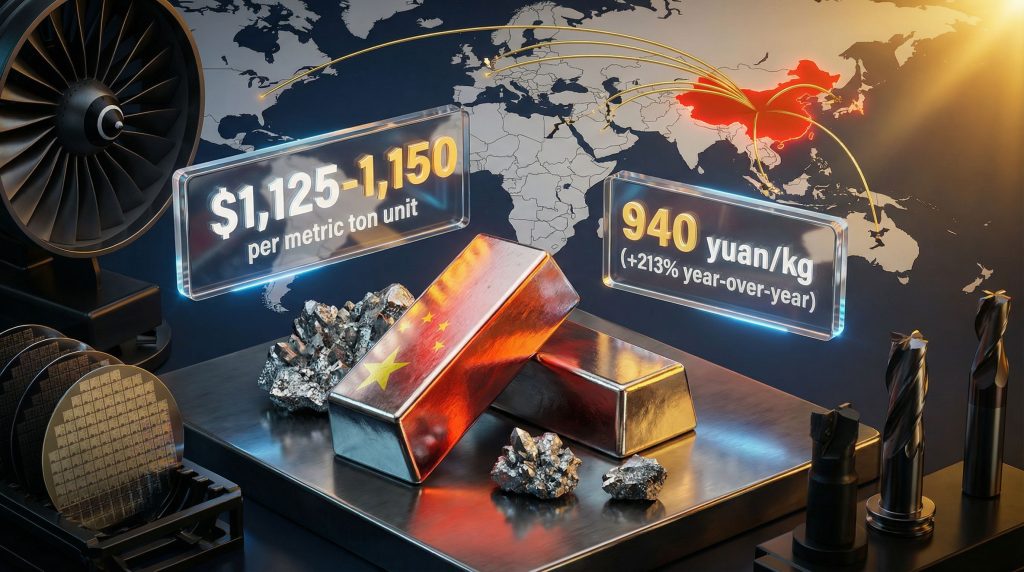
Chinese domestic markets established new price benchmarks in January 2026, with APT trading at $1,125-$1,150 per metric ton unit, representing all-time record levels. These prices reflect constrained supply conditions created by export controls and reduced mining quotas, establishing a new baseline for tungsten valuations globally.
International trading hubs mirror Chinese price appreciation, with Rotterdam APT prices reaching approximately $1,100 per metric ton unit, also marking historical highs. The convergence of domestic Chinese and international pricing indicates effective market segmentation through export controls, preventing arbitrage opportunities that previously moderated price disparities.
Tungsten carbide powder prices demonstrate the most dramatic appreciation, reaching 940 yuan per kilogram in January 2026, representing a 213% year-over-year increase. This downstream product pricing reflects both raw material cost increases and processing capacity constraints that amplify input price volatility.
Furthermore, tungsten concentrate pricing at 455,000-460,000 yuan per tonne shows even more dramatic appreciation, with 216% growth from January 2025 baseline levels. This upstream price movement indicates fundamental supply tightness that extends beyond export control effects to encompass reduced ore availability and declining grade quality.
Export volume data quantifies the physical supply impact driving price appreciation. Chinese tungsten exports declined 40% year-over-year since February 2025 control implementation, whilst APT-specific exports dropped 70% to just 243 tonnes during the January-November 2025 period. Overall tungsten exports fell 13.75% in the first nine months of 2025, demonstrating systematic supply reduction across all tungsten product categories.
What Factors Drive Current Pricing Trends?
Market participants attribute price escalation to multiple reinforcing factors beyond export controls. Declining ore grades increase production costs whilst defence and aerospace demand surges create additional consumption pressure. Industrial gas turbine manufacturing and semiconductor fabrication represent growing demand sources that compete for constrained tungsten supplies.
The transition from elastic pricing responsive to supply-demand fluctuations toward inelastic strategic resource pricing creates new investment dynamics. Long-term contract structures increasingly incorporate geopolitical risk premiums, whilst inventory management strategies balance carrying costs against supply security considerations.
Industrial Sector Vulnerability Assessment
Export control impacts cascade through industrial sectors with varying degrees of vulnerability based on tungsten dependency, substitute availability, and strategic importance. Defence and aerospace applications face the highest exposure due to performance requirements that prevent material substitution and national security implications that limit supply source diversification.
Military applications demonstrate absolute tungsten dependency for armour-piercing ammunition production, where the metal's exceptional density creates kinetic energy projectiles that cannot be replicated through alternative materials. Missile component manufacturing requires tungsten for heat-resistant nose cones and guidance system components operating under extreme thermal conditions.
Aerospace manufacturers confront supply chain disruption across multiple aircraft systems. Engine turbine blades and combustor liners require tungsten alloy specifications for components operating at 1,800-2,200°C, temperatures that exceed the performance capabilities of substitute materials. These applications represent non-negotiable performance requirements that force continued tungsten procurement despite elevated pricing.
Semiconductor fabrication presents a different vulnerability profile focused on tungsten hexafluoride gas production for interconnect deposition in advanced process nodes. Sub-7nm manufacturing processes from TSMC, Samsung Foundry, and Intel depend on 99.999% purity tungsten compounds that require specialised processing capabilities concentrated within Chinese supply chains.
In addition, the automotive sector's electric vehicle battery manufacturing equipment utilises tungsten for electrode components and thermal management systems. High-temperature welding and sintering equipment requires tungsten crucibles and electrodes that enable battery cell production processes. Supply chain disruption in this sector could impact electric vehicle manufacturing capacity across multiple global markets.
Industrial gas turbine manufacturing emerges as a particularly vulnerable sector combining high-temperature operational requirements with strategic energy infrastructure implications. Tungsten components enable power generation equipment operating at temperatures exceeding 1,600°C, supporting electrical grid stability and industrial energy supply.
Nuclear reactor components and shielding materials represent additional strategic vulnerabilities where tungsten supply interruption could impact energy security and nuclear fuel cycle operations. These applications involve long-term procurement planning cycles that make sudden supply restrictions particularly disruptive.
Alternative Supply Development and Market Response
Non-Chinese tungsten sources face significant technical and economic barriers to meaningful capacity expansion despite elevated market incentives. Alternative supply development requires simultaneous investment in mining operations, processing infrastructure, and technical expertise, creating complex coordination challenges that prevent rapid market response.
Vietnam's position as the largest non-Chinese producer illustrates both opportunities and constraints in supply chain diversification. Whilst Vietnamese mines produce 3,500 tonnes annually, the country lacks integrated refining capacity, requiring continued dependence on Chinese processing infrastructure. Capacity expansion initiatives focus on developing domestic APT crystallisation capabilities, though timeline expectations extend through 2027-2028.
Rwanda represents an emerging African tungsten source with new mining projects under development targeting production increases beyond current 1,200 tonne levels. However, these projects remain in early development phases with commercial production timelines that cannot address immediate supply constraints created by Chinese export controls.
Australian tungsten deposits offer potential supply diversification opportunities with several dormant mines receiving renewed investment attention. Policy support for domestic mining revival includes expedited permitting processes and critical minerals reserve procurement commitments designed to encourage production resumption.
North American tungsten development faces unique challenges related to environmental permitting timelines and indigenous land rights negotiations. Executive orders expediting domestic mining permits attempt to address regulatory barriers, though implementation timelines remain uncertain for meaningful production increases.
How Are Nations Responding to Supply Constraints?
Strategic reserve and stockpiling programmes represent more immediate responses to supply security concerns. The European Union's Critical Raw Materials Act implementation includes tungsten inventory requirements for member nations, whilst Japan and South Korea develop alternative supplier partnerships to reduce Chinese dependency.
Processing technology transfer initiatives attempt to address the fundamental bottleneck constraining non-Chinese supply development. These programmes focus on APT crystallisation, powder metallurgy, and quality control systems that enable value-added tungsten product manufacturing outside Chinese industrial networks.
Investment in recycling infrastructure provides additional supply augmentation opportunities, though capital requirements parallel those of primary processing facilities. Tungsten recovery from industrial waste streams and end-of-life products could contribute meaningful supply volumes if processing capacity constraints are addressed.
The next major ASX story will hit our subscribers first
Long-Term Market Transformation and Investment Implications
The structural changes in tungsten markets extend beyond temporary supply disruptions to encompass fundamental shifts in commodity market operations, pricing mechanisms, and investment strategies. These transformations reflect broader trends toward resource nationalism and strategic material control that are reshaping critical mineral supply chains globally.
New baseline pricing expectations emerge from the combination of constrained supply, elevated production costs, and geopolitical risk premiums that prevent return to historical price levels. Market participants anticipate a structural price floor of $400-450 per metric ton unit for APT, representing permanent elevation from previous baseline pricing.
Consequently, reduced price elasticity characterises the new market structure as supply concentration limits competitive pricing dynamics whilst strategic demand sources demonstrate willingness to accept elevated costs for supply security. Long-term contract renegotiations increasingly incorporate force majeure provisions addressing regulatory supply interruptions and geopolitical risk factors.
Premium structures for non-Chinese sourced material create dual market dynamics where supply source transparency commands price premiums beyond traditional quality specifications. These premiums reflect supply chain risk management considerations that extend beyond immediate procurement costs to encompass strategic supply security planning.
Supply chain reconfiguration accelerates through vertical integration strategies by major tungsten consumers seeking to reduce exposure to external supply disruptions. Defence contractors and aerospace manufacturers increasingly evaluate backward integration into tungsten processing and mining operations to ensure supply continuity for critical applications.
What Long-Term Changes Are Emerging?
Regional processing hub development represents the most significant long-term market transformation as consuming nations invest in tungsten refining infrastructure outside Chinese control. These initiatives require substantial capital commitments and technology transfer agreements that fundamentally alter global tungsten processing geography.
Strategic partnership formation between consuming nations creates new procurement mechanisms designed to reduce collective dependence on Chinese tungsten supplies. These partnerships combine purchasing power with investment coordination to support alternative supply chain development and processing capacity expansion.
Investment strategies adapt to new market realities through diversified supplier portfolios that prioritise supply security over cost optimisation. Organisations dependent on tungsten implement sophisticated procurement planning that balances inventory carrying costs with supply interruption risks.
Mining company valuations reflect scarcity premiums and strategic positioning advantages for companies with proven tungsten reserves and processing capabilities outside Chinese control. These valuations incorporate geopolitical risk factors and strategic material premiums that extend beyond traditional mineral resource evaluations.
The transformation of tungsten markets under Chinese export controls creates a new paradigm where critical mineral availability increasingly reflects political considerations rather than purely economic factors. This evolution demands sophisticated risk management approaches that account for regulatory uncertainty, supply chain vulnerability, and the intersection of commercial procurement with national security planning. Success in this environment requires understanding that tungsten price export controls have evolved the metal from a commodity input to a strategic resource whose availability shapes industrial competitiveness and national economic security. Moreover, recognising the impacts of tungsten mining impacts becomes crucial for long-term planning in this transformed market landscape.
Looking to Capitalise on Critical Mineral Market Disruptions?
Discovery Alert's proprietary Discovery IQ model instantly identifies significant ASX mineral discoveries, including tungsten and other strategic resources experiencing supply chain transformation. With real-time alerts delivering actionable investment opportunities as they unfold, subscribers gain crucial market advantages during periods of unprecedented commodity volatility. Start your 14-day free trial today to position yourself ahead of these transformative market dynamics.