August 5, 2026
Strategic metals markets have entered an unprecedented volatility phase, where traditional commodity pricing models prove inadequate for materials that exist outside conventional exchange frameworks. The convergence of geopolitical tensions, supply concentration risks, and defense modernization programs creates perfect storm conditions for price discovery mechanisms that operate fundamentally differently from mainstream industrial metals. When a single nation controls nearly four-fifths of global production for materials essential to military applications, market dynamics transcend typical supply-demand equilibrium calculations, leading to significant tungsten price increase patterns across global markets.
Understanding Tungsten's Strategic Market Position
Tungsten occupies a unique position within global commodity markets, demonstrating characteristics that separate it from traditional industrial metals like copper or aluminum. The global tungsten market reached approximately US$16 billion in 2026, representing roughly 5% of the copper market's US$320 billion valuation. Despite this relatively modest market capitalisation, tungsten's strategic importance far exceeds its financial footprint due to its irreplaceable properties in critical applications.
The metal possesses the highest melting point of all pure elements at 3,422°C, combined with exceptional density that makes it indispensable for applications requiring penetrating capability or extreme heat resistance. These physical properties cannot be replicated through alternative materials, creating fundamentally inelastic demand characteristics across aerospace, defence, and semiconductor manufacturing sectors.
Unlike copper, gold, or other commodities that trade on major exchanges with transparent price discovery, tungsten operates through bilateral negotiations and limited public pricing benchmarks. This structural difference creates amplified volatility patterns that exceed traditional commodity market behaviours. The APT (ammonium paratungstate) European benchmark serves as the primary reference point, but trading volumes remain substantially lower than exchange-traded metals.
Market Structure Vulnerabilities
Tungsten's market structure demonstrates several characteristics that differentiate it from mainstream commodities:
• Limited exchange trading creating opacity in price discovery mechanisms
• Small market capitalisation amplifying percentage price movements
• Concentrated supply chains reducing competitive pricing dynamics
• Specialised applications limiting demand elasticity responses
The absence of deep, liquid markets means that relatively small supply disruptions or demand increases can trigger disproportionate price movements. When a market valued at $16 billion experiences supply constraints, the same absolute dollar impact that might move copper prices by 5% can generate 50-100% price increases in tungsten, reflecting the extreme nature of this tungsten price increase phenomenon.
When big ASX news breaks, our subscribers know first
How China's Export Controls Reshaped Global Tungsten Supply
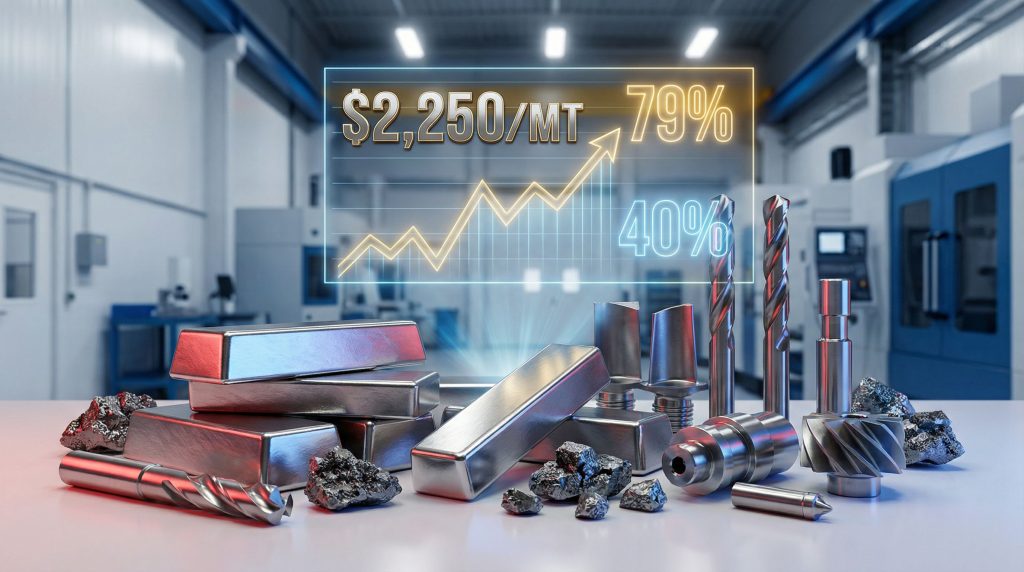
China's dominance over global tungsten production represents one of the most concentrated supply monopolies in strategic materials markets. Chinese production accounts for 79% of global tungsten mining output, a control level that exceeds even rare earth elements or lithium processing concentration. This overwhelming market position transforms any Chinese policy decision into a global supply shock mechanism, directly contributing to strategic antimony updates across critical minerals markets.
The implementation of export restrictions on tungsten products fundamentally altered global supply dynamics during 2025-2026. Chinese tungsten shipments declined approximately 40% following the inclusion of tungsten derivatives in China's export control framework. For context, this reduction represents roughly 32% of total global tungsten supply availability, creating immediate scarcity conditions across Western industrial consumers.
The 79% Market Dominance Factor
China's tungsten supply control stems from three interconnected advantages:
- Geological fortune through substantial ore deposits concentrated in Hunan, Jiangxi, and southern provincial regions
- Vertical integration encompassing mining, refining, and downstream processing within Chinese supply chains
- Industrial policy support aligning tungsten development with military-industrial complex requirements
This concentration differs from other commodities where multiple nations maintain significant production capacity. Australia, Canada, and Brazil collectively cannot rapidly compensate for Chinese supply reductions due to the extended timeline required for mine development and production scaling, highlighting broader raw materials supply risks across global markets.
Export Restriction Timeline and Policy Evolution
The strategic deployment of export controls represents a deliberate economic policy tool rather than technical trade restrictions. By including tungsten products in export control lists during escalating US-China tensions, Beijing effectively weaponised critical materials dependencies that Western nations had not previously addressed through strategic planning.
The 40% reduction in Chinese tungsten shipments created immediate inventory depletion across defence contractors and semiconductor manufacturers. Unlike agricultural commodities or energy products where strategic reserves exist, tungsten stockpiling had been minimal due to the metal's historically stable pricing and reliable Chinese supply availability.
What Industries Are Driving Unprecedented Tungsten Demand?
The convergence of supply restrictions with accelerating demand growth created the conditions for tungsten's remarkable price performance. Defence sector consumption represents the primary demand catalyst, with military tungsten applications projected to grow approximately 12% in 2026 according to industry estimates, forming a crucial component of modern defence critical materials requirements.
Defence Sector Consumption Surge
Military applications drive tungsten demand through several specialised uses that cannot substitute alternative materials:
• Kinetic energy penetrators utilising tungsten's superior density for armour-piercing ammunition
• Missile components requiring high-temperature resistance and dimensional stability
• Aircraft counterweights leveraging tungsten's density for helicopter and military aircraft balance systems
• Armour plating applications incorporating tungsten alloys for enhanced protection
The transition from depleted uranium to tungsten in military applications reflects both international treaty compliance and performance advantages. Tungsten provides equivalent terminal velocity characteristics whilst avoiding radioactive material handling requirements, making it the preferred choice for modernising military forces globally.
Technology Sector Applications Expanding
Beyond military demand, civilian applications continue expanding across technology-intensive industries:
Semiconductor manufacturing incorporates tungsten in interconnect layers and barrier applications where the metal's properties enable advanced chip architectures. As semiconductor complexity increases with AI and quantum computing development, tungsten requirements per chip continue rising.
Industrial tooling represents tungsten's largest historical application, with mining drill bits and cutting tools requiring tungsten carbide for durability in extreme conditions. The global tungsten prices surge has been driven partly by this growing exploration boom for energy transition minerals, which increases demand for tungsten-based drilling equipment.
Aerospace manufacturing extends beyond military applications into commercial aircraft development, where tungsten counterweights and high-temperature components support next-generation engine designs.
Why Traditional Price Models Failed to Predict This Rally
The 557% tungsten price increase from February 2025 to March 2026 represents a failure of conventional commodity forecasting methodologies that rely on exchange-traded market assumptions. Traditional models assume continuous supply elasticity, transparent price discovery, and demand substitution possibilities that simply do not exist in tungsten markets.
Market Structure Vulnerabilities
Standard commodity pricing models incorporate several assumptions that prove invalid for tungsten:
• Supply elasticity: Models assume producers can increase output in response to price signals, but new tungsten mines require minimum 2-year development timelines
• Demand substitution: Economic models expect alternative materials adoption as prices rise, but tungsten's unique properties prevent substitution in critical applications
• Transparent pricing: Forecasting relies on continuous price signals from liquid exchanges, whilst tungsten operates through opaque bilateral negotiations
The APT benchmark reaching US$2,250 per metric ton represents more than double early 2026 price levels, indicating that market participants had not incorporated geopolitical supply risk into pricing models. This suggests systematic undervaluation of concentration risk in strategic materials markets.
Inventory Depletion Acceleration
Unlike exchange-traded commodities where inventory levels are publicly reported, tungsten inventory data remains fragmented across private industrial users. The acceleration of price movements during late 2025 and early 2026 indicates that inventory-to-consumption ratios declined to critically low levels before market participants recognised the supply constraint severity.
Industrial consumers typically maintain 3-6 month tungsten inventories based on historical supply reliability. When Chinese export restrictions created delivery delays, inventory depletion occurred faster than alternative supply sources could be secured, creating panic buying conditions that amplified price volatility.
How Are Companies and Governments Responding to Supply Constraints?
The tungsten supply crisis triggered immediate strategic responses across Western governments and industrial consumers, though the effectiveness of these initiatives remains constrained by development timelines and technical challenges. Furthermore, these responses align closely with broader critical minerals strategy implementations across developed nations.
Alternative Supply Development Initiatives
Multiple countries launched tungsten mining development programs to reduce Chinese dependency:
South Korea initiated domestic tungsten exploration programmes whilst establishing strategic partnerships with non-Chinese suppliers. The country's advanced manufacturing base creates substantial tungsten consumption that had been entirely dependent on Chinese imports.
Spain renewed focus on historical tungsten mining regions that had been economically unviable during periods of stable Chinese supply. Spanish deposits offer potential production capacity but require significant capital investment and regulatory approval processes.
Brazil expanded tungsten exploration activities in regions with known deposits, though infrastructure development and environmental permitting create extended development timelines.
Australia accelerated feasibility studies for tungsten projects that had been shelved due to Chinese price competition. Australian deposits benefit from established mining infrastructure and regulatory frameworks.
United States renewed strategic focus on domestic tungsten production through both government initiatives and private sector development programmes, particularly considering US tariff impacts on minerals policy developments.
Despite these initiatives, new tungsten mines require a minimum of 2 years to enter production, creating a critical supply gap period where existing production cannot rapidly increase to offset Chinese restrictions.
Strategic Reserve Building and Corporate Responses
Western governments initiated strategic reserve accumulation programmes, though specific reserve targets and accumulation timelines remain largely confidential. The urgency reflects recognition that tungsten represents a critical vulnerability in defence supply chains that had been previously overlooked.
Corporate inventory management strategies evolved to prioritise supply security over cost optimisation. Defence contractors and semiconductor manufacturers began establishing longer-term contracts with non-Chinese suppliers despite premium pricing, viewing supply certainty as more valuable than cost minimisation.
Recycling technology advancement gained priority as an immediate response to supply constraints. Tungsten recycling from industrial scrap and used products can recover 60-80% of material content, providing a partial offset to primary mining supply restrictions. However, recycling capacity expansion requires time and investment to scale meaningfully.
What Does Tungsten's $2,250/MT Price Level Mean for Industries?
The elevation of tungsten prices to US$2,250 per metric ton creates significant cost pressures across industrial consumers whilst highlighting the strategic value of secure supply chains. This price level represents more than double the values recorded at the beginning of 2026, forcing industries to reassess cost structures and procurement strategies.
Manufacturing Margin Compression Analysis
Defence contractors face particular pressure as tungsten represents a significant percentage of munitions production costs. For armour-piercing ammunition and missile components, tungsten can constitute 15-20% of total material costs. At doubled tungsten prices, gross margins compress by approximately 7-8% without the ability to pass through costs to government contracts established with fixed pricing.
Semiconductor manufacturers experience more limited direct impact as tungsten represents a smaller percentage of chip production costs. However, supply certainty concerns create operational risks that extend beyond immediate cost calculations. Semiconductor fabs cannot afford production interruptions due to tungsten supply constraints, making premium pricing acceptable for guaranteed availability.
Aerospace manufacturers must balance tungsten cost increases against performance requirements that cannot accommodate material substitutions. Commercial aircraft counterweight applications and military aerospace components continue requiring tungsten despite price pressures, forcing margin absorption or customer price increases.
Substitution Possibilities and Limitations
The search for tungsten alternatives intensified across industries, though technical limitations constrain substitution options:
| Application Category | Substitution Viability | Technical Constraints |
|---|---|---|
| Military Penetrators | Very Limited | Density and hardness requirements |
| Semiconductor Interconnects | Moderate | Electrical and thermal properties |
| Industrial Cutting Tools | Limited | Wear resistance performance |
| Aerospace Components | Very Limited | Weight and temperature specifications |
Long-term Contract Renegotiation Pressures
Industrial consumers with existing long-term tungsten contracts face complex renegotiation pressures as suppliers seek price adjustments reflecting current market conditions. Defence contractors particularly struggle with fixed-price government contracts that cannot absorb significant material cost increases without renegotiation processes that may require congressional approval for major programmes.
The next major ASX story will hit our subscribers first
Market Outlook: Sustainable Rally or Speculative Bubble?
The sustainability of tungsten's price rally depends on several interconnected factors that will determine whether current price levels reflect fundamental supply-demand rebalancing or speculative overreaction to temporary supply disruptions.
Structural Supply-Demand Imbalance Duration
The 2-year minimum timeline for new tungsten mine development creates a structural supply deficit that supports elevated pricing through at least 2028. Even with accelerated development programmes across multiple countries, meaningful new supply capacity cannot address current shortfalls within the next 24 months.
Demand growth from defence modernisation programmes appears likely to continue as geopolitical tensions persist and military budgets prioritise advanced munitions and equipment. The 12% projected growth in defence tungsten consumption may prove conservative if conflict escalation accelerates military procurement timelines.
Geopolitical Tension Persistence Probability
The durability of Chinese export restrictions remains uncertain, creating both upside and downside risk scenarios for tungsten pricing. If US-China tensions continue escalating, additional export controls or complete tungsten export bans could drive prices significantly higher than current levels.
Conversely, diplomatic resolution or economic pressure from reduced export revenues might prompt China to relax tungsten restrictions, potentially triggering rapid price corrections as supply availability increases. According to Chinese tungsten product analysis, these policy decisions will significantly influence global market dynamics.
Price Correction Risk Scenarios
Several factors could trigger significant tungsten price corrections:
• Chinese policy reversal allowing increased exports to restore market share
• Demand destruction as industrial users adopt alternative materials or reduce consumption
• Economic recession reducing industrial activity and tungsten demand across sectors
• New supply acceleration if development timelines prove shorter than projected
The market's small size and limited liquidity mean that price corrections could occur rapidly once supply-demand dynamics shift, potentially creating substantial losses for speculative positions.
Strategic Recommendations for Market Participants
The tungsten market crisis provides important lessons for supply chain management and investment decision-making across strategic materials markets.
For Industrial Consumers
Supply chain diversification represents the primary strategic priority for tungsten consumers. Establishing relationships with suppliers across multiple geographic regions reduces dependency on any single source, though premium pricing for non-Chinese supply must be factored into cost structures.
Long-term contract structuring should incorporate supply security clauses and alternative sourcing provisions to manage disruption risks. Fixed-price contracts may require renegotiation mechanisms that allow for extraordinary market condition adjustments.
Alternative material evaluation frameworks should be established even for applications where substitution appears technically impossible. Research and development investments in alternative approaches may provide long-term competitive advantages as strategic materials markets become increasingly volatile.
For Investors and Traders
Tungsten market exposure through public markets remains limited, with few pure-play tungsten mining companies available for investment. Diversified mining companies with tungsten operations may provide indirect exposure, though tungsten typically represents a small percentage of total revenue.
Risk management in volatile commodity environments requires position sizing appropriate for potential rapid price movements in either direction. The tungsten market's small size and illiquidity create conditions where prices can move substantially faster than traditional commodity markets.
Due diligence requirements for tungsten-focused investments must incorporate geopolitical risk assessment, supply chain analysis, and market structure understanding that extends beyond traditional mining investment criteria.
Strategic Materials Portfolio Approach
The tungsten crisis highlights the importance of critical materials diversification across investment portfolios and industrial supply chains. Other strategic metals including rare earths, lithium, cobalt, and antimony face similar concentration risks that could trigger comparable supply crises.
"The tungsten price rally of 2025-2026 serves as a case study demonstrating how geopolitical tensions combined with supply concentration can create extraordinary volatility in strategically important but small commodity markets."
Lessons for Critical Materials Markets
Tungsten's transformation from a stable industrial commodity to a strategically contested material provides valuable insights for understanding critical materials market dynamics in an increasingly multipolar world.
The crisis demonstrates that market size does not correlate with strategic importance in materials essential for defence and technology applications. Whilst tungsten represents only 5% of the copper market's value, its supply disruption creates consequences across military and industrial sectors that far exceed its economic footprint.
Supply chain resilience emerges as more valuable than cost optimisation when materials cannot be easily substituted and suppliers maintain overwhelming market control. The premium pricing for non-Chinese tungsten supply reflects this reality as industrial consumers prioritise availability over cost minimisation.
Government strategic planning requires recognition that private markets alone cannot address critical materials vulnerabilities. Strategic reserves, alternative supply development, and recycling technology advancement require coordinated policy responses that extend beyond market mechanisms.
The tungsten price increase represents more than a commodity market anomaly; it exemplifies the weaponisation of resource dependencies in an era of strategic competition between major powers. For market participants across sectors, the lesson remains clear: in critical materials markets, supply security trumps cost optimisation when national security and economic continuity are at stake.
This analysis is for educational purposes only and does not constitute investment advice. Commodity markets carry substantial risks including potential for significant losses. Past performance does not guarantee future results. Readers should consult qualified professionals before making investment decisions.
Ready to Capitalise on Strategic Metals Discoveries?
Discovery Alert's proprietary Discovery IQ model delivers real-time alerts on significant tungsten and strategic metals discoveries across ASX markets, instantly empowering subscribers to identify actionable opportunities ahead of market movements. Understand why major mineral discoveries can lead to substantial returns by exploring examples of exceptional market outcomes, then begin your 14-day free trial today to position yourself ahead of the market in these critical materials sectors.