August 19, 2026
The global tungsten supply squeeze has evolved from a regional trade dispute into a comprehensive market restructuring that threatens industrial sectors worldwide. This critical mineral shortage stems from China's export restrictions, decades of underinvestment, and the irreplaceable nature of tungsten in high-performance applications. Furthermore, the crisis has exposed vulnerabilities in critical minerals supply chain management that extend far beyond typical commodity cycles.
Understanding Tungsten's Critical Role in Modern Manufacturing
Tungsten's industrial significance stems from its exceptional physical properties that make it indispensable across multiple high-value sectors. The metal possesses the highest melting point of all elements at 3,695°C, combined with a density nearly identical to gold at 19.3 g/cm³. These characteristics create performance parameters that manufacturing processes have been designed around for generations.
Industrial Applications Driving Demand Growth
The aerospace and defense industries represent the most critical demand centers for tungsten products. Military applications consume tungsten in armor-piercing ammunition, where its density and hardness create penetrating capabilities unmatched by alternative materials. Commercial aviation relies on tungsten carbide for cutting tools used in turbine blade manufacturing, where precision tolerances measured in micrometers are essential.
Cutting tool manufacturing represents the largest industrial consumption category, accounting for approximately 60% of global tungsten demand. Tungsten carbide cutting inserts enable machining operations on hardened steels and exotic alloys that would be impossible with conventional tool materials. The automotive industry depends on these tools for engine component manufacturing, transmission parts, and precision machining of hybrid vehicle components.
Electronics manufacturing has emerged as a rapidly expanding demand sector. Tungsten's low thermal expansion coefficient makes it ideal for semiconductor fabrication equipment, where temperature stability directly impacts chip yield rates. The metal's electrical properties also make it essential for heating elements in high-temperature furnaces used in solar panel production and LED manufacturing.
Why Tungsten Cannot Be Easily Substituted
Technical substitution challenges create demand inelasticity that amplifies price volatility during supply disruptions. Molybdenum offers similar density characteristics but fails at temperatures above 2,000°C, making it unsuitable for high-temperature applications. Titanium provides strength-to-weight advantages but lacks the density required for military applications and radiation shielding.
Performance trade-offs in substitute materials often require complete process redesign rather than simple material swapping. Ceramic cutting tools can replace tungsten carbide in specific applications but require different machining parameters, tool geometries, and cooling systems. These modifications can reduce production efficiency by 15-30% while increasing overall manufacturing costs.
The development timeline for substitute materials further complicates replacement efforts. Advanced ceramics and composites typically require 3-5 years of testing and qualification before industrial adoption. Military and aerospace applications demand even longer qualification periods, often extending 7-10 years due to stringent reliability requirements.
When big ASX news breaks, our subscribers know first
How Did China's Export Controls Trigger the Supply Crisis?
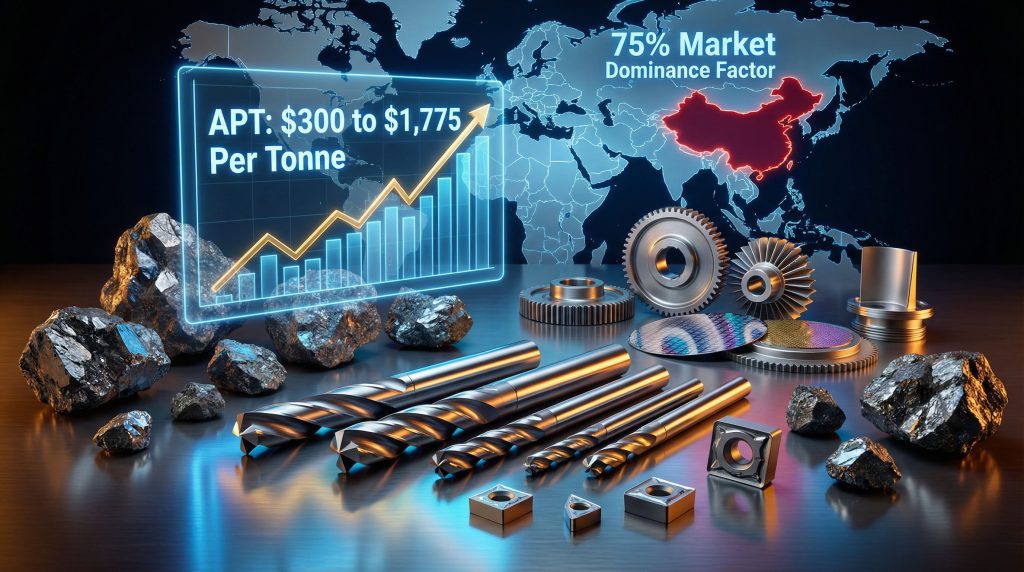
China's dominance in tungsten production extends beyond simple market share statistics to encompass every level of the supply chain. The country controls approximately 75% of global tungsten mining capacity while simultaneously dominating downstream processing, chemical conversion, and finished product manufacturing. This vertical integration created vulnerabilities that export restrictions transformed into systematic market disruption.
The 75% Market Dominance Factor
Chinese tungsten production concentration reflects both geological advantages and decades of strategic development. The country's tungsten deposits typically contain higher-grade ores ranging from 0.3% to 0.8% tungsten trioxide content, compared to global averages of 0.1% to 0.3%. This grade differential reduces processing costs and provides competitive advantages that discouraged international capacity development.
Beyond raw material production, China developed comprehensive downstream processing capabilities that other regions never replicated. Ammonium paratungstate (APT) production, the key intermediate chemical used in tungsten powder manufacturing, remains concentrated in Chinese facilities that process both domestic and imported concentrates. This processing bottleneck means even tungsten mined elsewhere often requires Chinese conversion facilities.
The geographic concentration of tungsten reserves compounds China's market control. Major deposits outside China include Russia's Tyrnyauz mine, Portugal's Panasqueira deposit, and Kazakhstan's development projects. However, these operations combined represent less than 15% of global production capacity, with many facing operational challenges, financing constraints, or environmental compliance issues.
Export Restriction Timeline and Impact Analysis
China's export control implementation followed a phased approach that initially targeted specific product categories before expanding to comprehensive restrictions. The first phase focused on tungsten concentrates and APT exports, limiting shipments through quota systems and licensing requirements. These measures reduced international availability while maintaining domestic supply for Chinese manufacturers.
The restrictions intensified during 2025 as geopolitical tensions escalated. Export quotas for tungsten products decreased by 60-70% compared to historical levels, while licensing approval times extended from weeks to months. Administrative delays created additional supply uncertainty as international buyers struggled to predict shipment timing.
By early 2026, export restrictions had effectively eliminated China's role as a reliable supplier for international markets. APT exports approached near-zero levels, while tungsten concentrate shipments became sporadic and unpredictable. This supply withdrawal forced international consumers to compete for limited alternative sources or develop expensive substitute materials.
What Makes Ammonium Paratungstate So Critical?
APT represents the most critical bottleneck in tungsten supply chains due to its essential role in powder metallurgy and carbide production. The chemical conversion process from tungsten concentrates to APT requires specialized facilities, high-purity chemicals, and extensive environmental controls. China's processing capacity for APT exceeds 80% of global requirements, creating dependencies that export restrictions immediately exposed.
International APT inventories typically operated on 30-60 day supply cycles based on reliable Chinese shipments. When exports ceased, these inventories depleted rapidly as manufacturers maintained production schedules. Alternative APT sources, primarily from recycling operations, could supply only 10-15% of normal requirements while operating at maximum capacity.
The technical specifications required for APT production created additional barriers to supply diversification. Purity requirements for tungsten carbide manufacturing demand APT with less than 50 parts per million of specific metallic impurities. Developing these purification capabilities outside China requires significant capital investment and technical expertise transfer that remains restricted under export control regimes.
| Product Category | 2025 Export Volume | 2026 Export Volume | Percentage Decline |
|---|---|---|---|
| APT | Baseline | Near Zero | -95%+ |
| Tungsten Concentrates | High | Severely Limited | -70%+ |
| Tungsten Carbide | Moderate | Restricted | -60%+ |
What Are the Root Causes of the Structural Supply Shortage?
The global tungsten supply squeeze extends beyond export restrictions to encompass fundamental structural challenges that have developed over decades. These underlying issues suggest that even resolution of trade disputes would not immediately restore market balance, as supply-side constraints reflect long-term trends in resource depletion, environmental compliance, and investment patterns.
Declining Ore Grades in Established Mines
Tungsten mining faces the same ore grade degradation challenges affecting most mineral commodities, but the metal's unique geology creates particularly acute problems. Historical tungsten mines typically extracted ore grades ranging from 0.5% to 1.2% tungsten trioxide, while current operations average 0.2% to 0.4% grades. This decline requires proportionally greater mining volumes and processing capacity to maintain output levels.
China's major tungsten districts demonstrate this grade deterioration pattern clearly. The Shizhuyuan mine complex in Hunan Province, historically one of the world's largest tungsten operations, has seen extractable grades decline by approximately 40% over the past two decades. Similar patterns affect the Yangshang deposit in Jiangxi Province and the Xianglushan mine system.
Grade decline impacts extend beyond simple economics to affect processing technology requirements. Lower-grade ores often require different beneficiation techniques, increased grinding energy, and more complex separation processes. These technological adaptations increase capital and operating costs while reducing plant throughput rates, creating compound effects on supply availability.
Environmental Compliance Costs and Mining Constraints
Tungsten extraction generates significant environmental challenges due to the metal's typical association with tin, bismuth, and molybdenum in complex ore systems. Acid mine drainage from tungsten operations can persist for decades after mine closure, while processing chemicals used in flotation and leaching require extensive waste treatment systems.
Chinese environmental regulations introduced stricter compliance requirements that increased operating costs and reduced production capacity at marginal operations. Wastewater treatment standards implemented since 2020 require tungsten operations to achieve discharge levels that many older facilities cannot economically meet. Plant closures and capacity reductions resulted from these regulatory changes.
International tungsten projects face similar environmental challenges with additional regulatory complexity. European Union mining regulations require comprehensive environmental impact assessments that can extend project development timelines by 5-7 years. North American projects encounter regulatory frameworks that vary by jurisdiction while maintaining equally stringent environmental standards.
Decades of Underinvestment in New Capacity
The tungsten industry experienced chronic underinvestment in new capacity development due to price volatility, Chinese market dominance, and technical barriers to entry. Capital requirements for tungsten mining and processing projects typically exceed those for comparable base metal operations due to complex metallurgy and environmental control systems.
Chinese market dominance discouraged international investment by creating pricing uncertainty and competitive disadvantages. Potential investors recognised that Chinese producers could manipulate prices to render new projects uneconomical, particularly during capital-intensive development phases. This dynamic created a self-reinforcing cycle of supply concentration.
In addition, the complexity of tungsten processing created additional investment barriers. Metallurgical expertise required for tungsten extraction and refining remains concentrated within established industry participants. Technology transfer restrictions and proprietary process knowledge limited the ability of new entrants to develop competitive operations.
How Severe Is the Current Price Escalation?
The tungsten market has experienced unprecedented price escalation that exceeds historical volatility patterns and reflects fundamental supply-demand imbalances rather than speculative trading activity. Price movements have demonstrated sustained upward momentum that began in late 2025 and accelerated dramatically following Chinese New Year celebrations in February 2026, contributing to a global supply squeeze.
APT Price Surge: From $300 to $1,775 Per Tonne
Ammonium paratungstate pricing has undergone the most dramatic transformation in the tungsten complex, reflecting its critical position in supply chains and limited substitute availability. Benchmark APT prices measured in major trading centres increased from approximately $300 per metric tonne unit (MTU) in early 2025 to current levels exceeding $1,775 per MTU, representing a nearly six-fold increase within eighteen months.
The price escalation pattern demonstrates classic supply shock characteristics with initial gradual increases followed by exponential acceleration. Monthly price gains averaged 15-20% throughout the latter half of 2025 before reaching 25-40% monthly increases during the first quarter of 2026. This acceleration coincides with inventory depletion and panic buying by industrial consumers.
Regional price differentials have emerged as supply chains fragment and transportation costs increase. European APT spot prices typically trade at $100-200 per MTU premiums to Asian benchmarks, while North American prices show even larger differentials. These geographic premiums reflect logistical constraints and regional supply security concerns.
Concentrate Price Movements and Market Volatility
Tungsten concentrate pricing has followed APT trends while demonstrating higher volatility due to limited trading liquidity and processing bottlenecks. Concentrate prices for 65% tungsten trioxide content material have increased from $190-210 per MTU in early 2025 to current ranges of $1,200-1,400 per MTU, depending on quality specifications and delivery terms.
The concentrate market exhibits unique pricing dynamics due to limited processing alternatives outside China. International tungsten smelters in South Korea, Japan, and Europe operate at capacity constraints while competing for available concentrate supplies. This competition has created bidding dynamics that drive prices beyond levels justified by downstream product values.
Quality premiums for higher-grade concentrates have expanded significantly as processors seek to maximise facility utilisation. Premium-grade concentrates containing 70%+ tungsten trioxide content command price premiums of $200-300 per MTU above standard materials, compared to historical premiums of $50-75 per MTU.
Post-Spring Festival 2026 Price Acceleration
The Chinese New Year holiday period in February 2026 marked a critical inflection point for tungsten markets as inventory positions became fully exposed and supply constraints intensified. Industrial restocking demand following the holiday coincided with continued export restrictions to create acute supply shortages across all product categories.
Manufacturing facilities worldwide discovered that inventory levels calculated for normal supply conditions proved inadequate during extended supply disruptions. Just-in-time inventory management practices that optimised working capital during stable supply conditions became liabilities when supply security trumped cost optimisation.
The post-holiday price surge demonstrated market participants' recognition that tungsten shortages represented structural rather than cyclical challenges. Forward contracting for tungsten materials extended to unprecedented 18-24 month terms as consumers prioritised supply security over price optimisation.
Price Alert: Tungsten prices have experienced a fivefold increase over the past 12 months, with APT reaching $1,775 per tonne compared to the historical average of $300 per tonne in 2025.
Can Alternative Supply Sources Fill the Gap?
The tungsten supply crisis has prompted intensive exploration of alternative supply sources, yet technical, economic, and logistical constraints limit the near-term potential for meaningful supply diversification. Alternative supply development requires understanding both the scale of supply needed and the realistic timelines for capacity expansion across different supply categories.
Artisanal Mining Potential and Limitations
Artisanal and small-scale tungsten mining operations represent the most immediately scalable alternative supply source, particularly in regions with known tungsten mineralisation but limited industrial development. Rwanda's tungsten sector exemplifies this potential, where small-scale mining operations have increased output by 40% in response to higher prices whilst maintaining acceptable quality standards.
However, artisanal mining faces inherent limitations that constrain its ability to replace industrial-scale Chinese production. Individual operations typically produce 5-50 tonnes of concentrates annually, meaning hundreds of new operations would be required to meaningfully impact global supply. Coordination challenges, quality control issues, and technical expertise limitations create scaling barriers.
Geographic constraints further limit artisanal mining expansion potential. Tungsten mineralisation occurs in specific geological environments that are not globally distributed, concentrating potential artisanal operations in regions that may lack infrastructure, regulatory frameworks, or investment capital necessary for sustainable development.
Recycling Infrastructure Constraints Outside China
Tungsten recycling represents a theoretically attractive supply alternative due to the metal's durability and concentrated use in specific applications. Recycling potential exists primarily in tungsten carbide cutting tools, where material recovery rates can reach 70-80% through proper collection and processing systems.
Current recycling infrastructure remains inadequately developed outside China and Japan. European recycling facilities process approximately 15,000 tonnes of tungsten annually from scrap materials, whilst North American capacity handles roughly 8,000 tonnes. These volumes represent significant contributions but remain insufficient to offset Chinese export restrictions.
Technical challenges in tungsten recycling create barriers to rapid capacity expansion. Carbide recycling requires specialised furnace systems, controlled atmospheres, and extensive quality control measures to produce APT meeting industrial specifications. Investment in recycling infrastructure requires 2-3 years for facility development and qualification.
Secondary Supply Development Challenges
Secondary tungsten supply sources include reprocessing of mine tailings, extraction from complex ore systems where tungsten occurs as a byproduct, and recovery from industrial waste streams. Tailings reprocessing has gained attractiveness due to higher tungsten prices and improved extraction technologies.
Historical tungsten mining operations often achieved only 40-60% recovery rates due to technological limitations and lower metal prices that did not justify additional processing investment. Modern processing techniques including column flotation, gravity separation improvements, and hydrometallurgical advances can potentially recover additional tungsten from existing tailings deposits.
Byproduct recovery from tin, copper, and molybdenum operations presents additional secondary supply potential. Integrated processing facilities can modify circuits to recover tungsten as a byproduct, though these modifications require significant capital investment and technical expertise that may not be economically justified at smaller operations.
| Supply Source | Current Contribution | Growth Potential | Timeline to Scale |
|---|---|---|---|
| Chinese Mines | 75% | Declining | N/A |
| Artisanal Mining | 6% | Limited Growth | 1-2 years |
| Recycling | 15% | Moderate Growth | 2-3 years |
| New Mine Development | 4% | High Potential | 5-7 years |
Which Industries Face the Greatest Supply Risk?
Tungsten supply constraints create disproportionate impacts across industrial sectors based on their ability to substitute materials, absorb higher costs, or modify production processes. Risk assessment requires evaluating both the technical criticality of tungsten in specific applications and the economic consequences of supply disruptions or material substitution.
Defense and Aerospace Manufacturing Dependencies
Military and aerospace applications represent the highest-risk category for tungsten supply disruptions due to performance requirements that preclude material substitution and procurement processes that prioritise reliability over cost considerations. Defence contractors utilise tungsten in armour-piercing ammunition, aircraft engine components, and electronic systems where material failure can have catastrophic consequences.
Ammunition manufacturing demonstrates particularly acute vulnerability to tungsten supply constraints. Kinetic energy penetrators rely on tungsten's density and hardness to achieve armour penetration capabilities that cannot be replicated with substitute materials. Military stockpiling requirements mean production interruptions can affect national security preparedness for extended periods.
Aerospace turbine manufacturing faces similar constraints in specialised applications. High-temperature turbine components utilise tungsten-based alloys in areas where other refractory metals cannot withstand operational stresses. Supply disruptions force manufacturers to redesign components, extend development timelines, and potentially reduce performance specifications.
Cutting Tool and Carbide Production Challenges
The cutting tool industry represents the largest industrial tungsten consumption sector and faces comprehensive supply chain disruption that affects manufacturing productivity across multiple sectors. Tungsten carbide production requires consistent APT supplies to maintain quality standards and production schedules that serve automotive, aerospace, and industrial manufacturing customers.
Carbide tool manufacturers operate under dual constraints of material availability and customer pricing pressures. Industrial customers expect reliable tool supplies whilst resisting price increases that reflect tungsten cost escalation. This dynamic forces tool manufacturers to absorb margin compression whilst managing supply allocation among competing customer priorities.
Quality control challenges emerge when manufacturers attempt to extend tungsten supplies through material substitution or process modifications. Carbide grade specifications developed over decades of optimisation cannot be easily modified without extensive testing and customer qualification processes that may take 6-18 months to complete.
Electronics and Semiconductor Industry Impact
Electronics manufacturing utilises tungsten in specialised applications where its electrical and thermal properties provide essential performance characteristics. Semiconductor fabrication equipment incorporates tungsten heating elements, electrical contacts, and thermal management components that operate under extreme conditions.
The semiconductor industry's supply chain complexity amplifies tungsten shortage impacts through cascading effects on equipment availability and production capacity. Fab equipment manufacturers face extended delivery times for tungsten components whilst managing customer expectations for new facility installations and capacity expansions.
Consumer electronics manufacturing encounters tungsten supply constraints in vibration motors for mobile devices and heating elements for display manufacturing. Production volume requirements in electronics often exceed available substitute material supplies, forcing manufacturers to redesign products or accept performance compromises.
The next major ASX story will hit our subscribers first
How Are Governments Responding to the Crisis?
Government responses to tungsten supply security challenges reflect broader critical mineral policy initiatives whilst addressing specific industrial vulnerabilities that affect economic competitiveness and national security interests. Policy interventions span strategic stockpiling, investment incentives, research and development programmes, and international cooperation agreements. Countries are implementing their critical minerals strategy to address supply vulnerabilities.
U.S. $12 Billion Critical Minerals Initiative
The United States has integrated tungsten into comprehensive critical minerals strategies that address supply chain vulnerabilities across multiple strategic materials. Federal investment programmes include loan guarantees for domestic mining projects, research grants for recycling technology development, and stockpile expansion activities managed through the Defense Logistics Agency.
Mining project development receives priority attention through expedited permitting processes and technical assistance programmes. Domestic tungsten projects benefit from geological survey support, environmental assessment guidance, and coordination between federal agencies to reduce development timelines and regulatory uncertainty.
Research and development initiatives focus on tungsten recycling technology, substitute material development, and processing efficiency improvements. University partnerships receive federal funding to investigate advanced separation techniques, alternative material systems, and supply chain optimisation strategies that could reduce tungsten dependence.
Strategic Stockpiling Programs Worldwide
International governments have recognised tungsten's strategic importance through stockpiling programmes designed to buffer supply disruptions and provide industrial security during extended shortages. National stockpiles serve dual purposes of emergency supply availability and market stabilisation during extreme price volatility.
European Union member states coordinate tungsten stockpiling through shared procurement programmes and inventory management systems. Collective purchasing power enables smaller economies to participate in strategic stockpiling whilst achieving economies of scale in procurement and storage activities.
Asian governments outside China have prioritised tungsten stockpiling as supply security measures. Japan and South Korea maintain substantial tungsten inventories relative to their industrial consumption patterns whilst developing domestic processing capabilities to reduce dependence on Chinese supply chains. These efforts complement Australia's development of a critical minerals reserve.
Public-Private Partnership Models
Government agencies increasingly collaborate with private sector partners to develop tungsten supply alternatives through risk-sharing arrangements that combine public policy objectives with commercial viability requirements. Partnership structures include government loan guarantees, equity investments, and purchase agreements that provide project financing security.
Mining development partnerships offer government agencies opportunities to influence project development whilst providing private partners with financial support and regulatory assistance. Public investment in tungsten projects typically focuses on early-stage development activities where private capital markets may be inadequate.
Technology development partnerships combine government research capabilities with private sector commercial expertise to accelerate tungsten recycling and substitute material programmes. Shared intellectual property arrangements enable broader adoption of successful technologies whilst providing returns on government research investments.
What Substitution Options Exist for Tungsten?
Material substitution represents the most immediate response option for industries facing tungsten supply constraints, yet the metal's unique property combination creates significant technical challenges that limit substitute effectiveness across many applications. Substitution analysis requires evaluating performance trade-offs, cost implications, and implementation timelines for alternative materials.
Molybdenum and Niobium Alternative Analysis
Molybdenum offers the closest technical approximation to tungsten's properties in specific applications, particularly those requiring high-temperature performance and corrosion resistance. Molybdenum substitution works effectively in electrical contact applications and some high-temperature furnace components where tungsten's extreme hardness is not critical.
However, molybdenum's limitations become apparent in applications requiring tungsten's full property spectrum. Density differences mean molybdenum cannot replace tungsten in applications where weight and momentum are critical factors, such as military penetrators and balancing weights. Temperature limitations restrict molybdenum use in extreme high-temperature applications above 2,000°C.
Niobium provides alternative performance characteristics for specialised applications, particularly those requiring corrosion resistance and low thermal expansion. Aerospace applications can utilise niobium alloys in some turbine components where tungsten's density is less critical than thermal stability and mechanical properties.
Titanium and Ceramic Replacement Potential
Titanium-based materials offer strength-to-weight advantages that can compensate for density limitations in specific applications. Aerospace manufacturers can substitute titanium alloys in structural applications where tungsten's density provides no functional advantage whilst achieving weight savings that improve overall system performance.
Advanced ceramics represent promising substitute materials for cutting tool applications where tungsten carbide traditionally dominates. Ceramic cutting tools utilising aluminium oxide, silicon nitride, and cubic boron nitride can achieve comparable cutting performance in specific machining applications whilst offering potential cost advantages.
Ceramic substitution faces implementation challenges related to machining parameter optimisation and tool geometry modifications. Manufacturing processes developed around tungsten carbide tools require adjustment when transitioning to ceramic alternatives, including cutting speed modifications, feed rate changes, and cooling system adaptations.
How Do Performance Trade-offs Affect Industrial Applications?
Substitute materials typically require performance compromises that affect productivity, quality, or operational flexibility in ways that extend beyond direct material cost comparisons. Total cost analysis must include productivity losses, quality impacts, and process modification expenses that accompany material substitution.
Cutting tool substitution demonstrates these trade-off complexities clearly. Ceramic cutting tools may reduce material costs by 20-30% compared to tungsten carbide whilst requiring 15-20% longer machining times due to conservative cutting parameters needed to prevent tool failure. The net economic impact depends on specific application requirements and labour cost structures.
Long-term reliability considerations affect substitute material acceptance in critical applications. Industrial customers often prefer paying premium prices for proven tungsten-based materials rather than accepting performance uncertainty associated with substitute materials, particularly in applications where tool failure creates significant production disruptions.
When Will New Mining Capacity Come Online?
New tungsten mining capacity development faces extended timelines that reflect both the technical complexity of tungsten extraction and the regulatory frameworks governing mining development in major jurisdictions. Capacity additions scheduled for the next decade represent projects initiated during previous market cycles and may be insufficient to address current supply shortfalls. This situation highlights the importance of mining innovation trends in accelerating development processes.
South Korean and Kazakhstani Project Timelines
South Korea's domestic tungsten development focuses on reopening historical mining areas and upgrading processing facilities to reduce dependence on Chinese imports. The Sangdong mine project, operated by Almonty Industries, represents the most significant near-term capacity addition with planned production of 3,500 tonnes per year scheduled for late 2027.
Kazakhstan's tungsten development benefits from existing mining infrastructure and favourable geological conditions in the Karaganda region. Multiple project developers are advancing feasibility studies for operations that could collectively produce 2,000-3,000 tonnes annually, though development timelines extend through 2028-2029 due to infrastructure requirements and financing challenges.
Technical challenges specific to these projects include complex ore mineralogy requiring specialised processing techniques and environmental considerations affecting permitting timelines. Metallurgical testing continues to optimise recovery rates whilst meeting environmental discharge standards that have become increasingly stringent.
European Mining Development Prospects
European tungsten development faces regulatory frameworks that prioritise environmental protection whilst recognising strategic mineral security requirements. Portugal's Panasqueira mine expansion represents the most advanced European project, with capacity increases planned to reach 1,500 tonnes annually by 2028.
Germany and Austria possess tungsten deposits that could support domestic production, though environmental regulations and community acceptance challenges create development barriers. Alpine Metals' projects in Austria advance through permitting processes that could enable production by 2029-2030, depending on environmental assessment outcomes.
The United Kingdom's tungsten potential centres on historical mining areas in Cornwall and Devon where modern extraction techniques could enable economic production. Wolf Minerals' Hemerdon project faces refinancing challenges that could delay development despite favourable technical parameters and proximity to European markets.
Investment Requirements for Market Rebalancing
Industry analysts estimate that $3-5 billion in new mining investment will be required to meaningfully rebalance global tungsten markets and reduce dependence on Chinese supply. This investment level reflects both the capital intensity of tungsten mining and the need for geographic diversification across multiple projects.
Individual tungsten mining projects typically require $200-500 million in development capital, depending on production capacity, ore complexity, and infrastructure requirements. Processing facilities represent 40-50% of total project costs due to specialised equipment and environmental control systems necessary for tungsten extraction.
Investment timelines reflect both project development requirements and capital market constraints affecting mining sector financing. Equity and debt financing for tungsten projects competes with other critical mineral investments whilst facing commodity price volatility that affects project economics and investor confidence.
What Does the Future Hold for Tungsten Markets?
Tungsten market evolution will be shaped by the intersection of supply diversification efforts, demand growth from emerging technologies, and geopolitical factors affecting international trade patterns. Market rebalancing requires understanding both the pace of supply development and the trajectory of demand growth across traditional and emerging applications. The tungsten market outlook suggests sustained higher prices will drive development.
Long-term Price Forecasting Scenarios
Price forecasting for tungsten markets involves multiple scenarios that reflect uncertainty regarding supply development timelines, Chinese export policy evolution, and demand growth rates. Base case projections suggest tungsten prices will remain elevated through 2027-2028 before moderating as new capacity becomes operational.
Conservative forecasting scenarios assume continued Chinese export restrictions and slower-than-expected new capacity development. These conditions could maintain APT prices at $800-1,200 per MTU through 2029, well above historical averages but below current crisis levels.
Optimistic scenarios incorporate successful development of multiple new mining projects and partial restoration of Chinese exports through diplomatic agreements. Price normalisation in these scenarios could see APT prices decline to $400-600 per MTU by 2028-2029, still representing premium levels compared to pre-crisis pricing.
Demand Growth from Clean Energy Transition
The global clean energy transition creates new tungsten demand sources that may offset supply improvements and maintain elevated price levels longer than traditional demand patterns would suggest. Wind turbine manufacturing increasingly utilises tungsten-based materials in generator components and power transmission systems.
Solar panel manufacturing equipment requires tungsten components for high-temperature processing systems used in polysilicon production and solar cell fabrication. Expansion of solar manufacturing capacity in Europe, North America, and Asia creates additional tungsten demand that competes with traditional industrial applications.
Electric vehicle production generates tungsten demand through specialised cutting tools required for battery component manufacturing and electric motor production. EV manufacturing growth rates of 15-20% annually create corresponding increases in tungsten-intensive machining operations.
Supply Chain Diversification Strategies
Industrial consumers are implementing comprehensive supply chain diversification strategies that extend beyond simple supplier geographic distribution to include vertical integration, strategic partnerships, and alternative material development. Supply security priorities now influence procurement decisions equally with cost optimisation considerations.
Vertical integration strategies include direct investment in mining projects, recycling facility development, and processing capability establishment. Major tungsten consumers are evaluating equity investments in mining projects to secure long-term supply agreements whilst participating in project economics.
Strategic stockpiling has evolved from emergency supply measures to comprehensive inventory management systems that buffer supply variability whilst providing market intelligence on supply-demand dynamics. Industrial stockpiling programmes now maintain 6-12 month inventory levels compared to historical 30-60 day supplies, aligning with broader raw materials supply security initiatives.
Market Outlook: Industry analysts project that sustained higher prices will be necessary to incentivise new mine development, describing this as the high-price cure required to rebalance global tungsten markets by 2027-2028.
How Can Industries Prepare for Continued Supply Constraints?
Industrial preparation for extended tungsten supply constraints requires comprehensive strategies that address immediate supply security whilst building long-term resilience through process optimisation, alternative materials development, and supply chain restructuring. Preparation strategies must balance current operational requirements with future supply realities.
Strategic Inventory Management Approaches
Modern inventory management for tungsten materials requires balancing supply security against working capital efficiency whilst maintaining quality standards throughout extended storage periods. Strategic stockpiling involves determining optimal inventory levels that provide security without creating excessive carrying costs.
Inventory management systems must accommodate quality degradation considerations specific to tungsten materials. APT storage requires moisture control and contamination prevention to maintain chemical purity required for carbide production. Tungsten carbide powders need inert atmosphere storage to prevent oxidation that affects final product quality.
Collaborative inventory management among industry participants can achieve economies of scale whilst sharing supply security risks. Industry consortiums enable smaller manufacturers to participate in strategic stockpiling whilst accessing professional inventory management services and quality control systems.
Supply Chain Risk Mitigation Strategies
Risk mitigation requires comprehensive assessment of supply chain vulnerabilities followed by systematic development of alternative sources, backup suppliers, and emergency response protocols. Supply chain mapping must identify all points of tungsten dependence, including indirect exposures through supplier networks.
Supplier diversification strategies extend beyond geographic distribution to include evaluation of supplier financial stability, technical capabilities, and emergency response capacity. Supplier qualification programmes now incorporate supply chain resilience criteria equally with traditional quality and cost metrics.
Emergency response planning includes rapid supplier switching procedures, emergency sourcing protocols, and production priority systems for critical applications. Response plans require regular testing and updating to address evolving supply constraints and market conditions.
Alternative Material Research and Development
Research and development programmes focusing on tungsten alternatives require long-term perspectives that balance near-term supply security with technological advancement opportunities. R&D initiatives should address both direct material substitution and process modifications that reduce tungsten intensity.
Collaboration with universities and research institutions can accelerate alternative material development whilst sharing development costs and technical risks. Joint development programmes enable smaller companies to participate in advanced materials research whilst providing access to specialised equipment and expertise.
Frequently Asked Questions:
Can molybdenum completely replace tungsten in industrial applications?
Molybdenum can substitute for tungsten in specific high-temperature and electrical applications but cannot replace tungsten's unique combination of density, hardness, and temperature resistance required in cutting tools, military applications, and radiation shielding.
How long will the current supply shortage persist?
Supply constraints are expected to persist through 2027-2028, as new mining capacity development requires 5-7 years whilst recycling infrastructure expansion needs 2-3 years to significantly impact global supply availability.
Which countries have the largest untapped tungsten reserves?
Russia, Kazakhstan, and Canada possess significant undeveloped tungsten reserves, whilst Australia and European nations have potential for production expansion through technology improvements and higher-grade deposit development.
Looking to Capitalise on Critical Mineral Supply Disruptions?
Discovery Alert's proprietary Discovery IQ model instantly identifies significant mineral discoveries across the ASX, including tungsten and other critical minerals experiencing acute supply shortages. As the tungsten crisis demonstrates how supply constraints can generate exceptional returns for early-positioned investors, Discovery Alert ensures subscribers receive actionable insights on discovery opportunities before broader market recognition drives substantial price appreciation. Begin your 14-day free trial today to secure your competitive advantage in critical mineral investments.