June 5, 2026
The Metal That Wars Are Built On: Why Tungsten's Supply Crisis Is Reshaping Capital Markets
Few industrial metals carry the kind of strategic weight that tungsten does. Its exceptional hardness, the highest melting point of any metal at 3,422 degrees Celsius, and its extraordinary density make it physically irreplaceable in applications where no substitute exists. Armour-piercing projectiles, missile guidance components, semiconductor fabrication tooling, and high-speed cutting equipment all depend on tungsten in ways that cannot be engineered around. Yet for decades, the global supply of this material has been quietly and almost entirely dominated by a single country. That concentration has now become one of the most significant vulnerabilities in Western industrial and defence supply chains, and the strategic importance of tungsten is prompting capital markets to begin pricing in the cost of fixing it.
Against this backdrop, the news that Almonty raises $700m from notes offering has drawn significant attention from institutional investors, critical mineral analysts, and defence sector procurement strategists alike.
When big ASX news breaks, our subscribers know first
Understanding What the $700M Convertible Notes Offering Actually Represents
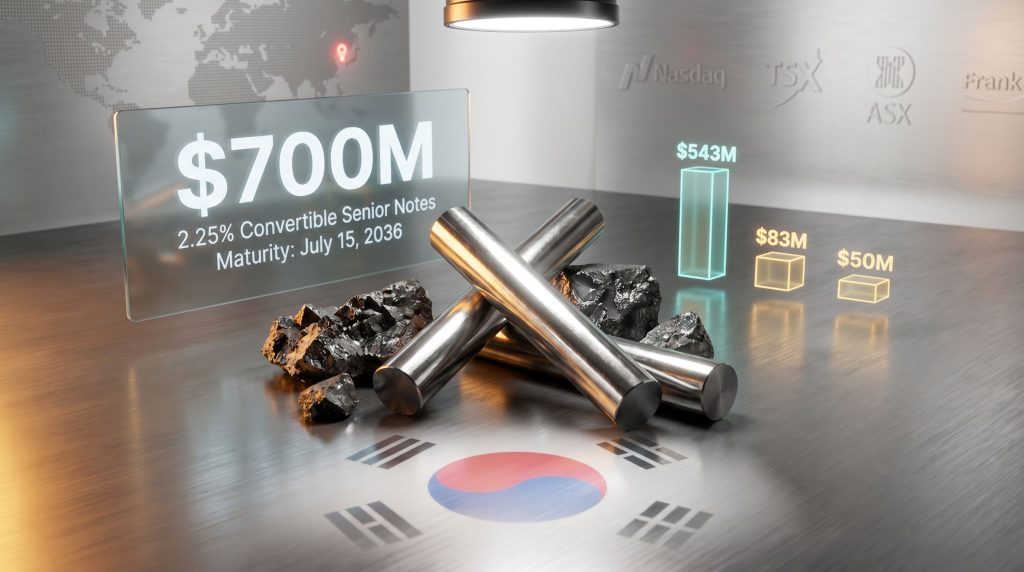
The headline figure tells only part of the story. Almonty Industries has priced an oversubscribed private placement of $700 million in 2.25% convertible senior notes, sold exclusively to qualified institutional buyers. The oversubscribed status of the raise is itself a data point worth examining: institutional capital does not pile into a niche mining company without a compelling thesis. That thesis, in this case, is the convergence of geopolitical necessity and physical scarcity.
A greenshoe option of up to $100 million has been extended to initial purchasers, exercisable within 13 days of the notes' first issuance, meaning the total potential raise could reach approximately $800 million. Settlement is expected on or around June 9, 2026, with the notes carrying a maturity date of July 15, 2036, representing a full ten-year tenor.
The key structural terms are outlined below:
| Parameter | Detail |
|---|---|
| Offering Size | $700 million (base) |
| Greenshoe Option | Up to $100 million additional |
| Coupon Rate | 2.25% |
| Maturity Date | July 15, 2036 |
| Conversion Rate | 36.4950 shares per $1,000 principal |
| Initial Conversion Price | ~$27.40 per share |
| Conversion Premium | ~32.5% above June 4, 2026 closing price of $20.68 |
| Net Proceeds (base) | ~$675 million |
| Net Proceeds (full greenshoe) | ~$772 million |
The 2.25% coupon is notably low for a company operating in the mining and resources sector, which typically commands higher yield premiums to compensate for commodity price and operational risk. This rate reflects the quality of the institutional bid and the perceived long-duration value of tungsten supply assets in Western-aligned jurisdictions.
How Almonty Plans to Deploy the Capital
The allocation of net proceeds breaks down into three distinct buckets, each revealing a different dimension of the company's strategic intent.
| Use of Proceeds | Estimated Amount |
|---|---|
| Capped Call Transactions | $83 million |
| Debt Refinancing | $50 million |
| General Corporate / M&A | $543 million |
| Total (Base Offering) | ~$675 million net |
The dominant allocation, roughly $543 million, is directed toward general corporate purposes, which the company has indicated may include acquisitions of assets or businesses. This is not a routine capital raise for sustaining existing operations. The scale and flexibility of this allocation signals a company positioning itself for consolidation-led growth in a global tungsten market that remains fragmented outside of China. Furthermore, the Almonty defence partnership context adds additional strategic weight to how this capital may ultimately be deployed.
What Capped Call Transactions Mean for Existing Shareholders
The $83 million allocated to capped call transactions is a mechanism less commonly understood by retail market participants but widely used in institutional-grade convertible note issuances. A capped call is a derivative instrument purchased by the issuer simultaneously with the note offering. It effectively raises the economic dilution threshold above the stated conversion price by allowing the company to purchase back shares at the conversion price, up to a defined ceiling.
In practical terms, this means that if the share price rises significantly, the economic impact of conversion on existing shareholders is partially offset. Allocating this level of capital to dilution protection signals that management is acutely aware of shareholder sensitivity and is actively structuring the raise to balance growth ambition with capital discipline. This is precisely the kind of sophisticated instrument that institutional-grade issuers in the US convertible debt market routinely deploy.
Why the Sangdong Mine Changes the Strategic Calculus
Any assessment of this capital raise must begin with the asset that underpins its commercial rationale. The Sangdong mine in South Korea is not simply another tungsten deposit. It is one of the largest known tungsten resources located outside of China's borders, and its geological characteristics set it apart from many comparable projects globally.
Tungsten deposits are geologically rare. Economically viable concentrations of wolframite and scheelite, the two primary tungsten-bearing minerals, are found in skarn and vein-hosted systems that require specific geological conditions to form. Sangdong is a skarn-type deposit, a classification associated with large tonnage, relatively consistent grade distribution, and favourable processing characteristics compared to more structurally complex vein systems.
The mine was brought back into commercial production in March 2026, ending a dormancy period of approximately 30 years. That hiatus was not the result of geological exhaustion but rather a combination of historically depressed tungsten prices and the economic pressure exerted by low-cost Chinese production that had flooded global markets through the 1990s and 2000s. The same supply dynamic that shuttered Sangdong is now, paradoxically, the reason its restart carries so much strategic weight. In addition, tungsten offtake agreements across the sector have reinforced just how urgently Western buyers are seeking contracted supply from non-Chinese sources.
The return to production at Sangdong represents one of the most consequential additions to Western-aligned tungsten supply in a generation. Its location in South Korea, a country deeply integrated into US and allied defence and technology supply chains, amplifies the strategic significance well beyond the mine's raw production metrics.
South Korea's advanced industrial infrastructure, established trade frameworks with the United States, European Union, and Japan, and its position within key technology supply chains create natural downstream demand pathways for Sangdong's output. The country's proximity to major electronics manufacturing hubs in Northeast Asia further reduces logistical friction for industrial end users.
The China Concentration Problem: A Supply Chain Vulnerability Decades in the Making
To understand why institutional capital is flowing toward tungsten, it is necessary to understand just how extreme the supply concentration problem has become. China controls an estimated 80% or more of global tungsten mine production and an even larger share of downstream processing capacity, including the production of ammonium paratungstate (APT), the primary intermediate product from which most tungsten materials are manufactured.
APT is the critical link in the tungsten supply chain that is least understood outside specialist circles. Raw tungsten ore must be chemically processed into APT before it can be converted into metal powder, wire, carbide, or other end-use forms. China's dominance in APT production means that even tungsten mined outside China often flows through Chinese processing infrastructure before reaching Western industrial buyers. This creates a bottleneck that persists even when alternative mining sources exist.
The strategic implications have become acute as geopolitical tensions between China and Western nations have escalated. Export restrictions, technology transfer controls, and trade policy uncertainty have prompted defence ministries, electronics manufacturers, and industrial conglomerates across North America, Europe, and allied Asia-Pacific nations to actively audit and restructure their tungsten procurement. Consequently, the defence supply chain risks associated with single-nation dependency have moved from theoretical concern to active procurement policy across multiple allied governments.
Tungsten's Irreplaceable Role in Defence and Advanced Manufacturing
The physical properties that make tungsten strategically critical are worth examining in detail, as they explain why substitution is not a credible near-term solution:
- Melting point of 3,422°C, the highest of any metal, making it essential in high-temperature industrial and aerospace applications
- Density of approximately 19.3 g/cm³, nearly twice that of lead, which is what makes tungsten penetrators so effective in armour-piercing applications
- Hardness and wear resistance that makes tungsten carbide the material of choice for cutting tools, drill bits, and machining inserts used throughout industrial manufacturing
- Electrical properties that make tungsten critical in semiconductor fabrication equipment, specifically in physical vapour deposition targets and interconnect applications in advanced chip manufacturing
- Dimensional stability at extreme temperatures, which is why tungsten is used in filaments, heating elements, and rocket nozzle components
No single alternative material replicates this combination of properties. This is the geological and materials science foundation of tungsten's critical mineral designation across multiple Western government frameworks. The broader critical minerals demand surge across defence and technology sectors has, however, brought these designations into sharper focus for both policymakers and investors.
Dilution Mechanics and Share Price Dynamics
The initial market reaction to the announcement included a share price decline of approximately 12.5%, a response that is consistent with standard investor behaviour around convertible note issuances. When a company announces a large convertible offering, the market immediately begins discounting anticipated future dilution, often before fully assessing the quality of capital deployment.
The conversion mechanics deserve careful attention. At the initial conversion rate of 36.4950 shares per $1,000 principal, a full conversion of the $700 million base offering would create approximately 25.5 million new shares. The conversion price of ~$27.40 per share represents a 32.5% premium over the June 4, 2026 closing price of $20.68, meaning conversion only becomes economically attractive for noteholders if the share price appreciates substantially from current levels.
This structure is designed to align noteholder and shareholder interests. Noteholders benefit from the fixed coupon income and the embedded call option on equity appreciation. Existing shareholders are protected in the near term by the premium conversion threshold, with further protection provided by the capped call overlay.
The oversubscribed nature of this offering, despite the immediate share price pressure, reflects a divergence between short-term equity market sentiment and longer-term institutional conviction. Investors willing to lock capital into a ten-year convertible instrument at 2.25% are not making a short-term trade. They are expressing a structural view on the future of tungsten supply and the strategic value of non-Chinese production capacity.
The next major ASX story will hit our subscribers first
Multi-Exchange Listing: Accessing the Broadest Possible Institutional Base
Almonty Industries trades across four major exchanges: Nasdaq in the United States, the TSX in Canada, the ASX in Australia, and the Frankfurt Stock Exchange in Germany. This multi-jurisdiction capital markets footprint is a deliberate strategy that extends well beyond geographic diversification for its own sake.
Each exchange taps a distinct institutional investor pool with different mandates, risk frameworks, and sector exposure preferences. North American institutional capital tends to be the deepest and most liquid for resource companies with defence-sector adjacency. European investors, particularly those operating under ESG frameworks that increasingly prioritise supply chain resilience, represent a growing allocation base for critical mineral producers in allied jurisdictions. Australian institutional capital, shaped by decades of mining investment culture, provides sector-specific expertise and appetite.
This breadth of access is particularly important for a capital raise of this magnitude. Concentrating liquidity across multiple markets reduces dependence on any single market's sentiment cycle and creates a more stable long-term institutional register.
Scenario Analysis: Where $543 Million in Strategic Capital Could Go
The largest single allocation, directed toward general corporate purposes including potential acquisitions, opens several strategic pathways worth mapping:
| Scenario | Capital Deployment Path | Strategic Outcome |
|---|---|---|
| Organic Expansion | Sangdong capacity scaling and processing upgrades | Higher production volume, lower unit costs over time |
| Acquisition-Led Growth | Acquiring underdeveloped tungsten assets in allied jurisdictions | Portfolio diversification, increased reserve base |
| Downstream Integration | Investment in APT or tungsten metal powder processing | Higher margin capture, reduced commodity price exposure |
| Defence Sector Offtake | Securing long-term supply agreements with NATO-aligned contractors | Stable contracted revenue, strategic positioning value |
| Processing Independence | Building non-Chinese APT processing capacity in Western jurisdictions | Supply chain sovereignty for allied industrial buyers |
The downstream integration scenario deserves particular attention. Currently, the value chain from mined ore to usable tungsten material is heavily compressed at the processing stage, where Chinese facilities dominate. A company that controls both the mine and the processing infrastructure in Western-friendly jurisdictions would occupy a uniquely valuable position in the critical mineral supply landscape. The capital now available to Almonty makes this kind of vertical integration strategically feasible in a way that was not possible before. Furthermore, as Almonty raises $700m from notes offering, the scale of ambition reflected in this deployment flexibility is difficult to overstate.
Key Takeaways for Investors and Industry Observers
Several conclusions can be drawn from examining this raise in full context:
- The oversubscription of the offering confirms that sophisticated institutional capital has moved beyond viewing tungsten as a niche industrial commodity and is now treating it as a strategic asset class
- The 10-year maturity tenor signals that institutional buyers are constructing long-duration positions, consistent with a view that the tungsten supply chain restructuring cycle will play out over years, not quarters
- The $543 million general corporate allocation is the most strategically significant figure in the entire offering, representing dry powder for moves that could reshape the Western tungsten supply landscape
- Sangdong's operational restart provides the production credibility that transforms this from a development-stage story into an active producer narrative, a distinction that matters enormously to institutional investment mandates
- The capped call structure and the 32.5% conversion premium together represent a carefully engineered balance between growth financing and shareholder protection, reflecting institutional-quality capital management
Disclaimer: This article is intended for informational purposes only and does not constitute financial advice. Statements relating to capital deployment plans, strategic outcomes, and market positioning involve forward-looking assumptions that are subject to material risks and uncertainties. Readers should conduct their own due diligence and consult a licensed financial adviser before making any investment decisions. Past share price performance and capital raise structures are not reliable indicators of future results.
Readers seeking ongoing coverage of tungsten supply chain dynamics, critical mineral market developments, and mining sector capital markets activity can explore related reporting at Mining Weekly.
Want to Be First When the Next Major Mineral Discovery Hits the ASX?
Discovery Alert's proprietary Discovery IQ model scans ASX announcements in real time, instantly identifying significant mineral discoveries across critical commodities like tungsten and delivering actionable insights directly to subscribers — explore historic discoveries and their returns to understand the scale of opportunity, then begin your 14-day free trial at Discovery Alert to position yourself ahead of the broader market.