July 25, 2026
The Hidden Architecture of a Critical Minerals Crisis
The global industrial economy has long operated on the assumption that commodity markets self-correct. When prices rise, production expands. When supply tightens, alternatives emerge. For most raw materials, this logic holds reasonably well. For tungsten in 2026, it is failing in ways that are reshaping defence procurement, industrial manufacturing, and critical minerals investment across NATO-aligned economies.
The tungsten supply deficit now unfolding is not the product of a single shock or policy decision. It is the cumulative result of geological depletion, geopolitical strategy, and a structural shift in how major economies think about supply chain security. Understanding why this deficit is proving so resistant to market correction requires stepping back from the price charts and examining the physical, political, and logistical architecture that governs how tungsten moves from mine to end-user.
When big ASX news breaks, our subscribers know first
What Makes Tungsten Structurally Irreplaceable
The Physics Behind the Scarcity Premium
Tungsten occupies a unique position in the periodic table that no amount of materials engineering has been able to replicate commercially. Its melting point of approximately 3,422 degrees Celsius is the highest of any known element, a property that makes it indispensable in environments where other metals would simply cease to exist as solids. Its density approaches that of gold, and its hardness rivals that of diamond, placing it among the most mechanically extreme substances in industrial use.
Furthermore, these are not theoretical properties. They translate directly into irreplaceable functions across critical sectors:
- Armour-piercing kinetic energy penetrators used in NATO-specification munitions require tungsten's density and hardness to maintain structural integrity at impact velocities exceeding 1,500 metres per second
- Turbine and rocket nozzle components in aerospace applications demand materials that remain structurally stable at temperatures far beyond what nickel superalloys can tolerate
- Precision industrial cutting tools, particularly in automotive and aerospace machining, rely on cemented tungsten carbide for cutting edge durability that no ceramic or steel composite can match across high-volume production runs
- High-specification electrical contacts and filaments in industries ranging from semiconductor fabrication to medical imaging depend on tungsten's combination of electrical conductivity, thermal stability, and corrosion resistance
For the highest-performance tier of each of these applications, substitution is not a design choice that engineering teams can simply make. Molybdenum can serve as a partial substitute in moderate-temperature applications, but once operating conditions exceed certain thermal and mechanical thresholds, tungsten becomes the only viable option. This physical reality underpins the entire investment thesis for non-Chinese tungsten supply development, and tungsten's strategic importance to Western nations continues to grow as a result.
How Large Is the Market Being Disrupted?
Global tungsten market volume was estimated at approximately 129,000 tonnes in 2025, a figure that encompasses everything from raw concentrate production through to intermediate chemical products and final manufactured components. This is not a small or obscure commodity market. The sectors it serves account for trillions of dollars in annual output globally.
Demand is distributed across several key end-use categories, with different growth trajectories shaping the market's future:
| End-Use Sector | Estimated Share of Demand | Demand Trajectory |
|---|---|---|
| Cemented Carbide Tools | ~55-60% | Stable to moderate growth |
| Automotive Components | ~25-30% | Evolving with electrification trends |
| Defence Applications | ~12% | Growing at approximately 8% annually |
| Electronics and Electrical | ~8-10% | Steady growth |
| Other Industrial | Remainder | Mixed |
The defence segment, while representing a relatively modest share of total volume, is expanding at roughly 8% annually and carries price-inelastic characteristics that distinguish it from other demand categories. Governments do not defer armaments procurement because tungsten costs more. This creates a demand floor that is insensitive to the price signals that normally moderate commodity markets.
What Is Causing the 2026 Tungsten Supply Deficit?
China's Control of the Supply Architecture
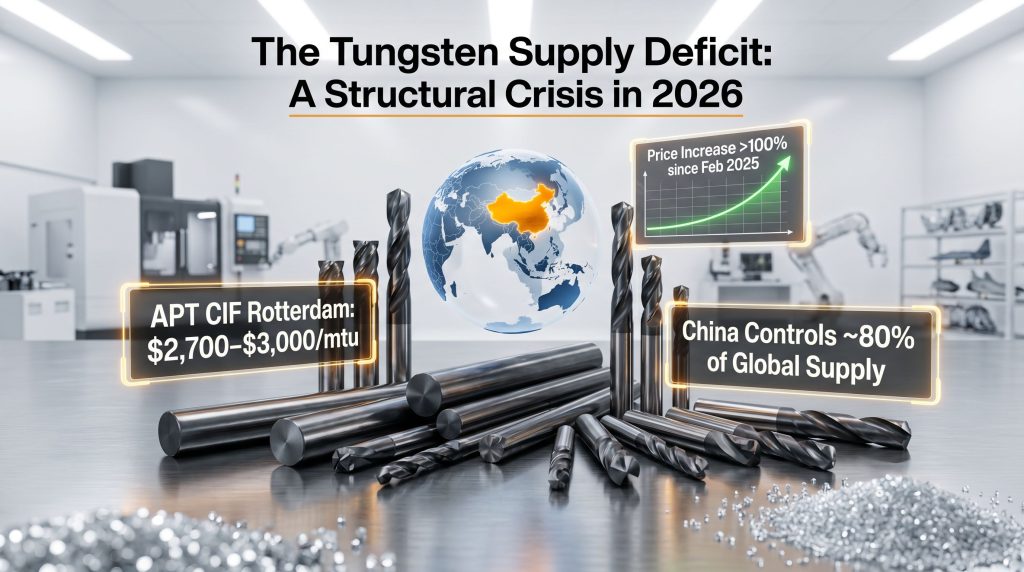
The foundation of the tungsten supply deficit is geographic. China controls approximately 80% of global tungsten mine supply, a concentration that has no precedent in critical minerals markets outside of rare earth elements. For decades, this dominance was managed in ways that kept global markets functional, if uncomfortably dependent. In early 2025, however, that arrangement changed fundamentally.
China implemented formal export licensing controls requiring approval processes lasting up to four months per shipment. By late 2025, ammonium paratungstate exports from China had effectively collapsed to near-zero volumes. For 2026 through 2027, export licences were reportedly restricted to approximately 15 approved exporters, a dramatic narrowing of the supply pipeline that eliminated the market's ability to respond flexibly to buyer demand. Year-on-year export volumes declined by an estimated 27.6% during January and February 2026.
The deliberate nature of this repositioning is suggested by an apparent paradox: while restricting outbound exports, China simultaneously increased its domestic imports of tungsten concentrate by approximately 61% year-on-year. A nation that controls 80% of global mine supply and is simultaneously importing more of its own feedstock is signalling something more consequential than a temporary administrative adjustment.
Several explanations for this behaviour are plausible, and they are not mutually exclusive:
- Strategic reserve building: Chinese state entities may be accumulating processed tungsten stocks for defence-industrial purposes, consistent with broader patterns of critical mineral stockpiling observed across multiple commodity classes
- Domestic demand absorption: Rapid expansion of China's defence manufacturing base, aerospace production, and high-technology industrial sector is creating legitimate internal demand that was previously exported
- Geopolitical leverage: Restricting supply of a material that NATO-aligned nations cannot quickly replace creates strategic bargaining capacity in trade and diplomatic negotiations
- Processing economics: Increasing concentrate imports while restricting APT exports suggests China may be seeking to retain higher-value processing steps domestically rather than exporting raw or semi-processed forms
Historical precedent makes this pattern familiar. China employed comparable supply restriction tactics with rare earth elements in the early 2010s, creating acute shortages that prompted years of policy responses from the United States, European Union, and Japan. The critical minerals demand surge now observable across Western nations follows a structurally similar logic, executed with greater sophistication given the lessons learned from the rare earth episode.
Understanding the APT Bottleneck
A critical concept that often goes underexplained in coverage of the tungsten supply deficit is the role of ammonium paratungstate in the global supply chain. APT is the primary intermediate chemical form through which tungsten moves from raw concentrate to finished products. It serves as the feedstock for producing:
- Tungsten metal powder (used in sintered components and alloys)
- Ferrotungsten (used in high-speed steel production)
- Tungsten trioxide (used in catalysts, coatings, and electrochromic applications)
- Cemented carbide precursors (the backbone of cutting tool manufacturing)
When APT exports from China cease, the consequences extend far beyond a simple reduction in raw material availability. Downstream processors in Europe, the United States, and Asia who have built their manufacturing around Chinese APT supply face a supply chain break at the most critical processing stage. Even where alternative tungsten concentrate sources exist, the infrastructure to convert that concentrate into APT outside China is severely limited. This distinction between a supply reduction and a supply chain severance is what makes the current situation qualitatively different from previous market tightening episodes.
The Production Quota Contraction
Compounding the export restriction problem is a simultaneous reduction in global production capacity. Global tungsten concentrate production quotas declined by approximately 8% year-on-year to roughly 115,000 tonnes in 2026, representing a cumulative reduction of approximately 14% compared to 2024 levels. Multiple converging factors are driving this contraction:
- Ore grade depletion: As the most accessible, high-grade tungsten ore zones are progressively exhausted at existing mines, extraction becomes physically more demanding and economically more expensive
- Environmental compliance burden: Increasingly stringent environmental regulations governing water usage, tailings management, and land disturbance are constraining extraction rates at existing Chinese operations
- Marginal operation closures: Operations that were economically viable at previous price levels but insufficient to recover elevated operating costs have been suspended or closed
- Resource protection policy: Chinese regulatory frameworks limiting new mine development timelines are preventing rapid expansion of production capacity
The ore grade issue deserves particular attention because it operates as an invisible structural ceiling on supply recovery. Even if prices rise substantially and policy restrictions ease, producers cannot simply reverse geological depletion. Lower-grade ore requires proportionally greater energy input, water consumption, and processing infrastructure per unit of final product, creating an upward cost ratchet with no reversal mechanism short of discovering new high-grade deposits.
The Logistical and Geopolitical Amplifiers
How Infrastructure Fragility Becomes Commodity Scarcity
The tungsten supply deficit does not exist in a vacuum. It is being amplified by broader disruptions to the logistical architecture that moves commodities across global supply chains. The collapse of Russia's railway and energy distribution infrastructure under the pressure of sanctions and wartime demands provides an instructive parallel that commodity analysts are beginning to treat as a template for vulnerability assessment.
The Russian case illustrates a phenomenon that applies to any major commodity exporter: infrastructure that appears robust can degrade rapidly when multiple stress factors converge simultaneously. Sanctions curtailed access to replacement components for rolling stock, reducing locomotive availability. Labour mobilisation for military purposes depleted maintenance workforces. Internal fuel distribution networks fractured under logistical strain. The result was supply disruption that extended far beyond what any single factor would have produced in isolation.
This pattern is directly relevant to the current crisis: a nation or region that controls critical commodity production can lose its effective export capacity through logistical degradation even without formal policy restriction. When both deliberate restriction and logistical vulnerability operate simultaneously, the supply disruption becomes effectively irreversible in the short term.
The Just-in-Time to Just-in-Case Transition
For decades, global manufacturing operated on lean inventory principles, holding minimal stockpiles and relying on predictable, low-cost supply chains to deliver materials on demand. The successive disruptions of the COVID-19 pandemic, the Russia-Ukraine conflict, and now the tungsten export restriction episode have fundamentally altered the calculus that procurement managers apply to inventory strategy.
Western industrial consumers are consequently transitioning toward just-in-case procurement models, maintaining larger safety stockpiles and prioritising supply security over working capital efficiency. For tungsten, this transition is creating a demand surge that existing supply infrastructure cannot absorb: buyers who previously held 30-60 days of inventory are attempting to build 6-12 month reserves simultaneously.
This psychological dynamic helps explain why tungsten prices have risen so rapidly even though physical consumption in many end-use industries has not increased proportionally. The price signal reflects not just actual consumption demand but the aggregate value that procurement managers place on supply certainty. In addition, energy security pressures are intensifying the urgency with which governments and industries are approaching strategic stockpiling across the board.
What Are Tungsten Prices Doing in 2026?
The Price Data Snapshot
Tungsten prices across all product forms have escalated sharply since China's export restrictions took effect, with increases exceeding 100% from February 2025 baseline levels in several segments of the market. The following table summarises reported price conditions in early 2026:
| Product Form | Price Range (Early 2026) | Weekly Movement | Market Condition |
|---|---|---|---|
| APT CIF Rotterdam | $2,150-$2,250/mtu avg; spikes to $2,700-$3,000/mtu | +$50/week | Seller-dominated, thin volumes |
| Ferrotungsten (Rotterdam) | $280-$310/kg W (avg $295/kg) | +$40/week | Tight European inventory |
| Tungsten Powder (US, Baltimore) | $355-$360/kg (99.95% purity) | +185 RMB/kg premium over China | US buyers paying significant premium |
| Cemented Carbide Scrap (India) | $92-$100/kg | Elevated | Global scrap competition |
| Tungsten Scrap (Europe) | Greater than €75/kg (~$82-$85/kg) | Rising | Demand-driven scrap competition |
Several features of this price structure warrant close attention. The emergence of a significant premium in US markets over Chinese domestic prices reflects buyers' willingness to pay for supply certainty and logistical accessibility outside Chinese export channels. The condition described by European traders as price without volume — where sellers are posting high prices but physical material availability is constrained — is particularly telling. It indicates that the market is not simply repricing available supply; in some segments, functional supply has ceased to flow regardless of what price buyers are willing to offer.
Scrap Markets Under Structural Pressure
Cemented carbide scrap recycling has historically provided a meaningful secondary supply of tungsten, converting used cutting tools, drill bits, and wear components back into usable tungsten feedstock. At current price levels, scrap recycling economics are compelling, with European scrap prices exceeding €75 per kilogram signalling intense competition for secondary material.
However, scrap availability is itself constrained by a counterintuitive dynamic: scrap generation rates track industrial activity. In periods of economic slowdown or manufacturing contraction in certain regions, fewer used tungsten tools are being retired and returned to the recycling stream. This creates a situation where the secondary supply mechanism weakens precisely when primary supply is most constrained, amplifying rather than moderating the deficit.
Recycling technology improvements continue to advance, reducing energy consumption and improving recovery rates, but infrastructure scale-up operates on timelines measured in years. Secondary supply cannot close a deficit driven by the simultaneous failure of primary production and export channels.
Where Non-Chinese Tungsten Supply Stands Today
Mapping the Alternative Production Landscape
The non-Chinese tungsten production base is, bluntly, thin. Understanding its specific characteristics is essential for assessing how quickly the tungsten supply deficit can realistically narrow:
- United States: No active tungsten mines are currently in operation. The US is entirely dependent on imported tungsten in all product forms, creating a strategic vulnerability that defence procurement agencies are now actively attempting to address through stockpiling programmes and project development incentives
- Europe: Production is concentrated in a small number of operations, primarily in Portugal (Almonty Industries' Panasqueira mine) and Austria (Wolfram Bergbau). These operations provide modest volumes but are insufficient to compensate for the loss of Chinese export supply at any scale relevant to European industrial demand
- South Korea: The Almonty tungsten partnership and its Sangdong mine expansion project represents one of the most significant non-Chinese tungsten development efforts globally, but meaningful production capacity is not anticipated before 2027
- Emerging sources: Vietnam, Bolivia, and Rwanda represent smaller-scale emerging supply origins, but none are at the production volumes or reliability levels needed to constitute systemic supply alternatives in the near term
- Australia: Geological endowment positions Australia as a credible longer-term source of non-Chinese tungsten supply, with several ASX-listed companies holding exploration and development stage projects attracting renewed institutional attention as the supply deficit deepens
The combined picture is one of a non-Chinese supply base that is structurally insufficient for the near-term crisis and would require years of sustained development investment to achieve meaningful scale.
The Defence Procurement Imperative
NATO member states are not passive observers of the tungsten supply deficit. Defence procurement agencies across the alliance are accelerating tungsten stockpile programmes, driven by the recognition that armour-piercing munitions, missile guidance components, and high-specification military tooling all require tungsten inputs that are now effectively controlled by a single geopolitical actor. Australia's defence critical materials strategy reflects this broader alliance-wide push to secure resilient supply chains for militarily essential minerals.
Defence demand for tungsten is structurally price-inelastic. Military procurement timelines are measured in years, munitions specifications cannot be casually redesigned, and strategic reserve requirements are determined by threat assessments rather than commodity prices. This creates a demand category that will absorb tungsten at prevailing market prices regardless of what those prices are, providing a durable floor beneath current elevated price levels.
With defence demand projected to grow from approximately 12% to 15% of total tungsten consumption by 2027-2028, the already-inelastic component of total demand is expanding at a pace that will increasingly crowd out price-sensitive industrial buyers at whatever price level the market clears.
The next major ASX story will hit our subscribers first
The Investment Landscape for Non-Chinese Tungsten Exposure
Why the Structural Deficit Creates Asymmetric Opportunity
The investment case for non-Chinese tungsten exposure operates on multiple levels simultaneously, which is what distinguishes it from a straightforward commodity price play. Several factors converge to create conditions for sustained value creation:
Supply inelasticity: New tungsten mines typically require 7-12 years from discovery through permitting and construction to first production. No amount of investor capital can materially accelerate this timeline in the near term, meaning that current supply constraints will not self-correct through conventional market mechanisms.
Strategic premium: Western government procurement programmes and critical minerals strategies are beginning to provide offtake frameworks and financing structures for qualifying non-Chinese projects. A tungsten project in a Western jurisdiction that can demonstrate a pathway to production carries a value that extends beyond commodity price expectations, incorporating the supply security premium that defence contractors and governments are willing to pay.
Demand floor durability: The price-inelastic nature of defence procurement, combined with the just-in-case stockpiling shift among industrial consumers, creates demand characteristics that are unlikely to normalise quickly even if Chinese export policy partially reverses. Furthermore, tungsten's record-breaking price movements in 2025 and 2026 have drawn significant new institutional attention to the sector.
Key Risk Factors That Require Honest Assessment
Balanced against the opportunity, investors must evaluate risks that are specific to the tungsten development sector:
| Risk Factor | Nature | Potential Impact |
|---|---|---|
| Development timelines | 7-12 years mine to production | Capital tie-up, opportunity cost |
| Permitting complexity | Western regulatory frameworks | Timeline extension, cost escalation |
| Chinese policy reversal | Export restrictions ease | Near-term price correction |
| Ore grade variability | Below-expectation grades at development projects | Resource estimate reductions, cost blowouts |
| Scrap substitution | Recycling technology advances | Long-term demand reduction for primary supply |
| Energy price exposure | Processing cost sensitivity | Margin compression in low-price environments |
The Chinese policy reversal risk deserves particular scrutiny. If Beijing determined that strategic or economic considerations favoured resuming APT exports, near-term prices could correct materially. However, the structural demand growth driven by NATO defence spending and the ongoing transition away from Chinese supply dependence would limit the depth of any such correction. Western procurement agencies that have spent years attempting to develop alternative supply are unlikely to abandon those efforts simply because Chinese supply temporarily becomes available again.
For investors, the most intellectually honest framing is that the tungsten supply deficit has created conditions where tungsten development projects function less like pure commodity assets and more like critical infrastructure investments. The value proposition includes not just commodity price upside but the strategic premium that governments and defence contractors assign to supply certainty.
The ASX Positioning Context
Australia's combination of geological endowment, established mining regulatory framework, and geopolitical alignment with NATO-member critical minerals strategies positions it as a credible source of non-Chinese tungsten supply. ASX-listed companies with tungsten exposure are attracting renewed institutional interest from funds that specifically seek critical minerals exposure outside Chinese supply chains.
Importantly, due diligence considerations for Australian tungsten projects increasingly extend beyond the ore body itself. Fuel security and sulphur availability for downstream processing are becoming material considerations in project assessment. A company with a credible tungsten resource but no concrete plan for fuel procurement and sulphur supply chain security faces execution risks that can materialise quickly during the production ramp-up phase. These are the practical infrastructure questions that separate projects likely to reach production from those that stall at development stage.
Scenario Analysis: Three Pathways for the Tungsten Market
Scenario One: Prolonged Deficit (Most Likely, 2026-2028)
In this base case, Chinese export restrictions persist through 2027 without substantive relaxation. No new large-scale non-Chinese mines reach meaningful production capacity within this window. Prices remain elevated across all product forms, scrap markets remain strained, and European and US industrial consumers face ongoing material shortages. Defence procurement continues to absorb available supply at prevailing prices, crowding out discretionary industrial demand.
Scenario Two: Partial Supply Recovery (Moderate Probability, 2027-2029)
The Sangdong expansion in South Korea reaches operational capacity. One or two additional non-Chinese projects advance sufficiently to provide modest supply increments. Scrap recycling infrastructure scales modestly in response to sustained high prices. Some demand destruction occurs in price-sensitive industrial segments as manufacturers seek design alternatives where tolerable quality compromises allow. Prices stabilise at historically elevated levels but cease accelerating.
Scenario Three: Policy Reversal (Low Probability, Near-Term)
China relaxes export licensing in response to diplomatic engagement or domestic economic considerations. A near-term price correction follows. However, the structural concentration risk that the restriction episode has exposed remains unresolved, and Western nations continue accelerating domestic supply development regardless, given the strategic lesson learned. The price correction would likely be temporary and incomplete, as defence procurement demand continues expanding.
Frequently Asked Questions: Tungsten Supply Deficit
What Is APT and Why Does Its Absence Create a Supply Chain Crisis?
Ammonium paratungstate is the primary intermediate chemical product in tungsten processing, serving as the essential feedstock for producing tungsten metal powder, ferrotungsten, cemented carbide precursors, and a range of specialty tungsten compounds. When APT exports from China collapsed in late 2025, downstream processors in Europe, the United States, and Asia lost access to the most critical input in their manufacturing chains. Even where raw tungsten concentrate exists outside China, the processing infrastructure needed to convert that concentrate into APT is severely limited, creating a supply chain break that cannot be resolved simply by sourcing concentrate elsewhere.
How Long Could the Tungsten Supply Deficit Persist?
Given the absence of active US mines, the 2027 timeline for meaningful output from South Korea's major expansion project, and the structural nature of China's export policy shift, the deficit is expected to persist through at least 2027-2028 without significant policy intervention or accelerated project development. The geological reality of ore grade depletion at existing operations means that even if policy restrictions eased tomorrow, production capacity could not recover rapidly.
Is Tungsten Recycling Capable of Closing the Supply Gap?
Scrap recycling contributes meaningfully to non-Chinese tungsten supply, and current price levels are improving recycling economics significantly. However, recycling capacity is bounded by scrap availability, which itself tracks industrial activity levels in ways that can reduce secondary supply precisely when primary supply is most constrained. Recycling technology improvements continue, but the timescale for meaningful infrastructure scale-up is measured in years. Secondary supply alone cannot close a deficit driven by simultaneous primary production shortfalls and deliberate export restriction.
Which Regions Face the Most Acute Exposure to the Deficit?
Europe carries the most severe near-term exposure due to its historical dependence on Chinese APT imports combined with limited domestic production capacity. The United States faces structural strategic vulnerability given the complete absence of domestic mine production. India's downstream cemented carbide manufacturing sector is also under significant raw material pressure as scrap prices escalate and primary supply becomes unavailable.
What Role Does Defence Spending Play in Sustaining Elevated Prices?
Defence demand for tungsten is structurally price-inelastic. Armaments procurement specifications cannot be casually redesigned around substitute materials, and strategic reserve requirements are driven by threat assessments rather than commodity price cycles. With NATO nations rebuilding munitions stockpiles and expanding defence industrial capacity, defence demand is expected to grow from approximately 12% to 15% of total tungsten consumption by 2027-2028. This expanding price-inelastic demand segment provides a durable floor that will support prices even if some industrial demand is destroyed by elevated costs.
The Structural Forces Defining the Deficit
| Factor | Impact Level | Status |
|---|---|---|
| China export licensing restrictions | Critical | Active |
| Global production quota reduction (approx. -14% vs 2024) | High | Ongoing through 2026 |
| Near-zero APT exports from China | Critical | Active since late 2025 |
| No active US tungsten mines | High | Medium-term structural constraint |
| South Korea Sangdong expansion | Partial relief expected | 2027 at earliest |
| NATO defence stockpiling demand surge | High | 2025-2028 and beyond |
| Scrap market strain in Europe and India | Moderate to High | Active |
| Price increase greater than 100% since February 2025 | Severe | Active across all product forms |
The tungsten supply deficit of 2026 is not a market anomaly that will self-correct through conventional supply and demand adjustment. It is the visible surface of a deeper structural realignment in how critical minerals flow through the global economy, shaped by geology, geopolitics, and the irreversible shift from supply chain efficiency to supply chain resilience as the primary design objective for industrial and defence procurement systems worldwide.
This article contains forward-looking statements, market projections, and scenario analysis based on available information as at the date of publication. Commodity markets involve inherent uncertainty, and actual outcomes may differ materially from projections. This content is general in nature and does not constitute financial product advice. Readers should seek independent financial advice before making any investment decisions. Figures relating to production quotas, export volumes, and price data reflect information available at the time of writing and may be subject to revision as additional data becomes available.
For ongoing coverage of critical minerals markets and ASX resource sector developments related to the tungsten supply deficit and related themes, visit SmallCaps.com.au.
Want to Position Yourself Ahead of the Next Major Critical Minerals Discovery?
Discovery Alert's proprietary Discovery IQ model delivers real-time alerts on significant ASX mineral discoveries — including critical minerals such as tungsten — cutting through complex market data to surface actionable opportunities the moment they are announced on the ASX. Explore how historic mineral discoveries have generated substantial returns and begin your 14-day free trial today to ensure you are positioned ahead of the broader market.