June 30, 2026
The Engineering Challenge Behind Tunisia's Phosphate Transport Infrastructure
North Africa's mineral extraction sector faces a fundamental constraint that extends far beyond geological reserves or processing capabilities. When transport infrastructure operates at severely reduced capacity, the entire supply chain becomes constrained by its weakest link. This phenomenon manifests clearly in Tunisia rail bottlenecks phosphate transport, where aging rail networks have transformed from enablers into bottlenecks.
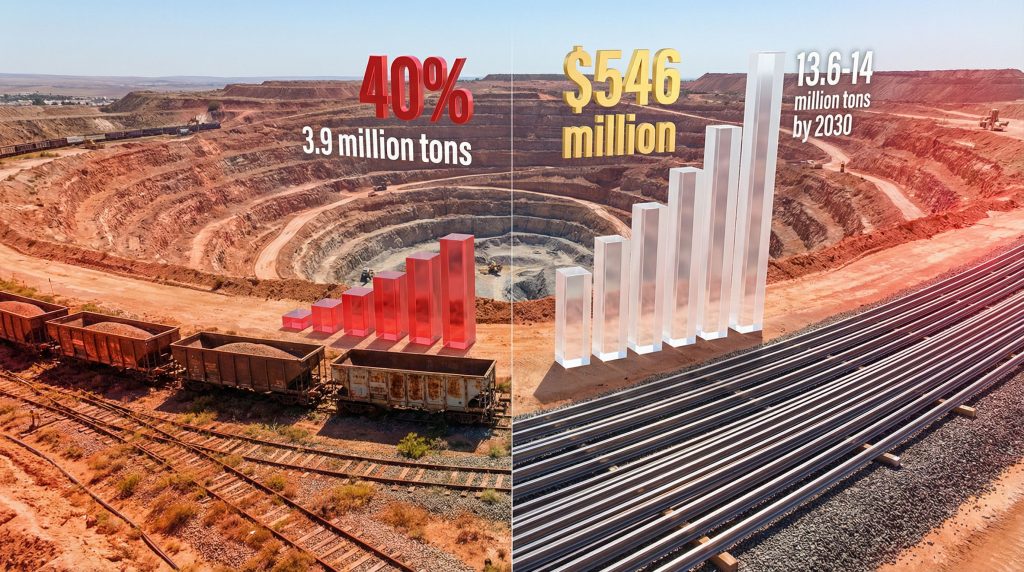
The Compagnie des Phosphates de Gafsa (CPG) demonstrates this constraint's real-world impact through stark production metrics. Current operations deliver approximately 3.9 million tons annually at just 40% capacity utilisation, representing a dramatic decline from the 8 million tons achieved in 2011. This 51% reduction over 14 years illustrates how infrastructure degradation creates cascading effects throughout mineral supply chains.
Tunisia's railway dependency is absolute for phosphate movement, with the Société Nationale des Chemins de Fer Tunisiens (SNCFT) deriving 40% of total revenue from phosphate transport contracts. This interdependency creates vulnerability: when rail infrastructure fails, both mining output and railway economics suffer simultaneously. Consequently, understanding mining evolution trends becomes crucial for addressing such infrastructure challenges.
The operational efficiency crisis extends beyond simple capacity constraints. Transport bottlenecks force processing facilities to operate below optimal levels, reducing economies of scale and increasing per-unit production costs. Storage facilities experience higher utilisation rates due to irregular transport schedules, while export terminals cannot maintain consistent loading operations.
When big ASX news breaks, our subscribers know first
Critical Infrastructure Components Limiting Daily Operations
Rolling Stock Degradation Patterns
The most significant operational constraint stems from wagon fleet deterioration, which has reduced daily train operations to 3.5 departures from extraction sites. International phosphate transport standards typically achieve 8-12 daily operations, indicating Tunisia's system operates at approximately 29-44% of industry frequency benchmarks.
Wagon availability constraints create a self-reinforcing negative cycle. As equipment reliability decreases, maintenance intervals increase, further reducing available fleet capacity. Load capacity per wagon has diminished due to structural wear, forcing lighter train configurations that mathematically constrain total throughput.
Current Operational Limitations:
- Maximum daily frequency: 3.5 train operations
- Reduced load capacity per wagon due to structural constraints
- Increased maintenance downtime affecting scheduling consistency
- Safety regulations requiring lighter loads on worn equipment
Track Infrastructure Assessment
Four critical railway lines require immediate intervention: Lines 5, 14, 17, and 21, spanning 190 kilometres of degraded infrastructure. Line 21's 129-kilometre extension represents the most urgent component, requiring dedicated reconstruction funding.
Track degradation occurs through multiple mechanisms in Tunisia's operating environment. Wheel loading stress concentrations accumulate over time, while environmental factors accelerate deterioration. The semi-arid climate typical of phosphate mining regions creates expansion-contraction cycles that stress rail joints and foundations.
Infrastructure Degradation Factors:
- Foundation settlement: Reducing uniform load distribution
- Environmental weathering: Temperature cycling and precipitation exposure
- Deferred maintenance: Allowing minor issues to compound into major failures
- Load-bearing capacity reduction: Forcing operational speed and weight limitations
Signalling Technology Constraints
Outdated signalling systems prevent automated train spacing optimisation, a critical factor limiting operational frequency. Modern signalling enables higher train frequencies by safely reducing separation intervals through continuous real-time monitoring capabilities.
The technology gap affects multiple operational aspects: manual train coordination increases human error risk, scheduling optimisation becomes mathematically complex without automated systems, and safety margins must be increased to compensate for reduced monitoring capabilities. Furthermore, data-driven operations could significantly enhance these systems.
Investment Requirements for Systematic Capacity Enhancement
Phase One Infrastructure Renewal ($138 Million)
The immediate intervention programme targets the most critical bottlenecks through a $138 million investment addressing 190 kilometres across four primary lines. The Arab Fund for Economic and Social Development (AFESD) provides $52 million (16 million Kuwaiti dinars) specifically for Line 21 completion.
| Investment Component | Scope | Funding Source | Amount |
|---|---|---|---|
| Track renewal (Lines 5, 14, 17, 21) | 190 kilometres | Multiple sources | Part of $138M total |
| Line 21 extension | 129 kilometres new construction | AFESD loan | $52 million |
| Engineering studies | Technical assessments | Completed by March 2026 | Integrated in budget |
| Construction contracts | Tender awards | Closed March 24, 2026 | Implementation phase |
The AFESD loan agreement, formally signed October 16, 2025, and approved by Parliament's finance committee March 26, 2026, represents 7.6% of the total two-phase investment requirement. This financing structure indicates Tunisia must identify additional capital raising methods for the remaining $632 million.
Phase Two Comprehensive Modernisation ($546 Million)
The complete system upgrade encompasses 415 additional kilometres of track rehabilitation, technology integration, and facility modernisation. This phase transforms Tunisia rail bottlenecks phosphate transport from a constraint into a competitive advantage.
Phase Two Scope Distribution:
- Track rehabilitation: 415 kilometres secondary network expansion
- Infrastructure modernisation: Tunnel improvements and station upgrades
- Technology deployment: Modern signalling and control systems
- Maintenance capabilities: Specialised equipment and service centres
The $684 million combined investment translates to approximately $1.13 million per kilometre across 605 total kilometres. This falls within international benchmarks of $1-3 million per kilometre for comprehensive rail modernisation, suggesting efficient cost management compared to global standards.
Technical Solutions for Transport Optimisation
Systematic Capacity Enhancement Mechanisms
Rolling stock modernisation addresses multiple constraint factors simultaneously. New wagons provide increased load capacity, enhanced coupling systems enable longer train configurations, and improved reliability reduces maintenance-related downtime.
Technical Specifications for Improvement:
- Higher-grade rail materials extending service life
- Enhanced ballast and foundation systems resisting environmental stress
- Improved drainage preventing weather-related degradation
- Standardised gauge and alignment specifications optimising train speeds
Advanced Signalling Integration
Modern signalling systems enable automated train spacing, real-time monitoring for predictive maintenance, and digital control platforms linking all operational nodes. These technologies collectively increase safe operating frequencies while reducing human error factors.
The integration supports multiple operational improvements: automated scheduling optimisation, predictive maintenance programmes utilising sensor data, environmental monitoring for sustainable operations, and safety systems exceeding international mining transport standards. However, implementing these solutions requires comprehensive investment strategy components to ensure successful deployment.
Production Economics and Infrastructure Investment Returns
Current Operational Cost Structure
The 60% capacity underutilisation creates significant economic inefficiencies across the supply chain. Mining operations capable of higher output cannot realise this potential due to transport constraints. Processing facilities operating below optimal capacity experience reduced economies of scale and higher per-unit costs.
Export revenue reduction approximates 4 million tons annually compared to 2011 baseline performance. Storage costs increase due to irregular transport schedules, while port facilities cannot maintain consistent loading operations for international customers.
Investment Return Projections
The infrastructure modernisation targets 13.6-14 million tons annual production by 2030, representing a 250-260% increase from current 3.9 million ton output. This capacity expansion enables several economic benefits:
- Enhanced export competitiveness through reduced logistics costs
- SNCFT revenue stabilisation from reliable phosphate transport contracts
- Multiplier effects supporting processing and downstream industries
- Improved facility utilisation reducing per-unit production costs
Investment Analysis Framework:
The $684 million investment requirement must be evaluated against the potential for 10+ million tons additional annual output. At typical phosphate export values, this capacity increase could generate substantial returns, though market conditions and global phosphate pricing will ultimately determine project economics.
International Benchmarking and Technology Standards
Operational Efficiency Comparisons
International phosphate transport operations typically achieve 8-12 daily train operations compared to Tunisia's current 3.5 maximum frequency. This performance gap indicates substantial improvement potential through systematic infrastructure renewal.
Global Best Practice Standards:
- Train frequency: 8-12 daily operations (versus Tunisia's 3.5)
- Load capacity: Optimised wagon design for maximum payload efficiency
- Transport speed: Balanced for safety and throughput requirements
- Maintenance programmes: Predictive rather than reactive approaches
Technology Adoption Framework
Modern phosphate transport systems integrate automated technologies reducing human error factors, logistics platforms optimising supply chain coordination, environmental monitoring ensuring sustainable operations, and safety systems exceeding international standards. In addition, industry analyses from Deloitte's phosphate and energy transition report highlight the importance of such technological integration.
Tunisia's modernisation programme incorporates these technological advances: automated signalling systems, real-time monitoring capabilities, digital control platforms, and integrated communication networks. This technology adoption positions the system for long-term competitive advantage in global phosphate markets.
The next major ASX story will hit our subscribers first
Implementation Timeline and Critical Milestones
Near-term Implementation (2026-2027)
Construction commences following the March 2026 tender awards, with Line 21 completion representing the highest priority component. Initial wagon fleet renewal supports pilot operations on upgraded track sections.
Critical 2026-2027 Deliverables:
- Line 21 construction initiation and progress milestones
- Phase One track renewal across 190 kilometres
- New wagon procurement and deployment
- Pilot testing of upgraded infrastructure sections
Medium-term Integration (2027-2029)
Phase One completion enables increased transport frequency and load capacity. Signalling system installation and testing occur simultaneously with maintenance facility construction.
Workforce training on new systems becomes critical during this phase, as operational procedures must adapt to modernised equipment and automated technologies. Performance monitoring establishes baseline measurements for continued optimisation. Furthermore, detailed feasibility study insights will guide these implementation phases.
Long-term Optimisation (2029-2030)
Phase Two infrastructure completion integrates the entire network, enabling target production capacity achievement of 13.6-14 million tons annually. Full network optimisation balances traffic flows across all lines whilst maintaining safety and efficiency standards.
Performance Targets by 2030:
- Daily train frequency: Approaching international standards of 8+ operations
- Annual production capacity: 13.6-14 million tons
- Operational efficiency: Sustained high utilisation rates
- Transport reliability: Consistent scheduling supporting export commitments
The systematic infrastructure renewal transforms Tunisia rail bottlenecks phosphate transport from production constraints into competitive advantages, positioning the phosphate transport system for sustained long-term performance in global mineral markets.
Looking to capitalise on infrastructure investment opportunities in mining?
Discovery Alert's proprietary Discovery IQ model delivers instant notifications on significant ASX mineral discoveries, helping investors identify actionable opportunities in resource companies before broader market awareness develops. Start your 14-day free trial today and discover how real-time discovery alerts can position you ahead of infrastructure and mining investment trends at Discovery Alert.