
June 24, 2026
The Race for Africa's Last Great Uranium Frontier
The uranium market operates on timelines that most commodity cycles do not. From initial geological survey to first production, greenfield uranium projects routinely require between ten and fifteen years of sustained capital commitment, regulatory navigation, and technical development. This structural reality means that the countries and companies positioning themselves in frontier uranium jurisdictions today are not chasing near-term returns. They are securing options on the next generation of global nuclear fuel supply, and increasingly, that means looking at the Horn of Africa.
Against this backdrop, the bilateral mineral engagement developing between Ankara and Mogadishu deserves more analytical attention than it typically receives. The Türkiye Somalia uranium reserves story is not simply a bilateral trade headline. It sits at the intersection of nuclear energy security, African resource sovereignty, and a shifting geopolitical contest for critical minerals demand that will define energy economics well into the second half of the twenty-first century.
When big ASX news breaks, our subscribers know first
Somalia's Mineral Endowment: What the Numbers Actually Represent
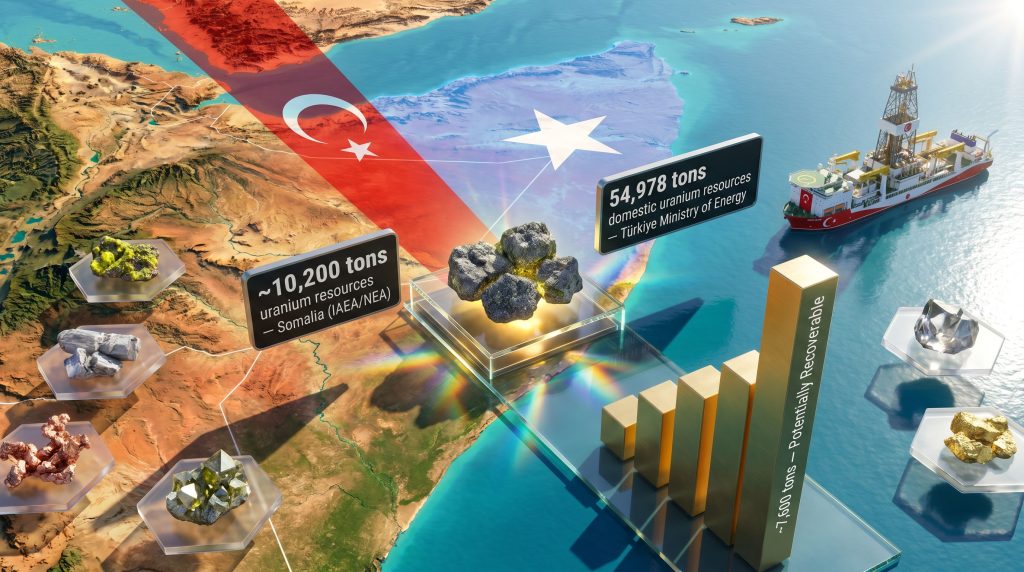
Before examining the geopolitics, the geology deserves precise framing. According to data compiled by the International Atomic Energy Agency and the OECD Nuclear Energy Agency, Somalia holds an estimated 10,200 tons of uranium resources in total, of which approximately 7,600 tons are considered potentially commercially recoverable under favourable conditions.
These figures represent resource estimates, not confirmed production-ready reserves. In mining terminology, a resource reflects the geological occurrence of a mineral based on available survey data, while a reserve is a narrower subset assessed as economically extractable under current market and technical conditions. Somalia's uranium figures sit firmly in the resource category, and upgrading them to reserve status requires a structured sequence of exploration, drilling, metallurgical testing, and economic assessment work that has not yet commenced at scale.
Somalia's broader mineral inventory extends well beyond uranium. Furthermore, geological surveys have identified the following commodity categories across the country's territory:
| Mineral | Current Status | Estimated Quantity |
|---|---|---|
| Uranium | Resource estimate (IAEA/NEA data) | ~10,200 tons total; ~7,600 tons potentially recoverable |
| Lithium | Early-stage survey identification | Not publicly quantified |
| Copper | Deposit indicators identified | Not publicly quantified |
| Titanium | Deposit indicators identified | Not publicly quantified |
| Gold | Survey-identified occurrences | Not publicly quantified |
| Rare Earth Elements | Preliminary identification stage | Not publicly quantified |
The central challenge underpinning all of these figures is that vast portions of Somali territory remain geologically unmapped. Decades of civil conflict interrupted survey programs, disrupted institutional knowledge, and prevented the kind of systematic airborne geophysical work that forms the foundation of modern mineral exploration in other African jurisdictions. What Somalia's resource estimates represent, therefore, is a partial picture based on historical data of variable quality, not a comprehensive national inventory.
This distinction matters enormously for any investor or policymaker assessing the country's mineral potential. The absence of modern data is not evidence of absence of mineralisation. If anything, it signals that Somalia's true resource endowment may be substantially larger than current estimates suggest, though any such assumption remains speculative until systematic exploration programs are completed.
Why Türkiye Is Looking Outward for Uranium Supply
Türkiye is not a country without domestic uranium resources. The Turkish Ministry of Energy has reported 54,978 tons of uranium resources across several provinces, with 547.6 tons of confirmed reserves at the Aydın-Söke deposit in the Aegean region. On paper, this suggests a meaningful domestic base. In practice, however, Türkiye's nuclear energy ambitions have grown faster than its domestic resource development capacity.
The Akkuyu Nuclear Power Plant, currently under development in southern Türkiye, represents the country's most significant nuclear infrastructure investment and creates long-term, structured fuel supply requirements that domestic production alone cannot reliably satisfy. This gap between domestic resource availability and projected fuel demand is the strategic driver pushing Ankara toward international mineral partnerships, and it explains why Somalia's uranium potential draws genuine interest rather than diplomatic courtesy.
Türkiye's broader Africa engagement model has evolved substantially over the past two decades. What began primarily as humanitarian diplomacy has transformed into a multi-sector partnership framework built on several interconnected pillars:
- Security cooperation, including military base agreements and defence training programs
- Infrastructure development financing across transport, health, and education
- Energy sector technical partnerships covering both hydrocarbons and renewables
- Mining and geological survey cooperation targeting underexplored jurisdictions
The Somalia relationship exemplifies this template in concentrated form, and the Nigeria parallel is instructive. Nigeria recently formalised a mining cooperation agreement with Türkiye targeting a solid minerals sector estimated to hold up to $700 billion in untapped potential, encompassing exploration technology transfer, digitisation of geological records, and technical capacity building. That Ankara is pursuing structurally similar frameworks in both Lagos and Mogadishu simultaneously suggests a deliberate continent-wide minerals strategy rather than opportunistic bilateral dealmaking.
The Depth of the Türkiye-Somalia Partnership
From Security Cooperation to Extractive Industry Engagement
Türkiye's relationship with Somalia is anchored by one of Ankara's most significant overseas security commitments. The Turkish military base established in Mogadishu remains one of Türkiye's largest foreign military installations and created the foundational trust architecture through which subsequent cooperation across education, infrastructure, trade, and healthcare has been built.
The energy dimension deepened meaningfully with the deployment of the Turkish drilling vessel Cagri Bey for offshore exploration activities in Somali waters, a milestone representing Türkiye's first overseas drilling operation. According to reporting on Somalia's offshore energy ambitions, both parties have expressed confidence in near-term results from this programme. The logistical, technical, and diplomatic groundwork required to execute an offshore drilling mission in a frontier jurisdiction creates transferable capabilities that can be leveraged for onshore mineral exploration programs.
The 2016 Mining Memorandum of Understanding between the two countries originally covered geological mapping, mineral exploration, technical training, and investment facilitation. That agreement stalled amid Somalia's ongoing security challenges and the administrative complexity of bilateral technical programs. However, recent discussions between Somali and Turkish officials in Istanbul have centred on reviving this framework with a more structured operational mechanism.
Somali Petroleum and Mineral Resources Minister Dahir Shire Mohamed has publicly stated that Somalia holds substantial wealth beneath its territory across multiple commodity categories, and has communicated a clear government preference for developing these resources through structured, partnership-oriented international engagement rather than through opaque concession arrangements. The minister also indicated that both parties intend to form a joint technical committee to systematically review existing geological data and identify priority areas for new survey work.
What a Revived Technical Committee Would Actually Do
The proposed joint technical committee, if formed, would face a specific sequenced workload:
- Systematic audit of historical geological survey records held by Somali institutions and legacy exploration files
- Identification of priority exploration zones based on existing data and regional geological analogues
- Design of new airborne and ground-based geophysical survey programs suited to Somalia's terrain
- Development of capacity building programs for Somali geological and mining professionals
- Creation of an investment-ready mineral project pipeline to attract third-party capital
This sequence reflects standard frontier exploration methodology, but executing it in Somalia requires confronting a multi-dimensional risk environment that no technical committee can resolve on its own.
Commercial Viability: Separating Potential From Production Reality
The Resource-to-Reserve Pathway in Uranium Mining
Understanding what Somalia's 10,200-ton uranium resource estimate actually represents requires familiarity with the international reporting standards governing mineral assets. The pathway from resource estimate to commercial production involves a series of defined technical milestones, each requiring significant capital and time:
- Systematic geological mapping of priority target zones using airborne and ground surveys
- Drilling programs to confirm subsurface mineralisation continuity and establish uranium grade distribution
- Metallurgical testing to assess uranium recovery rates and identify optimal processing methods
- Preliminary economic assessments incorporating capital cost estimates and projected operating costs
- Full feasibility studies meeting international financing standards
- Environmental and social impact assessments covering affected communities and ecosystems
- Regulatory framework development specific to uranium mining, including IAEA non-proliferation compliance mechanisms
At Somalia's current stage of geological knowledge, the country sits at step one of this process. This is not a criticism of Somalia's resource potential but rather an accurate representation of where frontier uranium jurisdictions begin. Niger's Arlit uranium complex, which grew to become a significant global producer, originated from French geological survey programs that preceded commercial production by well over a decade.
Tanzania's Mkuju River uranium project similarly required more than a decade of exploration and study work before reaching investment decision stage, and even then, production was deferred due to uranium market conditions. Understanding these uranium market dynamics is essential context for evaluating any frontier jurisdiction's development timeline.
Somalia's Development Risk Matrix
The barriers to uranium development in Somalia are significant and span multiple categories:
| Risk Category | Specific Challenge | Severity |
|---|---|---|
| Political Stability | Ongoing security challenges across parts of the country | High |
| Regulatory Framework | Absence of a mature uranium-specific mining regulatory regime | High |
| Infrastructure Deficit | Limited road, power, and water infrastructure in prospective areas | High |
| Geological Data Gaps | Large portions of territory remain unmapped due to conflict history | Medium-High |
| International Safeguards | IAEA non-proliferation compliance requirements specific to uranium | Medium |
| Capital Access | Limited international mining finance without sovereign risk mitigation | Medium-High |
It is worth noting that uranium mining carries a distinct regulatory layer that other mineral commodities do not. Any uranium development program in Somalia would need to comply with the IAEA's safeguards framework, which requires a comprehensive legal and institutional infrastructure that Somalia does not currently possess. Building that infrastructure is achievable but requires sustained investment in regulatory capacity, likely with technical assistance from bodies such as the IAEA itself.
The Competitive Landscape for African Uranium and Critical Minerals
A Multi-Player Contest for Resource Access
Türkiye is not operating in an uncontested space. The competition for Africa's critical mineral endowment has intensified markedly, with multiple major powers pursuing African resource access through different instruments and strategies:
- China has built established dominance in African critical mineral supply chains through state-backed investment vehicles operating across the Democratic Republic of Congo, Zambia, Zimbabwe, and increasingly francophone West Africa
- Western nations including the United States and European Union have developed structured critical minerals strategies targeting Africa specifically, including the US Minerals Security Partnership and the EU Critical Raw Materials Act, both of which identify African supply diversification as a strategic priority
- Gulf sovereign wealth funds from the UAE and Saudi Arabia are increasing direct investment in African resource projects, drawn by both financial returns and energy security imperatives
- Russia has historically maintained uranium partnerships in francophone West Africa, though the current status of these arrangements has been complicated by geopolitical developments following 2022
Within this field, Türkiye occupies a distinctive positioning. It is neither a superpower with overwhelming financial leverage nor a purely bilateral partner without strategic depth. Ankara brings unique geographic proximity to the Horn of Africa, established diplomatic relationships built through decades of engagement, cultural and religious connections across Muslim-majority African nations, and a growing technical capability in energy infrastructure demonstrated by the Cagri Bey deployment.
Furthermore, Turkey's multi-layered strategy in Somalia reflects a broader ambition to cement influence across the continent's most strategically sensitive corridors. Somalia's position at the intersection of the Horn of Africa and the Gulf of Aden gives the country strategic maritime significance beyond any specific mineral endowment. Whoever develops a meaningful footprint in Somalia's resource sector is not only accessing uranium and critical minerals, they are establishing presence in one of the world's most strategically sensitive maritime corridors.
The next major ASX story will hit our subscribers first
Development Economics and Scenario Analysis
How Somalia Can Avoid the Resource Curse
The history of African mineral development contains cautionary examples of countries whose resource wealth generated external extraction without proportional domestic benefit. Somalia, approaching this from a position of near-zero existing extraction, has the opportunity to structure its mineral sector from the ground up using frameworks that capture domestic value more effectively. Key mechanisms include:
- Local content requirements mandating minimum levels of Somali workforce participation and supplier engagement
- Revenue management frameworks modelled on successful African precedents, potentially including sovereign wealth fund structures
- Royalty and taxation structures calibrated to attract frontier exploration capital while capturing appropriate resource rent once production commences
- Technical capacity building programs embedded within bilateral cooperation agreements rather than treating human capital development as optional
International institutions including the IAEA, World Bank, and African Development Bank all maintain technical assistance programs for developing nations seeking to build mining regulatory capacity, and engaging these institutions in parallel with bilateral Turkish cooperation would reduce Somalia's dependence on any single partner's institutional framework.
Three Pathways Forward: A Scenario Framework
The trajectory of Somalia's uranium sector over the next two decades will be shaped by the interaction of political stability, bilateral cooperation effectiveness, and global uranium market conditions. Three scenarios span the realistic outcome range:
Scenario 1: Accelerated Development
The revived MoU produces a functioning technical committee within twelve months. Systematic aerial survey work commences within two years, generating data that attracts third-party exploration capital. Resource upgrade studies advance, and international mining companies begin formal engagement. First uranium production remains ten to fifteen years distant, contingent on sustained political stability and infrastructure investment.
Scenario 2: Gradual Technical Cooperation (Base Case)
The joint technical committee is established but moves through a multi-year data review process. Resource-to-reserve conversion studies are initiated incrementally, with commercial uranium production remaining a fifteen to twenty-year horizon. Progress is real but non-linear, shaped by Somalia's evolving security environment and shifting priorities on both sides.
Scenario 3: Stalled Engagement
Security deterioration or political instability in either country disrupts the cooperation framework before meaningful technical work is completed. The MoU revival stalls at committee formation stage, and Somalia's mineral resources remain undeveloped. Early-mover advantage passes to competing partnerships or jurisdictions with lower barriers to exploration entry.
Disclaimer: The scenarios presented above are analytical projections based on available information and historical precedents from comparable frontier mining jurisdictions. They do not represent financial advice, investment recommendations, or predictions of specific outcomes. Actual developments may differ materially from any of the scenarios described.
Frequently Asked Questions: Türkiye Somalia Uranium Reserves
How much uranium does Somalia actually hold?
Based on data from the International Atomic Energy Agency and OECD Nuclear Energy Agency, Somalia's uranium resource estimate stands at approximately 10,200 tons in total, with around 7,600 tons assessed as potentially commercially recoverable. These are resource estimates derived from historical geological survey data, not confirmed production-ready reserves. Significant additional exploration work would be required before any portion of this figure could be reclassified as an economically mineable reserve.
What role is Türkiye playing in Somalia's uranium sector?
Türkiye's current role is technical and exploratory rather than extractive. Bilateral discussions are focused on reviving a 2016 Memorandum of Understanding covering geological mapping, mineral exploration, technical training, and investment facilitation. No uranium extraction activities have commenced. The relationship builds on an existing security and infrastructure partnership that gives Türkiye an established institutional presence in Somalia.
Does Türkiye have domestic uranium resources of its own?
Yes. Türkiye's Ministry of Energy has reported 54,978 tons of domestic uranium resources across multiple provinces, with 547.6 tons of confirmed reserves at the Aydın-Söke deposit. Türkiye's international mineral partnerships reflect energy security strategy and the fuel requirements of its nuclear power development program rather than a simple domestic resource deficit.
What other minerals has Somalia identified beyond uranium?
Geological surveys have recorded occurrences of lithium, copper, titanium, gold, and rare earth elements across Somali territory. The majority of these occurrences remain unquantified due to limited systematic exploration, itself a consequence of decades of political instability. Somalia's mineral inventory should therefore be understood as a preliminary indication of potential rather than a comprehensive national resource assessment.
How does this deal compare to Türkiye's other African mineral partnerships?
Nigeria's mining cooperation agreement with Türkiye follows a structurally similar template, targeting a solid minerals sector estimated at up to $700 billion in untapped potential and emphasising exploration technology transfer, geological record digitisation, and technical capacity building. Both partnerships prioritise knowledge and capability development over direct state-to-state resource extraction, reflecting Ankara's preferred engagement model in African resource sectors.
What are the primary obstacles to uranium production in Somalia?
The main challenges include political and security instability across parts of the country, the absence of a mature uranium-specific mining regulatory framework, significant infrastructure deficits in prospective areas, large portions of unmapped geology, IAEA non-proliferation compliance requirements, and limited access to international mining finance without risk mitigation mechanisms in place. In addition, Australia's own critical minerals strategy offers a useful reference point for how frontier jurisdictions can build effective regulatory infrastructure over time.
Key Takeaways
The intersection of Türkiye's energy security ambitions and Somalia's underdeveloped mineral endowment creates a partnership with genuine long-term strategic logic, even if near-term production timelines remain measured in decades rather than years. Several conclusions stand out from the analysis:
- Somalia's 10,200-ton uranium resource estimate positions it as a frontier-stage uranium jurisdiction with meaningful potential, conditional on political stabilisation and sustained exploration investment
- The distinction between a resource estimate and a production-ready reserve is critical: Somalia's figures represent a starting point for exploration, not a confirmed inventory
- Türkiye's engagement model integrates security, infrastructure, and resource diplomacy into a bilateral framework that differs structurally from purely extractive foreign investment approaches
- Revival of the 2016 MoU and formation of a joint technical committee represent the near-term milestones that will indicate whether diplomatic intent translates into operational activity
- Nigeria's parallel minerals agreement confirms that Ankara is executing a continent-wide African minerals strategy
- Global uranium reserves are increasingly concentrated in a small number of jurisdictions, which consequently makes frontier-stage resource access in Somalia strategically significant for uranium-importing nations
- Kazakhstan's uranium dominance underscores how quickly a frontier-stage jurisdiction can become a global supplier given the right investment and institutional conditions, offering a template Somalia could study
- Global competition for African uranium and critical minerals from China, Western powers, Gulf sovereign wealth funds, and emerging mid-powers is intensifying, making early-stage positioning in frontier jurisdictions increasingly valuable
- Somalia's geographic position at the Gulf of Aden compounds the strategic significance of any mineral sector engagement beyond the resources themselves
For readers tracking African resource sector developments and bilateral investment dynamics, ongoing coverage is available at Business Insider Africa, which reports regularly on energy partnerships, mineral sector agreements, and investment frameworks across the continent.
Want to Catch the Next Major Mineral Discovery Before the Market Does?
Discovery Alert's proprietary Discovery IQ model delivers real-time alerts on significant ASX mineral discoveries — cutting through complex geological and commodity data to surface actionable opportunities the moment they hit the exchange. Explore historic discoveries and the substantial returns they generated, then start your 14-day free trial at Discovery Alert to position yourself ahead of the broader market.