June 30, 2026
The Middle East's petroleum infrastructure faces unprecedented vulnerability as modern drone technology fundamentally reshapes energy security dynamics. The UAE drone strike on ADNOC Ruwais refinery exemplifies how precision autonomous weapons can disrupt billion-dollar facilities, forcing immediate reassessment of critical infrastructure protection strategies across global energy markets.
Traditional energy security models assumed that critical infrastructure required significant military resources to threaten effectively. Contemporary drone capabilities have eliminated this assumption, creating scenarios where distributed, low-cost systems can inflict substantial economic disruption on high-value stationary targets that cannot be relocated for protection.
Strategic Importance of Gulf Refining Operations
The Middle East's downstream petroleum sector represents one of the world's most concentrated and economically significant industrial clusters. Modern integrated refining complexes combine multiple processing stages within single geographic locations, creating both operational efficiency and concentrated vulnerability profiles.
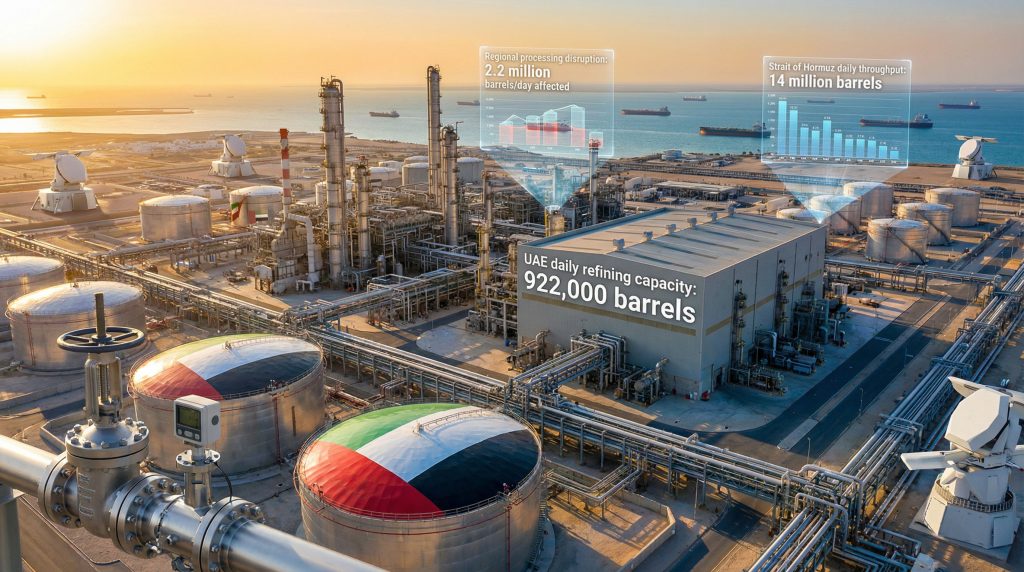
The UAE drone strike on ADNOC Ruwais refinery demonstrates how contemporary threats target these concentrated assets. The Ruwais complex processes approximately 922,000 barrels per day across integrated distillation units, representing one of the region's largest downstream operations. This facility combines crude oil refining with petrochemical production, fertilizer manufacturing, and industrial gas generation within a single geographic area.
Economic Magnitude of Integrated Processing
Contemporary refining economics favour large-scale integration where crude distillation feeds directly into downstream chemical processing. The Ruwais facility exemplifies this model through its combination of:
- Primary distillation capacity: 817,000 barrels daily across two main units
- Petrochemical integration: Direct feedstock supply to specialty chemical production
- Industrial gas production: Oxygen, nitrogen, and hydrogen for regional supply
- Fertilizer manufacturing: Ammonia and urea production from integrated feedstock
This integration model creates significant economic value through reduced transportation costs for intermediate products and optimised energy utilisation across multiple processing stages. However, the same integration creates cascading vulnerability where disruption to primary distillation affects all downstream production streams simultaneously.
Geographic Concentration Risk Factors
Energy infrastructure clustering reflects optimal economic configuration during stable operating conditions but creates correlated failure risks during disruption events. The concentration of multiple high-value processing units within limited geographic areas amplifies the economic impact of successful attacks.
Key vulnerability factors include:
- Shared utility systems connecting multiple processing units
- Common cooling water sources serving integrated facilities
- Centralised power distribution affecting multiple production lines
- Pipeline networks linking various processing stages
- Storage tank farms containing multiple product streams
When examining the UAE drone strike on ADNOC Ruwais refinery, the facility's integrated design meant that fire damage at one unit created safety risks requiring precautionary shutdown of the entire complex, demonstrating how modern refining integration amplifies disruption impact.
When big ASX news breaks, our subscribers know first
Contemporary Drone Strike Capabilities
Modern autonomous strike systems have fundamentally altered the cost-effectiveness equation for attacking critical infrastructure. The technology evolution enables precision targeting of specific facility components using relatively inexpensive platforms against assets worth billions in replacement costs.
Asymmetric Cost-Damage Ratios
The economic calculus of infrastructure attacks has shifted dramatically with autonomous weapon system development. Contemporary precision-strike drones cost thousands to tens of thousands of dollars while targeting facilities representing billions in capital investment and replacement costs.
| Attack System Cost | Target Asset Value | Cost Ratio |
|---|---|---|
| $10,000 – $50,000 | $5-8 billion refinery | 1:100,000+ |
| $100,000 – $500,000 | $2-3 billion petrochemical complex | 1:10,000+ |
| $1-5 million coordinated strike | $15-20 billion integrated facility | 1:5,000+ |
This asymmetry creates scenarios where attackers can inflict economic damage orders of magnitude greater than their investment in strike capabilities. The UAE drone strike on ADNOC Ruwais refinery exemplifies this dynamic, where a single drone attack caused fire forced shutdown of nearly one million barrels per day of refining capacity.
Technical Strike Precision
Contemporary drone technology enables targeting of specific facility components rather than general area attacks. This precision allows attackers to focus on critical infrastructure nodes that create maximum operational disruption.
Critical target categories include:
- Crude distillation units – Primary processing bottlenecks
- Utility systems – Power, steam, and cooling water infrastructure
- Control systems – Automated process management centres
- Storage infrastructure – Tank farms and pipeline distribution points
- Safety systems – Flare stacks and emergency response equipment
The ability to target specific components rather than conducting area bombardment maximises operational disruption while minimising the resources required for successful attacks.
Immediate Market Response Mechanisms
Energy markets demonstrate predictable response patterns during infrastructure disruption events, with price volatility and supply reallocation occurring within hours of confirmed attacks. Furthermore, the UAE drone strike on ADNOC Ruwais refinery triggered immediate market adjustments as traders assessed supply disruption severity and duration alongside broader oil price rally trends.
Oil Price Volatility Patterns
Infrastructure attacks create immediate price spikes as markets factor disruption scenarios into supply forecasts. The severity of price movements depends on several key factors:
- Disrupted capacity volume relative to global supply
- Estimated recovery timeline for damaged facilities
- Alternative supply availability from strategic reserves or spare capacity
- Geographic concentration of simultaneous disruptions
When the Strait of Hormuz shipping lane experienced near-complete disruption, approximately 14 million barrels per day of crude oil flows were affected, representing roughly one-fifth of global petroleum transport. This level of disruption creates immediate supply constraint concerns that manifest in rapid price escalation.
Strategic Reserve Activation
Major consuming nations maintain strategic petroleum reserves specifically for supply disruption scenarios. Reserve release decisions depend on disruption severity assessment and anticipated duration. However, factors such as US oil production decline may limit domestic production alternatives.
Reserve activation criteria typically include:
- Supply disruption exceeding 2-3% of global daily consumption
- Anticipated disruption duration longer than 30-60 days
- Price increases above predetermined threshold levels
- Coordination requirements with allied nations' reserve systems
The International Energy Agency coordinates reserve releases among member nations to maximise market stabilisation impact while preserving reserves for potentially longer-duration disruptions.
Regional Production Impact Assessment
The concentration of refining capacity within specific geographic regions creates scenarios where localised attacks can disrupt substantial portions of global processing capability. Recent events demonstrate how coordinated strikes across multiple facilities amplify individual facility disruption impacts.
Cascading Facility Shutdowns
Regional conflict has created multiple simultaneous disruptions across Gulf energy infrastructure. Beyond the UAE drone strike on ADNOC Ruwais refinery, additional facilities have experienced forced shutdowns. In addition, international producers face similar challenges where OPEC production impact decisions must balance market stability against geopolitical pressures.
- Saudi Aramco's Ras Tanura refinery – Temporary shutdown following attack, subsequently restarted
- Bahrain's Bapco Energies complex – Force majeure declaration after refinery attack
- Kuwait Petroleum Corporation – Production cuts and force majeure on operations
- Qatar LNG facilities – Shutdown affecting approximately 20% of global LNG exports
This pattern of simultaneous disruptions creates supply shortage scenarios that cannot be offset through individual facility alternatives or regional spare capacity activation.
Maritime Chokepoint Disruption
The Strait of Hormuz closure represents the most critical single-point failure in global energy transport. Unlike facility-specific disruptions, chokepoint closure affects all regional production regardless of individual facility operational status.
Critical Infrastructure Statistics:
- Pre-disruption daily throughput: 14 million barrels crude oil
- Total regional refining capacity affected: 2.2 million barrels/day
- Estimated alternative route capacity: Less than 5 million barrels/day
- Strategic pipeline alternative capacity: 5 million barrels/day (Saudi Petroline)
The mathematical impossibility of replacing Strait of Hormuz throughput through alternative routes creates fundamental supply constraint scenarios that strategic reserves and spare capacity cannot fully offset.
Long-Term Security Architecture Evolution
Infrastructure attacks are driving fundamental changes in energy facility design, geographic distribution, and defensive systems deployment. Consequently, the UAE drone strike on ADNOC Ruwais refinery represents one incident within broader trends toward hardening critical energy assets and implementing comprehensive energy security trends.
Facility Hardening Investment
Energy companies are implementing comprehensive facility protection systems specifically designed to counter autonomous strike threats. These defensive investments include:
Active Defence Systems:
- Radar-based detection networks for incoming aerial threats
- Electronic warfare systems for drone signal disruption
- Kinetic interception systems for confirmed hostile targets
- Coordinated response protocols with national defence systems
Passive Protection Measures:
- Underground facility construction for critical processing units
- Hardened control room design with blast-resistant construction
- Distributed utility systems reducing single-point failure risks
- Redundant safety systems with geographically separated backup facilities
Geographic Distribution Strategies
Long-term infrastructure resilience requires distributing processing capacity across multiple geographic locations to reduce concentration risk. This distribution conflicts with economic optimisation but provides operational continuity benefits during regional disruption events.
Distribution approaches include:
- Multi-site refining – Smaller facilities across multiple locations
- Strategic inventory positioning – Product storage in consuming regions
- Processing technology modularity – Rapid deployment capability for replacement capacity
- International partnership agreements – Cross-border processing capacity sharing
The economic costs of geographic distribution must be balanced against the operational continuity benefits during disruption scenarios that are becoming increasingly probable.
Investment Flow Reallocation Patterns
Energy infrastructure attacks are creating measurable shifts in capital allocation patterns as investors reassess geographic and technological risk profiles. For instance, the UAE drone strike on ADNOC Ruwais refinery contributes to broader investment pattern changes across global energy markets, particularly as US-China trade war dynamics influence energy supply chains.
Capital Migration from High-Risk Regions
Investment capital is demonstrating measurable preference for energy projects in regions with lower geopolitical risk profiles. This migration affects project financing costs and development timelines across different geographic regions.
Observable capital flow patterns:
- Increased financing costs for Middle East energy projects due to elevated risk premiums
- Accelerated investment in North American and European refining capacity expansion
- Technology investment priority shifting toward defensive and monitoring systems
- Insurance market restructuring with higher premiums for Gulf region facilities
Alternative Energy Security Premium
Energy security concerns are creating measurable value premiums for supply sources considered less vulnerable to geopolitical disruption. This security premium affects investment returns calculations for various energy supply alternatives.
Renewable energy projects benefit from perceived lower geopolitical risk profiles, creating additional investment incentives beyond traditional economic and environmental considerations. Energy storage technologies receive elevated investment priority due to their contribution to supply security and grid resilience.
The next major ASX story will hit our subscribers first
Market Stabilisation Mechanisms
Global energy markets have developed sophisticated response protocols for supply disruption events, though the effectiveness of these mechanisms depends on disruption severity and duration. The coordinated nature of recent attacks tests these stabilisation systems beyond their original design parameters.
International Coordination Protocols
The International Energy Agency maintains emergency response protocols specifically for major supply disruption scenarios. These protocols coordinate strategic reserve releases, alternative supply activation, and demand reduction measures across member nations.
Emergency response elements include:
- Coordinated reserve releases to maximise market impact
- Alternative supplier capacity activation through diplomatic and commercial channels
- Demand reduction protocols including fuel efficiency measures and rationing preparation
- Information sharing systems for accurate disruption assessment and recovery timeline estimation
Alternative Supply Route Economics
Major energy exporters maintain alternative export routes specifically for scenarios where primary transport channels become unavailable. However, alternative route capacity is typically limited compared to primary channel throughput.
Key alternative routes and capacities:
| Primary Route | Alternative Option | Capacity Difference |
|---|---|---|
| Strait of Hormuz (14M bpd) | Saudi Petroline (5M bpd) | 65% capacity reduction |
| Regional refineries | International imports | 3-6 month lead time |
| Pipeline networks | Tanker transport | 300-500% cost increase |
The capacity and cost constraints of alternative routes mean that disruptions to primary channels cannot be fully compensated through route diversification alone.
Risk Management Strategy Adaptation
Energy companies are implementing comprehensive risk management frameworks specifically designed for asymmetric infrastructure threats. The UAE drone strike on ADNOC Ruwais refinery has accelerated adoption of these enhanced risk management approaches across the industry.
Operational Continuity Planning
Modern energy companies maintain detailed contingency plans for various disruption scenarios, including facility-specific attacks, regional conflicts, and supply chain interruptions. These plans include:
Multi-Site Operations Protocols:
- Backup production capacity at geographically separated facilities
- Cross-training programmes for rapid personnel deployment
- Equipment and spare parts inventory strategically distributed
- Alternative supplier agreements with predetermined activation triggers
Financial Risk Hedging:
- Political risk insurance specifically covering infrastructure attacks
- Energy price volatility hedging instruments
- Business interruption insurance with force majeure coverage
- Currency hedging for international operations during regional instability
Technology Integration for Enhanced Security
Advanced monitoring and response technologies are becoming standard infrastructure protection components. These systems provide early warning capabilities and coordinated response management for various threat scenarios.
Integration of artificial intelligence systems enables pattern recognition for potential threat identification and automated response coordination. Additionally, satellite monitoring capabilities provide continuous facility observation and rapid damage assessment capability following incidents.
Future Scenario Analysis
Energy markets face multiple potential development pathways depending on conflict duration, geographic expansion, and international response effectiveness. Each scenario carries distinct implications for global energy security and market structure.
Rapid Stabilisation Scenario
If regional conflicts de-escalate within 60-90 days, energy markets could return to approximate normal operation with several permanent structural changes:
- Enhanced facility security systems as standard infrastructure components
- Elevated insurance premiums reflecting demonstrated infrastructure vulnerability
- Strategic reserve policies expanded to accommodate longer-duration disruptions
- International cooperation frameworks strengthened for crisis response coordination
Recovery timelines for damaged facilities like the Ruwais complex typically require 6-12 months for full capacity restoration, creating extended periods of reduced regional processing capability.
Prolonged Regional Instability
Extended regional conflict creates fundamental energy market restructuring as supply chains adapt to persistent disruption risks:
Structural market changes:
- Permanent capacity development outside traditional Middle East centres
- Technology acceleration for defensive systems and alternative energy sources
- Trade relationship realignment favouring suppliers in stable regions
- Energy pricing incorporating permanent geopolitical risk premiums
Escalation to Broader Infrastructure Warfare
Expansion of infrastructure targeting to additional regions would necessitate comprehensive global energy security framework restructuring. This scenario involves:
- International treaty development for critical infrastructure protection
- Technology sharing agreements for defensive system deployment
- Emergency energy allocation protocols between nations
- Fundamental reconsideration of energy supply chain concentration risks
The UAE drone strike on ADNOC Ruwais refinery represents an early indication of how modern autonomous weapons technology can reshape global energy security dynamics through precision targeting of critical infrastructure nodes.
Disclaimer: This analysis contains forward-looking assessments and scenario planning based on current available information. Energy markets involve substantial volatility and geopolitical risk factors that may differ significantly from projected scenarios. Investment and operational decisions should incorporate comprehensive risk assessment and professional consultation appropriate to specific circumstances.
Ready to Navigate Energy Market Volatility and Geopolitical Risks?
Discovery Alert's proprietary Discovery IQ model delivers real-time alerts on significant ASX mineral discoveries, helping investors identify opportunities in energy security and critical minerals sectors as global supply chains restructure. Begin your 14-day free trial today to position yourself ahead of market shifts driven by infrastructure vulnerabilities and evolving energy security dynamics.