May 14, 2026
The Slow Unravelling of a Six-Decade Cartel
Oil cartels are, by their nature, fragile constructs. They function only when member states are willing to subordinate national self-interest to collective discipline, and history shows this arrangement rarely holds indefinitely. Since its formation in 1960, the Organization of the Petroleum Exporting Countries has lost members, absorbed shocks, reinvented itself, and gradually ceded the pricing dominance it once wielded with near-absolute authority. The UAE exit from OPEC, effective May 1, 2026, represents something qualitatively different from anything that came before it, and the reverberations are already reshaping how analysts, traders, and governments think about the next decade of global oil markets.
When big ASX news breaks, our subscribers know first
How OPEC's Market Power Has Eroded Over Six Decades
When OPEC was established by five founding members in 1960, its collective grip on global petroleum was extraordinary. The numbers have shifted dramatically since then.
| Metric | OPEC at Founding (1960) | OPEC Today (Post-UAE Exit) |
|---|---|---|
| Share of Global Crude Output | ~40% | ~33% |
| Share of Internationally Traded Petroleum | ~60% | ~46% |
| Share of Proven Global Oil Reserves | ~80% | ~73% |
| Member Count | 5 (founding) | 11 (as of May 2026) |
The organisation's founding mandate was to coordinate and unify the petroleum policies of its member states. In practical terms, this gave OPEC the functional characteristics of a cartel: the ability to influence global oil prices by collectively managing supply. OPEC's influence on oil markets has become progressively harder to execute as the share of global supply under its umbrella shrinks, and as the members remaining inside the tent become increasingly divergent in their fiscal needs, production capacities, and geopolitical alignments.
Five countries have departed OPEC since 2016, each for distinct reasons:
- Indonesia exited in 2016 after transitioning to net importer status, making quota obligations counterproductive
- Qatar departed in 2019, pivoting its national energy identity firmly toward liquefied natural gas
- Ecuador left in 2020 citing budget constraints and persistent disagreements over production ceilings
- Angola exited in 2024 following an inability to reach agreement on allocated output levels
- UAE formally departed on May 1, 2026, in the most consequential exit the organisation has ever experienced
Each prior departure removed a relatively marginal production voice. The UAE's exit removes something categorically more significant.
Why the UAE Exit from OPEC Is Unlike Any Previous Departure
The distinction that elevates this departure above all others lies in a single concept: spare capacity. Of OPEC's 12 members prior to May 2026, only two possessed meaningful volumes of production capacity above their existing output levels. One was Saudi Arabia, whose true spare capacity has been increasingly questioned by independent energy analysts and remains a subject of genuine dispute. The other was the UAE.
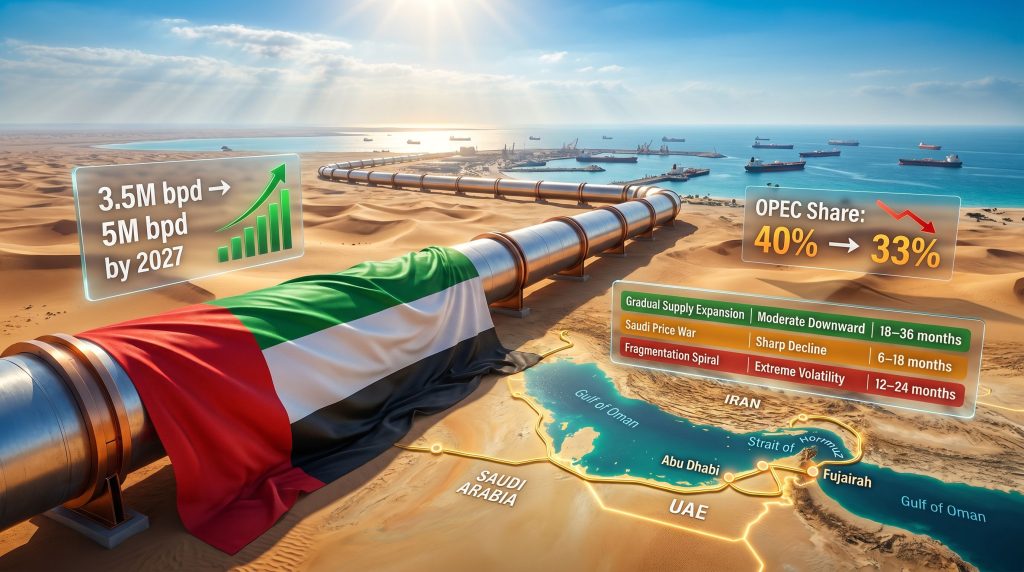
The UAE currently produces approximately 3.5 million barrels per day, positioning it as OPEC's third-largest producer after Saudi Arabia and Iraq. Until its departure, production was constrained by quota agreements limiting output to between 3.0 and 3.5 million barrels per day. The Abu Dhabi National Oil Company, known as ADNOC, has publicly stated its capacity to scale production to 5 million barrels per day by 2027, representing potential unconstrained upside of roughly 1.5 million barrels per day above its former quota ceiling.
With Saudi Arabia's spare capacity increasingly contested among energy analysts, the UAE's departure effectively removed OPEC's most credible and verifiable production flexibility buffer. Simon Watkins, writing for OilPrice.com on May 5, 2026, described the UAE as having been left as OPEC's key swing oil producer given the debatable nature of Saudi Arabia's available spare capacity.
This distinction matters enormously because swing capacity is what allows a cartel to credibly threaten supply responses to price movements. Without it, OPEC's ability to moderate market volatility in either direction is severely diminished.
ADNOC's Infrastructure Expansion and the Fujairah Bypass
The commercial logic for the UAE exit is reinforced by a parallel infrastructure strategy. ADNOC has plans to develop pipeline corridors connecting Abu Dhabi's oil fields directly to the port of Fujairah, which sits outside the Strait of Hormuz. This route provides two distinct advantages:
- Commercial flexibility: The ability to export crude independent of Hormuz transit fees, scheduling constraints, and chokepoint bottlenecks
- Geopolitical risk mitigation: Direct insulation from the Strait of Hormuz, which has been the subject of sustained instability, with recent headlines confirming tankers going dark to navigate exit routes and Iran making passage a case-by-case determination
Post-exit, ADNOC operates with no production ceiling and a fully funded expansion roadmap. Furthermore, the commercial incentive to leave OPEC was not marginal; it was structural. According to Al Jazeera's analysis, the UAE's departure signals a closer alignment with US interests — a dimension that extends well beyond production quotas alone.
The Geopolitical Fractures That Made Departure Inevitable
The commercial case alone does not fully explain why the UAE acted when it did. The timing of the exit was preceded by an unusually candid public assessment of Gulf alliance failure delivered by Anwar Gargash, diplomatic adviser to the UAE president, at the Gulf Influencers Forum hosted by the UAE Government Media Office on April 27, 2026, just four days before the OPEC departure took effect.
Gargash characterised the Gulf Cooperation Council's collective response to Iranian military provocations as the weakest it had ever been in the organisation's history, given the scale of the threat involved. He argued that Gulf solidarity had not proven adequate to the challenge, and that a unified Gulf vision at both the national and collective levels remained essential but had not materialised.
Critically, he identified Iran, not Israel, as the primary strategic threat to regional security, and stated explicitly that the American role in the region had grown more important rather than less, encompassing military infrastructure, political backing, and economic engagement. This statement amounts to a formal declaration of strategic alignment. Four days later, the UAE formalised its departure from an organisation that counts Iran as a member and operates within a framework that has historically elevated Saudi-Russian interests above those of Abu Dhabi.
The Abraham Accords Architecture and Washington's Gulf Anchor
The UAE's geopolitical positioning cannot be separated from its role within the Abraham Accords framework. In September 2020, the UAE became the first major Gulf state to normalise relations with Israel through the Accords. Unlike several regional peers, it maintained those diplomatic ties following the October 7, 2023 Hamas attacks. This consistency has made the UAE the cornerstone of Washington's Middle Eastern foreign policy architecture under the Abraham Accords model.
An additional dimension noted by Simon Watkins in OilPrice.com (May 5, 2026) involves the UAE's unusually close energy relationship with India. Washington views an energy-dependent India as a potential political, economic, and military counterbalance to Chinese influence across the Asia-Pacific region. Consequently, the UAE's role as a key energy supplier to India provides the United States with additional strategic leverage in that dynamic.
How the UAE Exit Reshapes OPEC+ and Erodes Russia's Leverage
Understanding the full significance of this development requires understanding why OPEC+ was created in the first place.
| Feature | OPEC (Core) | OPEC+ (Extended) |
|---|---|---|
| Formation | 1960 | Late 2016 |
| Key Non-OPEC Anchor | N/A | Russia |
| Trigger for Expansion | N/A | Failed price war against U.S. shale |
| Current Vulnerability | UAE departure | Russia's diminishing leverage |
In 2016, Saudi Arabia-led OPEC initiated a deliberate overproduction strategy designed to crash oil prices below the breakeven threshold of nascent U.S. shale producers. The strategy failed. Rather than capitulating, American shale operators restructured aggressively, cutting costs and improving drilling efficiency until they could sustain profitability at price levels that proved unsustainable for OPEC member budgets.
The episode destroyed OPEC's credibility as a market-stabilising force and created an urgent need for a new mechanism. Russia, which at that point held the position of the world's largest crude oil producer, was recruited into the production management framework. Fully aware of the economic and geopolitical leverage this position offered, Moscow entered OPEC+ and proceeded to use its role in a manner consistent with its broader strategic interests, as Simon Watkins documented in his analysis for OilPrice.com.
The UAE's departure now weakens this structure in concrete ways:
- A smaller, less diverse coalition reduces Russia's ability to leverage OPEC+ membership as a geopolitical instrument
- Venezuela, which analysts identify as a potential next departure following the U.S.-backed removal of Nicolás Maduro on January 3, 2026, could accelerate this fragmentation
- Saudi Arabia's influence contracts proportionally as the members capable of enforcing quota discipline exit the framework
Three Scenarios for Global Oil Prices
The departure creates genuine price uncertainty across multiple plausible pathways. Each scenario carries distinct implications for different geopolitical actors. Moreover, the interplay between oil price geopolitics and cartel cohesion means that no single outcome can be treated in isolation from broader market forces.
| Scenario | Trigger | Price Direction | Timeframe |
|---|---|---|---|
| Gradual Supply Expansion | ADNOC ramps toward 5M bpd by 2027 | Moderate downward pressure | 18 to 36 months |
| Saudi-Initiated Price War | Saudi Arabia overproduces to punish UAE and suppress new barrel margins | Sharp short-term decline | 6 to 18 months |
| OPEC+ Fragmentation Spiral | Further exits trigger coordination collapse | Extreme volatility, directionally bearish | 12 to 24 months |
The price war scenario deserves particular attention because it is not simply a bilateral energy dispute. A sustained Saudi-orchestrated price collapse would produce cascading effects across multiple geopolitical theatres simultaneously:
- Iran: Lower oil revenues would compress an already sanctions-constrained economy, potentially increasing the probability of a negotiated settlement with Washington
- Russia: Fiscal pressure would intensify on an economy already stretched by military expenditure now exceeding 1,500 days of active conflict in Ukraine
- United States: Falling crude translates to lower pump prices for American consumers, a politically valuable outcome ahead of November midterm elections
- UAE: Short-term margin compression on new barrels, partially offset by volume gains and the strategic flexibility of the Fujairah bypass route
As Simon Watkins noted in his OilPrice.com analysis, a price war scenario may paradoxically serve Washington's strategic interests more effectively than any direct policy intervention, simultaneously pressuring Iran and Russia while delivering domestic economic relief to American consumers.
The next major ASX story will hit our subscribers first
Washington's Strategic Calculus and Trump's Response
President Donald Trump publicly described the UAE's OPEC departure as a positive development, framing it as supportive of reducing global oil and gasoline prices while acknowledging it reflected internal tensions within the organisation. The sentiment reflects a broader set of converging U.S. interests served by the exit:
- Cartel erosion: Weakening OPEC's collective pricing power aligns with longstanding U.S. opposition to coordinated supply management
- Iran pressure: Lower prices reduce Tehran's revenue base and strengthen incentives for diplomatic engagement
- Russia containment: Diminished OPEC+ coherence limits Moscow's ability to weaponise energy as a geopolitical instrument
- Domestic price relief: Unconstrained UAE supply supports lower pump prices for U.S. consumers
- Abraham Accords reinforcement: The UAE's geopolitical pivot deepens its alignment with Washington's regional architecture
However, the broader context of the trade war and oil prices adds a further layer of complexity, as Washington simultaneously manages its energy strategy against an evolving backdrop of global trade tensions with China and other major consuming nations.
OPEC With 11 Members: Cohesion Risks and the Fragmentation Question
The remaining 11-member bloc faces significant internal cohesion challenges that compound the structural loss of the UAE's swing capacity.
Current OPEC Members (post-UAE exit): Algeria, Republic of the Congo, Equatorial Guinea, Gabon, Iran, Iraq, Kuwait, Libya, Nigeria, Saudi Arabia, Venezuela
Key cohesion risks within this remaining group include:
- Venezuela's political trajectory under post-Maduro governance creates membership uncertainty
- Nigeria and Libya face persistent domestic production instability, undermining their reliability as quota partners
- Iran's sanctions exposure limits its functional role as a stable production contributor
- Iraq and Saudi Arabia have historically experienced contentious disagreements over quota compliance
Furthermore, OPEC production decisions going forward will be made with a fundamentally reduced base of credible swing producers, making each meeting a more fraught exercise in collective discipline than before.
Following the UAE departure, OPEC's 11 remaining members account for approximately 33% of global crude oil production, 46% of total petroleum traded internationally, and 73% of the world's proven oil reserves. These figures represent a sustained decline from the organisation's founding-era control of 40%, 60%, and 80% across the same metrics.
The Long-Term Structural Question: Terminal Decline or Managed Contraction?
Three structural forces are compressing OPEC's long-run relevance in ways that extend beyond any single membership departure:
- Member attrition: Five departures since 2016 reflect a fundamental inability to align divergent national production interests under a unified framework as producer economics diverge
- U.S. shale resilience: The failure of the 2016 price war demonstrated conclusively that OPEC no longer holds effective veto power over non-member production growth
- Energy transition pressure: As global petroleum demand growth slows over coming decades, quota discipline becomes harder to enforce among members competing for what may become a structurally shrinking market share
The architecture that replaces OPEC's coordinating function may look quite different from what currently exists. Bilateral production agreements between major producers could replace multilateral quota frameworks. Price discovery may shift increasingly toward spot and WTI and Brent futures markets rather than cartel signalling. Non-OPEC producers including the United States, Canada, Brazil, and Guyana are already playing a more significant role in setting effective price floors and ceilings.
The UAE itself may emerge as an independent swing producer maintaining direct bilateral energy relationships with major consuming nations including India, China, and Japan, operating outside any formal multilateral framework. Reuters confirmed the official departure following a formal statement, underlining just how significant this moment is for the organisation's future trajectory.
| Dimension | Pre-Exit (Pre-May 2026) | Post-Exit Trajectory |
|---|---|---|
| UAE production ceiling | 3.0 to 3.5M bpd (quota-constrained) | Up to 5M bpd by 2027 (unconstrained) |
| OPEC membership | 12 members | 11 members |
| OPEC swing capacity | UAE plus Saudi Arabia | Saudi Arabia only (disputed) |
| U.S.-UAE alignment | Strong but within OPEC framework | Deepened, outside OPEC constraints |
| Russia's OPEC+ leverage | Significant | Diminishing |
| Global price volatility risk | Moderate | Elevated across multiple scenarios |
FAQ: UAE Exit from OPEC
When did the UAE officially exit OPEC?
The UAE's departure took effect on May 1, 2026, reducing membership from 12 to 11 countries.
How much oil does the UAE produce and why does it matter?
The UAE currently produces approximately 3.5 million barrels per day, making it OPEC's third-largest producer. ADNOC's stated target of 5 million barrels per day by 2027 represents production growth that was structurally incompatible with OPEC quota discipline.
What is the Fujairah pipeline and why is it strategically important?
ADNOC has plans to develop pipeline infrastructure connecting Abu Dhabi's oil fields to the port of Fujairah, which sits outside the Strait of Hormuz. This route allows crude exports without Hormuz transit exposure, a capability of growing strategic importance given ongoing regional instability.
Could Venezuela also leave OPEC?
Energy analysts have identified Venezuela as a potential next departure, particularly following the U.S.-backed political transition in early 2026. No official announcement has been made, and the timing remains uncertain.
Does the UAE's exit mean OPEC can no longer influence oil prices?
OPEC retains influence through Saudi Arabia and its remaining members. However, the loss of the UAE exit from OPEC, which served as its most credible swing producer, meaningfully reduces the organisation's capacity to fine-tune supply responses and its collective bargaining credibility in global markets.
Disclaimer: This article contains forward-looking scenarios and analysis based on publicly available information and should not be construed as investment advice. Oil price forecasts and geopolitical projections involve significant uncertainty. Readers should conduct independent research before making any financial decisions.
Want to Stay Ahead of the Commodity Market Shifts Reshaping Global Energy?
As OPEC's influence contracts and oil market volatility rises across multiple scenarios, Discovery Alert's proprietary Discovery IQ model scans ASX announcements in real time, delivering actionable alerts on significant mineral and energy-related discoveries directly to subscribers — explore historic discovery returns on Discovery Alert's discoveries page and begin your 14-day free trial to position yourself ahead of the next major market move.