July 25, 2026
The Fracturing Architecture of Global Oil Coordination
For six decades, the Organisation of the Petroleum Exporting Countries functioned on a foundational premise: that major producers would collectively subordinate national output ambitions to shared price management goals. That premise has now been tested more severely than at any point in OPEC's history. The UAE withdrawal from OPEC in May 2026 is not simply a diplomatic departure — it represents the visible endpoint of a structural contradiction that has been building for years, as one of the world's most aggressively expanding oil producers found itself perpetually constrained by a quota framework designed for a different era.
Understanding why this fracture occurred, what it means for global supply dynamics, and where oil markets go from here requires moving beyond the headlines and examining the underlying mechanics of how cartel coordination actually works — and where it breaks down.
When big ASX news breaks, our subscribers know first
Why Did the UAE Leave OPEC? Understanding the Strategic Calculus
A Decade of Quota Tensions Reaches a Breaking Point
The tension between Abu Dhabi's production ambitions and the ceiling imposed by collective quota management did not emerge overnight. For years, the UAE invested heavily in upstream capacity expansion through its national energy company ADNOC, steadily building the engineering and infrastructure foundation to push output well beyond what OPEC+ agreements permitted.
The most visible confrontation came during 2021 OPEC+ negotiations, when Abu Dhabi pushed hard for a materially higher baseline allocation to reflect actual capacity growth. According to Wood Mackenzie's Senior Vice President of Refining, Chemicals and Oil Markets, Alan Gelder, OPEC+ talks stalled as the UAE pushed for a higher baseline, and the eventual compromise raised the allocation from 3.17 million barrels per day to 3.5 million barrels per day from May 2022 — though this figure only partially reflected the scale of capacity growth the country had achieved.
The gap between what the quota framework permitted and what Abu Dhabi was technically capable of producing represented a structural incompatibility. Over time, that gap widened as capital continued flowing into UAE upstream projects while quota ceilings remained disproportionately anchored to older production baselines.
Three Converging Forces That Made Departure Inevitable
The UAE's exit from OPEC reflects the convergence of three distinct but reinforcing pressures:
| Driver | Description | Time Horizon |
|---|---|---|
| Capacity Expansion Ambitions | UAE targeting approximately 5 million bpd by 2027, constrained by quota framework | Long-term strategic |
| Fiscal Revenue Pressure | Conflict-related disruptions to oil, tourism, and trade revenues accelerating the need to monetise capacity | Near-term (2025-2026) |
| U.S. Diplomatic Alignment | Washington's policy objectives around global energy supply and price levels aligned with UAE production independence | Political (2025-2026) |
U.S. President Donald Trump publicly endorsed the UAE's decision when responding to questions from reporters at the Oval Office, describing it as positive for bringing down global energy costs. His remarks framed the withdrawal as consistent with broader objectives around reducing oil prices and increasing global supply — a clear signal that Washington viewed Abu Dhabi's pivot away from OPEC as strategically beneficial.
Rystad Energy described the UAE's departure as a long-term strategic repositioning driven by years of tension between Abu Dhabi's capacity expansion ambitions and the constraints of collective quota management, noting it reflects a deliberate move toward capacity-driven competition rather than a reactive response to short-term market conditions.
Furthermore, OPEC's market influence had already been under scrutiny well before this departure, with analysts questioning whether the organisation could maintain cohesion given diverging member interests.
"The UAE's exit was not a sudden diplomatic rupture. It was the logical endpoint of a strategic trajectory that prioritised production volume, fiscal maximisation, and bilateral diplomacy over the discipline of collective cartel membership."
How Significant Is the UAE Within OPEC's Architecture?
The UAE's Production Footprint: A Statistical Snapshot
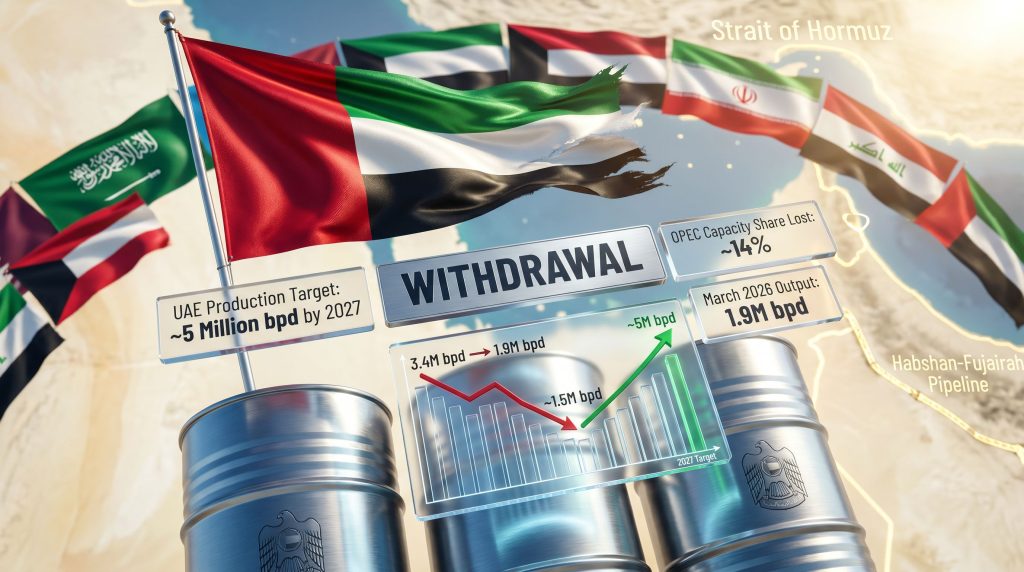
The scale of the UAE's departure cannot be overstated. According to Wood Mackenzie analysis, the UAE accounted for approximately 14 percent of OPEC's total production capacity prior to withdrawal — positioning it as the second-largest liquids capacity holder within the organisation. Simon Flowers, Chairman and Chief Analyst at Wood Mackenzie, described the UAE's exit as momentous precisely because of this scale.
Under normal operating conditions, the UAE has production capacity approaching 5 million barrels per day, making it one of a small number of producers globally capable of rapidly scaling output in response to market signals. The loss of this capacity from OPEC's coordination framework materially reduces the fraction of global oil supply the organisation can influence.
Wood Mackenzie noted that even in a scenario where UAE production policy remains unchanged in the near term, OPEC's stature has been diminished because it now exerts influence over a smaller fraction of the global oil market. As Al Jazeera's in-depth reporting highlights, the implications extend well beyond immediate supply figures.
What the Strait of Hormuz Disruption Means for Near-Term Supply
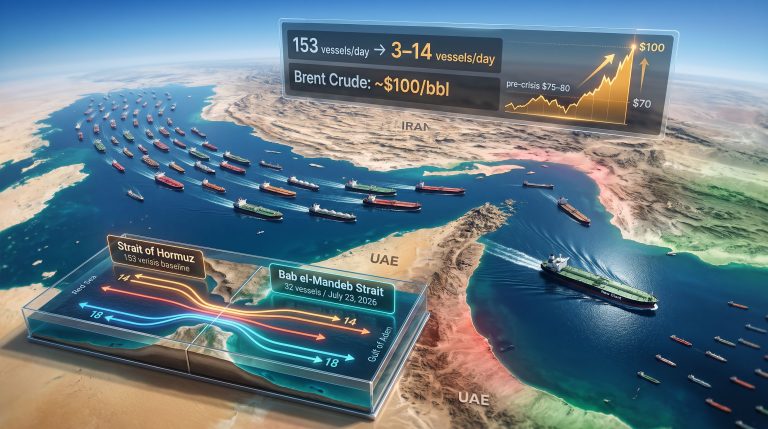
The UAE withdrawal from OPEC has coincided with one of the most significant supply disruptions the country has experienced in recent history. The closure of the Strait of Hormuz — a critical chokepoint through which a substantial share of global oil supplies transits — has severely constrained UAE output independent of any policy decision.
According to Wood Mackenzie data reported by Rigzone, the Hormuz closure has shut in close to 2 million barrels per day of UAE offshore production, with output falling sharply during early 2026 from approximately 3.4 million bpd in February to around 1.9 million bpd in March. This represents a production contraction of roughly 44 percent within a single month.
Critically, Wood Mackenzie noted that the UAE's ability to increase supply in 2026 is restricted regardless of policy changes, meaning the production disruption is a physical and logistical constraint rather than a policy one.
The UAE does retain a strategic infrastructure asset in the form of the Habshan-Fujairah pipeline, which provides an export route bypassing the Strait of Hormuz entirely. This pipeline allows a portion of Abu Dhabi's oil to reach international markets even when Hormuz transit is disrupted, providing partial insulation from the ongoing closure.
Even once Hormuz transit resumes, Wood Mackenzie analysts estimate that a return to pre-conflict production levels could take up to six months, reflecting the complexity of bringing shut-in offshore fields back online safely and efficiently.
What Does the UAE's OPEC Exit Mean for Global Oil Prices?
Near-Term Price Impact: Constrained by Physical Reality
In the immediate term, the price impact of the UAE withdrawal from OPEC is relatively contained. The reason is straightforward: the same Hormuz closure that is constraining UAE output also limits the country's ability to actually increase production in 2026 regardless of whether it operates inside or outside a quota framework. Rystad Energy's Vice President of Commodity Markets, Priya Walia, confirmed this assessment, noting that the UAE's exit does not materially alter near-term supply availability.
However, the structural damage to OPEC's authority is real regardless of near-term production volumes. As Wood Mackenzie emphasised, OPEC's influence over global oil markets has been reduced by the departure of its second-largest capacity holder, irrespective of whether barrels actually flow differently in the short term.
In addition, broader geopolitical oil price tensions continue to complicate price forecasting, with multiple regional flashpoints contributing to an already uncertain supply environment.
Medium-to-Long-Term Price Risks: 2027 and Beyond
The more consequential price dynamics are expected to emerge from 2027 onward, when the UAE pursues its stated capacity expansion target and Hormuz disruptions presumably resolve. Wood Mackenzie's analysis is direct on this point: the UAE's exit is more likely to influence supply dynamics in 2027 and beyond, as the country has the capability to take a growing share of global oil demand — directly challenging OPEC's concurrent policy of unwinding voluntary production cuts.
The scenario with the most significant downside price implications involves escalating market share competition between Abu Dhabi and remaining OPEC members. Wood Mackenzie assessed that if such competition intensifies, medium-term oil prices could fall sharply.
Key medium-term price risk factors include:
- UAE capacity scaling toward the 5 million bpd target while remaining OPEC members simultaneously unwind voluntary cuts
- Loss of OPEC's ability to credibly signal supply restraint to futures markets
- Erosion of quota compliance culture across the broader membership base
- Geopolitical headlines replacing policy signals as the primary driver of price volatility
Priya Walia of Rystad Energy highlighted that rather than moving cleanly in one direction, prices are likely to become more volatile, driven increasingly by geopolitical developments rather than coordinated policy signals from OPEC+. She further noted that as markets begin to rebalance further out, the weakening of OPEC+ as a coordination mechanism could amplify downside price risks relative to previous cycles.
Consequently, WTI and Brent futures markets are already beginning to price in greater structural uncertainty, reflecting the reduced predictability of OPEC+ as a supply management mechanism.
How Does the UAE Exit Reshape OPEC+'s Internal Dynamics?
Quota Compliance: Already Fragile, Now Further Weakened
Benjamin Zycher, Senior Fellow at the American Enterprise Institute's Center for Science, Technology, and Energy, provided one of the most analytically pointed assessments of the UAE exit's internal OPEC+ implications. Speaking to Rigzone, Zycher noted that the move will reduce the willingness of remaining members to adhere to formal production quotas, which he described as already operating with limited effectiveness even before the UAE's departure.
This matters enormously because OPEC+'s production management system depends not on legal enforcement but on voluntary compliance reinforced by reputational and diplomatic costs. When a major member exits, it signals to quota non-compliant members such as Iraq and Kazakhstan that the reputational cost of production independence is lower than previously understood.
Saudi Arabia-UAE Relations: A Deepening Geopolitical Rift
Zycher explicitly warned that the UAE's departure will increase the political rift between Saudi Arabia and the UAE. This is a significant development given that the two Gulf states have historically operated as close diplomatic and economic partners, and Saudi Arabia has been the primary architect of OPEC's supply discipline strategy throughout the OPEC+ era.
Saudi Arabia's ability to enforce production restraint across the membership base depends heavily on maintaining a coalition of willing partners. The UAE's exit directly undermines Riyadh's position as the pivotal swing producer capable of holding the cartel together during periods of disagreement.
Could Other Members Follow the UAE Out of OPEC?
| Member | Quota Compliance History | Post-UAE Exit Risk Assessment |
|---|---|---|
| Saudi Arabia | Consistently high | Low — Riyadh's influence depends on OPEC remaining intact |
| Iraq | Chronically below target | Moderate — financial pressures incentivise output maximisation |
| Kazakhstan | Persistent overproduction | Moderate to High — already openly exceeds quotas |
| Libya | Exempt from quotas | Low — exempt status reduces compliance pressure |
| UAE | Departed May 2026 | N/A |
Zycher's assessment was nuanced: OPEC is likely to remain formally as an organisation, but the effectiveness of its production quotas will be reduced markedly. This suggests the institution survives in name while losing material influence over the supply decisions of its remaining members — a hollow cartel scenario that energy economists have long theorised as the organisation's most probable long-term trajectory.
Furthermore, OPEC output increases had already been signalled prior to the UAE's departure, compounding the uncertainty around how remaining members will manage their own production ambitions going forward.
What Is the UAE's New Energy Strategy Outside OPEC?
Production Capacity Growth: Unconstrained Ambition
Operating outside the quota framework, the UAE faces no ceiling on how aggressively it pursues its capacity expansion roadmap. The country is targeting production capacity of approximately 5 million barrels per day by 2027, representing a significant increase from the constrained 2026 baseline. This target, if achieved, would position Abu Dhabi among a very small group of producers globally capable of influencing international supply at scale.
Outside the quota framework, the UAE gains full flexibility to respond to market signals with production decisions unconstrained by collective agreements. This is precisely what Wood Mackenzie described as the capacity to take a growing share of global oil demand — a strategic ambition that OPEC+ membership had structurally prevented Abu Dhabi from fully realising.
A Dual-Track Energy Portfolio
The UAE has indicated that its production decisions will be guided by market stability and global supply-demand fundamentals rather than purely by volume maximisation. Simultaneously, the country maintains investment across oil, gas, renewables, and lower-carbon technologies, reflecting Abu Dhabi's longer-term intent to remain relevant across the energy transition while maximising near-term hydrocarbon revenues.
This dual-track positioning is strategically sophisticated. By maintaining credible commitments to energy transition investment, the UAE insulates itself from reputational risk among European trading partners and institutional investors while retaining full flexibility to monetise its hydrocarbon reserves at scale.
Price Volatility as the New Operating Environment
For energy market participants, traders, and downstream industries, the post-OPEC UAE represents a structural shift in how oil price risk is assessed. With OPEC+ weakened as a coordination mechanism, the traditional expectation that the cartel would step in to defend price floors through production adjustments becomes less reliable.
The trade war oil impact adds yet another layer of complexity, as global trade tensions further reduce the predictability of demand forecasts and complicate the already fragile supply coordination dynamics.
Rystad Energy's Walia articulated this clearly: the weakening of OPEC+ as a supply coordination mechanism could amplify downside price risks compared with previous market cycles. For hedging strategies, capital allocation decisions, and long-term project economics across the energy sector, this represents a meaningful change in the underlying risk environment.
The next major ASX story will hit our subscribers first
Frequently Asked Questions: UAE Withdrawal from OPEC
Why Did the UAE Withdraw from OPEC?
The UAE's withdrawal reflects years of structural tension between Abu Dhabi's capacity expansion ambitions and the ceiling imposed by collective quota management. Combined with fiscal pressures from conflict-related revenue disruptions, a strategic diplomatic alignment with the United States, and the opportunity to freely monetise expanding production capacity, Abu Dhabi concluded that operating independently better serves its long-term national interests than remaining constrained within a collective framework.
When Did the UAE Leave OPEC?
The UAE announced its withdrawal from OPEC in May 2026, formally stepping outside the collective quota management framework that had governed its production ceiling for years. Reuters confirmed the departure with an official OPEC statement, marking a historic moment for the organisation.
How Much Oil Does the UAE Produce?
Under normal operating conditions, the UAE has production capacity approaching 5 million barrels per day. However, 2026 output has been severely constrained by the closure of the Strait of Hormuz, which reduced production to approximately 1.9 million bpd as of March 2026, with close to 2 million bpd of offshore production shut in as a result.
Will OPEC Survive the UAE's Departure?
According to Benjamin Zycher of the American Enterprise Institute, OPEC is likely to remain formally as an organisation, but the effectiveness of its production quotas will be reduced markedly. The institution is expected to survive structurally while operating with significantly diminished influence over global supply coordination.
What Does the UAE's OPEC Exit Mean for Oil Prices?
Near-term price impacts are limited due to Hormuz-related supply constraints that restrict UAE output regardless of membership status. From 2027 onward, as the UAE scales toward its capacity target, the risk of oversupply and downward price pressure increases materially — particularly if market share competition between Abu Dhabi and remaining OPEC members intensifies.
How Did the United States React to the UAE Leaving OPEC?
U.S. President Donald Trump publicly described the UAE's decision as a positive development, framing it as beneficial for reducing global oil and energy prices. The withdrawal is widely interpreted as consistent with Washington's broader energy policy objectives around increasing global supply.
The Broader Significance: Is This the Beginning of OPEC's Structural Decline?
OPEC at 66: From Dominant Cartel to Diminished Coordinator
Founded in 1960, OPEC built its historical influence on a simple but powerful mechanism: if enough major producers agreed to restrain output simultaneously, prices could be managed above competitive market levels. That mechanism depends entirely on the continued participation of high-capacity members who absorb the cost of production restraint in exchange for elevated prices.
The UAE withdrawal from OPEC by the second-largest capacity holder reduces the fraction of global oil supply under OPEC's coordinating influence to a historically low level. Wood Mackenzie described this as the most significant fracture in the organisation's 66-year history — a characterisation that underscores not just the immediate supply implications but the long-term legitimacy challenge facing the cartel.
The Shift Towards Capacity-Driven Competition
The post-UAE OPEC landscape is one where spare capacity management — long a cornerstone of cartel strategy — becomes structurally harder to enforce. Individual member states with large reserves and expansion ambitions face growing incentives to prioritise volume over price discipline, particularly when a prominent peer has demonstrated that exit carries manageable reputational costs.
This dynamic carries echoes of historical OPEC fragmentation episodes, including the 1980s price war triggered by Saudi Arabia's decision to abandon swing producer responsibilities and defend market share instead. However, the current context is more complex: it occurs against the backdrop of the global energy transition, rising U.S. production, and a geopolitical realignment that has weakened the diplomatic cohesion that once underpinned OPEC's collective bargaining power.
"The UAE's withdrawal does not simply remove one member from a table of equals. It removes the second-largest capacity holder from a coordination framework that depends on willing compliance from its most capable producers. When those producers conclude that independence serves them better than collective discipline, the cartel's foundational logic begins to unravel."
A New Era of Oil Market Uncertainty
For investors, energy companies, and policymakers navigating the oil markets of the late 2020s, the UAE's departure from OPEC signals something more profound than a single diplomatic event. It marks a transition point from a market environment where cartel coordination provided a degree of price predictability to one where supply decisions are increasingly fragmented, capacity-driven, and responsive to bilateral geopolitical relationships rather than multilateral production agreements.
The practical implication, as Rystad Energy identified, is that oil price volatility will increasingly be driven by geopolitical headlines rather than OPEC+ policy signals — a structural shift that demands a reassessment of how price risk is modelled, hedged, and factored into long-term investment decisions across the energy sector.
Key Data Summary: UAE and OPEC at a Glance
| Metric | Figure |
|---|---|
| UAE share of OPEC capacity (pre-withdrawal) | ~14% |
| UAE production capacity target (2027) | ~5 million bpd |
| UAE production (February 2026) | ~3.4 million bpd |
| UAE production (March 2026, post-Hormuz closure) | ~1.9 million bpd |
| Hormuz-related UAE offshore production shut-in | ~2 million bpd |
| OPEC years in operation at time of UAE exit | 66 years |
| UAE 2021 baseline compromise (OPEC+) | 3.17 million to 3.5 million bpd |
| Estimated Hormuz production recovery timeline | Up to 6 months post-reopening |
Disclaimer: This article contains forward-looking statements, analyst projections, and scenario-based assessments regarding oil prices, production capacity, and geopolitical outcomes. These represent informed analytical perspectives rather than guaranteed outcomes. Oil market dynamics are subject to rapid change based on geopolitical developments, technological factors, and macroeconomic conditions. Readers should not rely on this material as financial or investment advice. Independent professional advice should be sought before making investment decisions.
For further reporting and analysis on the UAE's OPEC withdrawal and its implications for global energy markets, readers can explore related coverage published by Rigzone at rigzone.com.
Want to Stay Ahead of the Next Major Market-Moving Discovery?
While geopolitical shifts like the UAE's OPEC departure reshape global commodity markets, Discovery Alert's proprietary Discovery IQ model delivers real-time alerts on significant ASX mineral discoveries, transforming complex market signals into actionable investment insights — explore historic discoveries and their exceptional returns to understand the opportunity, then begin your 14-day free trial at Discovery Alert to position yourself ahead of the market.