June 23, 2026
The Economic Architecture of Cartel Loyalty: Why Producers Eventually Break Free
Throughout the modern history of commodity cartels, the tension between collective price discipline and individual production ambition has never been resolved permanently. It has only ever been managed, deferred, and eventually overwhelmed. The most durable cartels in history have not collapsed because of external market forces alone. They have fractured from within, as members with expanding infrastructure and growing fiscal demands reach a point where the cost of compliance exceeds the benefit of membership. That structural breaking point, repeated across decades of energy history, arrived for the UAE on May 1, 2026, when Abu Dhabi formally ended its 59-year membership in OPEC.
Understanding what drove this decision requires looking beyond the headlines and into the underlying economics of production capacity, quota arithmetic, and long-term capital allocation. The UAE exit from OPEC was not a reactive political gesture. It was the logical conclusion of an investment thesis that the cartel's framework could no longer accommodate. Furthermore, the crude oil price trends leading up to this moment had already signalled mounting pressure on Gulf producers operating under strict quota constraints.
When big ASX news breaks, our subscribers know first
The Production Capacity Gap at the Core of the Decision
When Infrastructure Outgrows Its Institutional Constraints
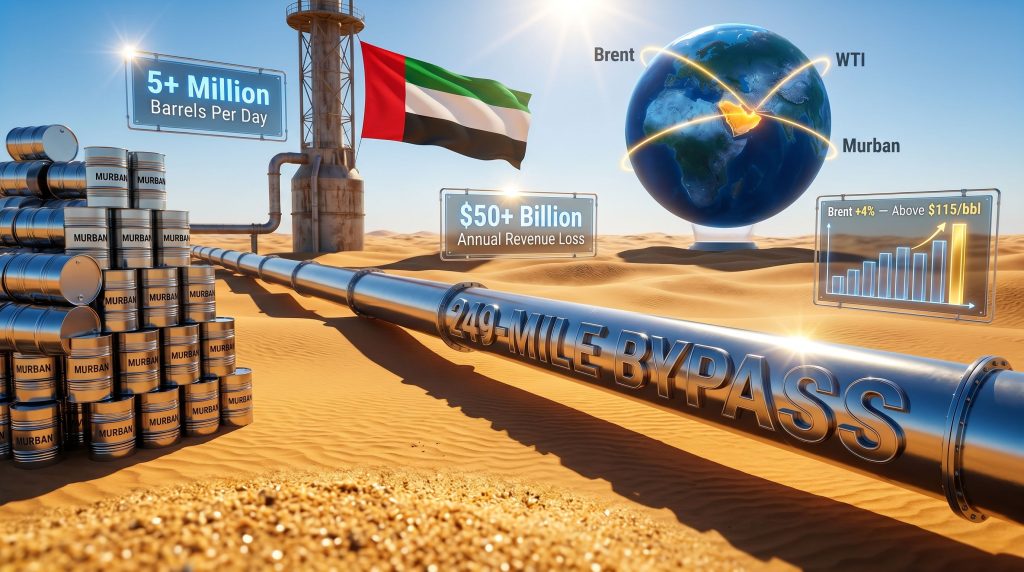
At the centre of the UAE's decision lies a fundamental mismatch between what the country built and what it was permitted to produce. According to figures cited in energy market analysis, the UAE's OPEC-assigned production quota stood at approximately 3.45 million barrels per day, while the country's actual production capacity had grown to exceed 5 million barrels per day. The gap between those two numbers represents the economic engine behind the exit.
Consider the investment context. Abu Dhabi channelled an estimated $122 billion to $150 billion into expanding its upstream production infrastructure, building a platform capable of delivering significantly more crude to global markets than OPEC's collective agreement allowed. With that capacity gap estimated to represent more than $50 billion in annual foregone revenue, continued membership carried an increasingly difficult-to-justify economic cost.
| Metric | Reported Figure |
|---|---|
| OPEC-assigned production quota | ~3.45 million barrels per day |
| Estimated actual production capacity | 5+ million barrels per day |
| Estimated annual revenue foregone | $50+ billion |
| Approximate capital invested in expansion | $122 billion to $150 billion |
| Years of OPEC membership at exit | 59 years |
Note: Production capacity estimates and revenue impact figures reflect analysis widely cited in energy sector commentary. Readers should consult primary sources including IEA and EIA reports for independently verified data.
This is not a new tension within OPEC. The cartel's quota system was designed for a different era of production politics, when member state infrastructure was less developed and collective price support generated sufficient benefit to offset individual output constraints. As Abu Dhabi built out its upstream capabilities through ADNOC, that calculus shifted materially. In addition, OPEC production decisions had increasingly failed to reflect the UAE's expanded capacity, making the institutional constraints all the more difficult to justify internally.
The Announcement and Its Immediate Framing
The withdrawal was announced on April 28, 2026, with the exit taking formal effect on May 1, 2026. In the immediate aftermath, ADNOC CEO Sultan Al Jaber made the UAE's strategic positioning explicit. Reported by Arab News on May 4, 2026, Al Jaber confirmed that the decision aligned with the UAE's national interests and long-term strategic objectives.
He further noted that the exit would give ADNOC greater capacity to accelerate investment, expand operations, and generate value across its portfolio. He also addressed the Strait of Hormuz directly, framing the security of critical maritime trade corridors as a responsibility shared across the international community rather than a concern confined to the region alone (Arab News, May 4, 2026).
That dual message, simultaneously reassuring energy buyers and asserting a globally responsible posture, was carefully constructed. It signals that Abu Dhabi's post-OPEC strategy involves positioning itself not as a rogue producer, but as a sovereign energy power capable of operating transparently and reliably on its own terms.
The Hormuz Dimension: Strategic Infrastructure as a Geopolitical Asset
Bypassing the World's Most Critical Oil Chokepoint
The Strait of Hormuz sits at the intersection of global energy security and regional geopolitical risk. Estimates suggest that more than 20 percent of global crude oil transits this narrow passage, making it one of the most strategically sensitive waterways in the world. The oil market geopolitical risks associated with ongoing tensions involving Iran have elevated the risk profile of Hormuz-dependent supply chains considerably.
The UAE's position within this risk landscape is materially different from most other Gulf producers. Abu Dhabi operates an overland pipeline infrastructure approximately 249 miles in length that routes crude from its interior fields to the port of Fujairah on the Gulf of Oman, entirely bypassing the Strait of Hormuz. This infrastructure gives the UAE a credible export pathway that remains operational even under conditions of significant Hormuz disruption.
Al Jaber's public commentary on Hormuz carried a deliberate strategic signal: by describing the security of vital trade routes as a shared global responsibility rather than a regional matter, the UAE positioned its energy supply chain as inherently more resilient and globally oriented than its OPEC membership constraints previously allowed it to demonstrate. (Arab News, May 4, 2026)
This bypass capacity is not merely a logistics asset. It functions as a geopolitical instrument, reducing the UAE's vulnerability to Iranian pressure and strengthening its ability to honour long-term supply commitments to Asian buyers regardless of regional escalation. For energy-importing nations in East Asia and Southeast Asia, this is a meaningful differentiator.
OPEC's Structural Fragility: A Pattern That Predates the UAE's Exit
Historical Precedent and the Incentive to Defect
The UAE's departure is the most consequential exit in OPEC's modern history, but it did not occur in isolation. A pattern of departures driven by quota disputes and strategic divergence has unfolded across the past decade. OPEC's market influence has consequently been in gradual decline long before this announcement:
-
Qatar withdrew in 2019, choosing to focus its energy identity on LNG dominance rather than crude oil quota politics
-
Ecuador exited in 2020, citing the incompatibility of OPEC quotas with its fiscal needs
-
Indonesia suspended its membership in 2016 and again in 2019, reflecting the fundamental awkwardness of a net oil importer participating in a production-restraint cartel
-
Angola departed in 2024, explicitly citing dissatisfaction with quota allocations that undervalued its production potential
What distinguishes the UAE exit from OPEC from all of these is scale. Abu Dhabi holds some of the highest-quality crude reserves in the world, with Murban crude widely regarded as a premium light-sweet grade sought by Asian refiners. Its production capacity, investment base, and supply chain infrastructure place it in a different category from any previous OPEC departure.
The Mechanism of Cartel Discipline and Its Limits
OPEC's price management system operates through voluntary production restraint. When members comply, reduced collective supply supports higher prices, generating revenue gains that theoretically compensate for the lost volume. This mechanism works when the revenue premium from higher prices exceeds the opportunity cost of withheld barrels. For producers with significant spare capacity and large capital bases, that arithmetic eventually inverts.
Key Concept: In cartel economics, quota rent refers to the premium a member receives from artificially restricted supply. When a member's capacity growth outpaces its quota allocation, the foregone production revenue begins to exceed the quota rent, creating a rational incentive to defect. The UAE's situation is a textbook illustration of this dynamic.
What the UAE's Exit Means for Saudi Arabia and Gulf Cohesion
Riyadh's Price Management Problem Just Got Harder
Saudi Arabia's economic model depends on OPEC functioning as an effective floor on global oil prices. The Kingdom's fiscal breakeven oil price, estimated by various analysts at between $70 and $80 per barrel depending on government expenditure projections, requires sustained price support that OPEC's collective framework is designed to provide.
The UAE's announced intention to scale production toward 5 million barrels per day by 2027 introduces a significant volume of additional supply into global markets that Saudi Arabia has no mechanism to discipline through cartel channels. The implications for Riyadh are layered:
-
Direct price pressure: Additional UAE barrels competing in Asian markets erode the price floor that Saudi fiscal planning depends on
-
Lost leverage: Without the UAE inside the cartel framework, Saudi Arabia's ability to broker production agreements across the Gulf loses a critical counterparty
-
Credibility risk: Every barrel the UAE produces above its former quota demonstrates to remaining members that the cost of compliance is real and the exit pathway is viable
The Gulf Cooperation Council Fault Line
The visible divergence between Abu Dhabi and Riyadh on energy strategy reflects deeper tensions within the Gulf Cooperation Council that extend well beyond oil production policy. The Abraham Accords normalisation framework, evolving relationships with global powers, and differing views on economic diversification timelines have all contributed to a gradual differentiation in strategic outlook between the two most powerful Gulf states. Analysts at CNBC have noted that Iran's shadow looms particularly large over this strategic repositioning.
The Murban Benchmark Ambition: Rewriting Asian Oil Pricing
A New Crude Reference Price for the World's Fastest-Growing Demand Centre
One of the most consequential and underappreciated dimensions of the UAE's post-OPEC positioning is the ambition to establish Murban crude as a globally recognised pricing benchmark. Currently, Asian crude buyers pay prices derived from Brent and WTI futures or Dubai/Oman marker grades. Murban, Abu Dhabi's flagship export grade, is a light-sweet crude with characteristics that make it particularly attractive to sophisticated Asian refinery configurations.
| Benchmark | Geographic Origin | Primary Market Focus |
|---|---|---|
| Brent Crude | North Sea, UK | Europe, Global Reference |
| WTI (West Texas Intermediate) | Permian Basin, USA | Americas |
| Dubai/Oman Marker | Gulf Region | Asian imports, medium-sour |
| Murban (Proposed) | Abu Dhabi, UAE | Asia-Pacific, premium light-sweet |
If Murban achieves benchmark status, the UAE gains direct pricing influence over the world's most dynamic demand region without requiring coordination through any collective framework. It would represent a structural shift in how Asian energy markets price their most critical input, and would entrench ADNOC's commercial relationships with buyers in Japan, South Korea, India, and China on terms defined by Abu Dhabi rather than by a cartel-influenced reference price.
ICE Futures launched a Murban crude futures contract in 2021, providing the foundational market infrastructure for this ambition. The volume and liquidity development of that contract will be a key indicator of whether the benchmark aspiration becomes a market reality.
The next major ASX story will hit our subscribers first
Market Reaction and the Medium-Term Price Outlook
Brent's Response and What Comes Next
Initial market reaction to the April 28 announcement reflected genuine uncertainty about the structural implications of the exit. Brent crude rose approximately 4 percent to trade above $115 per barrel in the immediate response, before retreating to around $114 per barrel as market participants began modelling the medium-term supply implications.
Disclaimer: Oil price figures referenced above reflect market reporting around the announcement date. Energy markets are highly volatile and subject to rapid change. Nothing in this article constitutes financial or investment advice. Readers should consult qualified financial professionals before making investment decisions.
The medium-term trajectory as the UAE scales toward its 5 million barrel per day target is expected by a number of analysts to carry downward pressure on Brent prices, though the pace and magnitude will depend heavily on:
-
The speed of UAE production ramp-up and infrastructure deployment
-
Saudi Arabia's response strategy, including potential compensating cuts
-
Global demand conditions, particularly in China and India
-
The evolution of the Hormuz disruption and its effect on supply from other Gulf producers
OPEC's Long-Term Relevance: Three Plausible Futures
Scenario Modelling for the Cartel's Institutional Trajectory
The UAE's departure does not automatically dissolve OPEC, but it materially alters the organisation's capacity to function as a credible supply management institution. Three broad scenarios now appear plausible:
| Scenario | Triggering Conditions | Assessment |
|---|---|---|
| OPEC Stabilises | Remaining members absorb the exit; Saudi Arabia reasserts quota compliance | Requires sustained member discipline; possible but increasingly difficult |
| Gradual Fragmentation | One or two additional exits within 24 months; pricing credibility weakens | Structurally incentivised given quota tensions across multiple members |
| Accelerated Dissolution | Multiple major exits; cartel loses price formation relevance | Lower probability near-term due to institutional inertia, but not negligible |
The scenario most likely to unfold in the near term is gradual fragmentation, not sudden collapse. Institutional inertia is a genuine force in cartel dynamics, and remaining members who lack the UAE's bypass infrastructure or diversified export markets have a stronger incentive to stay inside a framework that still provides meaningful price support.
The Sovereign Energy State: A New Model of Resource Power
What Abu Dhabi Is Actually Building
Stepping back from the immediate market mechanics, the UAE exit from OPEC reflects a broader model of energy sovereignty that other resource-rich nations will watch carefully. Rather than accepting the constraints of collective governance in exchange for price support, Abu Dhabi is betting that its combination of production capacity, infrastructure resilience, crude quality, and geopolitical positioning gives it sufficient market power to operate effectively as an independent energy state.
ADNOC's three-pillar strategic roadmap outside the cartel framework centres on:
-
Capital deployment acceleration: Removing quota-linked production ceilings unlocks the ability to fully utilise the investment already made in upstream infrastructure
-
Capacity expansion to 5 million barrels per day: Targeting completion by 2027, this represents the full monetisation of ADNOC's existing asset base
-
Value chain diversification: Expanding downstream refining, petrochemical processing, and LNG operations to reduce exposure to crude oil price cycles
This is not simply a production increase story. It is a comprehensive repositioning of Abu Dhabi as a vertically integrated energy power operating on its own strategic timeline, with the Murban benchmark ambition serving as the pricing architecture that would eventually sit beneath the entire structure.
Whether that ambition succeeds will depend on factors beyond ADNOC's direct control, including the depth of Murban futures liquidity, the evolution of Asian refinery demand for light-sweet crude, and the degree to which Saudi Arabia chooses competition or accommodation in response. What is already beyond question is that the era of unchallenged Gulf cartel solidarity, long treated as a foundational assumption of global energy markets, has entered a genuinely new and uncertain phase.
Want To Stay Ahead of the Next Major Commodity Market Shift?
Discovery Alert's proprietary Discovery IQ model delivers real-time alerts on significant ASX mineral discoveries, instantly translating complex data across 30+ commodities into actionable investment insights — explore historic discoveries and their returns to understand the opportunity, then begin your 14-day free trial at Discovery Alert to position yourself ahead of the broader market.