
August 6, 2026
The Architecture of OPEC's Most Consequential Fracture
The UAE OPEC exit, announced on April 28, 2026 and effective May 1, 2026, did not emerge from a vacuum. Sixty-five years of cartel diplomacy rests on a deceptively simple premise: that sovereign oil-producing nations will consistently subordinate short-term national revenue to collective price management. For most of OPEC's history, that premise held, even under significant strain. The 1973 oil embargo, the 2014 price war, and the extraordinary 2020 COVID-era production collapse all tested the coalition's cohesion, and each time the architecture survived.
What the cartel has rarely confronted, however, is a founding-tier producer with both the capacity ambition and the geopolitical motivation to walk away entirely. This departure represents precisely that scenario, and its implications extend far beyond the oil price screens.
When big ASX news breaks, our subscribers know first
What OPEC Actually Loses When the UAE Leaves
Understanding the weight of this departure requires moving past the headline figures and examining what kind of producer the UAE actually is within the cartel's operational architecture.
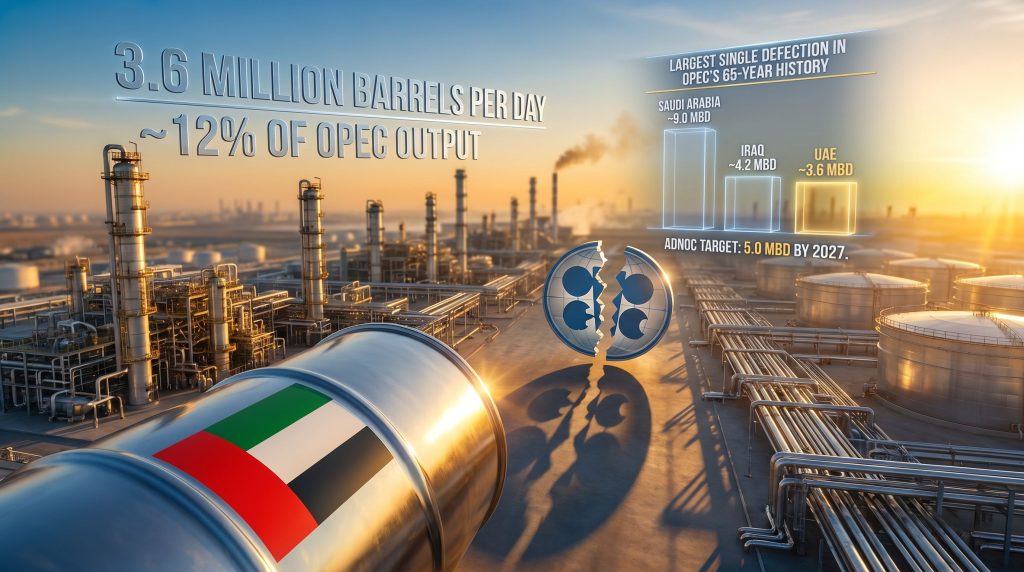
Before the exit, the UAE contributed approximately 3.6 million barrels per day (mbd), representing roughly 12% of total OPEC output and around 8% of the broader OPEC+ supply framework. That places Abu Dhabi third within OPEC's production hierarchy, trailing only Saudi Arabia and Iraq. To appreciate the scale, consider this comparison across the cartel's major contributors:
| Member | Approximate Daily Output (mbd) | Share of OPEC Output |
|---|---|---|
| Saudi Arabia | ~9.0 | ~30% |
| Iraq | ~4.2 | ~14% |
| UAE (pre-exit) | ~3.6 | ~12% |
| Iran | ~3.3 | ~11% |
| Kuwait | ~2.5 | ~8% |
Prior departures from OPEC offer useful context but imperfect parallels. Qatar's 2019 exit involved production of roughly 0.6 mbd. Ecuador's 2020 departure was even smaller in scale. Angola's 2023 exit, the most recent prior defection, removed approximately 1.0 mbd from the cartel's calculation, and global markets absorbed it without meaningful disruption.
The UAE's exit is categorically different in volume terms, making it the largest single producer withdrawal in the organisation's history by output.
Even so, OPEC+ collectively retains approximately 40% of global crude supply across its eleven remaining OPEC members plus Russia and allied producers. The volume loss is manageable in a mechanical sense. The credibility loss is a different matter entirely, and credibility is ultimately what gives a cartel its price-setting leverage.
How OPEC's Internal Quota Mechanics Create Structural Tension
OPEC's quota system operates through a reference production level framework, where the ministerial council sets an aggregate target and individual allocations are negotiated against that total. Saudi Arabia has historically functioned as the swing producer, adjusting its own output to keep the collective total near target while smaller members operate closer to their capacity ceilings.
The structural problem for high-growth producers like the UAE is straightforward: as upstream investment expands physical capacity, OPEC quota allocations do not automatically follow. A producer who has invested billions in new upstream infrastructure finds itself politically constrained from monetising that investment. Iraq has navigated this tension through systematic quota non-compliance for years. The UAE, by contrast, chose the more decisive path of formal exit.
Furthermore, OPEC's global oil influence has long depended on members accepting this constraint. Among remaining members, Nigeria faces chronic quota-versus-capacity tension with approximately 1.3 mbd of output, while Iraq's position as OPEC's second-largest producer alongside its persistent compliance disputes makes it a potential flashpoint for future defection risk.
Three Forces Behind the UAE OPEC Exit Decision
The exit did not emerge from a single trigger. It reflects the convergence of at least three distinct strategic pressures, each reinforcing the others.
The Production Capacity Ceiling Problem
Abu Dhabi's state energy company, ADNOC, has been executing a sustained capacity expansion programme with a near-term ceiling of 4.28 mbd and a stated strategic target of 5.0 mbd by 2027. The UAE holds estimated proven crude reserves of approximately 97.8 billion barrels (BP Statistical Review of World Energy, 2023), providing the geological foundation for multi-decade production growth.
The financial mathematics of operating below capacity are stark. At the gap between a 5.0 mbd capacity target and a realistic OPEC quota in the 3.0–3.2 mbd range, the unutilised volume approaches 1.8–2.0 mbd. At moderate oil price assumptions of around $70–$80 per barrel, that gap translates to somewhere between $46 billion and $58 billion in foregone annual revenues. Over a five-year horizon, the cumulative cost of quota compliance becomes a compelling argument for independence.
The production cost advantage compounds this calculation. UAE extraction costs are estimated in the $20–$28 per barrel range, among the lowest globally, meaning Abu Dhabi can remain highly profitable at price levels that would devastate higher-cost producers. This structural competitiveness makes volume maximisation a more rational strategy than price management through quota restraint.
The Iran Conflict and Diverging Economic Exposure
The Iran war has exposed a fundamental asymmetry in how the two Gulf powers experience the same regional conflict. Saudi Arabia, with its larger geographic buffer and more domestically insulated economy, faces manageable disruption. The UAE's exposure profile is materially different, given its deep integration with international finance, tourism, shipping corridors through the Strait of Hormuz, and a predominantly expatriate workforce whose confidence directly affects economic activity.
The war's economic toll on the UAE has been multidimensional:
- Disruption to maritime shipping lanes affecting Dubai's re-export hub status
- Pressure on real estate values as expatriate communities reassess risk
- Tourism revenue compression as regional instability weighs on visitor confidence
- Tightening fiscal space from reduced non-oil income streams
Against this backdrop, the logic of maximising oil revenue becomes fiscally imperative. A quota-free production posture allows Abu Dhabi to use its most competitive asset — its oil capacity — as both an economic stabiliser and a geopolitical signal. Consequently, OPEC production decisions that once served collective interests have increasingly conflicted with Abu Dhabi's own fiscal priorities.
The Washington Alignment Dimension
The timing of the UAE exit carries significant geopolitical signalling beyond the cartel itself. The departure followed US Treasury Secretary Scott Bessent's endorsement of an emergency dollar swap line with Abu Dhabi, a mechanism that positions the UAE as a preferred economic partner within US financial architecture.
By exiting OPEC, Abu Dhabi reduces its exposure to multilateral production management frameworks that can at times conflict with US energy policy preferences, particularly during periods when Washington favours higher global supply to dampen prices. This repositioning fits a broader pattern of UAE bilateral diplomacy that has increasingly emphasised direct partnership arrangements over multilateral cartel coordination.
The UAE Ministry of Energy and Infrastructure confirmed the decision was grounded in national interest and a commitment to contributing effectively to meeting the market's pressing needs — language that signals a deliberate pivot toward independent, market-driven supply relationships.
Will the UAE OPEC Exit Actually Move Oil Prices?
Industry executives broadly assessed the immediate price and supply disruption risk as low, and that assessment reflects sound market logic. The UAE is not withdrawing supply from the market. It is removing the administrative ceiling on its supply, which introduces a meaningfully different category of market risk: gradual oversupply pressure rather than a sudden shock.
The key variables that will determine price sensitivity over the medium term include:
- The speed at which ADNOC ramps output toward its 4.28 mbd capacity ceiling
- Whether Saudi Arabia responds with compensatory production cuts or retaliatory volume increases of its own
- The demand trajectory from Asia, particularly the combined import pull from India and China
- Whether other OPEC+ members use the disruption as cover to quietly exceed their own quotas
However, concerns around oil price stagnation are not new, and this exit adds another layer of complexity to an already pressured pricing environment.
Does the UAE OPEC exit lower oil prices? Not immediately. The exit removes quota constraints rather than adding supply overnight. However, if ADNOC accelerates production toward its 4.28–5.0 mbd capacity target, the incremental supply entering the market — potentially ~680,000 barrels per day above pre-exit baselines — could exert downward pressure on Brent crude over a 12–24 month horizon, particularly if OPEC+ proves unable to coordinate offsetting reductions elsewhere.
The historical analogy most cited is the 2014–2016 supply glut, when Saudi Arabia's decision to defend market share rather than cut production drove Brent from above $100/barrel to below $30/barrel. The current macro environment differs in important ways: US shale production has matured, demand recovery from COVID has plateaued, and the Iran conflict creates parallel geopolitical price support. These factors reduce the probability of a 2014-style collapse but do not eliminate the medium-term bearish vector that UAE capacity expansion introduces.
The Saudi Arabia–UAE Relationship After the Exit
Perhaps no bilateral relationship in global energy geopolitics has been more consequential — or more quietly strained — than the Saudi-UAE partnership. The two nations coordinated joint military operations in Yemen, maintained aligned OPEC positions through multiple volatile cycles, and pursued parallel economic diversification agendas under their respective Vision frameworks.
The fractures beneath that alliance have deepened progressively, driven by:
- Competition for foreign direct investment flows into the Gulf region
- Rivalry between Riyadh and Dubai/Abu Dhabi for regional financial hub status
- Divergent responses to the Iran conflict and differing expectations of Arab solidarity
- Growing competition for sovereign wealth influence in global asset markets
The manner of the exit itself carries its own diplomatic signal. The UAE provided minimal advance notice to fellow OPEC members, catching Saudi Arabia off-guard in a way that suggests the rupture was both intentional and deep. According to Al Jazeera's analysis, this is not the behaviour of a reluctant departure; it is the behaviour of a power that has already recalculated its strategic alignment and chosen to signal that recalculation publicly.
Saudi Arabia now faces a difficult choice in response: absorb the UAE's quota gap through its own production restraint, reinforcing price support but bearing the fiscal cost alone, or allow production to drift upward across the coalition, which risks a price-weakening spiral that damages Riyadh's own fiscal breakeven requirements.
India's Energy Equation and the Asian Buyer Calculus
For India, the UAE OPEC exit introduces both opportunity and complexity. The UAE supplies approximately 9% of India's total crude oil imports, alongside significant natural gas and LPG volumes, making it one of New Delhi's most critical bilateral energy relationships.
A quota-free Abu Dhabi theoretically offers Indian refiners access to more flexible, competitively priced supply contracts outside the OPEC pricing framework. ADNOC has already established the Murban crude benchmark as a futures-traded grade, giving buyers transparent, market-derived pricing rather than OPEC-administered reference prices. For Indian refiners accustomed to managing price risk across multiple supplier relationships, a more commercially flexible UAE could represent a meaningful procurement advantage.
The implications extend across Asian energy buyers broadly:
| Asian Buyer | UAE Crude Dependency | Key Consideration Post-Exit |
|---|---|---|
| India | ~9% of crude imports | Flexible pricing opportunity; bilateral supply security |
| Japan | Moderate | Long-term contract renegotiation dynamics |
| South Korea | Moderate | Murban benchmark pricing adoption |
| China | Significant | Supply diversification within portfolio |
Japan and South Korea, both deeply integrated into Gulf crude supply chains through long-term agreements, may find that a UAE operating outside OPEC's coordination framework offers more responsive volume commitments during periods of Asian demand growth. China's calculus is more complex, given its existing relationships with Iran and Russia, but incremental UAE supply at competitive prices fits Beijing's consistent strategy of diversifying crude sourcing. In addition, the trade war impact on oil markets continues to create further uncertainty around Asian demand projections that will influence how quickly Abu Dhabi scales its output.
The next major ASX story will hit our subscribers first
OPEC's Institutional Future: Resilience or Structural Decline?
OPEC was founded in September 1960 in Baghdad by Iran, Iraq, Kuwait, Saudi Arabia, and Venezuela, with the explicit mandate to coordinate petroleum production policy and stabilise oil markets. Over 65 years, it has demonstrated remarkable resilience against forces that should theoretically have dissolved it: member wars, sanctions, economic collapse, and price volatility that periodically destroyed members' fiscal positions entirely.
The post-COVID era, however, has accelerated internal tensions in ways the cartel's original architecture was not designed to manage. Aggressive output management has kept prices elevated but created a growing gap between quota allocations and members' actual capacity and fiscal needs. The OPEC+ framework, built around Russia as the anchor non-OPEC partner, adds coordination complexity at a time when Moscow's own geopolitical isolation constrains its freedom of movement within multilateral frameworks.
The UAE's departure combines three destabilising elements simultaneously: production scale, geopolitical symbolism, and US alignment. This trifecta makes the current episode categorically different from prior defections. Angola left because it was declining. Qatar left over a niche gas production dispute. The UAE is leaving from a position of strength, capacity growth, and deliberate strategic repositioning. That distinction matters enormously for how remaining members read the institutional signal.
Moreover, the US-China oil price tensions add yet another layer of complexity to a global energy market already navigating considerable geopolitical uncertainty.
Whether this triggers a broader OPEC+ restructuring or merely a period of reduced cohesion depends primarily on Saudi Arabia's response and Russia's ability to sustain its own commitment to coordinated cuts under ongoing Western sanctions pressure. The cartel retains the structural capacity to survive the departure in volume terms. Whether it can retain the credibility needed to manage prices effectively is a harder question, and one that will likely take years to fully resolve.
Frequently Asked Questions: UAE OPEC Exit Explained
What does it mean for the UAE to exit OPEC?
OPEC membership requires countries to accept production quota allocations set by the cartel's ministerial council, subordinating individual output decisions to collective supply management. Exiting OPEC removes this obligation, allowing Abu Dhabi to produce at whatever level it determines serves its own fiscal and strategic interests, without requiring negotiation or compliance with cartel targets.
When did the UAE officially leave OPEC?
The exit was announced on April 28, 2026, with an effective departure date of May 1, 2026.
How much oil does the UAE produce and what is its capacity?
- Current output at time of exit: approximately 3.6 mbd
- Near-term operational capacity ceiling: 4.28 mbd
- ADNOC's stated 2027 strategic production target: 5.0 mbd
Will other OPEC members follow the UAE?
Nigeria faces the most analogous quota-versus-capacity tension among remaining members, with persistent production challenges and fiscal pressure. Iraq's systematic compliance issues make it a longer-term institutional risk. However, the political and diplomatic costs of formal exit are high, and most smaller producers lack the geopolitical positioning that made the UAE's unilateral move viable.
How does the UAE's exit affect global oil prices in 2026?
Short-term disruption is assessed as minimal, given that markets are already navigating the Iran conflict overhang. Medium-term, if ADNOC ramps production materially above pre-exit baselines, the additional supply could create bearish price pressure on Brent crude over a 12–24 month horizon, particularly against a backdrop of moderate Asian demand growth.
What happens to OPEC after the UAE leaves?
OPEC retains 11 members and, through the OPEC+ framework, continues to represent approximately 40% of global crude supply. The organisation's market influence depends less on its precise membership count than on Saudi Arabia's willingness and capacity to manage the coalition's aggregate behaviour. That task has become measurably harder.
Three Analytical Lenses for Interpreting the UAE OPEC Exit
| Analytical Lens | Core Implication |
|---|---|
| Oil Market Dynamics | Limited immediate price disruption; medium-term oversupply risk as ADNOC scales toward 5 mbd and incremental barrels enter a market already under structural pressure |
| Geopolitical Realignment | Accelerates Saudi-UAE strategic rivalry; signals Abu Dhabi's deliberate pivot toward US-aligned bilateral energy diplomacy over multilateral cartel coordination |
| OPEC Institutional Health | Largest defection by output volume in the cartel's 65-year history; risks normalising capacity-driven exits and weakening collective price-setting credibility |
This article incorporates analysis of publicly available data and reported industry assessments. Forecasts relating to oil prices, production trajectories, and geopolitical outcomes are inherently speculative and subject to change based on market conditions, conflict dynamics, and policy decisions. Nothing in this article constitutes financial or investment advice.
Want To Capitalise On The Next Major Resource Discovery Before The Market Does?
Discovery Alert's proprietary Discovery IQ model scans ASX announcements in real time, delivering instant alerts on significant mineral discoveries and turning complex data into clear, actionable opportunities — explore historic discoveries and their returns to see what's possible, then begin your 14-day free trial at Discovery Alert to position yourself ahead of the broader market.