June 7, 2026
The Infrastructure Bet That Took Four Decades to Pay Off
Energy security planners rarely celebrate the infrastructure they hope never to use. Pipelines built as insurance policies, terminals constructed for theoretical contingencies, and bypass corridors engineered against low-probability disruptions tend to sit quietly in annual reports as depreciated assets rather than strategic advantages. Yet when a genuine chokepoint crisis materialises, the gap between producers with alternative export architecture and those without becomes the most consequential variable in global oil markets. That gap is precisely what is reshaping India's crude supply picture as UAE and Saudi bypass Hormuz to boost crude supplies to India.
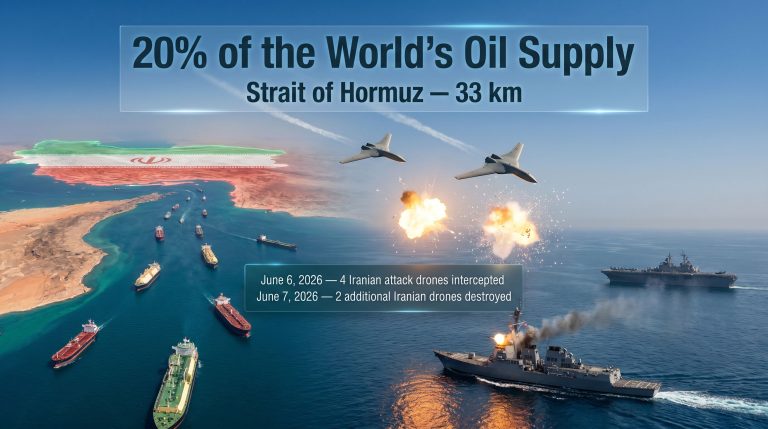
The Strait of Hormuz handles an estimated 20 million barrels per day under normal operating conditions, making it the single most critical petroleum transit corridor on the planet. When disruptions collapse tanker traffic through that narrow channel, the consequences are not evenly distributed. Some producers have spent decades quietly building escape routes. Others have none.
When big ASX news breaks, our subscribers know first
Why the Hormuz Chokepoint Creates Winners and Losers Simultaneously
The structural asymmetry of the current disruption is perhaps its most underappreciated dimension. Iran's effective shutdown of significant portions of strait transit has not disabled all Gulf producers equally. It has instead sorted them into two sharply defined categories: those with bypass-capable infrastructure and those facing near-total export paralysis.
The consequences for Hormuz-dependent producers are binary rather than graduated. Iraq, Kuwait, and Qatar possess no viable alternative export routes. Their crude shipments to India have been suspended entirely, not reduced. There is no graceful degradation pathway for a producer whose entire export system terminates at a single blocked chokepoint.
The contrast with Saudi Arabia and the UAE is stark. Both countries invested in alternative export corridors decades before the current crisis, and both are now deploying those assets as primary export arteries rather than backup systems. Understanding the broader oil price geopolitical factors at play helps explain why this infrastructure asymmetry matters so profoundly right now.
| Producer | Hormuz Dependency | Bypass Route Available | Current Export Status to India |
|---|---|---|---|
| Saudi Arabia | Partial | East-West Pipeline to Yanbu (Red Sea) | Active, volumes normalised |
| UAE | Partial | ADCOP Pipeline to Fujairah (Gulf of Oman) | Active, volumes significantly elevated |
| Oman | None | Direct Gulf of Oman access | Exports increasing sharply |
| Iraq | Total | None viable | Suspended |
| Kuwait | Total | None viable | Suspended |
| Qatar | Total | None viable | Suspended |
The fundamental divide between bypass-capable and Hormuz-dependent producers is now the single most important structural variable determining which Gulf states can maintain crude export revenues and bilateral energy relationships during this disruption.
Saudi Arabia's East-West Pipeline: Four Decades of Strategic Patience
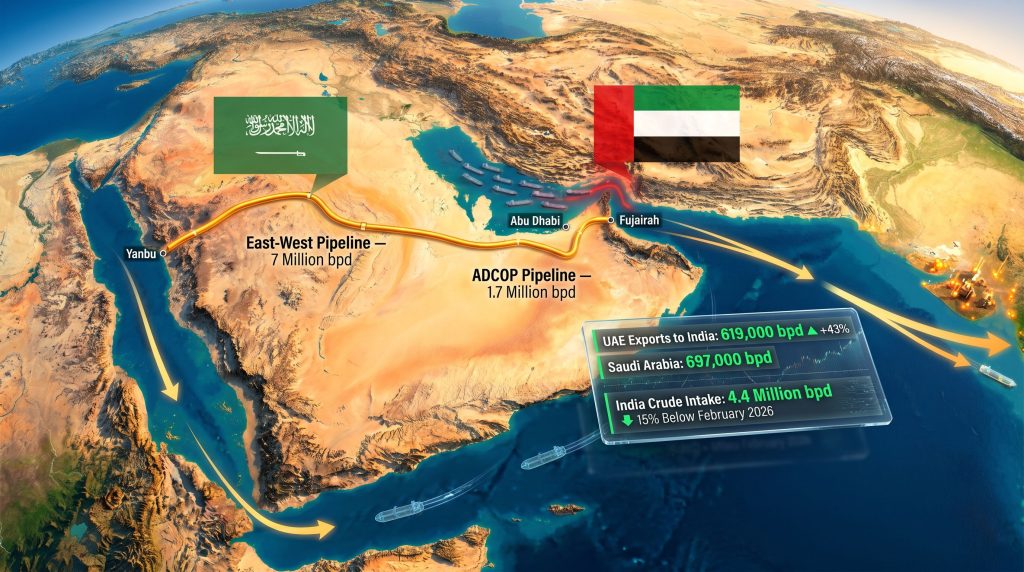
Built in 1981 against the backdrop of Cold War-era Persian Gulf instability, Saudi Arabia's East-West Pipeline was conceived as a hedge rather than a primary export system. Connecting inland Saudi oil fields to the Yanbu terminal on the Red Sea, the pipeline spans approximately 1,300 kilometres and carries a rated capacity of 7 million barrels per day. For much of its operational life, it functioned as a redundancy asset while the vast majority of Saudi crude continued flowing through Ras Tanura on the Persian Gulf.
The current disruption has inverted that logic entirely. Saudi Arabia has redirected a material portion of its Indian-bound crude from Ras Tanura to Yanbu, effectively decoupling those shipments from Hormuz exposure. The operational result is measurable: Saudi Arabia delivered 697,000 bpd to India in April 2026, slightly above its fiscal year 2025-26 average of 668,000 bpd. Supply continuity to one of its most important customers has been maintained not through diplomatic intervention but through existing infrastructure.
It is worth noting that operating the East-West Pipeline at or near maximum capacity introduces its own operational considerations. Sustained high-utilisation rates on ageing pipeline infrastructure typically accelerate maintenance cycles, require additional corrosion monitoring, and place pressure on pumping station reliability. These are not immediate crisis variables, but they represent medium-term constraints if the disruption extends for months rather than weeks.
Additionally, the Yanbu terminal must accommodate a surge in loading volumes that may approach or exceed its original design parameters. Berth congestion, tank storage saturation, and vessel scheduling conflicts become operational bottlenecks even when the pipeline itself is functioning normally. According to reporting on alternative Hormuz routes, these logistical pressures are common to all producers attempting to scale bypass operations rapidly.
The UAE's ADCOP Pipeline and the Fujairah Factor
The Abu Dhabi Crude Oil Pipeline (ADCOP) connects Abu Dhabi's inland production zones directly to Fujairah on the Gulf of Oman coast, bypassing the Strait of Hormuz entirely. With a rated capacity of 1.7 million barrels per day, it represents a fundamentally different scale of bypass capability compared to Saudi Arabia's East-West system, but its strategic logic is identical: provide an independent export pathway that remains functional when the Persian Gulf is compromised.
The April 2026 data confirms the UAE is pushing this advantage aggressively. UAE crude shipments to India reached 619,000 bpd during the period, compared with a fiscal year 2025-26 average of just 433,000 bpd. That represents a 43% year-on-year increase in deliveries to India from a single supplier within a single month of disruption. For Indian refiners scrambling to replace lost Iraqi and Kuwaiti volumes, this surge has been operationally significant, demonstrating precisely how UAE and Saudi bypass Hormuz to boost crude supplies to India in practice.
However, a critical complication shadows the UAE's bypass capacity. Reports indicate that Iranian military strikes have caused damage to the Fujairah terminal itself, creating operational constraints at precisely the moment when demand for the facility is at its highest. If Fujairah sustains further damage, the UAE's ability to compensate for broader Gulf supply losses would be materially impaired, potentially exposing India to a secondary supply shock even from its most reliable bypass-capable partner.
If Fujairah terminal damage worsens under continued pressure, the UAE's structural advantage over Hormuz-dependent producers narrows significantly, and India's diversification buffer shrinks accordingly.
Oman's Quiet Emergence as a Hormuz-Independent Supplier
While Saudi Arabia and the UAE attract most of the analytical attention, Oman's role in the current supply picture deserves closer examination. Oman's coastal geography gives it direct Gulf of Oman access without any Hormuz transit requirement. This structural advantage has historically been underutilised from India's perspective, with Omani deliveries averaging just 18,000 bpd during fiscal year 2025-26.
April 2026 data suggests that calculus is changing rapidly. Omani crude exports to India climbed to 101,000 bpd, representing a 461% increase over the prior fiscal year average. While this volume remains modest relative to India's total import requirements, the trajectory signals that both parties are recognising the strategic value of a supplier that is entirely insulated from Hormuz risk.
Oman's crude grades, predominantly medium-sour in character, are broadly compatible with Indian refinery configurations that process a mixture of Middle Eastern grades. Furthermore, this technical compatibility reduces processing friction as refiners increase Omani intake and supports the case for formalising Oman's role in India's long-term supply architecture.
India's April 2026 Import Picture: Partial Mitigation, Not Full Recovery
The aggregate picture of India's crude supply situation in April 2026 reflects successful crisis management rather than a return to normalcy. India's average crude intake between April 1 and 26 stood at 4.4 million bpd, approximately 15% below February 2026's intake of 5.2 million bpd. The 800,000 bpd shortfall is primarily attributable to the complete suspension of imports from Iraq, India's second-largest crude supplier, alongside the halt of Kuwaiti and Qatari volumes.
According to ship-tracking firm Kpler, the combination of higher UAE and Saudi flows, resumed imports from previously offline suppliers, and moderated but still significant Russian volumes has prevented a full supply crisis while not fully closing the gap.
| Origin | April 2026 Volume (bpd) | FY 2025-26 Average (bpd) | Direction | Notable Context |
|---|---|---|---|---|
| Russia | 1,600,000 | ~2,000,000 (March peak) | Moderated | Lower availability after March surge |
| Saudi Arabia | 697,000 | 668,000 | Slightly higher | East-West Pipeline rerouting active |
| UAE | 619,000 | 433,000 | +43% | ADCOP-Fujairah corridor at elevated capacity |
| Venezuela | 258,000 | ~0 (9-month gap) | Resumed | US policy shift post-Maduro capture |
| Iran | 151,000 | ~0 (7-year gap) | Resumed | US waivers issued March 2026 |
| Oman | 101,000 | 18,000 | +461% | Direct Gulf of Oman access, no Hormuz risk |
| United States | 115,000 | 314,000 | -63% | Premium pricing vs. discounted alternatives |
| Iraq | Suspended | Major supplier | Offline | No bypass route available |
The diversity of this supply matrix is itself a form of risk management. No single supplier now represents an existential dependency, though Russia's 1.6 million bpd contribution still accounts for a dominant share of total intake. The January-February 2026 experience, when tightened US sanctions caused Russian supply to dip sharply, revealed the vulnerability that emerges when one origin accounts for a disproportionate share of total imports.
The next major ASX story will hit our subscribers first
The Geopolitical Unlocks That Reshuffled India's Supply Map
Two US policy developments have materially altered the set of crude origin options available to Indian refiners during this disruption, and their timing cannot be separated from their impact.
The first was the US policy on Venezuela easing export restrictions following the capture of President Nicolás Maduro in January 2026. Venezuelan crude resumed flowing to India at 258,000 bpd in April after a nine-month supply gap. Venezuela's heavy crude grades, which are processed at lower cost premiums relative to light sweet grades in refineries configured to handle high-sulfur feedstocks, represent a commercially attractive complement to Middle Eastern blends under current market conditions.
The second development was the issuance of US waivers in March 2026 that facilitated Indian access to both Iranian and Russian oil volumes. Iran supplied 151,000 bpd to India in April 2026, marking the first Iranian crude deliveries in approximately seven years. The resumption carries implications beyond immediate supply volumes: it re-establishes a commercial relationship between Indian refiners and Iranian crude producers that had been dormant for nearly a decade. Moreover, the strategic implications of US resource policy extend well beyond the immediate supply situation, creating reference points for future supply architecture decisions that will depend heavily on the evolution of US-Iran diplomacy.
The sharp decline in US crude exports to India from a fiscal year average of 314,000 bpd to just 115,000 bpd in April provides a revealing counterpoint to these developments. Despite facilitating access to Iranian and Venezuelan barrels, US crude itself is being displaced in India's import mix. The explanation is straightforward: Indian refiners operating under supply pressure and price scrutiny are prioritising discounted sanctioned-origin barrels over premium-priced US grades. This commercial logic is rational but creates an interesting tension in the US-India energy relationship.
The Hard Arithmetic of Bypass Capacity
The most important structural constraint on the current bypass strategy is arithmetic. Saudi Arabia's East-West Pipeline and the UAE's ADCOP system, operating at full combined utilisation, can theoretically route approximately 6 million barrels per day around the Strait of Hormuz. Under pre-disruption conditions, the strait handles roughly 20 million barrels per day in total transit.
Consequently, this means the existing bypass infrastructure, even at maximum capacity, can substitute for approximately 30% of normal Hormuz throughput. The remaining 70% has nowhere to go. For producers without bypass options, including Iraq, Kuwait, Qatar, and others, the disruption is structurally unsolvable through existing infrastructure. Their exports are suspended not because of a policy decision but because of a physical one.
This gap explains why India's import volumes remain 15% below pre-disruption levels despite aggressive diversification across six or more source countries. The bypass operations by Saudi Arabia and the UAE are a mitigation strategy, not a solution. They preserve bilateral relationships and maintain partial supply flows to key importers. They do not restore the system to pre-disruption capacity. The broader trade war impact on oil compounds these physical constraints, adding yet another layer of complexity to global supply dynamics.
Long-Term Infrastructure Responses: Canal Projects and Corridor Frameworks
The structural inadequacy of existing bypass capacity has renewed serious attention to longer-term infrastructure solutions that have circulated in engineering and policy circles for years without reaching construction phase.
The India-Middle East-Europe Economic Corridor (IMEC), announced at the G20 Summit in New Delhi in September 2023, represents the most developed multilateral framework for reducing Hormuz dependency through integrated overland infrastructure. The corridor proposes connecting ports, rail networks, and pipeline systems across the UAE, Saudi Arabia, Jordan, and Israel to create a continuous trade corridor linking India to European markets, with energy infrastructure components that could provide non-Hormuz crude access pathways.
Separately, engineering feasibility studies have examined the viability of purpose-built canal infrastructure to connect the Persian Gulf to the Red Sea or Gulf of Oman. A proposal originating from Riyadh in 2015 outlined a 950-kilometre canal across the Arabian Peninsula at an estimated cost of approximately USD $80 billion. A 2024 engineering assessment identified three technically viable routing options:
- A corridor through Oman's Musandam Peninsula
- A route contained entirely within UAE territory connecting to Fujairah
- A broader 1,500-kilometre alignment spanning the wider Arabian Peninsula
An alternative framework involves routing crude through Israel's port of Haifa, connecting Arabian Peninsula production to Mediterranean access via overland infrastructure. This option carries significant geopolitical complexity that limits near-term feasibility regardless of engineering viability.
| Infrastructure Option | Estimated Cost | Bypass Capacity Potential | Development Status |
|---|---|---|---|
| Saudi East-West Pipeline | Built 1981, operational | 7 million bpd | Active |
| UAE ADCOP Pipeline | Built, operational | 1.7 million bpd | Active (partially constrained) |
| IMEC Corridor | Multi-billion, multi-nation | To be determined | Early development |
| Arabian Peninsula Canal | ~USD $80 billion | Significant | Feasibility study phase |
| Haifa Mediterranean Link | To be determined | To be determined | Conceptual only |
None of these long-term solutions will affect the current disruption. Their relevance is to the post-crisis energy security architecture that India and Gulf producers will need to negotiate and fund if the Hormuz vulnerability is to be structurally rather than incrementally addressed.
What India's Refinery Sector Needs to Absorb the New Supply Reality
India's diversified April 2026 import mix demonstrates genuine operational flexibility, but it also exposes a technical constraint that sits beneath the headline supply numbers. Indian refineries have historically been configured around a relatively narrow range of crude grades: predominantly medium-sour grades from the Middle East, with Russian Urals providing a comparable substitute at discount pricing.
Absorbing Venezuelan heavy crude, Iranian grades, and increased volumes of Omani crude simultaneously requires refineries to manage significantly wider variation in viscosity, sulfur content, and API gravity across their feedstock blend. This places additional demands on:
- Crude blending operations at terminal and refinery intake points
- Desulfurisation unit (hydrocracker and hydrotreater) capacity and throughput
- Coker unit availability for processing heavier residual fractions from Venezuelan and Iranian grades
- Catalyst management and replacement cycles, which accelerate under heavy crude processing
Indian state refiners including Indian Oil Corporation, Hindustan Petroleum, and Bharat Petroleum have invested progressively in refinery upgrades over the past decade, improving their ability to process a broader range of crude grades. However, sustained processing of non-standard feedstocks at elevated volumes introduces marginal cost increases and operational complexity that partially offset the discount pricing benefits of sanctioned-origin crude.
The long-term strategic implication is clear: India's energy security investment case is not limited to supply diversification at the geopolitical level. It extends to refinery infrastructure investment that can accommodate the widest possible range of crude origins without significant processing penalty.
India's Energy Security Calculus Going Forward
The April 2026 data provides a real-world stress test of India's multi-vector supply strategy, and the results are instructive in their nuance. The strategy has succeeded in preventing a supply collapse. It has not succeeded in maintaining pre-disruption import volumes. The 15% shortfall is manageable in the short term but would become increasingly consequential if extended across quarters rather than weeks.
Three conclusions emerge from the current supply picture that carry durable strategic relevance, particularly as analysts continue to examine oil trade and geopolitics in the context of ongoing disruptions:
-
Tier-one supplier relationships should prioritise bypass-capable producers. Saudi Arabia and the UAE have demonstrated that infrastructure optionality translates directly into supply continuity during crisis conditions. India's energy diplomacy and long-term supply contract frameworks should explicitly weight bypass capability as a selection criterion.
-
Oman warrants formal inclusion in strategic supply frameworks. The 461% increase in Omani crude imports is a market signal that both parties are recognising a structural advantage. Formalising Oman's role through long-term supply agreements and potential strategic petroleum reserve arrangements would convert a crisis-driven increase into a durable supply anchor.
-
Russian supply concentration remains a structural vulnerability. Russia's continued dominance of India's import mix at 1.6 million bpd means that any future disruption to Russian supply availability, whether from sanctions tightening, logistics constraints, or geopolitical developments, would create an immediate shortfall that no combination of current alternative suppliers could rapidly absorb.
The current disruption has, in effect, served as an unplanned audit of India's energy security infrastructure. The findings confirm genuine resilience in some dimensions and persistent structural gaps in others. Addressing those gaps, through refinery investment, infrastructure partnerships, and supply agreement diversification, will determine whether the next time UAE and Saudi bypass Hormuz to boost crude supplies to India produces the same manageable 15% shortfall or something considerably more severe.
Disclaimer: This article is based on trade data reported by ship-tracking firm Kpler and published reporting from ET EnergyWorld as of late April 2026. Supply volumes and geopolitical conditions are subject to rapid change. This article does not constitute financial or investment advice. All statistics and figures cited should be independently verified against official government, ministry, or authoritative industry sources before use in decision-making contexts. Readers are encouraged to consult primary sources including the U.S. Energy Information Administration, International Energy Agency, and relevant national oil ministry publications for authoritative data.
Want to Stay Ahead of the Next Major Energy or Resources Discovery?
Discovery Alert's proprietary Discovery IQ model scans ASX announcements in real time, delivering instant alerts on significant mineral discoveries across more than 30 commodities — turning complex data into clear, actionable opportunities for investors at every level. Explore how historic discoveries have generated substantial returns on Discovery Alert's dedicated discoveries page, and begin your 14-day free trial today to position yourself ahead of the broader market.