
August 14, 2026
From Regional Dependency to Global Commodity Hub: Zimbabwe's Extraordinary Trade Pivot
Few economic transformations in Southern Africa have unfolded as rapidly or as quietly as Zimbabwe's fundamental reorientation of its export geography. For most of the post-independence era, the gravitational pull of regional trade kept Zimbabwe's commercial relationships anchored firmly within the Southern African Development Community framework, with South Africa serving as the indisputable centre of economic activity. That architecture has been decisively dismantled.
A Gulf state situated more than 5,000 kilometres across the Indian Ocean now absorbs more of Zimbabwe's export output than any other nation on earth, and the scale of this shift demands serious analytical attention. UAE Zimbabwe trade relations have grown from a modest bilateral arrangement into one of Africa's most significant commercial partnerships of the past decade.
Understanding why this happened, how durable it is likely to be, and what it means for Zimbabwe's long-term economic trajectory requires moving beyond headline trade figures into the underlying structural, commodity, and diplomatic forces that have converged to produce this extraordinary realignment.
When big ASX news breaks, our subscribers know first
The Numbers That Define a Structural Break
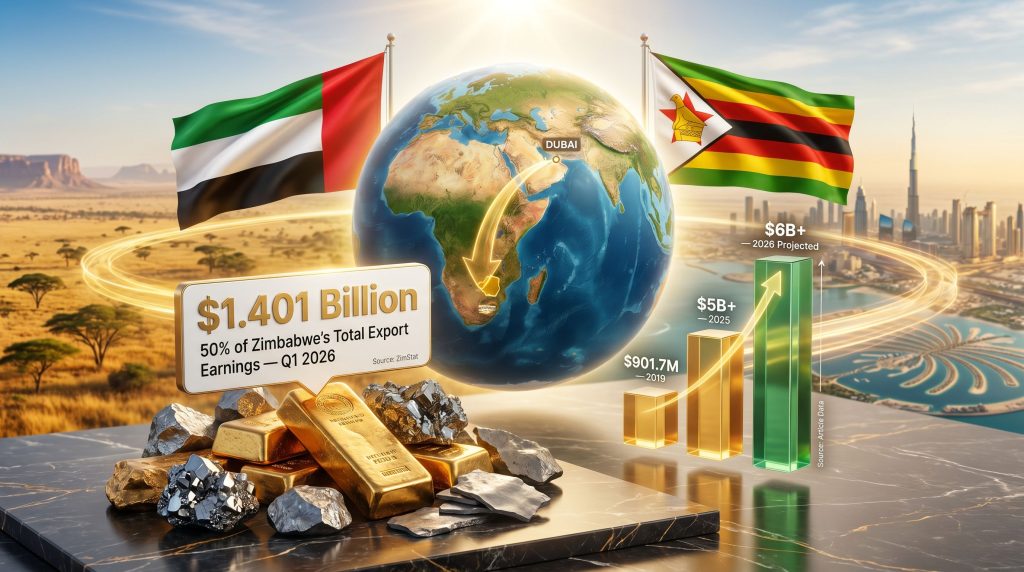
The raw data documenting UAE Zimbabwe trade relations leaves little room for interpretive ambiguity. According to figures published by the Zimbabwe National Statistics Agency (ZimStat), Zimbabwe exported goods worth approximately $1.401 billion to the UAE between January and March 2026, representing 50% of Zimbabwe's total export earnings of $2.775 billion during that quarter alone.
When a single bilateral partner absorbs half of a nation's quarterly export earnings, economists classify this not as a trade preference but as structural dependency. Most trade economists consider a 30–35% concentration with a single partner to represent elevated vulnerability to external shocks. Zimbabwe's 50% figure substantially exceeds that threshold.
The longer trajectory is equally striking. Trade data compiled by ZimTrade documents the following growth pattern:
| Period | Metric | Value |
|---|---|---|
| 2019 | Total bilateral trade | ~$901.7 million |
| 2022 | Zimbabwe exports to UAE | ~$2.7 billion |
| 2023 | Zimbabwe exports to UAE | ~$2.3 billion |
| 2023 | Zimbabwe imports from UAE | ~$268.6 million |
| 2025 | Total bilateral trade | $5 billion+ |
| 2026 (projected) | Total bilateral trade | $6 billion+ |
| Q1 2026 | Zimbabwe exports to UAE | $1.401 billion |
The apparent moderation in the 2023 export figure compared to 2022 most likely reflects updated customs data reconciliation rather than an actual contraction, as all surrounding data points confirm a consistent upward trajectory. The directional signal across six years of data is unambiguous: this relationship has grown more than fivefold from its 2019 baseline.
The Q1 2026 annualised export run rate implies Zimbabwe is on course to send approximately $5.6 billion worth of goods to the UAE in 2026 alone, a figure that would have represented Zimbabwe's entire national export portfolio just a few years ago.
What Zimbabwe Actually Exports to the Gulf
Gold as the Cornerstone Commodity
The dominant driver of Zimbabwe's export surge to the UAE is semi-manufactured gold, and understanding why requires appreciating the specific mechanics of the global gold trading ecosystem. Dubai has established itself as one of the world's most significant precious metals trading and intermediation centres, with infrastructure specifically designed to receive, process, and redistribute semi-processed gold from producing nations across Africa and Asia.
The critical technical distinction here is the difference between doré gold and semi-manufactured gold. Doré is an alloy bar containing gold, silver, and base metals typically poured directly at mine sites with relatively low purity. Semi-manufactured gold, which constitutes the bulk of Zimbabwe's exports to the UAE, has undergone initial processing to reach higher purity levels but has not yet been refined to the 99.5% fineness required for LBMA and COMEX gold markets accredited good delivery bars.
This intermediate product is exactly what UAE-based refiners seek as a feedstock for their final refining operations. Furthermore, this means Zimbabwe captures more value per tonne than raw doré exporters but still cedes significant value-addition potential to UAE-based processors, a dynamic with important long-term implications for Zimbabwe's economic development strategy.
The Broader Mineral Export Portfolio
While gold dominates, Zimbabwe's mineral diversity provides additional commercial depth to the UAE relationship:
-
Nickel and nickel-based products: Zimbabwe holds substantial nickel sulphide reserves, particularly in the Bindura Nickel Belt. The nickel uses and demand profile within UAE industrial sectors, including stainless steel manufacturing and battery precursor chemistry, creates viable offtake channels for Zimbabwean output.
-
Ferro-chromium: Zimbabwe sits within the Great Dyke geological formation, one of the world's most extraordinary layered mafic intrusions stretching approximately 550 kilometres through the centre of the country. This formation hosts some of the highest-grade chromite deposits globally, with Zimbabwean chromite ore grades averaging 40–48% Cr2O3 content.
-
Strategic and transition minerals: Zimbabwe's broader mineral endowment includes lithium, platinum group metals, and manganese. The critical minerals demand tied to clean energy technology supply chains positions Zimbabwe favourably for future trade flows, though these commodities do not yet feature prominently in the UAE trade data.
Agricultural and Horticultural Contributions
Minerals and horticultural products are confirmed as the dominant export categories in the ZimStat data. The UAE's substantial expatriate population, which numbers in the millions and includes a significant Southern African community, creates genuine demand channels for Zimbabwean agricultural produce, including cut flowers, macadamia nuts, and premium vegetables. However, this segment remains secondary to mineral exports in volume terms.
The UAE's Strategic Logic: Why Dubai Wants Zimbabwe's Resources
Commodity Intermediation as National Strategy
The UAE's deepening engagement with African commodity producers is not incidental. It reflects a deliberate national economic strategy built around commodity intermediation — the business of adding logistical, financial, and processing value between resource extraction and end-market consumption without being the ultimate producer or consumer of the resource itself.
As a nation with negligible domestic mineral resources, the UAE has constructed an economic model that leverages its world-class logistics infrastructure, sophisticated financial services ecosystem, and strategically located geography to insert itself into global commodity value chains. The UAE has invested deliberately in institutional infrastructure, including free trade zones, customs efficiency, and financial regulation, to maximise this geographic advantage.
The Re-Export Multiplier: What It Means for Zimbabwe
Private sector organisations including the Zimbabwe-UAE Business Council Organisation (ZIBCO) have consistently emphasised a dimension of this relationship that receives insufficient analytical attention: the UAE functions not merely as a direct end-market for Zimbabwean goods but as a re-export gateway to broader global markets.
When Zimbabwean gold enters the UAE trading system, it enters a sophisticated redistribution network that channels refined metal to jewellery manufacturers across Asia, central bank gold demand reserves across the Middle East, and investment product providers globally. For smaller Zimbabwean mining operations, this gateway function is particularly valuable because it eliminates the need to establish direct relationships with end-market buyers across multiple jurisdictions.
The Trade Balance Asymmetry and Its Implications
One of the most analytically significant characteristics of UAE Zimbabwe trade relations is the profound asymmetry in trade flows. Zimbabwe exports vastly more than it imports in this bilateral relationship, consequently running a substantial trade surplus.
Zimbabwe's primary exports to the UAE:
- Semi-manufactured gold (dominant category)
- Nickel and nickel-based products
- Ferro-chromium and mineral derivatives
- Horticultural and agricultural products
Zimbabwe's primary imports from the UAE (totalling ~$268.6 million in 2023):
- Pearls, precious stones, and refined metals
- Electrical machinery and components
- Vehicle parts and automotive accessories
This trade surplus structure delivers substantial hard currency inflows to Zimbabwe, which carries macroeconomic significance given the country's historical challenges with foreign exchange availability. The Reserve Bank of Zimbabwe has identified export receipts from mineral sales as a primary mechanism for building foreign currency reserves that support monetary stability under the ZiG currency framework introduced in 2024.
How This Compares to Zimbabwe's Historical Trade Relationships
South Africa's Declining Dominance
South Africa's long-standing role as Zimbabwe's dominant trading partner reflected genuine structural integration: shared rail networks, common electrical grid infrastructure, overlapping corporate ownership across key industries, and a large Zimbabwean diaspora community. None of these underlying linkages have disappeared, and South Africa will almost certainly retain significance as a source of imports and transit corridor.
What has changed is the export destination question, where the UAE has decisively displaced South Africa. This displacement is attributable to a combination of factors, including South Africa's own economic challenges and the UAE's more sophisticated infrastructure for absorbing and redistributing Zimbabwean minerals at globally competitive prices.
A Shifting Landscape of Partners
| Trade Partner | Historical Role | Current Status |
|---|---|---|
| South Africa | Primary partner across imports and exports | Displaced as top export destination |
| China | Major investor and infrastructure developer | Remains significant across multiple sectors |
| UAE | Emerging commodity market pre-2019 | Now Zimbabwe's single largest export destination |
| European Union | Traditional market for agricultural exports | Declining portfolio share |
China's continued significance across Zimbabwe's economic landscape deserves particular note. While the UAE has captured the export headline, Chinese investment in Zimbabwe's infrastructure, mining, and agriculture sectors has been deepening simultaneously, creating a complex multi-polar investment and trade environment.
The next major ASX story will hit our subscribers first
The Institutional Architecture Supporting This Relationship
The Bilateral Investment Treaty Framework
A critical but underappreciated element underpinning UAE Zimbabwe trade relations is the bilateral investment treaty (BIT) between the two countries, which provides the legal scaffolding for deeper economic integration beyond commodity transactions. According to the UNCTAD investment policy framework, BITs typically deliver several commercially significant protections:
- Investment protection clauses that guard against expropriation without fair compensation
- Most-favoured-nation provisions ensuring equal treatment for investors from treaty partners
- Dispute resolution mechanisms providing access to international arbitration rather than domestic courts
- Profit repatriation frameworks enabling investors to move capital across borders without discriminatory restrictions
Diplomatic Engagement at the Highest Levels
UAE Ambassador Jassim Mohammed Al Qasimi has publicly characterised the commercial relationship as experiencing sustained growth, noting that investment activity and ongoing projects across multiple sectors are expected to accelerate trade further through 2026. This diplomatic signalling at ambassadorial level reflects institutional commitment to the relationship that extends well beyond market opportunism.
President Mnangagwa's re-engagement policy framework has explicitly targeted the cultivation of Gulf state partnerships as a strategic priority, positioning the UAE relationship within a deliberate foreign economic policy architecture rather than as an accidental trade outcome.
The Concentration Risk Problem: What Could Go Wrong
Single-Partner Dependency and Systemic Vulnerability
The same concentration that makes Zimbabwe's UAE relationship impressive in scale creates genuine systemic vulnerability. When any single partner absorbs 50% of export earnings, the consequences of a demand contraction are amplified disproportionately across the exporting economy.
Several scenarios could trigger a reduction in UAE demand for Zimbabwean minerals:
- A sustained decline in global gold prices driven by USD strengthening or rising real interest rates
- UAE sourcing diversification toward alternative African mineral suppliers
- Geopolitical developments affecting UAE-Africa trade architecture, with metals and mining geopolitics remaining a persistent variable
- Global industrial slowdowns reducing demand for ferro-chromium and nickel
Risk Warning: The analysis of projected trade volumes in this article involves forward-looking estimates based on current data and official projections. Actual outcomes will depend on commodity prices, geopolitical developments, and macroeconomic conditions that cannot be reliably predicted. This content does not constitute financial or investment advice.
The Value-Addition Deficit: The Beneficiation Imperative
Perhaps the most consequential long-term limitation in Zimbabwe's current export model is the predominance of semi-manufactured rather than fully refined mineral products. By exporting gold at the semi-manufactured stage, Zimbabwe effectively exports the value-creation opportunity to UAE-based refiners and traders.
The economic calculus here is significant. Developing domestic beneficiation capacity to capture refining margins would increase Zimbabwe's export revenue per tonne without requiring proportional increases in mining output. The challenge is that establishing internationally accredited refining infrastructure requires substantial capital investment, technical expertise, and regulatory credentialing. These barriers are real but not insurmountable, and several African nations including South Africa and Uganda have successfully navigated them.
Scenario Projections: The Path Toward $6 Billion and Beyond
With Q1 2026 data already tracking strongly, the $6 billion bilateral trade projection for the full year appears achievable under several plausible scenarios:
| Scenario | Conditions | Projected 2026 Bilateral Trade |
|---|---|---|
| Base case | Q1 momentum holds, stable commodity prices | $5.6 – $6.0 billion |
| Upside case | Gold price appreciation, new investment activation | $6.5 billion+ |
| Downside case | Commodity price softening, logistical disruptions | $5.2 – $5.4 billion |
The upside scenario is bolstered by gold's sustained strength through 2025 and into 2026, with gold prices trading near multi-year highs driven by central bank accumulation, geopolitical risk hedging, and emerging market investor demand.
Frequently Asked Questions: UAE Zimbabwe Trade Relations
Why has the UAE become Zimbabwe's largest export destination?
The UAE's emergence as Zimbabwe's top export market is primarily driven by its role as a global hub for gold trading, precious metals refining, and commodity intermediation. Zimbabwe's mineral exports, particularly semi-manufactured gold, align precisely with the UAE's sophisticated commodity processing and re-export infrastructure. The relationship has been reinforced by active diplomatic engagement and a bilateral investment treaty.
How much does Zimbabwe export to the UAE?
In Q1 2026, Zimbabwe exported approximately $1.401 billion worth of goods to the UAE, representing 50% of Zimbabwe's total export earnings of $2.775 billion during that quarter. Total bilateral trade exceeded $5 billion in 2025 and is projected to surpass $6 billion in 2026.
What are the main goods Zimbabwe exports to the UAE?
Zimbabwe's exports are dominated by semi-manufactured gold, with nickel, ferro-chromium, and horticultural products also contributing meaningfully to the export portfolio.
What does Zimbabwe import from the UAE?
Zimbabwe's imports from the UAE are considerably smaller, totalling approximately $268.6 million in 2023. Key import categories include pearls, precious stones and refined metals, electrical machinery, and vehicle parts.
Is there a formal trade agreement between Zimbabwe and the UAE?
The two countries have an in-force bilateral investment treaty (BIT) providing legal frameworks for investment protection, dispute resolution, and profit repatriation. This treaty supports deeper economic integration beyond commodity trade flows.
How quickly has UAE-Zimbabwe trade grown?
Total bilateral trade grew from approximately $901.7 million in 2019 to over $5 billion in 2025, representing more than a fivefold increase across six years.
The Strategic Outlook: A New Template for Gulf-African Integration
The UAE-Zimbabwe partnership is increasingly discussed among African trade analysts as a template demonstrating how Gulf states can construct deep, multi-dimensional economic relationships with resource-rich African nations. The combination of commodity demand, investment capital provision, logistics infrastructure, and diplomatic engagement creates a relationship architecture that extends well beyond conventional buyer-seller commercial dynamics.
For Zimbabwe specifically, the strategic implications span several dimensions:
- Foreign exchange generation: UAE-linked export receipts are providing substantial hard currency inflows that underpin monetary stability
- Investment sector development: UAE capital flows are expected to support further development of Zimbabwe's mineral extraction and processing capacity
- Market diversification: The relationship structurally reduces Zimbabwe's historical over-dependence on SADC regional markets
- Beneficiation opportunity: The scale of mineral exports creates a compelling economic case for domestic value-addition investment
The deeper question facing Zimbabwe's economic planners is whether to accept the current architecture, where substantial value-creation occurs in UAE refining and trading infrastructure, or to invest aggressively in domestic beneficiation capabilities that would shift the value-capture dynamic meaningfully in Zimbabwe's favour. This strategic choice will likely define the long-term economic legacy of the UAE-Zimbabwe commercial relationship more than any single trade volume figure.
What is already beyond doubt is that UAE Zimbabwe trade relations have fundamentally altered Southern Africa's commercial geography in ways that are unlikely to reverse. The structural foundations of this partnership — combining Zimbabwe's resource endowment, the UAE's intermediation capabilities, and the legal architecture of their bilateral investment treaty — appear sufficiently durable to sustain continued growth even as the global commodity cycle evolves.
This article incorporates trade data from ZimStat and ZimTrade, and draws on reporting by Business Insider Africa. Forward-looking projections reflect official estimates and scenario analysis, not guaranteed outcomes. Readers should conduct independent research before drawing investment conclusions from this content.
Want to Catch the Next Major Mineral Discovery Before the Market Does?
Zimbabwe's extraordinary commodity export surge — driven by gold, nickel, and ferro-chromium — underscores how rapidly mineral markets can shift and reward those positioned early. Discovery Alert's proprietary Discovery IQ model delivers real-time alerts on significant ASX mineral discoveries, instantly transforming complex geological data into actionable investment insights — explore historic discoveries and their exceptional returns to understand the opportunity, then begin your 14-day free trial to secure your market-leading edge.