July 20, 2026
When Supply Chains Break: Labour Disputes as Steel Market Stress Tests
Every automotive supply chain carries within it a hidden architecture of interdependence that rarely becomes visible until something breaks. The tiered supplier structure connecting raw steel producers to finished vehicle assembly lines is not a simple sequence of transactions; it is a web of concentrated relationships, precision specifications, and just-in-time delivery windows that can unravel rapidly when a single node fails. Labour disputes at Tier 1 components manufacturers sit near the top of this risk hierarchy.
These disputes are capable of generating simultaneous demand disruptions across multiple steel product categories in ways that bear little resemblance to ordinary demand fluctuations. The resolution of the United Auto Workers dispute with Dauch Corporation, the manufacturer formerly operating as American Axle, offers a case study in exactly how these dynamics unfold, and why the UAW American Axle agreement and steel demand have become intertwined topics for commodity analysts, automotive procurement teams, and supply chain strategists alike.
When big ASX news breaks, our subscribers know first
The Supply Chain Topology That Made This Strike So Consequential
Understanding why a single facility in Three Rivers, Michigan, could create ripple effects across the entire U.S. automotive steel market requires appreciating a structural feature that rarely receives adequate attention: concentration risk within tiered supply chains.
According to Marick Masters, professor of business at Wayne State University in Detroit, approximately 44% of the output from the Three Rivers plant feeds directly into General Motors' assembly operations in Flint, Michigan. That degree of single-customer dependency from one facility would raise eyebrows in any supply chain risk assessment. When the downstream customer happens to be assembling some of the highest-volume, highest-margin trucks in the North American market, the stakes escalate considerably.
The broader customer picture compounds this concentration further. The Detroit Big Three automotive producers, specifically GM, Ford, and Stellantis, collectively account for 75% of American Axle's total revenue, according to Masters. This means that a production stoppage at the Three Rivers plant does not threaten one automaker's schedules in isolation; it introduces scheduling uncertainty across multiple OEM planning horizons simultaneously.
This is the architecture that transforms what might otherwise be a contained industrial dispute into a market-moving supply chain event. Furthermore, the global steel outlook for 2025 and beyond adds additional pressure to an already complex supply chain environment.
Steel Products Most Exposed: Not All Grades Face Equal Risk
One of the most analytically important insights from studying automotive supply disruptions is that steel demand losses are not distributed evenly across product categories. The specific manufacturing activities of a disrupted supplier determine which grades face acute exposure versus secondary or tertiary effects.
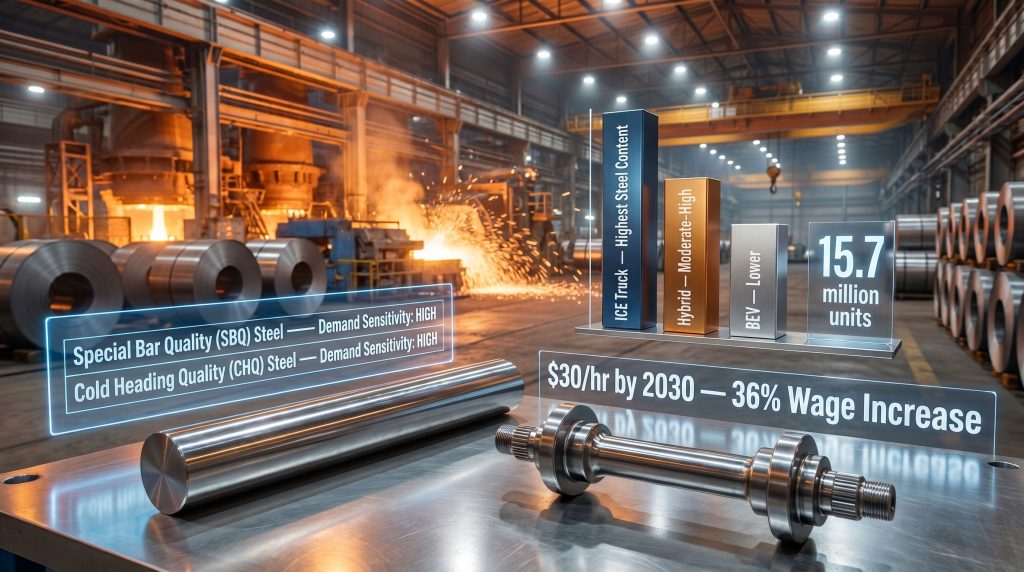
Driveline component manufacturing, which is central to American Axle's operations, draws most heavily on Special Bar Quality (SBQ) steel and Cold Heading Quality (CHQ) steel. These are precision-specification grades used in axle shafts, driveshafts, and fasteners that require exacting metallurgical properties. Unlike commodity flat-rolled products, SBQ and CHQ demand cannot be easily rerouted when a single downstream customer pauses; the precision qualification requirements governing which mills can supply driveline-grade steel are considerably more restrictive.
The table below illustrates the hierarchy of steel demand exposure across vehicle manufacturing categories:
| Steel Product Category | Primary Application | Demand Sensitivity to Strike |
|---|---|---|
| Special Bar Quality (SBQ) | Axle shafts, driveline components | High |
| Cold Heading Quality (CHQ) | Fasteners, precision parts | High |
| Cold-Rolled Coil (CRC) | Structural body panels | Moderate to High |
| Hot-Dipped Galvanized Coil (HDG) | Corrosion-resistant body components | Moderate to High |
| Ultra-High Strength Steel (UHSS) | Chassis and safety structures | Moderate |
| High-Carbon Steel | Springs, wear-resistant components | Moderate |
| Stainless Steel Long Products | Exhaust and specialty trim | Lower |
The structural rigidity of SBQ and CHQ qualification pathways means demand suppression in these grades is materially harder to redistribute than equivalent volume losses in commodity flat-rolled products. Mills supplying driveline-grade bar must meet strict chemistry and mechanical property certifications that limit substitution flexibility on short notice.
Flat-rolled exposure through cold-rolled coil and hot-dipped galvanized products is real but extends more broadly across vehicle body assembly, making it somewhat less concentrated to any single Tier 1 driveline supplier's output.
The Commercial Weight Behind GM's Heavy-Duty Truck Platforms
The scale of what was at risk during the strike becomes clearer when expressed in production and financial terms. GM assembles more than 1,000 heavy-duty trucks per day at its Flint operations, according to Sam Fiorani, vice president of global vehicle forecasting at AutoForecast Solutions. The Chevrolet Silverado and GMC Sierra platforms together generate approximately $2.7 billion in annual profits, per Fiorani's analysis.
These figures matter for steel market analysis for a straightforward reason: the higher the commercial priority of the affected vehicle lines, the stronger the internal pressure on all parties to resolve a supply disruption rapidly. A strike affecting the production of low-margin, low-volume vehicles might be allowed to run for weeks before corporate urgency reaches critical levels.
A strike threatening the output of two of the most profitable vehicle nameplates in North America creates a fundamentally different decision-making environment. Each production day lost across a 1,000-unit-per-day assembly line also represents a meaningful quantum of steel consumption removed from the market. Over a 10-day strike window, the aggregate volume impact across SBQ, flat-rolled, and specialty steel categories accumulates into a figure that steel service centres and mill order books cannot simply absorb without adjustment.
The Wage Agreement: Economic Context Behind a Historic Settlement
The tentative agreement reached on June 10, 2026, following 10 days of strike action beginning June 1, carries significant economic context that extends well beyond the immediate labour relations story. UAW Local 2093's approximately 1,000 members ratified the agreement on June 15, formally ending the stoppage and clearing the path for production resumption.
The headline financial commitment in the contract secures a wage rate of $30 per hour by 2030, representing a wage increase exceeding 36% over four years from the prior top rate. This figure needs to be contextualised against the 18-year period preceding the dispute, during which workers at the facility absorbed sustained wage concessions in the aftermath of the 2008 automotive industry restructuring.
The UAW's position was not simply about current compensation; it reflected nearly two decades of accumulated wage restraint finally being brought back to the bargaining table. Fiorani noted that the skilled manufacturing labour market had shifted significantly, with competitive pressures making it increasingly difficult for component manufacturers to retain and attract qualified workers without meaningful compensation adjustments.
From a strategic calculus perspective, Dauch Corporation's decision to accept wage demands rather than sustain prolonged production losses reflects the arithmetic of a 10-day disruption threatening billions in downstream vehicle profit versus the annualised cost of the wage commitment.
Demand Deferral vs. Demand Destruction: The Critical Distinction
For steel market participants, the most practically important question following any automotive strike resolution is not whether demand will return, but how quickly and whether any of it is permanently lost.
Industry analysts, including Bill Renna, vice president, Americas, at GlobalData Automotive, indicated that given the commercial importance of the Silverado and Sierra platforms, steel demand tied to these vehicles was expected to return to pre-strike levels relatively quickly following ratification. This expectation is grounded in a well-established pattern for short-duration automotive supply disruptions. Fastmarkets' analysis of automotive sector steel demand further supports the view that short-duration disputes typically result in deferred rather than destroyed demand.
| Strike Duration | Estimated Steel Demand Impact | Recovery Pathway |
|---|---|---|
| Under 2 weeks (actual outcome) | Minimal, largely deferred demand | Rapid restoration within 1 to 2 production cycles |
| 2 to 6 weeks | Moderate, partial demand destruction | Gradual recovery over 4 to 8 weeks |
| Over 6 weeks | Significant, structural demand loss | Extended recovery with potential model mix adjustments |
At 10 days, the American Axle dispute sits firmly in the demand deferral category. Assembly plants operating on just-in-time inventory protocols typically carry buffer stocks sufficient to absorb brief supply interruptions, and OEMs with high commercial stakes in affected models will prioritise accelerated production ramp-up schedules once component supply resumes.
Direct answer for steel market participants: A resolved labour dispute at a Tier 1 automotive supplier with high OEM commercial priority typically produces demand deferral, not destruction, when the stoppage is resolved within two weeks. Demand returns to baseline levels once production resumes and inventory buffers are replenished.
The next major ASX story will hit our subscribers first
Structural Headwinds That Cap the Recovery Ceiling
While the near-term demand recovery narrative is broadly positive following the UAW American Axle agreement and steel demand implications are being reassessed, the broader context for U.S. automotive steel consumption is considerably more constrained. Several structural factors limit how high the recovery ceiling can reach.
Annual U.S. vehicle production forecasts have been revised downward to approximately 15.7 million units, a reduction of roughly 300,000 vehicles compared to prior expectations of 16 million for 2026, according to Elizabeth Krear, president and chief executive officer at the Center for Automotive Research in Ann Arbor, Michigan. Rising vehicle prices are suppressing consumer demand across both passenger car and light truck segments, creating a demand environment where even full recovery from the strike disruption still leaves total automotive steel consumption below earlier projections.
In addition, commodity market tariffs are adding further complexity to the pricing environment for automotive steel procurement. The powertrain transition adds a further layer of structural complexity:
| Vehicle Powertrain Type | Approximate Steel Content | Key Demand Implication |
|---|---|---|
| Internal Combustion Engine (ICE) Truck | Highest intensity | Maximum SBQ and flat-rolled demand |
| Hybrid (HEV/PHEV) | Moderate to high | Partial demand retention, reduced driveline complexity |
| Battery Electric Vehicle (BEV) | Lower, no traditional driveline | Significant SBQ and CHQ demand reduction |
The electric vehicle transition is reshaping per-vehicle steel intensity across the industry. The shift away from pure battery electric vehicles toward hybrid powertrains, while partially stabilising near-term steel intensity, does not fully replicate the per-vehicle steel consumption of traditional ICE truck production. Hybrids reduce driveline component complexity relative to ICE vehicles, even while retaining more steel content than full BEVs.
For suppliers like Dauch Corporation, whose operations are centred on axle and driveshaft production, the long-term trajectory of powertrain electrification represents a structural demand risk that no single labour agreement can resolve.
Labour Cost Escalation and Its Secondary Supply Chain Consequences
The 36%-plus wage increase embedded in the new contract carries implications that extend beyond the immediate parties to the agreement. Tier 1 automotive component manufacturers facing significantly higher labour cost bases will face intensified pressure from OEMs on component pricing, accelerating incentives to invest in automation or to pursue supply chain diversification strategies.
For steel procurement, these secondary dynamics matter. Automation investment at component manufacturers typically shifts the mix of steel grades consumed rather than reducing total volume, but supplier consolidation or facility rationalisation driven by cost pressures could alter the geographic distribution and specification profile of automotive steel demand over time.
Furthermore, US steel tariffs are already reshaping cost structures across the supply chain, adding another layer of pressure on component manufacturers navigating higher wage commitments. The American Axle settlement may also strengthen UAW bargaining leverage in upcoming contract cycles across the broader Tier 1 supplier landscape, potentially establishing a compensation floor that propagates through multiple upcoming negotiations.
The china steel market dynamics also remain a relevant backdrop, as global overcapacity pressures continue to influence how U.S. mills price and position driveline-grade steel products competitively.
Frequently Asked Questions: UAW American Axle Agreement and Steel Demand
What is the UAW American Axle agreement and why does it matter for steel markets?
The tentative agreement reached on June 10, 2026, between UAW Local 2093 and Dauch Corporation ended a 10-day strike at the Three Rivers, Michigan facility. The plant supplies approximately 44% of its output to GM's Flint truck assembly operations, where production of the Silverado and Sierra had been placed at risk. Steel demand across SBQ, CHQ, flat-rolled, and galvanized product categories was affected during the work stoppage.
Which steel grades face the highest exposure from driveline supplier disruptions?
Special Bar Quality and Cold Heading Quality steel grades carry the most concentrated direct exposure, given their use in precision axle and fastener applications. Flat-rolled products including cold-rolled coil and hot-dipped galvanized coil face secondary exposure through broader vehicle body assembly operations.
Will steel demand fully recover following the strike resolution?
Analysts expect a relatively rapid return to pre-strike consumption levels for affected vehicle platforms. However, the downward revision in annual U.S. vehicle production to approximately 15.7 million units and the ongoing powertrain shift toward hybrids impose a ceiling on the total magnitude of recovery in automotive steel demand.
How does the hybrid and EV transition affect long-term demand for driveline-grade steel?
As hybrid powertrains reduce traditional axle and driveshaft complexity, and full battery electric vehicles eliminate conventional driveline components entirely, demand for SBQ and CHQ grades faces progressive structural erosion. Near-term ICE and hybrid truck production sustains current consumption, but the long-term trajectory is toward lower per-vehicle driveline steel intensity.
What does the wage settlement signal for automotive supply chain dynamics?
A wage commitment exceeding 36% over four years in a single contract cycle represents a meaningful cost base shift for Tier 1 component manufacturing. This may intensify OEM pricing pressure on suppliers, accelerate automation investment decisions, and potentially influence union leverage in upcoming contract negotiations across the sector.
Key Takeaways
- The 10-day duration of the American Axle strike positions the demand impact firmly in the deferral rather than destruction category, supporting expectations of a relatively rapid return to pre-strike steel consumption levels
- SBQ and CHQ steel grades face the most concentrated and structurally complex demand exposure from driveline supplier disruptions, given precision specification barriers to supply rerouting
- GM's production of more than 1,000 heavy-duty trucks daily and the combined $2.7 billion annual profit contribution of the Silverado and Sierra platforms created strong commercial pressure for a rapid settlement
- The 36%-plus wage increase ratified by approximately 1,000 UAW Local 2093 members on June 15 ends 18 years of wage concessions and sets a potential precedent for broader automotive labour negotiations
- Structural headwinds including a 300,000-unit downward revision in 2026 U.S. vehicle production forecasts and the accelerating shift toward hybrid powertrains constrain the long-term recovery ceiling for automotive steel demand
- Longer-term, driveline-focused steel grades face progressive structural displacement as powertrain electrification reduces or eliminates traditional axle and driveshaft content across the vehicle fleet
This article contains forward-looking statements and analytical projections based on available industry data. Steel demand recovery timelines, production forecasts, and long-term powertrain transition estimates involve inherent uncertainty and should not be relied upon as investment advice. Readers seeking detailed steel price benchmarks and automotive sector data can explore resources available through Fastmarkets.
Want to Stay Ahead of Major Commodity and Resource Discoveries Shaping Global Supply Chains?
Discovery Alert's proprietary Discovery IQ model delivers real-time alerts on significant ASX mineral discoveries, translating complex commodity data into actionable insights for both short-term traders and long-term investors — begin your 14-day free trial today and explore how historic discoveries have generated substantial market returns.