June 13, 2026
Uganda's petroleum export capabilities represent a transformative development in East African energy infrastructure, marking the country's emergence as a significant regional oil producer. The complex Uganda oil exports project involves sophisticated cross-border infrastructure and strategic partnerships that position Uganda within continental energy networks. Furthermore, this development occurs during a period of global supply chain disruption, creating both opportunities and challenges for new market entrants.
Strategic Infrastructure Architecture in East Africa's Energy Development
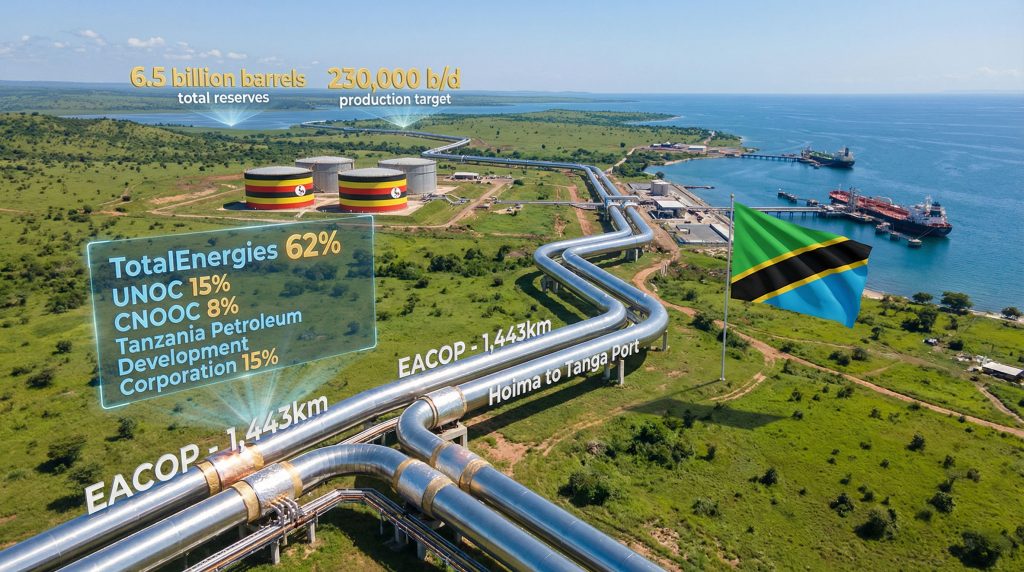
Uganda's petroleum export capabilities centre on a sophisticated pipeline network designed to overcome the geographical challenges facing landlocked oil producers. The East African Crude Oil Pipeline (EACOP) represents a transformative piece of continental infrastructure, stretching 1,443 kilometres from Uganda's Hoima region to Tanzania's Tanga Port on the Indian Ocean coast.
Engineering Solutions for Waxy Crude Transport
The EACOP employs specialised heated pipeline technology specifically engineered to handle Uganda's Lake Albert crude oil, which exhibits waxy characteristics that would solidify at ambient temperatures during transport. This technical requirement distinguishes the system from conventional crude oil pipelines and demonstrates the engineering complexity required for Uganda's specific geological resources.
The partnership structure reflects international investment patterns in major African energy projects:
- TotalEnergies: 62% equity stake in pipeline operations
- China National Offshore Oil Corporation (CNOOC): 8% participation
- Uganda National Oil Company (UNOC): 15% state representation
- Tanzania Petroleum Development Corporation: 15% cross-border partnership
This multinational framework illustrates how modern energy infrastructure projects require coordination across multiple stakeholders. Consequently, it combines European technical expertise, Chinese financing capacity, and regional government participation to achieve operational viability.
Production Framework and Upstream Development
The Lake Albert Basin development operates under a different partnership structure for upstream operations, with TotalEnergies holding 57%, CNOOC maintaining 28%, and UNOC retaining 15% of the production assets. This configuration reflects the distinct technical requirements and risk profiles between upstream production and midstream transportation.
Production targets indicate ambitious scaling plans:
- Plateau production: 230,000 barrels per day within two years of first oil
- Plateau maintenance: Five to six years at maximum capacity
- First oil timeline: Production scheduled for July 31, 2026
- Export commencement: October 30, 2026
These timelines reflect the complex coordination required between upstream production optimisation and pipeline operational readiness. In particular, the heated technology requirements for crude transport create additional complexity.
When big ASX news breaks, our subscribers know first
Global Market Positioning Within Regional Energy Security
Uganda oil exports enter international crude oil markets during a period of significant supply chain disruption across traditional energy corridors. The timing presents both opportunities and challenges as regional economies seek alternatives to established import patterns from Middle Eastern suppliers.
Asian Market Integration Strategy
The Indian Ocean routing via Tanga Port positions Uganda strategically for Asian market penetration, particularly targeting Chinese and Indian refineries that represent the fastest-growing crude oil import destinations globally. This geographical advantage eliminates the need for Atlantic routing around the Cape of Good Hope, potentially reducing transportation costs and delivery timeframes.
Energy Minister Ruth Nankabirwa indicated that Uganda was strategically positioning to capitalise on rising crude prices during the project's market entry phase. This suggests awareness of cyclical pricing opportunities and the importance of timing in commodity market debuts.
The regional context provides additional motivation for diversification. East African nations face elevated fuel costs and supply pressures due to Middle Eastern conflicts disrupting traditional Gulf supply routes. However, this creates demand for alternative sources that can provide greater supply security.
Economic Development Through Dual-Track Resource Strategy
Uganda's approach balances immediate export revenue generation against longer-term value-added processing through domestic refining capacity. This strategy reflects lessons learned from other African producers about maximising resource value capture across the petroleum value chain.
The planned Hoima refinery represents a $4 billion investment with 60,000 barrels per day capacity. It's designed to reduce Uganda's current $2.02 billion annual refined product import burden whilst generating export opportunities for processed petroleum products via the same Tanzanian corridor.
This dual approach offers several strategic advantages:
- Import substitution reducing foreign currency outflows for refined products
- Export diversification beyond crude oil into higher-value processed products
- Regional market positioning as a refining hub for landlocked East African economies
- Energy security enhancement through domestic processing capabilities
Technical Challenges and Operational Readiness
The complexity of Uganda oil exports infrastructure extends beyond conventional pipeline operations due to the specific characteristics of Lake Albert crude oil. Moreover, the cross-border nature of the transportation system adds additional complexity.
Pipeline Operational Requirements
As of April 2026, construction was reported to be in its final phase. Energy Minister Nankabirwa expressed confidence in meeting stated timelines following site inspections. However, the heated pipeline technology requires specialised commissioning procedures and operational protocols not found in conventional crude oil systems.
The waxy nature of Uganda's crude necessitates continuous heating throughout the 1,443-kilometre pipeline length. This creates operational complexities including:
- Energy consumption for maintaining optimal transport temperatures
- System reliability requirements for uninterrupted heating operations
- Maintenance protocols for thermal management equipment
- Emergency procedures for system failures or temperature loss
Port Infrastructure and Logistics Coordination
Tanga Port serves as the critical interface between Uganda's pipeline system and international shipping markets. The port's crude oil terminal capabilities determine the efficiency of the entire export operation, from storage capacity to vessel loading systems.
The logistics framework must accommodate varying vessel sizes and loading requirements whilst maintaining quality specifications for different destination markets. This operational flexibility becomes crucial as Uganda develops relationships with multiple international buyers and adapts to varying refinery specifications across target markets.
Regional Energy Security and Continental Integration
Uganda's petroleum development contributes to broader East African energy security objectives by providing an alternative to import-dependent regional economies. The availability of locally produced crude oil and refined products can reduce regional vulnerability to supply disruptions and price volatility in international markets.
Cross-Border Infrastructure Investment
The EACOP represents one component of broader East African energy corridor development. Furthermore, it demonstrates how infrastructure investment can create mutual benefits for participating nations. Tanzania's role extends beyond simple transit services to include equity participation through its state petroleum company, creating aligned interests in project success.
This model of cross-border energy cooperation provides a framework for other regional infrastructure projects. In addition, it potentially includes gas pipelines, power transmission systems, and refined product distribution networks that could enhance energy security across the East African region.
Investment Climate and International Partnerships
The international partnership structure demonstrates Uganda's ability to attract significant foreign direct investment whilst maintaining meaningful state participation through UNOC. This balance between international expertise and local ownership reflects evolving approaches to petroleum sector development in African markets.
The technology transfer implications extend beyond immediate operational requirements. They include workforce development, technical capacity building, and industrial cluster development around Uganda's petroleum sector infrastructure.
Market Entry Scenarios and Strategic Options
Uganda oil exports marketing strategy will significantly influence the country's long-term position in international energy markets. Several strategic scenarios could shape the country's market development trajectory, particularly considering the broader OPEC production outlook and global supply dynamics.
Premium Market Positioning Strategy
One approach involves emphasising quality differentiation and crude oil specifications to capture premium pricing in selective markets. This strategy requires detailed understanding of refinery specifications in target markets and the development of long-term supply relationships with major international refineries.
The success of this approach depends on Uganda's ability to maintain consistent quality standards. Additionally, it requires reliable delivery schedules and competitive pricing relative to alternative suppliers serving the same markets.
Regional Hub Development Model
Alternatively, Uganda could position itself as a regional petroleum hub through integrated refining and petrochemicals development. This approach emphasises value-added processing and regional distribution networks that serve multiple East African markets.
The Hoima refinery project represents the foundation for this strategy. Potential expansion into petrochemicals production and industrial cluster development could transform Uganda's economic structure beyond petroleum exports.
Risk Assessment and Market Challenges
Several risk factors could influence Uganda's success in international petroleum markets, ranging from technical operational challenges to broader market and geopolitical considerations. The current oil price rally analysis provides context for market entry timing challenges.
Operational and Technical Risks
The heated pipeline technology creates unique operational risks not found in conventional crude oil systems. Temperature maintenance throughout the 1,443-kilometre system requires reliable energy supplies and sophisticated monitoring systems to prevent waxy crude solidification.
Cross-border pipeline security considerations involve coordination between Ugandan and Tanzanian authorities for infrastructure protection and emergency response procedures. The length and complexity of the system create multiple potential points of vulnerability that require comprehensive security planning.
Market and Price Volatility Management
Uganda's entry into international crude oil markets exposes the country to global price volatility and demand fluctuations beyond its control. Effective risk management requires hedging strategies, diversified buyer relationships, and flexible production profiles that can adapt to market conditions.
Currency risk management becomes particularly important given Uganda's need to service international debt and finance ongoing development. However, receiving petroleum revenues in US dollars provides some natural hedging.
The next major ASX story will hit our subscribers first
Global Supply Impact and Long-term Sustainability
Uganda's addition to global crude oil supply represents a modest but strategically significant contribution to African petroleum production growth. The country's 230,000 barrel per day plateau production provides meaningful volume for regional energy security whilst offering international markets additional supply diversity.
Given the potential for US oil production decline and ongoing tariffs' market impact considerations, new suppliers like Uganda may find enhanced market opportunities.
Strategic Resource Management Framework
Long-term production sustainability requires careful resource management that balances immediate revenue requirements against intergenerational equity considerations. Uganda's approach to depletion policy and production rate optimisation will influence both project economics and resource longevity.
The establishment of sovereign wealth fund mechanisms could provide a framework for converting petroleum revenues into sustainable development investments. Consequently, this would outlast the production phase of resource development.
Environmental and Sustainability Considerations
The development of Uganda's petroleum sector occurs within increasingly stringent global environmental frameworks. The International Energy Agency's analysis suggests that Uganda must balance development objectives with international climate commitments.
Furthermore, the East African Crude Oil Pipeline project faces scrutiny from environmental groups regarding biodiversity impacts and carbon emissions. These considerations may influence international financing and market access over time.
Conclusion
Uganda oil exports represent a significant development in regional energy security and continental infrastructure integration. The sophisticated engineering solutions, international partnerships, and strategic market positioning demonstrate how emerging producers can successfully navigate complex technical and commercial challenges.
However, the success of Uganda's petroleum export programme depends on effective risk management, operational excellence, and adaptive market strategies. The country's dual approach of export revenue generation and domestic refining capacity provides strategic flexibility in volatile global markets.
The broader implications extend beyond Uganda's economic development to include regional energy security, continental infrastructure networks, and evolving patterns of South-South trade in petroleum products. For instance, considering potential oil price crash insights, Uganda's diversified approach may prove prescient.
Investment Considerations: Petroleum sector investments involve significant operational, market, and geopolitical risks that can materially affect project returns and timeline execution. Prospective investors should conduct comprehensive due diligence regarding technical, regulatory, and market conditions before making investment decisions.
This analysis is based on publicly available information and should not be considered as investment advice. Market conditions, regulatory frameworks, and operational parameters may change materially from current projections.
Looking for Investment Opportunities in East African Energy Development?
Discovery Alert's proprietary Discovery IQ model delivers real-time alerts on significant mineral and energy discoveries across the ASX, empowering subscribers to identify actionable opportunities in the rapidly evolving resources sector. With Uganda's petroleum exports highlighting the transformative potential of regional energy projects, begin your 14-day free trial today to position yourself ahead of emerging market developments.