August 7, 2026
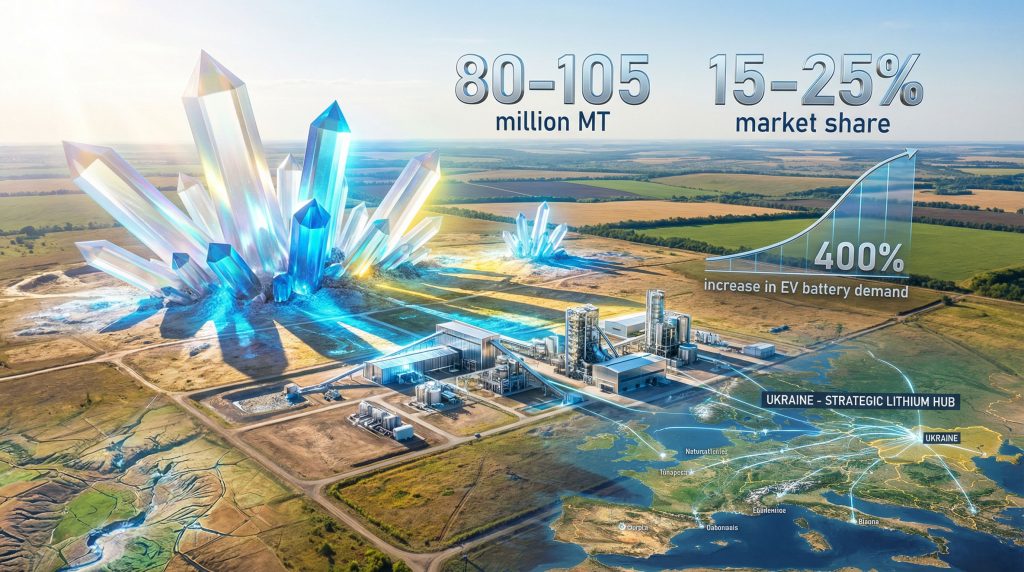
Ukraine's lithium sector presents compelling opportunities as global supply chains undergo unprecedented transformation following recent geopolitical developments. The Ukraine lithium project landscape has evolved dramatically since the country's strategic minerals received international attention, with investors recognising the potential for establishing European supply independence from traditional lithium producers. This shift represents more than simple geographic diversification; it embodies a fundamental restructuring of critical minerals supply chains prioritising security and resilience over pure cost optimisation.
Strategic Mineral Classification and European Supply Integration
Ukraine's lithium sector occupies a unique position within Europe's critical minerals strategy, representing one of the continent's few domestically accessible lithium resources outside established Nordic operations. The Dobra deposit in Kirovohrad region serves as the focal point for this strategic repositioning, offering European battery manufacturers potential supply chain independence from traditional Chilean and Australian sources.
European Union critical minerals frameworks prioritise supply chain resilience through geographic diversification, particularly following supply disruptions experienced during recent geopolitical tensions. Furthermore, the European raw materials facility demonstrates the continent's commitment to securing strategic resource access. Ukraine's pegmatite-hosted lithium deposits align with EU Battery Alliance objectives emphasising regional resource development over import dependency.
The geological characteristics of Ukrainian deposits differ significantly from established lithium provinces. Pegmatite-hosted resources require specialised extraction and processing methodologies compared to brine-based operations dominating South American production. Consequently, this technical distinction influences both capital requirements and operational timelines for development projects.
Mining operations in politically volatile regions demand sophisticated risk mitigation strategies encompassing security protocols, insurance arrangements, and flexible operational frameworks capable of adapting to changing circumstances.
Investment security mechanisms for Ukrainian lithium projects incorporate multiple layers of protection including bilateral investment treaties, political risk insurance coverage, and development finance institution participation. These structures attempt to balance investor risk concerns with Ukraine's need for foreign capital and technology transfer.
When big ASX news breaks, our subscribers know first
Production Sharing Agreement Architecture and Investment Frameworks
The Dobra lithium project operates under a production sharing agreement (PSA) structure rather than conventional mining licenses, representing a strategic shift in how emerging markets attract foreign investment in critical minerals development. This framework provides investors with operational control while ensuring government participation in resource revenues.
According to official government announcements from January 13, 2026, the Dobra Lithium Holdings consortium secured development rights with a minimum capital commitment of $179 million. The investment allocation designates $12 million specifically for exploration activities and reserves auditing, indicating a phased approach prioritising resource validation before major infrastructure deployment.
The winning consortium comprises TechMet, a London-based critical minerals investment firm, and Rock Holdings, with reported connections to significant political networks that may provide additional project protection mechanisms. However, investors must recognise the Ukrainian regulatory risks that can affect mining operations. This political alignment potentially serves as informal risk mitigation beyond traditional insurance and legal protections.
Why Are PSA Frameworks Gaining Popularity?
PSA frameworks offer several advantages over traditional mining licenses:
- Revenue sharing flexibility allowing government participation without direct capital investment
- Operational autonomy for foreign investors in technical and commercial decisions
- Risk allocation mechanisms distributing geological and political risks between parties
- Technology transfer obligations ensuring local capability development
- Performance milestone structures linking investment phases to specific development targets
Capital deployment strategies under PSA arrangements typically follow staged progression models where initial exploration investments trigger subsequent development commitments based on resource validation results. The $167 million implied production phase allocation suggests significant infrastructure requirements for processing facility construction and operational setup.
Foreign investors in Ukrainian lithium projects must navigate complex regulatory environments while ensuring compliance with international ESG standards demanded by institutional capital sources. In addition, local content requirements and community engagement protocols add operational complexity but provide social licence legitimacy essential for long-term project success.
Resource Quality Assessment and Global Competitive Positioning
Ukrainian lithium deposits present distinct geological characteristics requiring specialised evaluation methodologies compared to established global producers. Pegmatite-hosted lithium resources typically contain higher-grade concentrations but demand more complex processing technologies than brine-based operations.
The Dobra deposit's resource estimates require independent verification through international mining consultancy assessments to establish credible reserve classifications. Resource estimation methodologies must account for pegmatite deposit variability and extraction recovery rates under Ukrainian geological conditions.
| Operational Characteristic | Ukrainian Context | Global Standard |
|---|---|---|
| Processing Complexity | Hard rock extraction required | Varies by deposit type |
| Infrastructure Requirements | Substantial development needed | Established in major producers |
| Extraction Technology | Conventional crushing/flotation | DLE emerging in brines |
| Transportation Logistics | European market proximity | Long-haul shipping typical |
Cost structure competitiveness depends on multiple variables including energy pricing, labour costs, processing efficiency, and transportation expenses to end markets. Ukrainian projects benefit from proximity to European battery manufacturers but face higher infrastructure development costs compared to established mining regions.
Quality specifications for lithium concentrate must meet stringent battery-grade requirements including minimal impurity levels and consistent chemical composition. European battery manufacturers increasingly demand supply chain transparency and environmental compliance documentation beyond basic product specifications.
Processing technology selection influences both capital requirements and operational costs. Direct lithium extraction technologies show promise for reducing environmental impact but require validation for pegmatite applications under Ukrainian conditions. Traditional flotation and hydrometallurgical processing remain proven approaches but demand substantial water and energy resources.
Transportation logistics from Ukrainian mines to European processing facilities provide competitive advantages over overseas suppliers. Reduced shipping costs and shorter delivery times enhance project economics while supporting European supply chain resilience objectives.
Multi-Scenario Development Pathway Analysis
Ukrainian lithium development timelines correlate directly with regional security stabilisation and international investment confidence restoration. Three distinct scenarios emerge from current geopolitical and economic conditions, each presenting different risk-return profiles for stakeholders.
Accelerated Development Under Stabilisation
Rapid security improvements could trigger accelerated foreign investment influx, compressing traditional development timelines through parallel activity execution. This scenario assumes:
- Conflict resolution within 12-18 months enabling full operational deployment
- International reconstruction funding supporting infrastructure development
- EU integration acceleration providing regulatory harmonisation benefits
- Technology transfer partnerships with established European mining companies
Under accelerated conditions, lithium production could commence within 3-4 years from project award, significantly faster than typical hard rock lithium development timelines of 5-7 years. This compression requires substantial upfront capital deployment and parallel construction activities.
Gradual Stabilisation Approach
Moderate security improvements allow phased development aligned with risk reduction milestones. This pathway emphasises:
- Incremental investment deployment tied to security benchmarks
- Regional development clustering around stable mining zones
- Risk-adjusted project timelines with built-in flexibility mechanisms
- Milestone-based funding reducing investor exposure to adverse developments
Gradual development extends project timelines to 5-6 years for commercial production but provides greater operational flexibility and reduced capital at risk during early phases. This approach appeals to institutional investors requiring predictable risk management frameworks.
Technology Leapfrog Strategy
Advanced extraction technologies could enable development models bypassing traditional infrastructure requirements. Key elements include:
- Remote monitoring capabilities reducing on-site personnel requirements
- Automated processing systems minimising operational complexity
- Digital twin technologies enabling real-time optimisation
- Modular facility design allowing rapid deployment and reconfiguration
Technology leapfrog approaches require higher initial capital investment in advanced systems but potentially offer superior operational efficiency and reduced security vulnerability. Furthermore, this pathway appeals to technology-focused investors seeking competitive advantages through innovation deployment.
European Battery Market Dynamics and Demand Projections
European lithium demand acceleration reflects multiple converging trends including electric vehicle adoption, grid-scale energy storage deployment, and manufacturing reshoring initiatives. Understanding these demand drivers provides essential context for evaluating Ukrainian supply development viability.
Electric vehicle production expansion across European manufacturers creates substantial lithium hydroxide and carbonate demand. Major automotive groups including Volkswagen, Stellantis, and BMW target significant EV production volume increases through 2030, requiring secure lithium supply arrangements.
Grid storage deployment for renewable energy integration represents additional demand growth beyond transportation applications. Wind and solar capacity additions necessitate corresponding battery storage installations, creating steady industrial demand for lithium compounds.
What Battery Chemistry Trends Are Shaping Demand?
Battery chemistry evolution influences lithium demand characteristics and quality requirements. Lithium iron phosphate (LFP) battery adoption in commercial vehicle and storage applications creates different lithium compound specifications compared to nickel-based chemistries used in premium automotive applications.
Price volatility significantly impacts project economics and investment decision-making. For instance, lithium market insights reveal historical lithium price ranges demonstrate extreme volatility:
- 2021 peaks: Approaching $80,000 per metric ton for lithium carbonate
- 2022-2023 corrections: Declining to $15,000-20,000 per metric ton ranges
- Current levels: Stabilising around $10,000-15,000 per metric ton
Ukrainian lithium projects must demonstrate economic viability across commodity price cycles to attract long-term investment capital. Break-even analysis should assume conservative pricing scenarios while maintaining operational flexibility for price upside capture.
Supply chain diversification benefits extend beyond simple cost considerations to include security of supply guarantees and reduced geopolitical dependency. European battery manufacturers increasingly value supply source reliability over absolute cost minimisation, creating premium opportunities for strategically located producers.
Technology Transfer and Operational Excellence Development
Advanced extraction methodologies require substantial technology transfer from established lithium producers to Ukrainian operations. This knowledge transfer encompasses both technical processes and operational best practices essential for competitive performance achievement.
Hydrometallurgical processing technologies for pegmatite lithium extraction demand specialised expertise in crushing, flotation, and chemical processing. Ukrainian projects benefit from partnerships with established lithium processors possessing proven technical capabilities and operational experience.
Environmental compliance standards increasingly influence technology selection and operational procedures. European regulations demand comprehensive environmental management systems including:
- Water usage optimisation and recycling protocols
- Waste tailings management with long-term stability assurance
- Air quality monitoring and emission control systems
- Biodiversity protection measures for sensitive ecological areas
Automation technologies offer multiple advantages for Ukrainian operations including reduced personnel requirements, enhanced safety protocols, and improved operational consistency. Remote monitoring capabilities enable operational oversight from secure locations while maintaining production efficiency.
Local capability development requirements under PSA arrangements necessitate structured training programs and technology transfer initiatives. These obligations create opportunities for Ukrainian technical institutions while ensuring sustainable operational capacity beyond initial foreign investment phases.
Research and development partnerships with Ukrainian universities and technical institutes provide pathways for innovation development and local expertise cultivation. These relationships support long-term operational sustainability while fulfilling technology transfer obligations.
The next major ASX story will hit our subscribers first
Investment Protection Mechanisms and Regulatory Frameworks
Regulatory stability represents a critical success factor for long-term lithium project viability, particularly in politically volatile environments. Ukrainian investment protection mechanisms must provide credible assurance of regulatory consistency and dispute resolution access.
Bilateral investment treaties between Ukraine and investor home countries provide foundational legal protections including fair treatment guarantees, expropriation protection, and dispute resolution mechanisms. These treaties create binding international legal obligations beyond domestic regulatory frameworks.
Political risk insurance availability through multilateral agencies and private insurers provides additional protection layers for foreign investment. Coverage typically includes:
- Currency inconvertibility protection ensuring profit repatriation
- Expropriation insurance covering asset seizure or nationalisation
- Political violence coverage protecting against conflict-related losses
- Breach of government contract insurance for PSA obligation failures
Development finance institution participation provides both capital and implicit political protection through multilateral engagement. Organizations such as the International Finance Corporation (IFC) and European Bank for Reconstruction and Development (EBRD) offer investment partnerships combining financing with policy dialogue and institutional support.
Environmental and social governance (ESG) compliance requirements increasingly influence investor participation and financing availability. International institutional investors demand comprehensive ESG frameworks including:
- Community engagement protocols ensuring local stakeholder consultation
- Environmental impact assessments with independent verification
- Labour standards compliance meeting international workplace requirements
- Transparency and reporting standards for operational and financial performance
Grandfathering provisions in investment agreements provide protection against adverse regulatory changes after project commencement. These provisions ensure that regulatory modifications cannot retroactively affect existing investments, providing operational certainty for long-term development planning.
Financial Optimisation and Risk-Return Analysis
Optimal financing structures for Ukrainian lithium projects must balance risk mitigation with return maximisation while accommodating diverse investor requirements and regulatory constraints. Sophisticated capital structures typically combine multiple funding sources with varying risk tolerances and return expectations.
Development finance institutions provide patient capital at below-market rates in exchange for developmental impact and policy alignment. These institutions typically accept lower returns while requiring comprehensive ESG compliance and local development contributions.
Commercial bank syndication enables large-scale project financing while distributing credit risk across multiple financial institutions. However, bank participation requires robust feasibility studies, proven technology deployment, and comprehensive risk mitigation frameworks including political risk insurance coverage.
How Do Strategic Partnerships Enhance Project Viability?
Equity partnership structures allow risk sharing between financial investors and strategic partners while providing operational expertise and market access. Strategic partnerships with established battery manufacturers create natural offtake relationships reducing market risk for lithium production.
Revenue optimisation strategies must address both commodity price volatility and currency exposure risks. Offtake agreement structuring provides price certainty while maintaining upside participation through flexible pricing mechanisms linked to market benchmarks.
Hedging strategies for commodity price and currency exposure require sophisticated financial instruments including:
- Forward contracts providing price certainty for production volumes
- Options strategies maintaining upside participation while limiting downside exposure
- Currency hedging protecting against exchange rate fluctuations
- Revenue smoothing mechanisms reducing cash flow volatility
Value-added processing opportunities enhance project margins through downstream integration. Battery-grade lithium compound production captures additional processing margins while providing strategic positioning in rapidly growing battery supply chains.
Financial performance metrics must demonstrate attractive risk-adjusted returns across multiple scenarios while maintaining operational flexibility for changing market conditions. Internal rate of return targets typically exceed 15-20% for emerging market mining investments reflecting elevated political and operational risks.
Strategic Investment Considerations and Future Outlook
The Ukraine lithium project landscape presents unique opportunities for investors willing to navigate complex risk-return profiles. Recent developments, including the Ukrainian minerals deal arrangements, demonstrate growing international confidence in the country's mineral sector potential.
Furthermore, successful project development requires sophisticated risk management frameworks addressing multiple uncertainty sources while maintaining operational flexibility for changing conditions. The combination of geological potential, strategic location, and evolving regulatory frameworks creates compelling investment opportunities for appropriately capitalised and experienced mining companies.
International interest in Ukrainian lithium projects reflects broader supply chain security concerns driving European mineral policy. Consequently, the intersection of geopolitical strategy, technological advancement, and commercial opportunity positions Ukraine as a potentially significant player in global lithium markets.
This analysis represents general market observations and does not constitute investment advice. Readers should conduct independent due diligence and consult qualified professionals before making investment decisions regarding lithium sector opportunities or Ukrainian market exposure.
Ready to Capitalise on the Next Strategic Mineral Discovery?
Discovery Alert's proprietary Discovery IQ model delivers real-time alerts on significant ASX mineral discoveries, instantly empowering subscribers to identify actionable opportunities in critical minerals and strategic commodities ahead of the broader market. Understand why major mineral discoveries can lead to substantial market returns by exploring historic examples whilst securing your competitive advantage with a 30-day free trial today.