
June 4, 2026
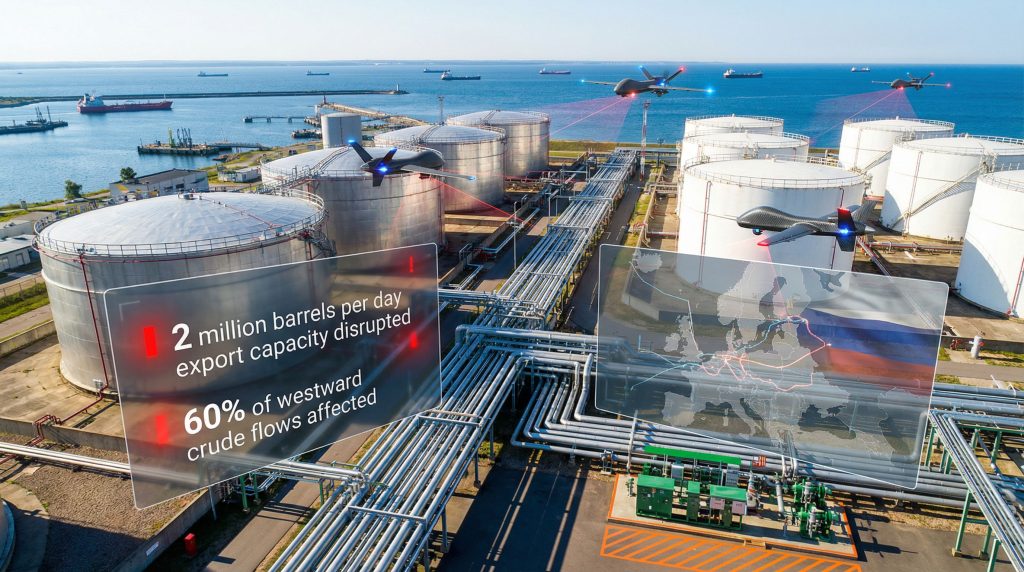
Ukrainian drone attacks on Russia's oil export capacity have emerged as a defining example of how modern precision warfare can systematically disrupt global energy markets through targeted infrastructure campaigns. The strategic targeting of critical export terminals demonstrates how technological capabilities enable smaller military forces to achieve disproportionate economic impact through coordinated strikes on high-value infrastructure nodes. Furthermore, these operations illustrate the evolution of economic warfare from traditional military doctrine toward precision infrastructure degradation that achieves strategic objectives without territorial conquest.
Critical Infrastructure Vulnerabilities in Energy Export Systems
The concentration of energy export capacity in limited geographic nodes creates systemic vulnerabilities that extend far beyond regional security concerns. When examining global energy infrastructure, three critical factors emerge: geographic concentration, transportation bottlenecks, and technological dependencies that collectively create single points of failure in complex supply chains.
Geographic Concentration Analysis:
Russian energy exports demonstrate how geographic clustering creates vulnerability multipliers. The western export infrastructure handles approximately 60% of crude oil destined for European and Atlantic markets through just three primary terminals. This concentration pattern, while economically efficient during stable periods, creates cascading failure risks during conflict scenarios.
Current Ukrainian drone attacks on Russia's oil export capacity have demonstrated these vulnerability patterns with unprecedented clarity. The targeting of Novorossiysk, Primorsk, and Ust-Luga terminals has disrupted approximately 2 million barrels per day, representing 40% of total export capacity according to market calculations. This disruption magnitude qualifies as the most severe oil supply interruption in Russian modern history, affecting the world's second-largest oil exporter.
Infrastructure Dependency Mapping:
| Critical Node | Daily Capacity | Vulnerability Factor | Strategic Importance |
|---|---|---|---|
| Novorossiysk Terminal | 700,000 bpd | Coastal exposure to drone strikes | Primary Black Sea export hub |
| Primorsk Port | 400,000 bpd | Baltic Sea maritime access | Northwestern European supply |
| Ust-Luga Port | 300,000 bpd | Limited air defense coverage | Alternative Baltic route |
| Druzhba Pipeline | 1,000,000 bpd | Cross-border transit vulnerability | Central European distribution |
The systematic nature of these attacks reveals how precision warfare can target revenue-generating infrastructure with remarkable efficiency. Ukrainian operations explicitly aim to diminish oil and gas revenue streams that constitute approximately 25% of Russia's state budget proceeds, totaling roughly $650 billion annually from a $2.6 trillion economy.
Transportation Bottleneck Assessment:
Maritime chokepoints represent another layer of infrastructure vulnerability. The concentration of tanker traffic through specific sea lanes creates opportunities for disruption through various means, from direct attacks to regulatory seizures. European enforcement actions have disrupted an additional 300,000 barrels per day of Arctic oil exports from Murmansk, demonstrating how legal mechanisms can compound military targeting effects.
When big ASX news breaks, our subscribers know first
Market Adaptation Mechanisms During Supply Chain Disruptions
Energy markets respond to infrastructure-focused disruptions through distinct adaptation patterns that differ significantly from traditional supply interruptions. These mechanisms involve price discovery adjustments, supply route reconfigurations, and risk premium calculations that reflect both immediate disruptions and long-term infrastructure security concerns.
How Do Markets Price Infrastructure Vulnerabilities?
The current disruption has pushed Brent crude pricing above $100 per barrel, driven primarily by supply uncertainty rather than fundamental demand changes. This pricing dynamic reflects market recognition that infrastructure targeting creates sustained disruption risks distinct from temporary production interruptions or political embargoes. Additionally, understanding oil price rally dynamics helps explain how geopolitical tensions amplify market reactions.
The systematic targeting of energy export terminals creates pricing volatility patterns distinct from traditional supply disruptions, as markets must factor infrastructure repair timelines and escalation potential into forward pricing mechanisms.
Alternative Route Utilisation Analysis:
With western export routes compromised, Russian supply chains have intensified utilisation of eastern pathways to Asian markets. However, WTI and Brent trends demonstrate how infrastructure constraints affect global pricing convergence. These alternative routes include:
- Chinese Pipeline Systems: Skovorodino-Mohe and Atasu-Alashankou routes handling combined capacity approaching 1.9 million bpd
- ESPO Blend Exports: Seaborne transport via Kozmino port as part of Far Eastern supply infrastructure
- Sakhalin Projects: Island-based exports maintaining approximately 250,000 bpd despite broader disruptions
- Belarusian Transit: Refinery supplies of roughly 300,000 bpd through alternative transportation corridors
Capacity Constraint Economics:
The reorientation toward Asian markets reveals inherent limitations in supply chain flexibility. While these routes continue operational, they operate near capacity constraints that prevent full substitution for disrupted western infrastructure. This constraint dynamic creates sustained market tightness and supports premium pricing in Asian markets as buyers compete for limited alternative supply sources.
Consequently, traders are increasingly focused on market volatility hedging strategies to manage exposure to infrastructure-related supply disruptions. Financial markets have begun incorporating infrastructure vulnerability assessments into commodity pricing models, representing a fundamental shift from traditional geopolitical risk calculations toward infrastructure-specific threat modelling.
Strategic Economic Warfare Evolution
Infrastructure-focused conflict represents an evolution in economic warfare strategies that maximises disruption while minimising direct military confrontation. This approach leverages technological capabilities to target economic foundations of state power, creating strategic effects through fiscal constraint rather than territorial control.
Revenue Targeting Methodology:
The systematic approach to infrastructure targeting reflects sophisticated understanding of economic leverage points. By focusing on facilities that generate approximately 25% of state budget revenues, operations achieve strategic impact disproportionate to tactical scale. The 2 million barrel per day disruption potentially affects $260 billion in annual revenue streams, creating immediate fiscal pressure on military capabilities and state operations.
What Makes Drone Warfare So Effective Against Infrastructure?
Drone-based infrastructure targeting demonstrates favourable cost-exchange ratios compared to traditional military approaches. The operational costs of unmanned systems targeting high-value infrastructure creates strategic leverage where relatively modest tactical investments yield substantial economic disruption. This dynamic fundamentally alters strategic calculations about conflict escalation and response mechanisms.
Escalation Management Considerations:
Infrastructure warfare creates unique escalation dynamics distinct from conventional military operations. Moscow's characterisation of infrastructure strikes as terrorist attacks while implementing nationwide security measures demonstrates how this warfare approach challenges traditional conflict classification frameworks. The response involves security intensification across 11 time zones, indicating recognition of systemic vulnerability beyond targeted facilities.
Counter-Strategy Development:
Russian defensive adaptations include enhanced air defence deployment, maritime security protocols, and supply chain diversification initiatives. These countermeasures represent significant resource allocation away from offensive capabilities toward protective systems, demonstrating how infrastructure warfare can force defensive resource reallocation even when attacks achieve only partial success.
Comparative Analysis: Infrastructure Attacks Versus Traditional Disruptions
Infrastructure-focused warfare creates disruption patterns distinct from conventional supply interruptions, sanctions regimes, or natural disasters. Understanding these differences provides insight into how modern conflict capabilities reshape global commodity markets and strategic planning frameworks.
Disruption Sustainability Factors:
Traditional supply disruptions often involve temporary capacity reduction followed by restoration to baseline operations. Infrastructure targeting creates sustained degradation patterns where facilities operate below capacity for extended periods during repair and reconstruction phases. Current data indicates Novorossiysk terminal continues loading below planned capacity weeks after initial damage, demonstrating persistent operational impact.
Predictability Patterns:
Unlike sanctions or natural disasters, targeted infrastructure campaigns follow systematic patterns that markets can anticipate and price accordingly. The methodical targeting of all three major western export ports within a single month demonstrates operational planning that creates predictable escalation sequences rather than random disruption events. Moreover, OPEC production impact becomes more significant when infrastructure constraints limit supply flexibility.
Recovery Timeline Analysis:
Infrastructure repair timelines depend on component availability, technical expertise, and ongoing security conditions. These factors create recovery uncertainty distinct from policy reversals or weather-related disruptions. The complexity of modern export terminals means restoration requires specialised equipment and engineering capabilities that may face supply chain constraints or security limitations.
How Do Markets Respond Differently to Infrastructure Attacks?
Traditional Disruption Responses:
- Strategic reserve releases to offset temporary capacity loss
- Diplomatic initiatives to restore normal operations
- Short-term alternative sourcing arrangements
Infrastructure Attack Responses:
- Long-term supply chain reorientation and diversification
- Enhanced security investment for critical facilities
- Alternative route development and capacity expansion
- Insurance market adaptation for infrastructure war risk
Global Energy Infrastructure Security Implications
The systematic targeting of Russian export facilities establishes precedents that extend beyond current conflict boundaries, influencing how energy security frameworks must adapt to precision strike capabilities available to state and non-state actors worldwide.
Vulnerability Assessment Framework Updates:
Energy infrastructure planning must now incorporate precision strike vulnerability alongside traditional security considerations. This includes aerial approach vectors, coastal exposure patterns, and concentrated facility designs that create attractive targets for unmanned systems or precision-guided munitions.
Investment Priority Realignments:
Infrastructure security considerations are reshaping capital allocation decisions across global energy systems. Projects must now balance economic efficiency against security considerations, potentially favouring distributed systems over concentrated facilities despite higher per-unit costs. Consequently, addressing energy transition challenges becomes more complex when security requirements are factored into renewable infrastructure planning.
International Cooperation Requirements:
Multilateral Security Frameworks:
- Shared Air Defence Systems: Coordinated protection for critical energy infrastructure nodes
- Rapid Response Protocols: Emergency repair capabilities and alternative supply activation
- Intelligence Sharing Mechanisms: Early warning systems for infrastructure threat detection
- Insurance Pool Coordination: Risk sharing arrangements for infrastructure war damage
Technology Development Priorities:
- Automated Defence Systems: Unmanned infrastructure protection capabilities
- Rapid Repair Technologies: Modular replacement systems for critical components
- Distributed System Designs: Reduced single-point failure vulnerabilities
- Alternative Transportation Methods: Pipeline route diversification and maritime security enhancement
The next major ASX story will hit our subscribers first
Future Energy Market Structure Evolution
Current infrastructure targeting campaigns provide insight into how energy markets may restructure to address systematic infrastructure vulnerabilities while maintaining operational efficiency and cost competitiveness.
Regional Market Integration Trends:
The limitation of long-distance energy transportation during conflict scenarios accelerates regional market integration and supply source diversification. This trend favours continental supply chains over transcontinental dependencies, potentially reshaping global energy trade patterns toward more localised systems.
Strategic Stockpiling Expansion:
Enhanced strategic petroleum reserves become more critical when supply chain restoration timelines extend beyond traditional disruption periods. Countries dependent on imported energy may need to maintain larger stockpiles to buffer against infrastructure attack scenarios rather than temporary supply interruptions.
Will Infrastructure Attacks Accelerate Renewable Energy Adoption?
Infrastructure vulnerability concerns provide additional incentives for renewable energy deployment beyond environmental considerations. Distributed renewable systems offer inherent security advantages over concentrated fossil fuel infrastructure, potentially accelerating energy transition timelines based on security rather than purely environmental rationales.
Risk Management Evolution:
Corporate Strategy Adaptations:
- Geographic Diversification Requirements: Portfolio balancing across multiple supply sources and transportation routes
- Security Investment Integration: Infrastructure protection costs as standard operational expenses
- Emergency Response Capabilities: Rapid supply chain reconfiguration and alternative sourcing protocols
- Insurance Strategy Updates: Comprehensive war risk coverage for infrastructure assets and supply chain disruption
The systematic disruption of Russian oil export infrastructure through Ukrainian drone attacks on Russia's oil export capacity demonstrates how modern precision warfare capabilities can fundamentally alter global energy markets through targeted infrastructure degradation. The 2 million barrel per day capacity disruption represents more than a regional conflict impact—it establishes new parameters for how infrastructure vulnerability affects international commodity systems and strategic planning frameworks.
As precision strike technologies become more accessible globally, energy infrastructure protection and supply chain resilience emerge as critical strategic priorities requiring comprehensive risk management approaches, enhanced security investment, and fundamental reassessment of concentration versus distribution trade-offs in global energy system design.
Looking to Navigate Energy Market Volatility?
Discovery Alert's proprietary Discovery IQ model delivers real-time alerts on significant ASX mineral discoveries, instantly empowering subscribers to identify actionable opportunities as energy and commodity markets face increasing infrastructure vulnerabilities. Begin your 14-day free trial today at Discovery Alert and secure your market-leading advantage in an increasingly complex global investment landscape.