August 5, 2026
How Ukrainian Drone Warfare Is Reshaping Global Energy Economics
Economic warfare has evolved beyond traditional military strategies into precise infrastructure targeting that can paralyse entire national economies. Modern conflict demonstrates how relatively inexpensive drone technology can inflict disproportionate damage on critical energy systems, fundamentally altering global market dynamics and revealing structural vulnerabilities in resource-dependent economies.
The systematic targeting of energy infrastructure through Ukraine drone attacks on Russia oil exports represents a paradigm shift in economic warfare methodology. This strategy demonstrates how precision strikes against strategic chokepoints can generate cascading disruptions across global energy markets, forcing fundamental reassessments of supply chain resilience and geopolitical risk pricing.
The Scale of Economic Disruption – 2 Million Barrels Per Day Impact
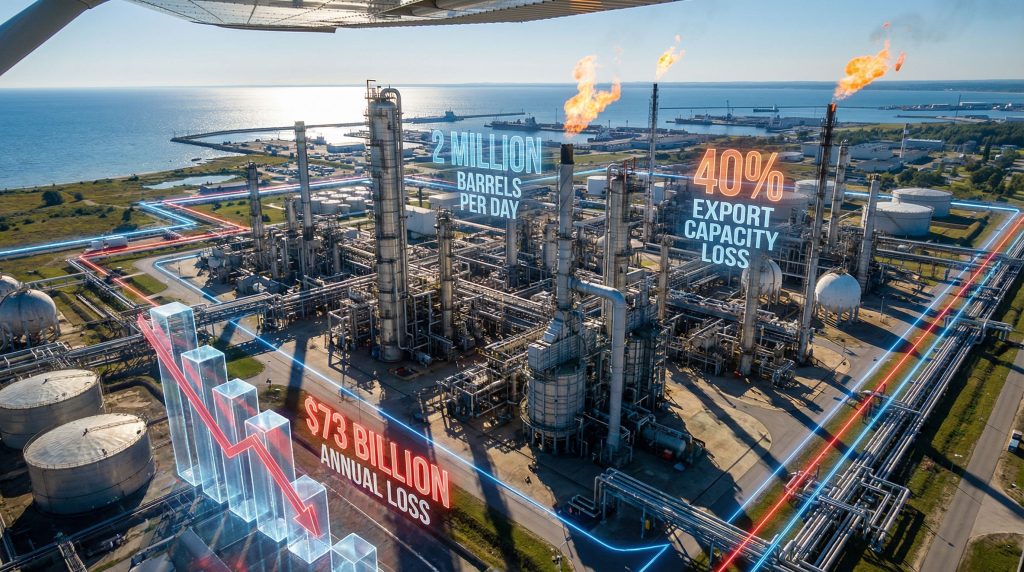
Current infrastructure damage has eliminated 2 million barrels per day of Russian crude oil export capacity, representing approximately 40% of the nation's total export infrastructure. This disruption affects critical facilities including the Primorsk and Ust-Luga Baltic Sea ports, the Novorossiysk Black Sea terminal, and sections of the transnational Druzhba pipeline system.
The scale of this disruption becomes evident when examined against global production metrics. While 2 million barrels per day represents only 2% of worldwide crude production, the targeting of infrastructure rather than distributed production assets creates amplified market impacts.
Unlike field-level production losses that can be gradually compensated through spare capacity, infrastructure destruction creates immediate supply bottlenecks that cannot be quickly circumvented. Furthermore, this coincides with an oil price rally that has pushed Brent crude above crucial psychological thresholds.
Macro-Economic Context – Energy as Economic Warfare Tool
This infrastructure campaign reveals sophisticated understanding of Russia's economic architecture, where energy revenues constitute approximately 25% of state budget proceeds within a $2.6 trillion economy. The targeting strategy focuses on maximum revenue disruption rather than tactical military objectives, demonstrating how civilian infrastructure can become strategic economic weaponry.
The asymmetric nature of this conflict is particularly striking. Low-cost drone operations, requiring minimal capital investment, generate sustained large-scale economic damage to state finances without requiring massive military expenditure. This cost-effectiveness ratio fundamentally challenges traditional military spending models and defence infrastructure priorities.
Global Oil Price Implications and Market Volatility
International markets have responded to these supply disruptions with Brent crude prices exceeding $100 per barrel, reflecting geopolitical risk premiums that extend beyond the immediate supply loss. According to Reuters analysis, this represents the most severe oil supply disruption in modern Russian history.
The timing of these disruptions coincides with elevated global energy demand, amplifying price discovery challenges. Strategic petroleum reserve managers across major economies are evaluating release scenarios to moderate price volatility, while energy traders reassess risk models for infrastructure-dependent supply chains.
However, concerns remain about potential oil price stagnation if global economic growth falters or alternative supplies rapidly materialise.
When big ASX news breaks, our subscribers know first
What Does 40% Export Capacity Loss Mean for Russia's Economic Foundation?
Russia's fiscal architecture demonstrates extreme vulnerability to energy revenue disruption, with oil and gas proceeds serving as foundational elements of government financing. This dependency creates systemic economic exposure when export infrastructure faces sustained operational challenges.
Budget Revenue Dependencies – The $2.6 Trillion Economy at Risk
With energy revenues representing 25% of state budget proceeds, the current 2 million barrel per day capacity loss translates to immediate fiscal pressure. At current prices exceeding $100 per barrel, this disruption represents approximately $200 million in daily revenue losses, potentially reaching $73 billion annually if sustained.
The mathematical implications extend beyond simple volume calculations. Energy revenue disruption affects:
- Currency stability: Reduced hard currency inflows from energy exports pressure ruble exchange rates
- Fiscal deficit expansion: Budget shortfalls may force spending reductions or increased borrowing requirements
- Investment capacity: Infrastructure development and military procurement capabilities face funding constraints
- Regional economic impacts: Oil-producing regions dependent on energy sector employment face secondary economic effects
State Budget Composition – Energy's 25% Revenue Share Under Threat
The structural dependence on energy revenues creates cascading vulnerabilities throughout Russia's governmental financing. If 25% of budget revenue derives from oil and gas sectors, and 40% of export capacity remains offline, the proportional impact suggests approximately 10% of total state budget revenue faces immediate risk.
However, this simplified calculation understates additional complications including:
- Price elasticity effects: Reduced supply availability may drive price increases, partially offsetting volume losses
- Alternative routing costs: Redirecting exports through Asian markets involves premium transportation and infrastructure costs
- Production shifting constraints: Limited pipeline capacity to alternative markets prevents full volume redirection
These factors compound with the ongoing US oil production decline, which reduces available alternative supplies in global markets.
Comparative Analysis – Modern Russia's Worst Energy Crisis
Reuters analysis indicates this represents "the most severe oil supply disruption in the modern history of Russia", exceeding previous sanctions-related export restrictions. Unlike gradual policy-imposed limitations, infrastructure destruction creates immediate, binary capacity losses that cannot be negotiated or gradually circumvented.
Historical comparisons reveal the unprecedented nature of this disruption:
| Crisis Period | Capacity Impact | Primary Cause | Recovery Timeline |
|---|---|---|---|
| 2022-2024 Sanctions | 15-20% gradual reduction | Policy restrictions | 12-18 months adaptation |
| 1990s Economic Crisis | 25-30% production decline | Economic collapse | 5-7 years recovery |
| 2026 Infrastructure Campaign | 40% immediate capacity loss | Physical destruction | 18-24 months minimum |
Which Critical Infrastructure Targets Are Driving Maximum Economic Damage?
The systematic targeting of specific infrastructure nodes reveals sophisticated strategic planning focused on maximising economic disruption through precision strikes against irreplaceable facilities. Consequently, the OPEC production impact on global markets becomes increasingly significant.
Baltic Sea Export Terminals – Strategic Chokepoints
The Baltic ports of Primorsk and Ust-Luga represent Russia's highest-volume export corridor, collectively handling over 1.8 million barrels per day of crude oil exports. These facilities offer the shortest export distances to European and global markets, enabling cost-competitive operations that generate premium revenues compared to longer Asian routing alternatives.
Primorsk Port Operations:
- Daily capacity: 1,000,000+ barrels per day
- Current status: Completely halted
- Strategic significance: Primary Baltic export hub
- Recovery complexity: High – requires specialised loading equipment replacement
Ust-Luga Port Operations:
- Daily capacity: 800,000 barrels per day
- Current status: Operations suspended
- Infrastructure damage: Multiple loading berths affected
- Geographic constraints: Limited alternative capacity in Baltic region
Black Sea Operations – Novorossiysk's Reduced Throughput
The Novorossiysk terminal serves as Russia's only operational Black Sea crude export facility, handling up to 700,000 barrels per day under normal operations. Recent drone strikes in early March have reduced operations below designed capacity, creating bottlenecks for Southern European and Mediterranean market access.
The terminal's strategic importance extends beyond capacity metrics. Novorossiysk enables direct maritime access to Mediterranean refineries, avoiding the extended routing required for Asian markets. Its compromised operations force additional cargo through already-constrained Baltic facilities or expensive alternative transportation networks.
Pipeline Networks – The Druzhba Disruption Strategy
The Druzhba pipeline system, representing 500,000 barrels per day of export capacity, faces unique vulnerabilities as transnational infrastructure crossing through Ukraine. This 4,000+ kilometre network includes multiple pumping stations and border crossing facilities, creating distributed attack vectors across its operational route.
Pipeline Vulnerability Assessment:
- Geographic exposure: Multiple border crossings create security challenges
- Pumping station dependencies: Single-point failures cascade across entire system sections
- International implications: Disruptions affect Hungarian and Slovakian refinery operations
- Recovery complexity: Cross-border repairs require diplomatic coordination and specialised equipment
January 2026 damage to pipeline infrastructure has created ongoing operational complications, with partial capacity restoration dependent on diplomatic agreements and security guarantees from multiple national governments.
How Is Russia's Economic Response Revealing Strategic Vulnerabilities?
Russia's adaptation strategies to infrastructure disruption expose fundamental limitations in alternative export capacity and geographic constraints that cannot be rapidly overcome through policy adjustments or diplomatic initiatives.
Eastern Pivot Limitations – Asian Route Capacity Constraints
Current Asian export infrastructure provides approximately 1.9 million barrels per day of pipeline capacity through various routes including the Skovorodino-Mohe pipeline, Atasu-Alashankou corridor, and ESPO Blend exports via Port Kozmino. Additional maritime exports from Sakhalin Island projects contribute 250,000 barrels per day of Far Eastern capacity.
Asian Route Capacity Analysis:
| Export Route | Daily Capacity | Operational Status | Expansion Potential |
|---|---|---|---|
| Skovorodino-Mohe Pipeline | 600,000 bpd | Operating at capacity | Limited – requires Chinese agreement |
| Atasu-Alashankou Route | 400,000 bpd | Operational | Moderate – infrastructure dependent |
| ESPO Port Kozmino | 700,000 bpd | Active | Low – geographic constraints |
| Sakhalin Maritime | 250,000 bpd | Operational | Limited – island infrastructure |
The critical limitation emerges in the capacity mathematics: 2 million barrels per day offline versus 2.15 million barrels per day maximum Asian capacity creates minimal surplus for volume absorption. This constraint prevents Russia from rapidly compensating for western infrastructure losses through eastern redirection.
Shadow Fleet Economics – Cost Escalation Analysis
Alternative transportation networks involve substantial cost premiums that erode realised crude oil prices. Maritime routing through non-traditional channels requires:
- Insurance premium escalation: Vessels operating in geopolitically restricted contexts face elevated coverage costs
- Extended transit times: Routing around European enforcement zones adds 5-7 days to delivery schedules
- Port congestion expenses: Limited Far Eastern infrastructure creates vessel queuing, increasing demurrage costs
- Security escort requirements: High-risk routing may necessitate additional protective measures
These cumulative costs reduce effective pricing for Russian crude exports, further eroding revenue generation even when alternative routing proves technically feasible. Moreover, the broader tariffs impact markets by creating additional trade friction across multiple commodity sectors.
Geographic Dependency Risks – Time Zone Spanning Security Challenges
Russia's continental geography, spanning 11 time zones, creates unique defence vulnerabilities for distributed energy infrastructure. This geographic scale generates:
Operational Challenges:
- Dispersed security requirements: Protecting facilities across continental distances strains defence resources
- Communication coordination delays: Multi-time zone security responses create vulnerability windows
- Maintenance logistics complexity: Repairing damaged infrastructure in remote regions requires specialised equipment and personnel movement
- Resource allocation decisions: Limited security assets must protect multiple high-value targets simultaneously
The Arctic maritime route disruption, affecting 300,000 barrels per day of exports from Murmansk, demonstrates how European enforcement activities compound geographic vulnerabilities by eliminating northern export alternatives.
What Are the Broader Macro-Economic Implications for Global Markets?
The infrastructure campaign's effects extend beyond bilateral trade relationships, creating systemic changes in global energy market structure, pricing mechanisms, and supply chain risk assessment methodologies.
Supply Chain Reconfiguration – European Energy Security
European energy markets face immediate supply source diversification pressure as traditional Russian export routes become unreliable. The Druzhba pipeline's operational uncertainties directly affect Central European refineries in Hungary and Slovakia, forcing accelerated alternative supply arrangements.
This reconfiguration involves several strategic adaptations:
- Alternative supplier negotiations: European buyers must secure replacement crude supplies from Middle Eastern, African, or American sources
- Transportation infrastructure adjustments: Port facilities require modification to handle different crude grades and shipping configurations
- Storage capacity expansion: Increased supply uncertainty necessitates larger strategic reserve holdings
- Price volatility management: Procurement strategies must incorporate elevated price risk from supply disruption scenarios
Price Discovery Mechanisms – Market Premium for Geopolitical Risk
Global crude oil pricing now incorporates infrastructure vulnerability premiums that reflect the demonstrated capacity for precision strikes to disrupt major supply systems. This premium pricing extends beyond immediate supply shortfalls to encompass systemic risk assessments across multiple producing regions.
Risk Premium Components:
- Physical infrastructure vulnerability: Assessment of export facility security across major producing regions
- Restoration timeline uncertainty: Market pricing for unknown capacity recovery periods
- Escalation potential: Evaluation of conflict expansion affecting additional production areas
- Alternative supply elasticity: Availability and cost of replacement supplies from non-affected regions
Strategic Reserve Utilisation – Global Buffer Capacity Testing
International strategic petroleum reserve systems face utilisation pressure to moderate price volatility and maintain supply stability. Major consuming nations are evaluating reserve release scenarios while balancing current market support against future emergency requirements.
The reserve deployment calculations involve complex trade-offs:
Strategic Considerations:
- Current market intervention versus future emergency preparedness
- Coordinated international releases versus unilateral national actions
- Market price moderation versus supply security prioritisation
- Reserve replenishment planning during elevated price periods
How Do These Disruptions Compare to Historical Energy Crises?
Contemporary infrastructure targeting represents a distinct category of energy crisis, differing fundamentally from previous supply disruptions in methodology, recovery requirements, and systemic implications.
1973 Oil Embargo Parallels – State-Level Economic Warfare
The 1973 oil embargo utilised policy mechanisms to restrict supply access, creating gradual market adjustments as alternative sources were developed and diplomatic solutions pursued. Current infrastructure destruction employs physical capacity elimination that cannot be resolved through negotiations or policy modifications.
Comparative Disruption Characteristics:
| Crisis Element | 1973 Embargo | 2026 Infrastructure Campaign |
|---|---|---|
| Primary Mechanism | Policy restriction | Physical destruction |
| Resolution Method | Diplomatic negotiation | Infrastructure reconstruction |
| Recovery Timeline | 6-12 months | 18-24 months minimum |
| Market Adaptation | Alternative supplier access | Alternative infrastructure development |
Gulf War Impact Analysis – Infrastructure vs. Production Targeting
Historical military conflicts typically targeted production facilities (oil fields, refineries) rather than export infrastructure, creating different recovery dynamics and market impacts. Production facility damage can often be circumvented through alternative field development, while export infrastructure destruction creates absolute capacity constraints.
The precision infrastructure targeting demonstrates strategic evolution toward maximum economic disruption per operational investment, optimising cost-effectiveness ratios compared to broader military campaigns.
Modern Warfare Economics – Precision Disruption Strategies
Contemporary conflict methodology emphasises strategic leverage points where minimal investment generates disproportionate economic consequences. This approach represents fundamental changes in warfare economics, prioritising cost-effective economic damage over territorial control or broad infrastructure destruction.
Strategic Targeting Evolution:
- Precision identification: Critical infrastructure nodes that create cascading disruption
- Cost optimisation: Maximum economic damage per operational dollar invested
- Duration strategy: Sustained pressure through repeated targeting of repair attempts
- Psychological impact: Market uncertainty generation beyond physical capacity loss
The next major ASX story will hit our subscribers first
What Economic Models Predict for Sustained Infrastructure Warfare?
Economic modelling of sustained infrastructure targeting reveals potential tipping points where temporary disruptions transition into permanent structural changes in global energy trade patterns. Furthermore, the Ukraine drone attacks on Russia oil exports demonstrate how precision warfare can fundamentally reshape economic relationships.
Revenue Elasticity Analysis – State Budget Breaking Points
Russia's fiscal stability demonstrates critical dependency thresholds where revenue reductions force fundamental governmental priority adjustments. With energy revenues comprising 25% of budget proceeds, sustained 40% export capacity loss creates annual revenue reductions potentially exceeding $70 billion.
Fiscal Stress Indicators:
- Defence spending sustainability: Military procurement capacity under reduced revenue scenarios
- Social programme maintenance: Governmental services funding during fiscal constraint periods
- Infrastructure investment capacity: Ability to fund export facility reconstruction while maintaining operations
- Currency stability pressure: Foreign exchange reserves adequacy for extended revenue disruption
Export Route Diversification Costs – Infrastructure Investment Requirements
Alternative export capacity development involves substantial capital requirements and extended construction timelines that may exceed the duration of current disruptions. Pipeline construction to Asian markets requires multi-billion dollar investments and 5-7 year development periods.
Infrastructure Development Cost Analysis:
- New pipeline construction: $5-10 billion per major route, 5-7 year completion timeline
- Port facility expansion: $2-4 billion for significant capacity increases, 3-5 year construction period
- Storage infrastructure: $500 million – $1 billion for strategic buffer capacity
- Security infrastructure: $100-500 million for facility protection systems
Economic Resilience Modelling – Recovery Timeline Projections
Recovery timeline modelling suggests 18-24 month minimum periods for major infrastructure restoration, assuming uninterrupted reconstruction efforts and available specialised equipment. However, continued targeting of repair activities could extend recovery indefinitely.
Recovery Scenario Variables:
- Construction security: Ability to protect reconstruction activities from repeated targeting
- Specialised equipment availability: Access to specialised loading and pumping infrastructure
- International contractor participation: Willingness of foreign companies to engage in high-risk reconstruction projects
- Financing availability: Capital markets access for infrastructure investment during conflict periods
How Are Allied Economic Strategies Amplifying the Impact?
Coordinated economic pressure through maritime enforcement and financial system restrictions compounds the infrastructure disruption effects, creating multiplicative rather than additive economic consequences.
Tanker Seizure Economics – Maritime Enforcement Costs
European maritime enforcement has disrupted 300,000 barrels per day of Arctic oil exports from Murmansk, demonstrating how legal mechanisms complement physical infrastructure targeting. These seizures create additional cost pressures through:
- Insurance premium escalation: Maritime coverage costs increase substantially for high-risk routing
- Vessel detention expenses: Legal proceedings and asset recovery costs
- Alternative shipping premiums: Non-sanctioned vessel charter rates reflect elevated operational risks
- Route modification costs: Extended shipping distances to avoid enforcement zones
Insurance Market Responses – Risk Premium Escalation
International insurance markets are repricing coverage for energy infrastructure and transportation, reflecting demonstrated vulnerability to precision targeting. These premium increases affect operational costs across entire energy supply chains, extending economic impacts beyond directly affected facilities.
Insurance Premium Implications:
- Infrastructure coverage: Facility insurance costs increase substantially for energy export terminals
- Maritime transportation: Tanker insurance premiums reflect routing risks and seizure possibilities
- Political risk assessment: Coverage for assets in conflict-affected regions faces significant premium increases
- Business interruption insurance: Policies for supply chain disruption become more expensive and restrictive
Secondary Sanctions Effects – Financial System Isolation
Financial system restrictions compound physical infrastructure challenges by limiting access to international banking, trade financing, and insurance services necessary for alternative export arrangements. These restrictions create systemic barriers to circumventing infrastructure damage through alternative commercial arrangements.
Additionally, recent reports from Oil Price indicate that Russia's vital Baltic oil hubs remain severely compromised, further limiting alternative routing options.
At current oil prices exceeding $100 per barrel and 2 million barrels per day offline, Russia faces potential daily revenue losses of $200 million, translating to $73 billion annually if disruptions persist. This represents approximately 10% of total state budget revenue and demonstrates how precision infrastructure targeting can generate strategic economic pressure exceeding traditional military capabilities.
The systematic infrastructure campaign reveals how modern warfare economics prioritise strategic leverage points where minimal investment generates maximum economic disruption. Unlike historical conflicts focused on territorial control or broad destruction, contemporary strategies demonstrate sophisticated understanding of economic architecture vulnerabilities that create sustained fiscal pressure through precision targeting of critical revenue-generating assets.
Investment and Risk Considerations:
Investors evaluating energy sector exposure should consider infrastructure vulnerability as a systematic risk factor requiring premium risk assessment and portfolio diversification strategies. The demonstrated capacity for precision strikes to eliminate major export facilities suggests traditional geopolitical risk models may underestimate actual business interruption probabilities in conflict-affected regions.
Ready to Identify the Next Energy Sector Opportunity?
Energy infrastructure disruptions create both risks and opportunities across resource markets, demanding real-time intelligence for informed investment decisions. Discovery Alert's proprietary Discovery IQ model delivers instant notifications on significant ASX mineral discoveries, helping investors capitalise on market volatility and identify emerging opportunities whilst traditional energy sources face geopolitical challenges—explore historical discovery returns to understand the potential impact or begin your 14-day free trial today to position yourself ahead of rapidly changing markets.