June 24, 2026
Revolutionary Ultra-Class Mining Equipment Reshapes Industry Standards
The Komatsu PC9000-12 hydraulic mining excavator represents a significant advancement in ultra-class mining equipment, establishing new benchmarks for productivity and operational efficiency. Furthermore, this technological breakthrough demonstrates how mining industry innovation continues to push the boundaries of what's achievable in large-scale material handling operations.
Ultra-class mining excavators represent a technological arms race where manufacturers compete on productivity metrics that directly translate to operational profitability. The latest generation of these massive machines operates within complex performance matrices involving material handling capacity, fuel efficiency, automation integration, and environmental compliance.
When big ASX news breaks, our subscribers know first
Performance Specifications Define Ultra-Class Mining Capabilities
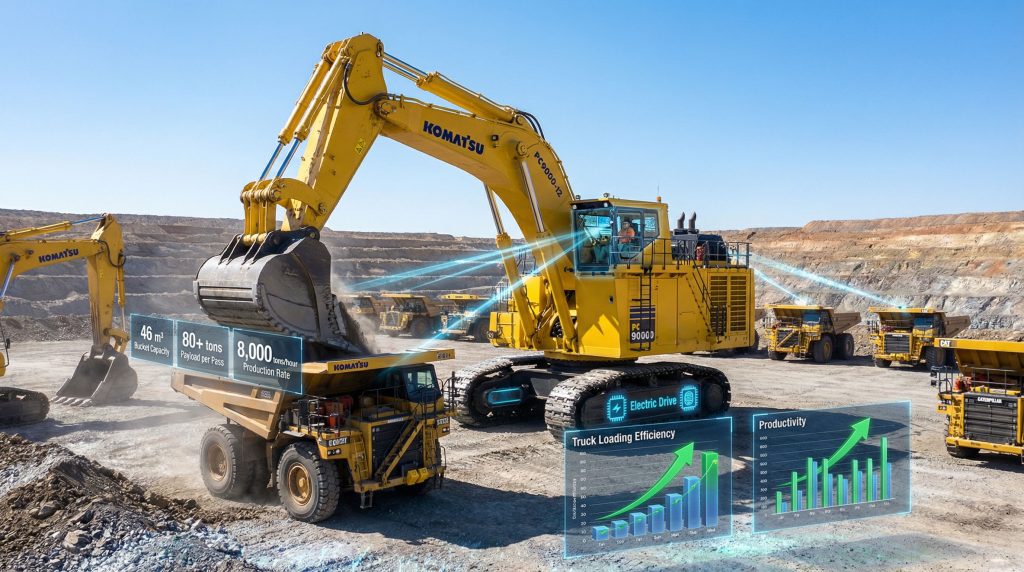
The Komatsu PC9000-12 hydraulic mining excavator establishes its market position through measurable performance parameters that mining operations use for productivity calculations. With bucket configurations ranging from 46 cubic metres for front shovel applications to 49 cubic metres for backhoe operations, the machine delivers payload capacity exceeding 80 tons per loading cycle.
These specifications translate to practical operational metrics that mining engineers use for production planning. In addition, the excavator completes full truck loading sequences for Komatsu 980E vehicles within 150 seconds using five loading passes, achieving production rates approaching 8,000 tons per hour under optimal conditions.
Key Performance Metrics Overview
| Configuration | Bucket Capacity | Payload Per Pass | Production Rate | Truck Loading Time |
|---|---|---|---|---|
| Front Shovel | 46 m³ | 80+ tons | 8,000 tons/hour | 150 seconds |
| Backhoe | 49 m³ | 80+ tons | 8,000 tons/hour | 150 seconds |
The machine's compatibility with mining trucks ranging from 240 to 400 short tons provides operational flexibility for diverse fleet configurations. Loading requirements vary from 3 to 5 passes depending on truck capacity and material characteristics, enabling mining operations to optimise truck-excavator matching for maximum efficiency.
However, operational deployment in oil sands environments validates the PC9000-12's capability to handle complex material conditions. Oil sands operations present challenging excavation scenarios involving variable material densities, moisture content fluctuations, and continuous high-volume production requirements.
The inaugural delivery to a Canadian oil sands operation in May 2025 demonstrated real-world performance capabilities under demanding conditions. For instance, material handling efficiency depends on factors beyond bucket capacity, including hydraulic system response times, boom and stick reach specifications, and cycle time optimisation.
What factors influence actual productivity rates?
Production rate calculations incorporate multiple variables including material density, loading distance variations, truck availability, and operator proficiency levels. The 8,000 tons per hour baseline represents peak performance under controlled conditions, with actual productivity modified by site-specific factors.
Drive System Configurations Address Diverse Operational Requirements
The Komatsu PC9000-12 hydraulic mining excavator offers three distinct powerplant options designed to meet varying regulatory environments and operational priorities. This multi-configuration approach reflects how data-driven mining operations balance performance requirements with environmental compliance and operational cost optimisation.
Diesel Tier 4 Configuration Technical Advantages
The Tier 4 diesel option incorporates advanced emissions control technology including selective catalytic reduction systems, diesel particulate filters, and exhaust gas recirculation. These systems achieve nitrogen oxide and particulate matter reductions of approximately 90% compared to unregulated engines, enabling operations in jurisdictions with strict environmental standards.
Nevertheless, emissions compliance systems introduce operational considerations including increased maintenance complexity, periodic regeneration cycles, and parasitic power losses typically ranging from 3-5% of total engine output. These factors influence fuel consumption rates and maintenance scheduling requirements.
Unregulated Diesel Configuration Benefits
Unregulated diesel engines operate without emissions after-treatment systems, theoretically maximising power output and minimising parasitic losses. This configuration suits remote mining locations where regulatory emissions standards may not apply or where maximum power density is prioritised over environmental compliance.
The practical performance advantage of unregulated systems may be smaller than anticipated due to modern engine design improvements that optimise combustion efficiency independent of emissions control requirements. Consequently, long-term operational costs require evaluation of maintenance frequency, component replacement intervals, and fuel consumption patterns.
Electric Drive Alternative Specifications
Electric drive systems represent a significant technological transition for ultra-class mining equipment. The electric configuration offers zero on-site emissions capability, reduced operational noise levels, and potential integration with renewable energy sources.
Key technical considerations for electric drive systems include:
• Battery technology selection and cycle-life limitations
• Charging infrastructure requirements and operational downtime implications
• Power density requirements for continuous heavy-duty digging operations
• Thermal management in extreme mining environments
• Grid integration capabilities versus on-site renewable energy systems
The electric option's lower long-term operational costs depend on electricity pricing, charging efficiency, and battery replacement schedules. Mining operations must evaluate total cost of ownership across typical equipment lifespans of 15-20 years.
Autonomous System Integration Enhances Operational Efficiency
The Komatsu PC9000-12 hydraulic mining excavator incorporates compatibility with FrontRunner Autonomous Haulage System technology, representing a shift toward automated mining operations. This integration demonstrates how AI-driven mining automation requires sophisticated coordination between excavator control systems and autonomous truck fleet management protocols.
Precision Loading Requirements
Autonomous truck integration demands loading precision beyond traditional operator-controlled systems. Autonomous vehicles require consistent payload placement within tight tolerances to maintain balance, prevent spillage, and ensure predictable cycle times.
Communication protocols between excavator sensors and autonomous fleet management systems utilise either hardwired connections or wireless networks depending on mining environment requirements. Wireless systems in mining applications face challenges from electromagnetic interference, topographic obstructions, and harsh environmental conditions.
Double-Side Loading Capabilities
The PC9000-12's double-side loading configuration enables simultaneous truck positioning from multiple angles, reducing cycle times and increasing operational throughput. This capability requires sophisticated spatial awareness systems and coordination algorithms to manage multiple truck positions safely.
Operational Benefits of Autonomous Integration
• Reduced human exposure in high-hazard mining environments
• Consistent loading precision across all operating shifts
• Enhanced coordination with fleet management systems
• Real-time performance analytics and optimisation
• Predictive maintenance integration with fleet-wide systems
Fail-safe operations require redundancy systems and emergency protocols when autonomous communication systems experience failures. Furthermore, mining operations must maintain manual override capabilities and operator intervention procedures for system malfunctions.
Operator Experience and Safety Enhancement Features
The PC9000-12's operator cabin design prioritises ergonomics and safety through spacious compartment configuration and advanced monitoring systems. These features directly impact operator fatigue levels, productivity consistency, and long-term health outcomes in demanding mining environments.
Ergonomic Cabin Design Elements
• Enhanced visibility through optimised window placement and sizing
• Advanced climate control systems for extreme temperature conditions
• Vibration dampening technology to reduce operator fatigue
• Intuitive control interface layout minimising learning curves
• Adjustable seating and control positioning for diverse operator requirements
Real-time performance analytics provide operators with immediate feedback on loading efficiency, fuel consumption, and maintenance status. Predictive maintenance alerts enable proactive component replacement before failures occur, reducing unplanned downtime.
Enhanced situational awareness displays integrate camera systems, proximity sensors, and hazard detection algorithms. These systems help operators maintain awareness of surrounding activities, particularly important in busy mining environments with multiple equipment operations.
Fleet Productivity Optimisation Through Truck Matching
The Komatsu PC9000-12 hydraulic mining excavator's productivity optimisation depends significantly on proper truck-excavator matching ratios. Different truck capacities require varying loading approaches that influence overall fleet efficiency and operational costs.
Truck Capacity Matching Specifications
| Truck Capacity Range | Loading Passes Required | Typical Cycle Time | Productivity Impact |
|---|---|---|---|
| 240-280 short tons | 3-4 passes | 120-140 seconds | Maximum efficiency |
| 280-350 short tons | 4-5 passes | 140-160 seconds | Optimal balance |
| 350-400 short tons | 5 passes | 150-180 seconds | Heavy-duty operations |
Production Rate Variables
Actual production rates depend on multiple operational factors beyond theoretical capacity specifications. Material density variations affect payload calculations, with wet or compacted materials reducing effective bucket fill factors.
Truck availability and queue management directly impact excavator utilisation rates. Optimal productivity requires coordinated scheduling to minimise excavator waiting time while avoiding truck queuing delays. Fleet management systems must balance truck dispatch timing with excavator loading capabilities.
The next major ASX story will hit our subscribers first
Environmental Impact and Sustainable Operations
The Komatsu PC9000-12's environmental impact varies significantly between drive configurations, with each option presenting different trade-offs between emissions reduction, operational costs, and performance characteristics. This aligns with the broader sustainable mining transformation occurring across the industry.
Emissions Reduction Strategies by Configuration
The electric drive configuration achieves zero direct emissions at the point of operation, though total environmental impact depends on electricity generation sources. Regions with high renewable energy penetration provide greater environmental benefits than areas dependent on fossil fuel-generated electricity.
Diesel Tier 4 systems reduce particulate matter and nitrogen oxide emissions by approximately 90% compared to unregulated engines, while maintaining conventional fuel infrastructure requirements. However, the emissions control systems require periodic maintenance and replacement of after-treatment components.
Cost-Per-Ton Optimisation Factors
• Higher payload capacity reduces total operational cycles required
• Enhanced fuel efficiency through optimised hydraulic systems
• Reduced maintenance requirements through advanced engineering
• Lower labour costs through increased automation capabilities
• Decreased equipment fleet requirements through higher individual productivity
Mining Application Versatility and Material Handling
The PC9000-12's dual configuration capability enables optimisation for diverse mining applications and material types. Each configuration offers specific advantages depending on operational requirements and geological conditions.
Surface Mining Configuration Applications
• Open-pit copper operations requiring high-volume overburden removal
• Iron ore extraction with varying material density characteristics
• Coal surface mining with selective material handling requirements
• Oil sands operations involving complex material composition
Dense ore materials benefit from optimised hydraulic pressure settings and reinforced bucket construction. The excavator's hydraulic systems adjust automatically to material resistance levels, maintaining consistent cycle times across varying material densities.
Variable moisture content materials present challenges for consistent payload calculations. The excavator's weight monitoring systems provide real-time payload feedback to optimise loading precision regardless of material moisture variations.
Maintenance and Service Network Support
The PC9000-12's predictive maintenance capabilities integrate advanced monitoring systems with global service network support. These systems enable proactive component replacement and minimise unplanned downtime through early failure detection.
Predictive Maintenance System Components
• Component wear monitoring through vibration analysis and oil sampling
• Hydraulic system diagnostics including pressure and temperature tracking
• Engine performance monitoring with fuel consumption analysis
• Scheduled maintenance optimisation based on actual operating conditions
Global service network integration provides worldwide dealer support with standardised parts availability and technical expertise. Remote diagnostic capabilities enable troubleshooting support without on-site technician deployment for many maintenance issues.
The service network's effectiveness directly impacts equipment availability and operational costs. Mining operations in remote locations particularly benefit from comprehensive remote diagnostic capabilities and local parts inventory management.
Economic Impact on Mining Operations
The Komatsu PC9000-12 hydraulic mining excavator's economic impact extends beyond direct operational costs to influence mine planning, infrastructure requirements, and long-term profitability projections. This economic transformation contributes to enhanced operational safety, including iron haulage safety boost initiatives across the industry.
Capital Investment Considerations
Higher initial equipment costs for ultra-class excavators require justification through productivity improvements and operational cost reductions. The PC9000-12's enhanced capabilities may enable reduced fleet size requirements, offsetting individual unit costs through decreased total capital investment.
Enhanced operational lifespan compared to smaller equipment provides improved capital efficiency over extended depreciation periods. Technology upgrade pathways enable future capability enhancements without complete equipment replacement.
Operational Cost Analysis Components
• Fuel consumption per ton moved across different material types
• Maintenance cost projections based on operating hours and conditions
• Operator training investments for new technology features
• Technology integration expenses for autonomous system implementation
Mining operations must evaluate total cost of ownership including direct costs, productivity improvements, and indirect benefits such as reduced environmental compliance costs or enhanced safety metrics.
Future Technology Development and Market Positioning
The mining equipment industry continues evolving toward increased automation, electrification, and data-driven optimisation. The PC9000-12's design architecture accommodates future technology integration while maintaining current operational capabilities.
Technology Integration Roadmap
• Enhanced autonomous capabilities through artificial intelligence integration
• Advanced data analytics for predictive maintenance and operational optimisation
• Remote operation possibilities for hazardous environment applications
• Electrification expansion with improved battery technology and charging infrastructure
Ultra-class excavator segment leadership requires continuous innovation in productivity, efficiency, and environmental performance. Global availability through established dealer networks provides competitive advantages in service support and parts availability.
Application-specific customisation options enable optimisation for particular mining environments or material types. Long-term customer partnership approaches focus on lifecycle support rather than transactional equipment sales.
The Canadian Mining Journal reports that this technological advancement represents a significant milestone in mining equipment development. Consequently, the PC9000-12 demonstrates how manufacturers continue pushing the boundaries of what's achievable in ultra-class mining operations.
"Investment Note: Mining equipment investments represent significant capital commitments with long depreciation periods. Operational performance claims should be verified through independent testing and real-world deployment data before making equipment selection decisions. Technology integration capabilities may require additional infrastructure investments and operator training programmes."
The evolution of ultra-class mining excavators like the PC9000-12 reflects broader industry trends toward productivity optimisation, environmental responsibility, and technological integration. These machines represent substantial investments that mining operations must evaluate within comprehensive operational and financial frameworks extending far beyond initial purchase considerations.
Looking to Capitalise on Mining Equipment Innovation Opportunities?
Discovery Alert's proprietary Discovery IQ model delivers real-time alerts on significant ASX mineral discoveries, instantly empowering subscribers to identify actionable investment opportunities ahead of the broader market. Begin your 14-day free trial today and secure your market-leading advantage in the evolving mining sector.