May 22, 2026
Understanding Ultraviolet Fluorescence Detection Systems
The mining industry's technological arsenal continues to evolve, with spectroscopic detection methods gaining prominence for their ability to reveal mineralization patterns invisible to conventional exploration techniques. Among these emerging approaches, black light mineral exploration represents a cost-effective methodology that leverages ultraviolet radiation to identify specific mineral assemblages through fluorescent responses.
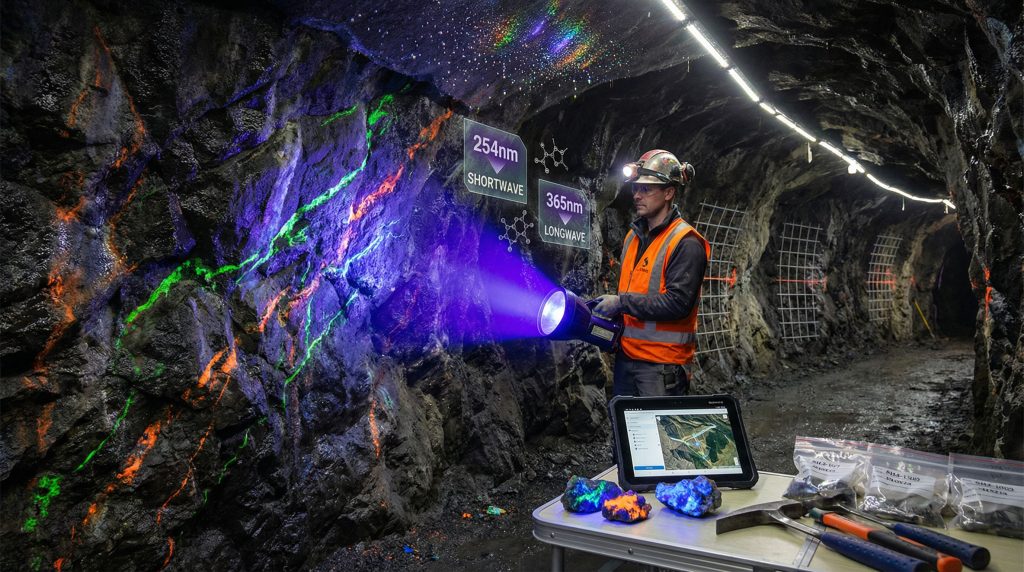
Ultraviolet fluorescence occurs when certain minerals absorb UV energy and re-emit it as visible light. This phenomenon results from trace element substitutions within crystal lattices, particularly in carbonate minerals where manganese and lead create distinctive fluorescent signatures. The scientific foundation rests on molecular-level interactions where UV photons excite electrons in these trace elements, causing energy release in the visible spectrum.
Core Equipment Requirements for Field Operations
Professional-grade UV systems typically operate at two primary wavelengths: shortwave (254nm) for high-intensity applications and longwave (365nm) for portable field reconnaissance. Equipment selection depends on target mineral types and operational environments, with underground applications requiring portable LED systems that maintain consistent output across varying temperatures and humidity levels.
Modern black light mineral exploration systems incorporate:
- Portable UV LED arrays with 8-12 hour battery life
- Filter systems to isolate specific wavelength ranges
- Digital documentation capabilities for real-time recording
- Weatherproof housings for harsh field conditions
- Safety protocols including UV-protective eyewear
When big ASX news breaks, our subscribers know first
Primary Target Minerals in Fluorescent Detection Programs
Calcite Variations and Trace Element Signatures
Fugitive calcite represents the primary focus of black light mineral exploration, particularly in carbonate replacement deposit (CRD) environments. These calcite populations exhibit fluorescent properties due to trace amounts of manganese and lead, which serve as pathfinder elements toward more significant mineralization zones.
Research from exploration programs in Montana demonstrates that fluorescent calcite populations can be distinguished from visually identical non-fluorescent veins, providing critical structural and geochemical information. The presence of these trace elements indicates proximity to hydrothermal systems where sulfide mineralization with higher metal concentrations may be present.
Secondary Fluorescent Indicators
Beyond calcite, several other minerals respond effectively to UV illumination. Furthermore, these fluorescent minerals often occur in paragenetic sequences that provide additional context for exploration targeting and geological interpretation:
- Scheelite: Tungsten-bearing mineral exhibiting bright blue fluorescence under shortwave UV
- Fluorite: Displays variable colours including blue, green, and purple under UV radiation
- Willemite: Zinc silicate showing green fluorescence useful in zinc exploration
- Hyalite opal: Exhibits green fluorescence indicating hydrothermal alteration zones
Underground Deployment Strategies and Operational Protocols
Systematic Scanning Methodologies
Underground implementation of black light mineral exploration requires systematic approaches to ensure comprehensive coverage while maintaining safety standards. The Madison copper-gold project in Montana provides a practical example, where geologists utilised seasonal windows of lower water levels to access additional underground workings spanning 150 feet of exposed ramp.
Operational protocols typically follow this sequence:
- Pre-deployment assessment: Evaluation of ventilation systems and electrical requirements
- Systematic grid scanning: Methodical coverage of newly exposed rock surfaces
- Real-time documentation: Photography and GPS coordinate recording of fluorescent zones
- Structural data collection: Stereonet plotting of vein orientations and spatial relationships
- Integration analysis: Combining UV data with existing geological models
Vector Analysis Techniques Toward Porphyry Systems
Structural data collected from fluorescent vein populations enables vector analysis toward potential porphyry and CRD targets. At Madison, this approach supported hypothesis testing for multiple porphyry centres rather than a single mineralization system, demonstrating the technique's value in refining exploration models.
The fluorescence in calcite indicates the presence of trace amounts of manganese and lead, both indicators of carbonate replacement associated with skarn, CRD and distal porphyry mineralization systems.
Technical Advantages Over Conventional Exploration Methods
Cost-Effectiveness and Operational Efficiency
Black light mineral exploration offers significant economic advantages compared to traditional geochemical surveys and geophysical methods. The technique requires minimal equipment investment and can be deployed by single-operator teams, reducing labour costs while maintaining high detection sensitivity.
Key operational benefits include:
- Rapid reconnaissance capabilities: Large areas can be surveyed in hours rather than days
- Real-time results: Immediate identification of target zones without laboratory delays
- Minimal environmental impact: No sample collection or ground disturbance required
- Underground applicability: Functions effectively in low-light environments where other methods are limited
Data Quality and Integration Capabilities
The technique provides structural orientation data through stereonet compilation, enabling integration with broader exploration datasets. This structural information refines drilling results insights and supports hypothesis testing for mineralization system architecture, as demonstrated in the Madison project where data supported a multi-centre porphyry model.
Advanced Applications in Carbonate Replacement Deposit Targeting
Proximity Mapping and Exhaust Trail Analysis
Advanced practitioners utilise fugitive calcite as geological "exhaust" proximal to zones where sulfide mineralization formed with higher metal concentrations. This concept enables proximity mapping, where fluorescent calcite intensity and distribution patterns guide exploration toward core mineralization zones.
The relationship between manganese and lead concentrations in fluorescent calcite and distance to primary mineralization provides a targeting tool for CRD exploration. Systematic mapping of these trace element signatures creates exploration vectors that can be tested through drilling programmes.
Multi-Centre Porphyry System Identification
Black light mineral exploration excels in testing hypotheses about porphyry system architecture. The Madison project exemplifies this application, where structural data from fluorescent vein populations supported a multi-centre hypothesis rather than a single porphyry model. This distinction carries significant implications for resource estimation and development planning.
Field Implementation: Systematic Operational Procedures
Pre-Survey Planning and Access Optimisation
Successful implementation requires careful timing considerations, particularly in underground environments where water levels or seasonal access windows affect operational capabilities. The Madison example demonstrates the importance of coordinating surveys with seasonal water level variations to maximise accessible underground workings.
Critical planning elements include:
- Access timing assessment: Seasonal windows for optimal underground access
- Safety protocol verification: Underground ventilation and electrical system compatibility
- Equipment staging: Pre-positioning UV systems and documentation tools
- Data management setup: GPS units and digital photography systems preparation
Active Scanning and Data Capture Techniques
Effective scanning requires systematic coverage patterns that ensure complete assessment of target areas. Underground applications benefit from methodical grid approaches where rock surfaces are illuminated at consistent angles to maximise fluorescent detection probability.
Documentation protocols must capture both visual evidence through photography and quantitative data through GPS coordinates and structural measurements. Consequently, the combination of these data types enables integration with existing geological models and supports drilling target prioritisation.
The next major ASX story will hit our subscribers first
Equipment Selection for Professional Applications
Professional-Grade UV Systems
Commercial black light mineral exploration requires robust equipment capable of consistent performance across varying environmental conditions. Professional systems typically feature:
- High-intensity LED arrays producing 1000+ lumens of UV output
- Dual-wavelength capabilities enabling detection of diverse mineral assemblages
- Extended battery life supporting 8-12 hours of continuous field operation
- Ruggedised housings protecting electronics from moisture and impact damage
Budget-Conscious Alternatives for Junior Exploration
Smaller exploration companies can implement effective programmes using consumer-grade UV equipment with appropriate modifications. While these systems may lack the intensity and durability of professional units, they provide cost-effective entry points for testing black light mineral exploration methodologies.
Considerations for budget implementations:
- LED flashlight modifications: Adding appropriate filters to improve mineral detection
- Battery management systems: Ensuring adequate power for extended field sessions
- Maintenance protocols: Protecting equipment longevity in challenging environments
Regional Case Studies and Implementation Success
North American Carbonate-Hosted Systems
The Montana copper-gold environment exemplifies ideal conditions for black light mineral exploration, where carbonate-hosted mineralization and associated alteration create extensive fugitive calcite populations. Similar geological settings across the western United States provide comparable opportunities for UV-based exploration techniques.
Success factors in these environments include:
- Underground access availability: Existing workings provide controlled environments for systematic surveys
- Carbonate-dominant lithologies: Host rocks favourable for calcite precipitation and preservation
- Hydrothermal alteration footprints: Regional-scale systems creating extensive fluorescent zones
International Applications and Adaptations
Global implementation of black light mineral exploration requires adaptation to diverse geological settings and climatic conditions. Arid environments present challenges for equipment cooling and dust protection, while high-altitude applications may require modified power systems for reliable operation.
Integration with Modern Exploration Technologies
Digital Data Management and GIS Integration
Contemporary black light mineral exploration programmes incorporate sophisticated data management systems that link UV survey results with broader exploration databases. GPS coordinate integration enables precise spatial correlation between fluorescent zones and other geological datasets.
Modern workflows include:
- Real-time data upload: Field tablets streaming UV survey results to central databases
- Photographic metadata standards: Automated georeferencing and timestamp recording
- Integration protocols: Linking UV anomalies with geophysical and geochemical datasets
Complementary Survey Method Coordination
Black light mineral exploration achieves maximum effectiveness when coordinated with complementary exploration techniques. Magnetic and gravity surveys can identify structural controls that influence fluorescent mineral distribution, while geochemical sampling validates pathfinder element signatures identified through UV methods.
The integrated approach enables cross-validation of exploration targets and reduces drilling risk through multiple lines of evidence supporting anomaly selection. Additionally, these methods align with current mineral discovery trends that emphasise multi-technique integration for enhanced success rates.
Quality Control and Validation Protocols
Standardisation and Calibration Requirements
Professional implementation requires standardised procedures ensuring consistent results across different operators and survey periods. Equipment calibration protocols verify UV output intensity and wavelength accuracy, while operator training programmes establish consistent scanning techniques and data recording standards.
Critical QC elements include:
- Daily equipment testing: UV intensity verification using standard fluorescent materials
- Inter-operator comparison studies: Ensuring consistent identification of fluorescent zones
- Environmental correction factors: Adjusting for temperature and humidity effects on fluorescent response
Follow-up Validation Through Drilling Correlation
Long-term validation of black light mineral exploration requires systematic comparison between UV-identified targets and subsequent drilling results. Success rate tracking enables refinement of interpretation criteria and targeting parameters for improved programme effectiveness.
Future Technological Development Trends
Spectral Analysis Integration and Automation
Emerging technologies promise to enhance black light mineral exploration through automated mineral identification systems. Spectral analysis capabilities combined with machine learning algorithms could provide real-time mineral classification and grade estimation based on fluorescent signatures.
Furthermore, these developments align with broader data-driven mining initiatives that leverage artificial intelligence and automated analysis for enhanced exploration efficiency.
Drone-Mounted Systems and Remote Deployment
Aerial UV survey systems represent the next frontier for black light mineral exploration, potentially enabling systematic coverage of large areas without ground access requirements. Technical challenges include maintaining adequate UV intensity at operational altitudes while managing power consumption and data transmission requirements.
In addition, AI-enhanced mining technologies could revolutionise how UV data is processed and interpreted, providing real-time anomaly detection and automated target prioritisation.
Investment and Market Psychology Implications
The adoption of black light mineral exploration reflects broader industry innovation trends toward cost-effective, rapid-deployment exploration technologies. Junior exploration companies particularly benefit from methodologies that provide immediate results with minimal capital investment, enabling more agile exploration strategies in volatile commodity markets.
Market psychology factors include:
- Investor preference for technologies demonstrating immediate, visible results
- Risk reduction through rapid target identification and validation
- Capital efficiency enabling broader exploration programmes with limited budgets
Disclaimer: This analysis is for informational purposes only and does not constitute investment advice. Mineral exploration involves significant risks, and success rates vary considerably across different geological settings and implementation approaches. Readers should conduct independent research and consult qualified professionals before making investment decisions.
The evolution of black light mineral exploration from specialised technique to mainstream exploration tool reflects the mining industry's ongoing adoption of cost-effective, scientifically-sound methodologies that enhance discovery probability while managing capital deployment risk in increasingly competitive resource markets.
Could Black Light Technology Transform Your Mining Investment Strategy?
Discovery Alert's proprietary Discovery IQ model delivers real-time alerts on significant ASX mineral discoveries, instantly empowering subscribers to identify actionable opportunities in innovative exploration companies utilising cutting-edge technologies like UV fluorescence systems. Explore Discovery Alert's discoveries page to understand how major mineral discoveries can generate substantial returns, and begin your 14-day free trial today to position yourself ahead of the market.