May 13, 2026
Why Underground Carbon Storage Could Define Australia's Energy Future
Australia's energy landscape stands at a critical juncture where traditional hydrocarbon production must align with aggressive emissions reduction targets. The nation's geological formations present unique opportunities for large-scale carbon sequestration, potentially storing millions of tonnes of CO₂ while maintaining energy security. This technological pathway offers energy companies a strategic bridge between current fossil fuel operations and future low-carbon requirements, particularly as energy transition strategies become increasingly sophisticated.
The convergence of depleted gas reservoirs, existing pipeline infrastructure, and favourable regulatory frameworks creates conditions where carbon capture and storage (CCS) technologies can achieve commercial viability at unprecedented scales. Understanding these dynamics becomes essential for investors evaluating energy sector opportunities over the next decade.
When big ASX news breaks, our subscribers know first
What Makes Carbon Capture Technology Critical for Australia's Energy Independence?
Understanding Australia's Emissions Reduction Pathway
Australia's commitment to reducing emissions by 43% by 2030 creates substantial market pressures on energy producers to demonstrate measurable carbon management capabilities. Traditional approaches focusing solely on renewable energy expansion cannot address the immediate need to reduce emissions from existing gas production and processing facilities.
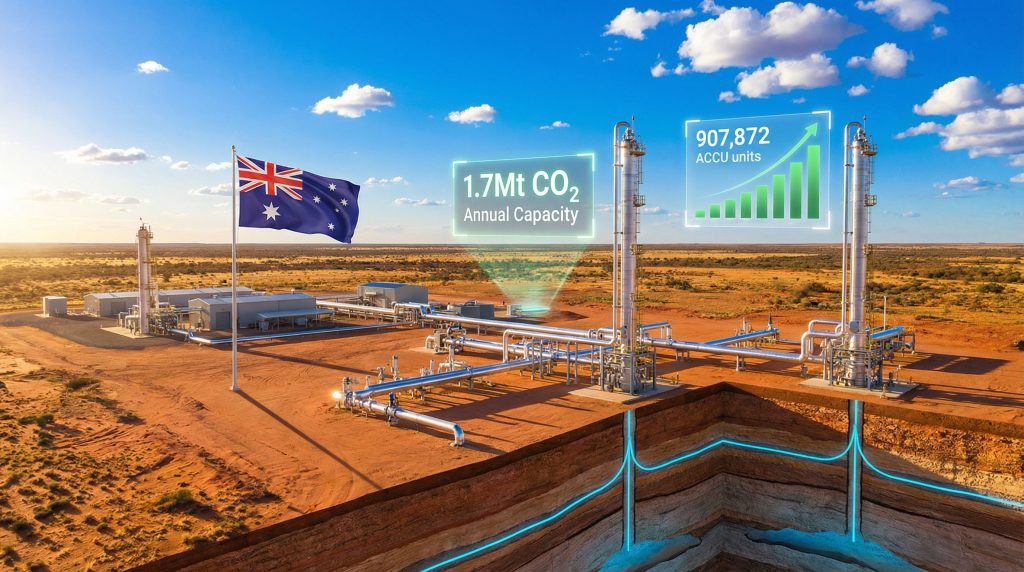
The carbon capture plan by Beach Energy exemplifies how major operators are responding to these challenges through direct intervention technologies. With 1.5 million tonnes of CO₂ successfully injected into subsurface formations during the first half of 2026, the company has demonstrated operational feasibility at commercial scales.
Carbon pricing mechanisms currently being implemented across Australian jurisdictions create direct financial incentives for CCS deployment. Furthermore, energy companies that fail to implement effective carbon management strategies face exposure to escalating carbon tax liabilities, potentially affecting profit margins by 15-25% over the next five years.
Cooper Basin's Strategic Importance to National Energy Security
The Cooper Basin's geological characteristics provide optimal conditions for long-term carbon storage, with depleted gas reservoirs offering proven containment capabilities. These formations have successfully held hydrocarbons for millions of years, indicating structural integrity suitable for CO₂ sequestration over similar timeframes.
Existing pipeline networks connecting production facilities to processing plants reduce infrastructure development costs by approximately $200-400 million compared to greenfield CCS projects. This connectivity advantage positions Cooper Basin operations as early movers in commercial-scale carbon management, aligning with broader industry innovation trends driving operational efficiency.
Key Infrastructure Advantages:
- Established wellhead infrastructure requiring minimal modification for CO₂ injection
- High-pressure pipeline systems capable of handling compressed CO₂ streams
- Proximity to major gas processing facilities generating concentrated CO₂ streams
- Geological monitoring systems already in place from decades of hydrocarbon production
- Skilled workforce familiar with subsurface injection technologies
Why Are Energy Companies Investing Billions in Underground CO₂ Storage?
Technical Feasibility Assessment Framework
Successful carbon storage requires specific geological conditions including adequate reservoir capacity, appropriate rock porosity, and effective caprock sealing. Cooper Basin formations demonstrate porosity rates of 12-18% and permeability levels suitable for sustained CO₂ injection at industrial scales.
Reservoir capacity calculations indicate potential storage volumes exceeding 50 million tonnes across multiple formations, providing decades of sequestration capability for regional emissions sources. Additionally, advanced drilling technology enables precise CO₂ injection through 4D seismic surveys and downhole pressure sensors for real-time verification of CO₂ plume behaviour.
Critical Technical Parameters:
- Injection depths of 1,500-3,000 metres ensuring CO₂ remains in supercritical phase
- Formation temperatures of 60-120°C maintaining optimal storage conditions
- Caprock thickness exceeding 50 metres providing effective containment
- Multiple injection zones allowing operational flexibility and risk mitigation
Financial Returns from Carbon Credit Generation
The Australian Carbon Credit Unit (ACCU) market provides direct monetisation pathways for verified carbon storage activities. Current ACCU pricing ranges from $15-35 per tonne CO₂, creating revenue streams that can offset CCS operational costs over 25-year crediting periods.
| Revenue Component | Annual Value (AUD) | 25-Year Total |
|---|---|---|
| ACCU Generation (1.5Mt) | $22.5-52.5 million | $562.5M-1.31B |
| Tax Credit Optimisation | $8-12 million | $200-300 million |
| Enhanced Oil Recovery | $5-15 million | $125-375 million |
| Total Revenue Potential | $35.5-79.5 million | $887.5M-1.99B |
Cost-benefit analyses demonstrate positive net present value for CCS projects when ACCU prices exceed $18 per tonne CO₂. Current market conditions suggest sustained pricing above this threshold, supporting long-term project economics that align with investment strategy insights for energy sector portfolios.
How Do Joint Venture Partnerships Accelerate CCS Development?
Santos-Beach Energy Collaboration Model
Strategic partnerships between major energy producers enable risk sharing and capital optimisation for large-scale CCS projects. The carbon capture plan by Beach Energy benefits from technical expertise sharing with Santos, Australia's second-largest gas producer, as highlighted in recent innovation expo insights.
Operational responsibilities are typically allocated based on each partner's core competencies, with Beach Energy managing reservoir engineering whilst Santos contributes processing facility expertise. This division of responsibilities reduces project execution risks and accelerates deployment timelines.
Partnership Benefits:
- Shared capital expenditure reducing individual company exposure
- Combined technical capabilities enhancing project success probability
- Diversified revenue streams from multiple CO₂ sources
- Enhanced regulatory compliance through shared expertise
- Improved access to specialised equipment and services
Risk Distribution Across Multiple Stakeholders
Joint venture structures enable distribution of geological, operational, and regulatory risks across multiple entities. Each partner maintains limited liability exposure whilst participating in potential upside from successful carbon storage operations.
Capital expenditure allocation typically follows 60/40 or 70/30 splits based on asset contribution and operational responsibilities. Consequently, performance guarantees ensure each partner meets specific operational benchmarks, maintaining project integrity and timeline adherence.
What Are the Long-Term Implications for Australia's Gas Export Industry?
Maintaining LNG Competitiveness in Global Markets
International LNG buyers increasingly demand carbon intensity certifications, with premium pricing available for verified low-carbon gas products. Australian producers implementing CCS technologies can achieve carbon intensity reductions of 15-25% compared to conventional production methods.
Global LNG Carbon Intensity Comparison:
- Australian LNG with CCS: 45-55 kg CO₂/GJ
- Conventional Australian LNG: 65-75 kg CO₂/GJ
- US Gulf Coast LNG: 55-65 kg CO₂/GJ
- Qatar LNG: 60-70 kg CO₂/GJ
- Russian Pipeline Gas: 70-80 kg CO₂/GJ
Premium pricing for certified low-carbon LNG ranges from $0.50-2.00 per MMBtu, creating additional revenue streams that can justify CCS investment costs. Moreover, long-term supply agreements increasingly include carbon intensity clauses, making CCS capabilities essential for contract renewals.
Domestic Gas Market Transformation
CCS-enabled gas facilities can provide low-carbon baseload power generation during renewable energy intermittency periods. This capability becomes increasingly valuable as Australia's electricity grid incorporates higher renewable energy percentages.
Industrial decarbonisation opportunities emerge when captured CO₂ can be utilised for enhanced oil recovery, synthetic fuel production, or chemical manufacturing. These applications create additional revenue streams beyond traditional carbon storage credits, as demonstrated by Beach Energy's Moomba CCS project.
Which Australian Basins Offer the Greatest CCS Expansion Potential?
Cooper Basin Geological Advantages
The Cooper Basin's extensive depleted reservoir network provides immediate access to proven storage formations with established containment capabilities. Over 60 years of hydrocarbon production has generated detailed geological data supporting accurate storage capacity assessments.
Existing infrastructure includes over 1,200 kilometres of pipeline networks and 150+ wellheads requiring minimal modification for CO₂ injection operations. This infrastructure density creates opportunities for hub development connecting multiple emission sources to centralised storage facilities.
Cooper Basin Storage Specifications:
- Total storage capacity: 50+ million tonnes CO₂
- Average injection depth: 2,000-2,800 metres
- Formation pressure: 200-280 bar
- Temperature range: 80-110°C
- Caprock integrity: Proven over geological timeframes
Otway Basin Development Opportunities
The carbon capture plan by Beach Energy includes Otway Basin assessment indicating 200,000 tonnes annual CO₂ storage capacity at individual sites. Victorian government policy frameworks provide additional financial incentives for CCS project development in this region.
Proximity to Melbourne's industrial emissions sources creates opportunities for multi-source capture networks reducing transportation costs and improving project economics. In addition, offshore storage potential in Bass Strait formations offers additional capacity expansion possibilities.
Emerging Basin Opportunities
Browse Basin offshore Western Australia presents opportunities for floating CCS platforms serving remote gas production facilities. Woodside's technical capabilities in deepwater operations could enable pioneering offshore storage projects.
Gippsland Basin benefits from decades of oil and gas production creating extensive geological databases. Existing Esso-BHP infrastructure provides potential partnership frameworks for rapid CCS deployment.
Industry Insight: Australia's total theoretical CCS capacity exceeds 300 million tonnes of CO₂, equivalent to storing the nation's entire annual emissions for multiple years whilst maintaining existing energy production levels.
The next major ASX story will hit our subscribers first
How Does CCS Technology Impact Energy Company Valuations?
ESG Investment Criteria and Capital Access
Institutional investors increasingly require demonstrable emissions reduction strategies before committing capital to energy sector investments. CCS capabilities provide quantifiable evidence of environmental stewardship, improving access to $2-5 billion in ESG-focused investment funds.
Green bond financing for CCS projects typically offers interest rate reductions of 0.5-1.5% compared to conventional debt instruments. These cost savings can improve project returns by 8-15% over typical 10-15 year financing periods.
Credit rating agencies now incorporate carbon management capabilities into energy company assessments. Companies with operational CCS projects typically receive 1-2 notch upgrades in environmental risk scoring, reducing borrowing costs across their entire debt portfolios.
Operational Cost Reduction Through Emissions Management
The carbon capture plan by Beach Energy demonstrates how proactive emissions management reduces regulatory compliance costs and provides operational flexibility during policy transitions. Companies avoiding carbon tax liabilities can reinvest savings into additional CCS capacity expansion.
Cost Optimisation Areas:
- Avoided carbon tax payments: $15-35 per tonne CO₂
- Reduced regulatory monitoring requirements
- Enhanced social licence to operate in sensitive regions
- Priority access to new exploration acreage
- Preferred partner status for government-backed projects
What Regulatory Framework Governs Australia's CCS Industry?
Commonwealth and State Approval Processes
The Petroleum and Greenhouse Gas Storage Act 2006 provides the primary regulatory framework for CCS operations, requiring comprehensive environmental impact assessments and ongoing monitoring protocols. State governments maintain additional oversight responsibilities for onshore storage projects.
Indigenous land use agreements become essential for projects affecting traditional country, requiring extensive community consultation and benefit-sharing arrangements. These agreements typically include employment targets, training programmes, and revenue sharing of 2-5% of project revenues.
Key Regulatory Requirements:
- Environmental Impact Statement with public consultation period
- Geological characterisation studies and risk assessments
- Indigenous cultural heritage surveys and agreements
- Water resource impact assessments and management plans
- Emergency response procedures and financial assurance bonds
International Standards and Verification Protocols
ISO 27914 carbon capture and storage standards establish technical requirements for monitoring, measurement, and verification of CO₂ storage projects. Third-party verification ensures ACCU eligibility and international carbon credit recognition.
Cross-border recognition of Australian carbon credits depends on United Nations Framework Convention on Climate Change protocols, creating potential for international carbon credit trading worth $50-100 per tonne CO₂ in premium markets. Furthermore, the Australian Government's research on carbon capture and storage provides comprehensive technical guidance for project developers.
Future Scenarios: Australia's CCS Landscape by 2035
High Adoption Scenario Analysis
Accelerated CCS deployment could achieve 50+ million tonnes annual CO₂ storage capacity across multiple basins by 2035. Hub development connecting petrochemical facilities, power generation, and industrial emissions sources creates economies of scale reducing storage costs to $10-15 per tonne CO₂.
Technology Integration Possibilities:
- Direct air capture facilities powered by renewable energy
- Blue hydrogen production using captured CO₂ for synthetic fuel manufacturing
- Circular carbon economy connecting multiple industrial sectors
- Export opportunities for CCS technology and engineering expertise
- International carbon credit trading generating $2-5 billion annually
Investment Implications for Energy Sector Stakeholders
The carbon capture plan by Beach Energy represents early-stage development of what could become Australia's $20-50 billion CCS industry by 2035. First-mover advantages in technology deployment and regulatory compliance create sustainable competitive positioning.
Portfolio Diversification Benefits:
- Revenue stream stability from 25-year carbon credit contracts
- Reduced stranded asset risk for gas production facilities
- Enhanced asset life extension through emissions management
- Technology licensing opportunities for international projects
- Strategic partnerships with carbon-intensive industries
Revenue projections suggest successful CCS operators could achieve 15-25% internal rates of return when combining carbon credit sales, enhanced oil recovery, and avoided carbon tax benefits. These returns compare favourably to traditional upstream gas investments whilst providing significant risk mitigation through diversified revenue streams.
Disclaimer: This analysis contains forward-looking statements based on current market conditions and regulatory frameworks. Actual results may vary significantly due to changes in carbon pricing, technological developments, or regulatory modifications. Investors should conduct independent due diligence and consult qualified financial advisors before making investment decisions.
Ready to Capitalise on Australia's Energy Transition Opportunities?
Discovery Alert's proprietary Discovery IQ model delivers real-time alerts on significant ASX mineral discoveries, including critical minerals essential for carbon capture technologies and renewable energy infrastructure development. Begin your 14-day free trial today to position yourself ahead of the market as Australia's energy sector transforms through underground carbon storage and related innovations.