August 22, 2026
Underground energy storage represents one of the most promising pathways for managing renewable energy intermittency at massive scale. While surface-level battery installations dominate current headlines, geological formations beneath our feet offer storage capacities measured in terawatt-hours rather than megawatt-hours. The physics of subsurface energy storage leverages natural geological properties that have remained stable for hundreds of millions of years, creating opportunities for grid-scale applications that dwarf conventional technologies.
The technical mechanics underlying underground storage systems operate through principles of pressure differential, thermal management, and controlled fluid dynamics. These systems transform excess renewable electricity into stored potential energy using compressed gases, elevated fluids, or chemical conversion processes. Furthermore, the scale differential becomes apparent when comparing surface installations requiring thousands of acres to underground facilities utilising vertical space hundreds of metres below ground level.
Geological Foundations for Energy Storage Applications
Salt Formation Characteristics and Structural Integrity
Ancient salt caverns for energy storage represent geological formations that developed during the Permian and Triassic periods, approximately 200-300 million years ago. These deposits formed through evaporation of inland seas, creating concentrated halite (rock salt) layers with exceptional structural properties. The crystalline structure of these formations demonstrates impermeability ratings of 10⁻¹⁸ to 10⁻²⁰ darcy, placing them among the most impermeable geological materials available for industrial applications.
Critical Geological Properties:
- Pressure tolerance: Salt formations withstand operational pressures of 40-80 bar without structural degradation
- Creep characteristics: Deformation rates of 0.5-2% annually under standard conditions
- Temperature stability: Underground environments maintain 10-20°C regardless of surface seasonal variations
- Self-healing capacity: Plastic deformation enables automatic sealing of minor fractures through recrystallisation
The mechanical properties of rock salt differ fundamentally from brittle rock formations like sandstone or granite. Salt exhibits plastic behaviour under stress, meaning gradual deformation rather than sudden fracturing. This plasticity provides crucial safety advantages for pressurised operations, as stress concentrations redistribute through plastic flow rather than creating catastrophic failure points.
Density and Load-Bearing Specifications:
| Property | Measurement | Engineering Significance |
|---|---|---|
| Material density | 2,160 kg/m³ | Excellent structural load capacity |
| Compressive strength | 20-40 MPa | Suitable for high-pressure applications |
| Thermal conductivity | 5.4 W/m·K | Stable temperature management |
| Porosity | <1% | Minimal gas diffusion pathways |
Cavern Development Through Solution Mining
Solution mining represents the primary method for creating artificial storage caverns within salt formations. This process involves controlled injection of fresh water to dissolve halite, creating precisely engineered void spaces. Water injection rates typically range from 500-2,000 cubic metres daily, with dissolution efficiency depending on temperature, pressure, and water chemistry parameters.
The resulting brine contains salinity concentrations of 250-300 grams per litre, representing approximately seven times ocean salinity levels. This concentrated brine serves as a valuable industrial byproduct, often contracted for chemical manufacturing processes including chlor-alkali production and de-icing applications. Consequently, the economic value of recovered brine helps offset cavern development costs, improving project economics significantly.
Development Timeline and Volume Specifications:
- Cavern creation period: 18-60 months depending on depth and target volume
- Typical operational volume: 300,000-500,000 cubic metres per cavern
- Maximum achievable volume: 750,000 cubic metres for large installations
- Leaching efficiency: 90-95% salt recovery before stability considerations require cessation
Temperature management during solution mining proves critical for optimising dissolution rates. Heated water at 30-40°C accelerates halite dissolution compared to ambient temperature injection. In addition, pressure equilibrium between injected water and surrounding salt formations requires careful monitoring to prevent uncontrolled cavern expansion or structural collapse.
When big ASX news breaks, our subscribers know first
Compressed Air Energy Storage Implementation
Technical Operating Parameters
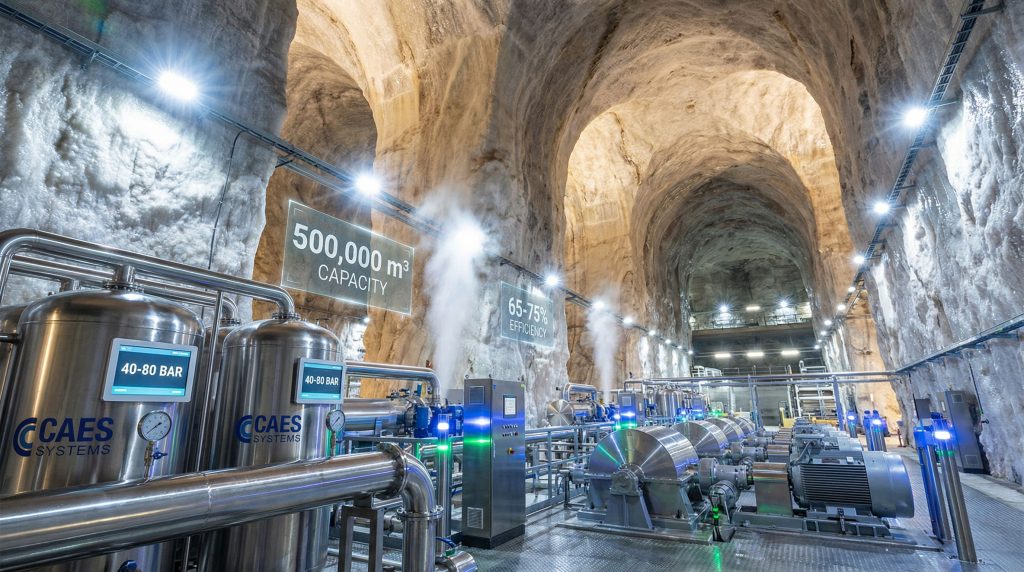
Compressed Air Energy Storage (CAES) systems utilise ancient salt caverns for energy storage by storing atmospheric air at elevated pressures during periods of excess renewable generation. These systems operate through multistage compression processes that require approximately 0.5-0.7 kWh of electricity to store 1 kWh of potential energy, with efficiency losses primarily occurring during compression heat rejection and expansion temperature management.
Verified Performance Specifications:
| Parameter | Operational Range | Commercial Examples |
|---|---|---|
| Power output capacity | 50-330 MW | Huntorf (321 MW), McIntosh (110 MW) |
| Storage duration | 4-26 hours | Varies by cavern volume and pressure rating |
| Round-trip efficiency | 70-75% | Advanced adiabatic systems achieve upper range |
| Operating pressure | 40-75 bar | Some installations reach 100 bar maximum |
The Jintan CAES facility in China, commissioned in 2013, represents the world's first non-supplemental adiabatic compressed air plant. This installation demonstrates zero-carbon operational profiles through integration with renewable energy sources, generating approximately 86 million kWh cumulatively since operations began. Furthermore, the facility provides peak shaving and grid balancing services whilst maintaining operational reliability over multiple daily cycles.
Thermodynamic Processes and Heat Management
CAES systems face significant technical challenges related to thermal energy management during compression and expansion cycles. Adiabatic CAES configurations capture compression heat for later use during expansion, improving overall system efficiency compared to diabatic systems that reject compression heat to the environment.
Heat Integration Strategies:
- Compression heat capture: Thermal energy storage systems maintain temperatures for expansion heating
- Inter-stage cooling: Temperature control during multistage compression prevents equipment damage
- Expansion preheating: Recovered or supplemental heat maximises turbine output during discharge
- Thermal buffering: Underground environments provide natural temperature stability
The expansion process requires careful temperature management to optimise energy recovery. Compressed air expansion through turbines generates maximum electricity when inlet temperatures reach 300-500°C, necessitating either recovered compression heat or supplemental heating systems.
Underground Pumped Storage Hydroelectric Systems
Dual-Cavern Configuration and Fluid Dynamics
Underground Pumped Storage Hydroelectric (UPSH) systems adapt conventional pumped storage principles to underground salt cavern environments. These installations utilise two caverns at different elevations, circulating brine between upper and lower chambers to store and release energy. The density differential between fresh water and saturated brine solutions provides additional pressure head compared to traditional surface pumped storage systems.
UPSH facilities achieve round-trip efficiencies of approximately 80%, matching performance levels of surface pumped storage installations. Efficiency depends primarily on pump and turbine technology rather than cavern geometry, making underground systems competitive with traditional surface installations whilst requiring significantly smaller surface footprints.
Engineering Specifications:
- Storage capacity range: 500-2,500 MWh per installation
- Facility footprint: 70-120 acres depending on site configuration
- Cavern separation: 200-500 metres vertical spacing for optimal pressure differential
- Brine circulation: Automated pressure control maintaining 2-10 bar differential
Operational Advantages and Technical Challenges
UPSH systems provide several operational benefits compared to surface alternatives, including reduced environmental impact, minimised land use requirements, and protection from weather-related operational disruptions. Underground installations eliminate surface reservoir evaporation losses and reduce environmental permitting complexity.
Technical Challenges:
- Corrosion management: High-salinity brine requires specialised materials and protective coatings
- Pressure control systems: Automated management prevents cavern damage during rapid cycling
- Thermal effects: Pumping operations generate heat requiring cooling system integration
- Cavern stability monitoring: Continuous structural assessment prevents operational hazards
The Gulf Coast region presents optimal geological conditions for UPSH development, with multiple projects under development utilising existing salt dome formations. These natural structures reduce cavern development timelines and costs compared to solution-mined installations.
Hydrogen Storage Applications in Salt Caverns
Storage Capacity and Leakage Prevention
Hydrogen storage in ancient salt caverns for energy storage represents a critical component of renewable energy sector coupling, connecting electricity generation to industrial processes and transportation applications. Salt caverns accommodate hydrogen storage volumes ranging from 2,000-8,000 tonnes per installation, with 6,000 tonnes representing typical commercial capacity for large-scale operations.
The impermeability characteristics of salt formations prove particularly advantageous for hydrogen storage because hydrogen molecules demonstrate extremely small size and high diffusion rates through porous rock formations. Salt caverns prevent these leakage pathways, achieving annual loss rates of only 0.1-0.5% under properly sealed conditions. For instance, the mineral exploration economics of these projects benefit significantly from such low operational losses.
Hydrogen-Cavern Compatibility Factors:
- Chemical stability: Hydrogen does not react with rock salt at storage conditions
- Pressure requirements: 25-60 bar operational range optimises storage density
- Material compatibility: Salt formations resist hydrogen embrittlement effects
- Indefinite storage: No degradation over extended storage periods
Production Integration and Withdrawal Systems
Electrolytic hydrogen production integration with salt cavern storage creates complete renewable energy storage cycles. Modern alkaline and PEM (Proton Exchange Membrane) electrolyzers convert electricity to hydrogen at 70-85% efficiency, with advanced systems achieving 90% efficiency levels. These production systems connect directly to renewable generation sources, storing excess capacity as chemical energy.
Withdrawal systems must account for hydrogen's low density characteristics, requiring specialised compression and pressure management equipment. Hydrogen extraction maintains cavern pressure through careful flow control, preventing structural damage whilst ensuring consistent supply rates for connected industrial processes. However, the geological logging importance becomes evident when monitoring these complex operations.
System Integration Components:
- Electrolyser connectivity: Direct renewable energy coupling for production optimisation
- Pressure management: Automated control systems maintain optimal storage conditions
- Purity maintenance: Gas treatment systems ensure hydrogen quality standards
- Safety systems: Comprehensive monitoring prevents operational hazards
Research from the University of Adelaide demonstrates Australia's significant potential for underground hydrogen storage, identifying multiple suitable salt formations across the continent.
Economic Considerations and Commercial Viability
Cost Structure Analysis and Revenue Streams
The economics of ancient salt caverns for energy storage depend heavily on cavern development costs, surface equipment specifications, and grid integration requirements. Cavern development typically represents 30-40% of total project costs, with solution mining duration significantly impacting overall economics. Surface equipment including compressors, turbines, and generators comprises 40-50% of capital requirements.
Capital Cost Breakdown:
| System Component | Percentage of Total | Cost Range ($/kW) |
|---|---|---|
| Cavern development | 30-40% | $240-800 |
| Surface equipment | 40-50% | $320-1,000 |
| Grid integration | 10-15% | $80-300 |
| Control systems | 5-10% | $40-200 |
Revenue generation opportunities include energy arbitrage (purchasing electricity during low-cost periods and selling during peak pricing), ancillary grid services (frequency regulation and voltage support), capacity payments for guaranteed availability, and carbon credit monetisation for zero-emission operations. Furthermore, the decarbonisation benefits contribute to the overall economic case for these projects.
Revenue Stream Analysis:
- Energy arbitrage: $20-80/MWh depending on market conditions
- Frequency regulation: $15-45/MW monthly capacity payments
- Spinning reserves: $5-15/MW monthly availability fees
- Carbon credits: $25-100/tonne CO₂ equivalent for verified emissions avoidance
Project Development Timelines and Risks
Underground energy storage projects require 5-10 year development timelines from initial geological assessment through commercial operation. Site characterisation and cavern development represent the longest phases, with geological surveys requiring 12-24 months and solution mining extending 18-60 months depending on target capacity.
Development Risk Factors:
- Geological uncertainty: Subsurface conditions may differ from surface surveys
- Regulatory approval: Environmental and safety permitting timelines vary significantly
- Grid interconnection: Transmission capacity and connection costs impact project viability
- Technology integration: Equipment procurement and installation coordination challenges
Financing structures typically require long-term power purchase agreements or capacity contracts to support project development. The capital-intensive nature of underground storage systems necessitates 15-25 year revenue certainty for commercial viability.
Global Implementation Examples and Performance Data
Operational Facilities and Demonstrated Reliability
The Huntorf CAES facility in Germany demonstrates over 45 years of operational reliability, utilising solution-mined caverns in Zechstein salt deposits. This 321 MW installation provides grid balancing services whilst maintaining equipment availability above 90% throughout its operational lifetime. The facility's longevity validates the fundamental technical approach for large-scale underground energy storage.
Germany's extensive salt cavern storage infrastructure supports both natural gas and emerging hydrogen storage applications. Hundreds of existing caverns provide proven operational experience, with transition strategies under development for renewable energy integration. European regulations increasingly support hydrogen storage development as critical infrastructure for achieving carbon neutrality targets.
International Performance Benchmarks:
- Huntorf (Germany): 45+ years operation, 321 MW, >90% availability
- McIntosh (Alabama): 33+ years operation, 110 MW, 26-hour discharge capability
- Jintan (China): 11+ years operation, 60 MW, adiabatic technology demonstration
- Multiple European facilities: Natural gas storage transitioning to hydrogen applications
Technology Advancement Pathways
Future developments in ancient salt caverns for energy storage include hybrid system integration, advanced thermal management, and smart grid connectivity. Pumped thermal energy storage (PTES) concepts leverage cavern thermal properties for additional efficiency improvements, whilst artificial intelligence optimisation maximises charging and discharging cycle performance. Moreover, evolving mining trends support these technological advancements.
Innovation Areas:
- Hybrid configurations: Multiple storage technologies within single installations
- Thermal integration: Advanced heat recovery and thermal storage systems
- Smart controls: AI-optimised operation based on grid conditions and pricing signals
- Modular expansion: Standardised cavern development for scalable capacity additions
Regulatory frameworks continue evolving to support underground energy storage deployment, with streamlined environmental permitting processes and standardised safety protocols under development. International technical standards facilitate cross-border technology transfer and project financing.
The next major ASX story will hit our subscribers first
Technical Challenges and Engineering Solutions
Operational Monitoring and Safety Systems
Underground energy storage operations require comprehensive monitoring systems to ensure cavern structural integrity, equipment performance, and operational safety. Real-time pressure, temperature, and flow monitoring prevents operational excursions that could damage cavern structures or surface equipment.
Cushion gas management represents a critical operational consideration for compressed air and hydrogen storage applications. Minimum gas volumes maintain cavern stability during operational cycling, whilst pressure monitoring prevents excessive drawdown that could compromise structural integrity.
Monitoring System Requirements:
- Pressure sensors: Continuous measurement at multiple cavern depths
- Temperature monitoring: Thermal profile tracking for operational optimisation
- Structural assessment: Periodic cavern volume and shape verification
- Gas composition: Purity monitoring for hydrogen and compressed air systems
- Flow measurement: Injection and withdrawal rate control
Infrastructure Integration and Grid Connectivity
Grid integration requirements for underground energy storage systems include high-voltage transmission connections, advanced control systems for rapid response, and maintenance access protocols for underground equipment. Power conditioning equipment manages voltage and frequency characteristics to match grid requirements during both charging and discharging operations.
Grid Integration Specifications:
- Transmission voltage: 69-500 kV depending on system size
- Response time: <10 seconds for grid balancing applications
- Ramp rates: 10-50% of rated capacity per minute
- Power factor: 0.95 leading/lagging for voltage support
Underground maintenance requirements present unique challenges compared to surface installations. Specialised equipment access, confined space safety protocols, and remote monitoring systems ensure operational reliability whilst minimising maintenance costs and downtime.
According to recent research by Geoscience Australia, Australia possesses numerous suitable geological formations for large-scale underground hydrogen storage applications.
Investment Considerations: Underground energy storage projects require careful evaluation of geological conditions, regulatory environment, and long-term market fundamentals. While capital costs remain higher than conventional technologies, the unique scale and duration advantages of salt cavern storage may justify premium pricing for specific grid applications.
The convergence of renewable energy deployment, grid modernisation requirements, and technological advancement continues driving interest in ancient salt caverns for energy storage applications. These underground systems provide proven pathways for achieving grid-scale energy storage capacity that surface technologies cannot economically match, positioning salt cavern storage as essential infrastructure for renewable energy integration. The energy transition insights demonstrate how these technologies support broader sustainability objectives whilst delivering commercial returns for investors and operators.
Ready to Capitalise on Energy Storage Investment Opportunities?
Discovery Alert's proprietary Discovery IQ model delivers real-time alerts on significant mineral discoveries across critical energy storage materials, instantly empowering subscribers to identify actionable opportunities ahead of the broader market. Begin your 14-day free trial today and secure your market-leading advantage in the rapidly evolving energy transition sector.