
July 9, 2026
When Volume Becomes the Enemy of Margin: Rethinking Underground Gold Mining Strategy
There is a persistent myth in the junior mining sector that bigger throughput always equals better returns. For decades, the volume-first mentality shaped how underground gold-silver operations were designed, staffed, and evaluated. Processing plants ran continuously, multiple mining fronts advanced simultaneously, and contractor armies expanded headcounts to match production ambitions. Then the pandemic arrived, stripped away the operational noise, and forced management teams to confront an uncomfortable question: was all that complexity actually generating sustainable margin, or simply generating activity?
The decision by Premier Gold Mines to terminate 40% of workers at the Mercedes mine in Mexico while simultaneously announcing a full operational restart is one of the most instructive examples of how a forced shutdown can be transformed into a deliberate strategic redesign. This is not simply a story about job losses. It is a case study in what modern underground mining economics looks like when margin discipline replaces volume maximisation as the primary operating philosophy.
When big ASX news breaks, our subscribers know first
Understanding "Restart Economics" in Underground Mining
When an underground mine exits care-and-maintenance, management faces a decision architecture that is rarely discussed in mainstream mining coverage. The default assumption is that a mine resumes operations at or near its previous production rate. In practice, the economics of restarting are far more nuanced.
Restart economics refers to the cost-benefit calculus that determines whether returning to nameplate capacity is actually the most value-accretive path. Key variables in this analysis include:
- The condition of underground workings and ventilation infrastructure after an extended halt
- The current ore inventory accessible from existing development versus the capital required to open new stoping fronts
- The market price of the target commodity relative to the mine's all-in sustaining cost (AISC) at various throughput levels
- The availability and cost of skilled labour in the local market post-shutdown
- The ore grade profile of accessible stopes versus development-stage zones
In many cases, a mine can generate superior margin per ounce at 60% of nameplate throughput compared to full-capacity operation, provided the lower-throughput model concentrates mining activity on higher-grade ore zones and eliminates the fixed cost overhead associated with running multiple simultaneous working faces.
This is precisely the logic underpinning the Mercedes restructuring. Rather than scrambling to restore the pre-pandemic operating model, management used the shutdown period to fundamentally reassess which elements of the previous structure were margin-accretive and which were simply operational inertia. Understanding drill results interpretation is essential context for evaluating the decisions that followed.
The Mercedes Mine: Operational Context and Pre-Restructuring Profile
A Jurisdiction With Deep Mining Roots
The Mercedes mine is an underground gold-silver operation located in the state of Sonora, Mexico, a jurisdiction with one of the longest continuous precious metals mining histories in North America. Sonora has produced gold and silver for centuries and hosts a mature mining services ecosystem, including experienced underground workforces, established regulatory frameworks, and proximity to major infrastructure corridors.
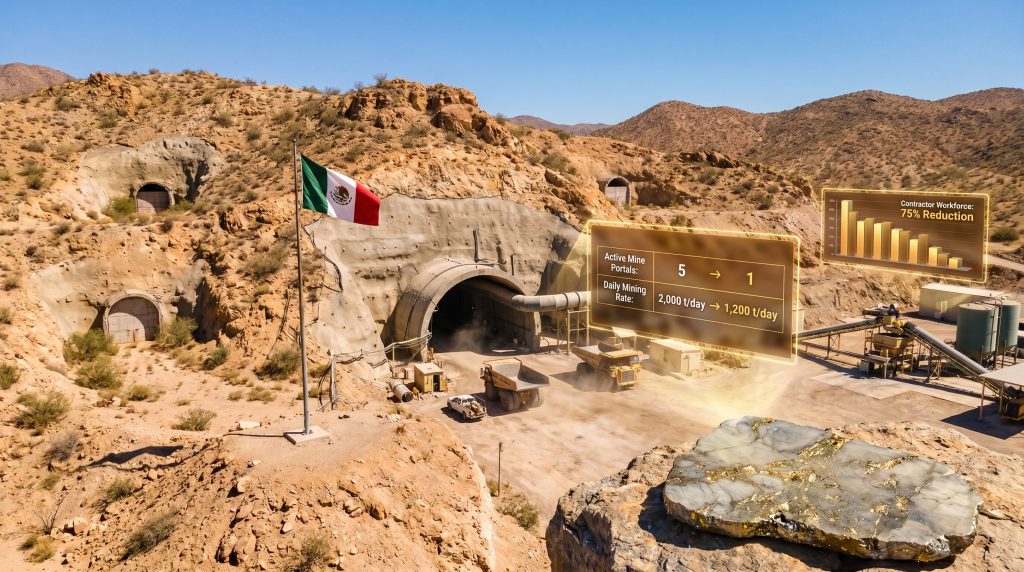
Before the pandemic-enforced shutdown, Mercedes operated across five active mine portals at a mining rate of 2,000 tonnes per day. The operation was processing ore continuously, a model that requires large, permanently deployed workforces and significant contractor support for development activities.
The mine was placed into care-and-maintenance at the end of the first quarter of 2020 as COVID-19 restrictions were implemented across Mexico. For most of the second quarter, activities remained halted entirely. When limited operations resumed in June 2020, only selective activities were permitted, including ore and waste development and delineation and exploration drilling, specifically to reduce the number of personnel on site at any given time.
Ore extracted during the June restart phase was stockpiled rather than processed, with processing only resuming in early July 2020. This phased reopening period, while operationally constrained, gave management approximately three months to evaluate the mine's economics from the outside in, an unusual luxury that most operating mines never receive.
The Four Structural Changes That Define the New Operating Model
The restructuring announced by Premier Gold Mines involves four interconnected operational changes that collectively represent a fundamental shift in production philosophy:
| Operational Parameter | Pre-Restructuring | Post-Restructuring | Net Change |
|---|---|---|---|
| Active Mine Portals | 5 | 1 | 80% reduction |
| Daily Mining Rate | 2,000 t/day | 1,200 t/day | 40% reduction |
| Employee Headcount | Baseline | 40% reduction applied | Significant downsizing |
| Mining Contractors | Baseline | 75% reduction applied | Major contractor exit |
| Processing Mode | Continuous throughput | Campaign-based rotation | Structural shift |
Each of these changes is interdependent. Consolidating from five portals to one eliminates the need for multiple simultaneous ventilation circuits, reduces equipment deployment complexity, and shrinks the number of active working faces requiring supervision and safety oversight. That consolidation directly enables the workforce reduction because fewer working faces require fewer miners, fewer equipment operators, and fewer surface support personnel.
The 75% contractor reduction is particularly revealing. In underground mining, contractors are primarily engaged for two activity types: development work (driving new access tunnels, ramps, and raises) and drilling programs. A 75% reduction in contractors signals a deliberate decision to slow the pace of mine development, concentrating near-term production on already-developed stopes rather than aggressively advancing new working areas.
Why Contractor Reductions Signal More Than Cost Cutting
The distinction between employee reductions and contractor reductions carries significant operational meaning that investors and analysts sometimes overlook. Furthermore, the implications extend well beyond headline workforce numbers:
- Employee reductions (40%) affect core operational personnel: miners, processing plant operators, maintenance technicians, and supervisory staff. These reductions reflect a genuine downsizing of the mine's ongoing production capability.
- Contractor reductions (75%) primarily affect development and drilling activities. Their removal is a deliberate signal that the mine is entering a production consolidation phase rather than a development expansion phase.
Together, these two actions communicate a coherent strategic message: the mine is pivoting from growth-oriented development to margin-oriented production, extracting value from existing ore inventory rather than investing capital in opening new mining areas before exploration success has been confirmed.
Campaign-Based Processing: A Cost Management Tool With Hidden Complexity
One of the less-discussed elements of the Mercedes restructuring is the shift from continuous processing to campaign-based processing. This operational mode is common in smaller and mid-tier operations but is less frequently explained in accessible terms.
In a continuous processing model, the mill runs 24 hours a day, seven days a week, regardless of ore availability fluctuations. This maximises processing plant utilisation but requires continuous staffing across all shifts and creates energy and reagent costs that are difficult to reduce during periods of lower ore feed.
Campaign-based processing works differently. Ore is stockpiled at surface until sufficient inventory has accumulated to justify a concentrated processing run. The plant then operates intensively for a defined campaign period, aligned with crew rotation cycles and ore availability, before pausing while the next stockpile builds.
The advantages of this approach include:
- Reduced energy consumption per tonne processed due to optimised plant loading during campaigns
- Lower reagent costs through more controlled dosing during planned runs
- Simplified labour scheduling aligned with crew rotation patterns
- Reduced wear on processing equipment through managed start-stop cycles
However, the risks that require careful management include:
- Ore stockpiles exposed to weather can experience grade degradation in some mineralogical settings
- Processing gaps introduce batch-to-batch variability in recovery rates if ore blending is not carefully controlled
- Delays in stockpile accumulation can extend campaign intervals, creating cash flow timing variability
Campaign-based processing is best understood as a cash flow management tool rather than simply a cost reduction mechanism. It trades processing continuity for cost predictability, which is a rational trade-off when throughput has been deliberately reduced.
Dilution Management: The Hidden Value Driver in Portal Consolidation
One aspect of the Mercedes restructuring that deserves specific attention is the emphasis on dilution reduction as a core objective of the single-portal operating model. Dilution in underground mining refers to the inclusion of waste rock or lower-grade material within the ore stream, which reduces the average grade of material fed to the processing plant.
In a five-portal operation running at 2,000 tonnes per day, the challenge of maintaining consistent supervision quality across multiple simultaneous working faces is significant. Ground conditions, stope geometry, and blast pattern compliance all influence dilution outcomes, and with multiple active fronts operating concurrently, maintaining uniform quality control becomes operationally demanding.
Consolidating to a single portal with a reduced but permanently employed core workforce allows for enhanced supervision density on the active stoping areas. This concentrated oversight directly translates to improved blast pattern compliance, tighter ore-waste boundary management, and higher average feed grades to the processing plant. Consequently, cut-off grade economics become far more favourable under this operating structure.
The economics of dilution control are often underappreciated. A 1-gram-per-tonne improvement in mill feed grade at a 1,200-tonne-per-day operation can add meaningful ounce-equivalent production without any increase in tonnes mined or processed. In a gold-silver operation, where both metals contribute to revenue, improving feed grade quality can have a disproportionate impact on AISC per ounce.
The next major ASX story will hit our subscribers first
Three Scenarios for Mercedes: Where Does the Operation Go From Here?
The restructuring creates a genuine strategic fork. The direction the mine takes over the subsequent 12 to 24 months depends almost entirely on the results of ongoing exploration and delineation drilling programs.
Scenario 1: Exploration Success Validates Capacity Expansion
The phased restart plan explicitly includes completion of access ramps to the Diluvio West and Lupita Extension stoping areas, alongside delineation and definition drilling at Marianas, Diluvio West, and San Martin. If these programs return sufficient high-grade ore inventory, management has a credible pathway to reopen additional portals and increase throughput back toward the 2,000-tonne-per-day nameplate capacity.
This scenario is the most value-accretive outcome for shareholders, as it would combine the improved cost structure of the restructured model with higher production volumes. In addition, interpreting drill results correctly will be critical to understanding whether that expansion is genuinely justified.
Scenario 2: Lean Operations Become the Permanent Model
If exploration drilling delivers incremental rather than transformative results, the 1,200-tonne-per-day single-portal model may become structurally permanent. This is not necessarily a negative outcome. Higher ore grades achieved through improved dilution control, combined with the lower fixed cost base, could generate comparable or superior AISC per ounce metrics compared to the previous higher-throughput model.
This scenario positions Mercedes as a smaller but more margin-efficient operation, a profile that can be attractive to acquirers in a consolidating gold sector. A definitive feasibility study at this stage could clarify the long-term economic viability of this leaner configuration.
Scenario 3: Exploration Disappointment Triggers Strategic Review
If exploration drilling across the Marianas, Diluvio West, and San Martin zones fails to delineate sufficient ore inventory to sustain even the reduced 1,200-tonne-per-day operation at acceptable grades, the strategic options narrow considerably. An extended care-and-maintenance period or outright asset divestiture becomes more probable in this scenario.
Investor Note: The Mercedes restructuring embeds a clear exploration-dependent optionality structure. The reduced operating model is viable as a standalone business, but the full value proposition of the restructuring decision is only realised if exploration success at the named target zones justifies phased production expansion. Investors should treat ongoing exploration drilling results from Marianas, Diluvio West, and San Martin as the primary value catalyst to monitor.
What the Mercedes Case Reveals About Mining in Post-Pandemic Latin America
The broader significance of Premier terminates 40% of workers at Mercedes mine in Mexico extends beyond a single asset restructuring decision. It reflects a structural shift in how mid-tier and junior miners are approaching operational design in Latin American jurisdictions following the pandemic.
| Strategic Dimension | Pre-2020 Norm | Post-2020 Shift |
|---|---|---|
| Production philosophy | Volume maximisation | Margin optimisation |
| Portal and face count | Multiple simultaneous | Selective consolidation |
| Contractor dependency | High, flexibility-driven | Reduced, cost-driven |
| Processing approach | Continuous 24/7 | Campaign-based batching |
| Workforce composition | Contractor-heavy | Permanent core staff |
| Exploration priority | Growth-oriented development | Grade delineation focus |
Mexico's labour law environment adds a layer of complexity to workforce restructuring decisions that is often underweighted in external analysis. Mexico's Federal Labour Law imposes statutory severance obligations for terminated employees that can be substantial, typically including three months of integrated salary plus 20 days per year of service. In Sonora's established mining communities, these obligations can represent meaningful near-term cash costs for the operating company.
The pandemic context provided a legally and socially navigable framework for implementing workforce reductions that would have been significantly more contentious under normal operating conditions, not because regulations changed, but because the external shock created shared understanding of the economic necessity driving the decisions. However, ongoing production updates suggest the site continues to evolve under its restructured operational model.
Frequently Asked Questions
What is the Mercedes mine and where is it located?
The Mercedes mine is an underground gold-silver operation situated in Sonora, Mexico. Sonora is one of Mexico's most historically significant precious metals mining states and hosts numerous active gold and silver operations alongside a well-developed mining services sector.
Why did Premier Gold Mines reduce its workforce by 40%?
The reduction was implemented as part of a deliberate operational restructuring designed to improve production margins following an extended care-and-maintenance period caused by COVID-19 pandemic restrictions. The new operating model, which consolidates production to a single portal, reduces daily throughput, and adopts campaign-based processing, requires significantly fewer personnel to execute effectively.
What is the difference between the employee and contractor reductions?
The 40% employee reduction reflects a genuine downsizing of core operational capacity, affecting miners, plant operators, maintenance crews, and supervisory staff. The 75% contractor reduction primarily affects development and drilling activities, signalling a deliberate slowdown in mine development pace rather than a reduction in ongoing production activity.
How does campaign-based processing work?
Rather than operating the processing plant on a continuous 24/7 basis, ore is stockpiled until sufficient inventory accumulates, then processed in concentrated campaign runs aligned with crew rotation cycles. This approach reduces fixed operating costs but requires disciplined stockpile management to avoid processing gaps.
What would need to happen for Mercedes to return to full production capacity?
Successful delineation drilling at the Marianas, Diluvio West, and San Martin zones would need to demonstrate sufficient high-grade ore inventory to justify reopening additional portals and increasing throughput back toward the 2,000-tonne-per-day nameplate capacity.
Key Takeaways
- Forced shutdowns can function as strategic resets, creating rare windows to implement structural operational changes without the friction of active production pressure
- The 40% employee and 75% contractor reductions are complementary signals of a deliberate shift from volume-driven throughput to margin-driven selectivity
- Consolidating from five portals to one is a high-conviction bet on dilution control and ore quality over raw production volume
- Campaign-based processing reduces fixed costs but introduces stockpile management complexity that requires rigorous operational discipline
- Exploration success at Marianas, Diluvio West, and San Martin is the critical variable determining whether Mercedes returns to nameplate capacity or stabilises as a permanently leaner operation
- The broader lesson for junior miners operating in Latin America is that the pandemic created a template for margin-focused operational redesign that continues to influence how producers approach asset management in volatile commodity price environments
This article is intended for informational and educational purposes only and does not constitute financial or investment advice. Mining operations involve significant operational, geological, and market risks. Past production profiles are not indicative of future results. Readers should conduct independent due diligence before making investment decisions.
Want to Stay Ahead of the Next Major ASX Mineral Discovery?
Discovery Alert's proprietary Discovery IQ model delivers real-time alerts on significant ASX mineral discoveries, instantly translating complex geological data into actionable investment insights — explore the historic returns major discoveries have generated to understand what's possible, then begin your 14-day free trial at Discovery Alert to position yourself ahead of the broader market.