May 22, 2026
Underground Mining Infrastructure: The Foundation of Copper Production Success
Deep underground copper extraction requires sophisticated thermal and ventilation management systems that become increasingly critical as mining operations extend to greater depths. Modern copper mines operating at depths exceeding 500 meters face exponential increases in geothermal heat, requiring advanced cooling infrastructure to maintain safe working conditions and operational efficiency.
Australian copper operations demonstrate unique geological characteristics that distinguish them from copper deposits in other global regions. The country's copper mineralization often occurs in complex geological formations where structural controls and hydrothermal alteration create high-grade ore zones at significant depths, necessitating specialised mining approaches and infrastructure investments.
When big ASX news breaks, our subscribers know first
Operational Constraints Restricting Australian Copper Mine Performance
Ventilation System Deficiencies in Deep Underground Operations
The CSA copper mine in New South Wales faces fundamental infrastructure limitations that restrict access to deeper, higher-grade ore bodies. Current ventilation capacity cannot support the air flow requirements necessary for safe mining operations below existing operational levels.
Underground copper mining operations require minimum air flow rates of approximately 200-300 cubic feet per minute per person working underground, with additional ventilation capacity needed for equipment operation and heat dissipation. As mining depths increase, these requirements escalate significantly due to:
- Increased geothermal temperature gradients (typically 1°C per 30-40 meters of depth)
- Higher equipment heat generation from extended haulage distances
- Compressed air system heat contributions
- Blasting fume evacuation requirements at depth
Critical Infrastructure Investment Categories
| Investment Priority | Technical Requirement | Implementation Timeline | Capital Intensity |
|---|---|---|---|
| Primary ventilation fans | 500+ CFM capacity upgrade | 12-18 months | High |
| Thermal management systems | Active cooling for 35°C+ zones | 18-24 months | Very High |
| Air distribution networks | Underground ductwork expansion | 6-12 months | Medium |
| Emergency ventilation systems | Redundant safety infrastructure | Ongoing | High |
Thermal Management Limitations Affecting Mining Flexibility
Inadequate thermal insulation systems prevent efficient mining operations in high-temperature underground zones where geothermal conditions exceed safe working parameters. This constraint directly limits the mining flexibility required to optimise ore extraction sequences and maintain consistent production output.
The technical challenge involves managing rock wall temperatures that can exceed 40°C in deeper mining areas, combined with humidity levels that create dangerous working conditions without proper environmental controls. Advanced thermal management solutions require:
- Refrigeration plants capable of cooling large volumes of underground air
- Insulated ventilation ducting to prevent heat gain during air distribution
- Cooling water circulation systems for equipment and workspace temperature control
- Personal protective equipment upgrades for workers in high-temperature environments
Strategic Diversification Beyond Traditional Gold Mining Operations
Geological Limitations Driving Portfolio Transformation
South African gold mining operations face increasingly challenging geological conditions as deposits extend to depths exceeding 3,000 meters below surface. These extreme depths create operational cost structures that significantly impact profitability and long-term viability.
The fundamental challenge involves accessing gold ore bodies at depths where:
- Rock temperatures approach 55-65°C requiring massive cooling infrastructure
- Seismic activity and rock stability become critical safety concerns
- Labour productivity decreases due to harsh working conditions
- Equipment maintenance costs escalate due to extreme operational environments
Harmony Gold Australian copper mine revamp represents a strategic pivot away from these challenging geological conditions toward copper assets with more favourable operational parameters and infrastructure requirements.
Copper Market Fundamentals Supporting Geographic Expansion
Furthermore, global copper supply forecast continues expanding driven by electrification trends across multiple industrial sectors. Electric vehicle production requires approximately 80-100 kilograms of copper per vehicle, compared to 25-30 kilograms for internal combustion engine vehicles.
Power grid modernisation initiatives worldwide create additional copper consumption drivers through:
- Transmission line infrastructure upgrades requiring high-conductivity copper cables
- Renewable energy integration demanding extensive electrical distribution networks
- Energy storage systems incorporating copper-intensive battery and power electronics
- Smart grid technologies utilising copper-based communication and control systems
Market analysts project copper supply deficits emerging through 2030 as demand growth outpaces new mine development timelines, creating favourable pricing environments for established producers with expansion capabilities.
Technical Infrastructure Improvements for Enhanced Production Capacity
Short-Term Operational Enhancement Strategies
Immediate infrastructure improvements focus on addressing the most critical operational bottlenecks that restrict current production capacity. These interventions target existing systems rather than comprehensive redesign approaches.
Primary Ventilation System Upgrades
- Installation of additional primary ventilation fans with combined capacity exceeding 1,000 CFM
- Optimisation of underground air distribution pathways to eliminate circulation dead zones
- Implementation of automated ventilation control systems for dynamic airflow management
- Integration of real-time air quality monitoring throughout the mine workings
Thermal Regulation Infrastructure
Underground cooling systems require sophisticated engineering solutions to manage heat loads effectively while maintaining energy efficiency. The technical approach involves:
- Centralised refrigeration plants sized for peak summer operational demands
- Chilled water circulation systems with redundant pumping capacity
- Heat recovery systems to optimise energy utilisation efficiency
- Zone-based temperature control allowing targeted cooling in active mining areas
Medium-Term Infrastructure Development Programs
Comprehensive infrastructure redesign initiatives target fundamental system improvements that unlock access to higher-grade ore zones currently inaccessible due to operational constraints.
Mining Method Optimisation for Constrained Environments
Underground mining operations in thermally challenging environments require specialised extraction techniques that minimise heat generation while maximising ore recovery efficiency. Advanced mining methods include:
- Mechanised cut-and-fill operations using remote-controlled equipment
- Sublevel stoping with engineered cooling systems integrated into extraction sequences
- Drift-and-fill techniques optimised for high-temperature working conditions
- Automated ore handling systems reducing human exposure to extreme environments
Processing Efficiency Enhancement Initiatives
Ore processing infrastructure improvements target throughput optimisation while maintaining concentrate quality standards. Moreover, mining industry innovation continues to drive technical enhancements that focus on:
- Crushing circuit capacity expansion to handle increased ore tonnage
- Flotation system optimisation for complex copper-sulfide mineralogy
- Concentrate dewatering efficiency improvements reducing shipping costs
- Tailings management system upgrades for increased processing volumes
Comparative Analysis of Harmony's Australian Copper Portfolio
Eva Copper Project Development Timeline and Specifications
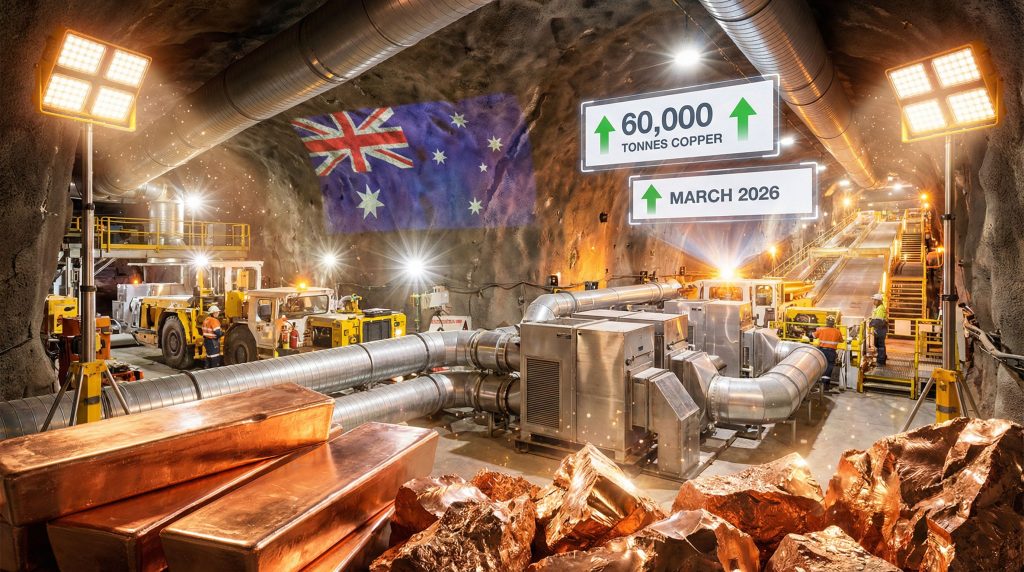
The Eva copper project in Queensland represents Harmony's largest Australian copper development with planned annual production of 60,000 tonnes copper and 19,000 ounces gold. This dual-commodity operation provides revenue diversification and operational risk mitigation compared to single-commodity mining ventures.
Eva Project Technical Specifications
| Development Phase | Timeline | Production Target | Infrastructure Requirement |
|---|---|---|---|
| Construction initiation | Q2 2026 | – | $1.6B capital expenditure |
| Processing plant commissioning | Q4 2027 | 50% capacity | Primary infrastructure complete |
| Full production achievement | Q2 2028 | 60,000 tonnes Cu/year | All systems operational |
| Mine life extension | 2043+ | Consistent output | Ongoing expansion potential |
The Eva project utilises open-pit mining methods that avoid the thermal and ventilation challenges associated with deep underground operations, providing operational simplicity and cost advantages over underground mining alternatives. Thiess wins $700 million Eva copper deal with Harmony Gold, signifying major contract awards for project development.
Wafi-Golpu Joint Venture Permitting Progress
The Papua New Guinea gold-copper project operates through a joint venture structure with Newmont Corporation, combining technical expertise and financial resources for large-scale development. Current project status remains dependent on special mining licence approval from PNG regulatory authorities.
Regulatory permitting in Papua New Guinea involves complex environmental, social, and economic impact assessments that can extend approval timelines significantly. Key permitting considerations include:
- Environmental impact mitigation plans for tropical ecosystem protection
- Community engagement protocols with local landowner groups
- Infrastructure development agreements with national and regional governments
- Economic benefit-sharing arrangements covering royalties and employment commitments
Financial Analysis of Infrastructure Investment Requirements
Capital Expenditure Breakdown for CSA Revamp
The $1.03 billion acquisition cost for CSA represents the baseline investment, with additional revamp capital requirements yet to be fully quantified by Harmony management. Infrastructure improvement costs typically represent 20-40% of acquisition value for constrained mining operations.
Estimated Capital Allocation Categories
- Ventilation infrastructure: 35-45% of revamp budget
- Thermal management systems: 25-35% of revamp budget
- Mining equipment upgrades: 15-20% of revamp budget
- Safety and environmental systems: 10-15% of revamp budget
Investment Recovery Timeline and Risk Mitigation
Harmony Gold Australian copper mine revamp follows a phased investment approach designed to minimise capital exposure while validating technical solutions before full-scale implementation. This strategy reduces execution risk and allows for operational learning during the improvement process.
Phased Investment Milestones
- Phase 1 (2026): Critical infrastructure assessment and short-term improvements
- Phase 2 (2027): Major ventilation and thermal system installations
- Phase 3 (2028): Production optimisation and capacity expansion initiatives
- Phase 4 (2029+): Long-term efficiency improvements and expansion opportunities
The phased approach allows Harmony to validate technical solutions and operational improvements before committing full revamp capital, reducing technical and financial risks associated with large-scale infrastructure projects.
The next major ASX story will hit our subscribers first
Production Optimisation Timeline and Performance Indicators
Operational Improvement Milestone Schedule
Harmony management plans to announce formal production targets and investment timelines during March 2026 half-year results reporting, providing detailed guidance on operational improvements and capital expenditure requirements. Harmony Gold says newly acquired Australian copper mine requires two-year revamp, as confirmed by company statements.
Quarterly Milestone Progression
- Q1 2026: Formal production outlook and revamp capital guidance announcement
- Q2-Q3 2026: Primary ventilation system upgrade completion and commissioning
- Q4 2026: Thermal management system installation and initial testing phases
- Q1-Q2 2027: Integrated system optimisation and production capacity validation
- Q3-Q4 2027: Full operational capacity achievement and sustained production levels
Key Performance Indicators for Operational Success
Monitoring criteria for successful infrastructure improvements include both production metrics and operational efficiency measures that demonstrate systematic improvements across all mining operations.
Primary Performance Metrics
- Monthly copper production tonnage: Baseline 3,333 tonnes/month (40,000 annual target)
- Operational cost per tonne: Target 15-25% reduction from current levels
- Equipment utilisation rates: Improvement from constrained operational capacity
- Safety incident frequency: Reduction through improved environmental controls
- Energy efficiency ratios: Optimisation of cooling and ventilation power consumption
Strategic Portfolio Integration and Market Positioning
Geographic Risk Distribution Across Multiple Jurisdictions
Harmony's Australian copper portfolio provides operational diversification across three distinct projects with different development timelines, reducing single-asset dependence and creating multiple revenue streams from copper production.
Portfolio Risk Mitigation Benefits
- Operational risk spreading: CSA, Eva, and Wafi-Golpu projects operate in different geological and regulatory environments
- Production timeline staggering: Sequential project development maintains consistent capital deployment
- Technical expertise development: Copper mining experience applicable across multiple operations
- Market positioning enhancement: Established copper producer status supporting future acquisition opportunities
Australian Copper Market Competitive Advantages
CSA's high-grade copper mineralisation provides significant advantages over lower-grade operations that require higher tonnage processing to achieve equivalent copper production. However, copper & uranium investments in high-grade deposits typically demonstrate:
- Processing cost advantages: Lower tonnage requirements for equivalent copper output
- Transportation efficiency: Higher-grade concentrates reduce shipping costs per copper unit
- Infrastructure optimisation: Smaller processing facilities with lower capital and operating costs
- Environmental footprint reduction: Reduced waste rock and tailings generation per copper tonne produced
Technical Lessons for Mining Infrastructure Revitalisation
Due Diligence Importance in Acquisition Analysis
The CSA acquisition demonstrates critical importance of comprehensive technical due diligence for mining asset acquisitions, particularly regarding infrastructure constraints that may not be immediately apparent during initial asset evaluation.
Essential Assessment Categories
- Infrastructure capacity analysis: Detailed evaluation of all support systems relative to production targets
- Hidden constraint identification: Discovery of operational bottlenecks limiting production flexibility
- Capital requirement estimation: Accurate projections for post-acquisition improvement investments
- Timeline projection methodology: Realistic assessment of improvement implementation schedules
Industry Applications for Similar Infrastructure Challenges
Underground mining operations worldwide face similar infrastructure constraints when accessing deeper, higher-grade ore zones. Consequently, data-driven mining operations implemented at CSA provide valuable case study information for other mining operations addressing comparable challenges.
Transferable Technical Solutions
- Modular ventilation system design: Scalable infrastructure allowing incremental capacity expansion
- Integrated thermal management: Comprehensive cooling solutions optimised for specific geological conditions
- Phased implementation strategies: Risk mitigation through sequential infrastructure improvements
- Performance monitoring systems: Real-time operational data supporting optimisation decisions
Conclusion: Infrastructure Investment as Strategic Competitive Advantage
The Harmony Gold Australian copper mine revamp represents a comprehensive infrastructure modernisation initiative that addresses fundamental operational constraints limiting production capacity and mining flexibility. Technical improvements targeting ventilation and thermal management systems will unlock access to higher-grade ore zones currently inaccessible due to environmental limitations.
Success metrics for this $1.03 billion strategic investment will become apparent through systematic operational improvements over the 24-month revamp timeline, with formal production guidance expected in March 2026. The phased approach reduces technical risk while validating solutions before full capital commitment.
Infrastructure revitalisation provides competitive advantages through enhanced operational flexibility, improved safety conditions, and access to previously constrained ore reserves. Furthermore, gold & copper exploration improvements position CSA as an optimised copper producer within Harmony's diversified Australian portfolio alongside the Eva development project and Wafi-Golpu joint venture.
The technical lessons learned from CSA infrastructure improvements will inform future mining asset acquisitions and operational optimisation initiatives across Harmony's expanding copper production portfolio, establishing systematic approaches for similar infrastructure challenges in underground mining environments.
Ready to Capitalise on the Next Major Copper Discovery?
Discovery Alert's proprietary Discovery IQ model delivers real-time alerts on significant ASX copper discoveries, instantly empowering subscribers to identify actionable opportunities ahead of the broader market. Understand why major mineral discoveries can lead to substantial returns by exploring Discovery Alert's dedicated discoveries page, showcasing historic examples of exceptional outcomes, then begin your 14-day free trial today to position yourself ahead of the market.