August 7, 2026
Understanding African Energy Infrastructure Through Continental Integration
Africa's natural gas sector stands at a transformative juncture where cross-border energy partnerships could reshape the continent's economic landscape. The development of transcontinental pipeline systems represents more than mere infrastructure projects – they signal a fundamental shift toward regional energy transition analysis that could influence global gas markets for decades to come.
Strategic energy cooperation across Sahel nations demonstrates how diplomatic relationships directly impact large-scale infrastructure viability. When neighbouring countries align their energy policies, the resulting synergies can unlock previously inaccessible hydrocarbon resources while creating new export pathways to international markets.
When big ASX news breaks, our subscribers know first
What Is the Trans-Saharan Gas Pipeline and Why Does It Matter for Africa's Energy Future?
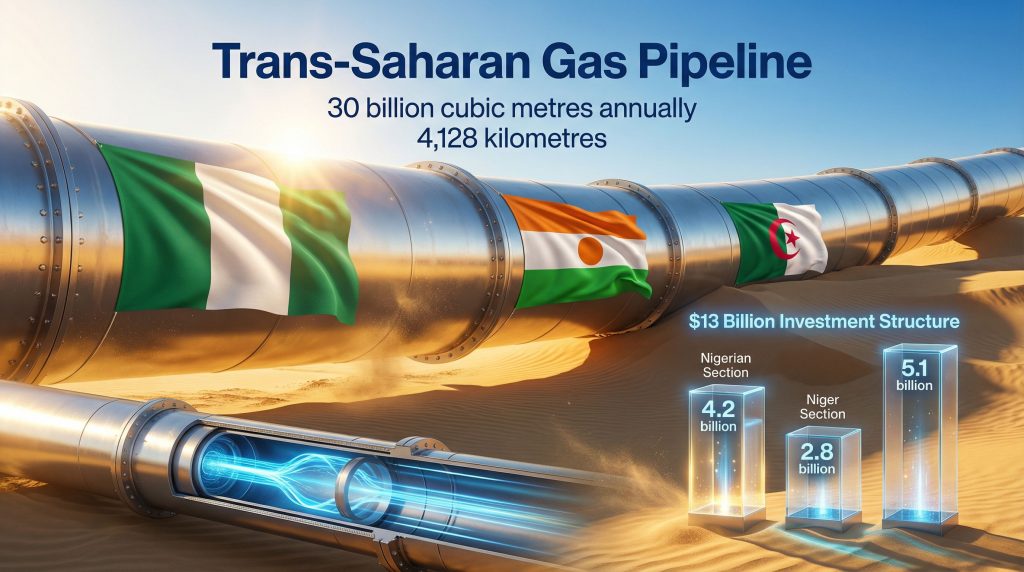
The trans-Saharan gas pipeline represents one of Africa's most ambitious energy infrastructure undertakings, designed to transport 30 billion cubic metres of natural gas annually across 4,128 kilometres of challenging terrain. This massive conduit will traverse three nations, creating an energy corridor that connects West African gas reserves directly to Mediterranean export terminals.
Pipeline Specifications and Technical Framework
Engineering specifications for the trans-Saharan pipeline reveal the complexity of desert infrastructure development. The system must withstand extreme temperature variations ranging from scorching daytime heat exceeding 50°C to nighttime temperatures that can drop below freezing in winter months. Furthermore, sand dune navigation requires specialised trenching techniques and anti-corrosion materials capable of functioning in highly abrasive environments.
Pipeline diameter specifications call for large-bore steel construction with advanced coating systems designed to prevent sand erosion and chemical degradation. Additionally, pressure maintenance across such vast distances necessitates strategic compression station placement, with facilities positioned approximately every 150-200 kilometres along the route.
Environmental baseline studies conducted across the Sahara crossing reveal unique challenges related to groundwater protection, wildlife migration patterns, and archaeological site preservation. These considerations have influenced routing decisions and construction methodologies throughout the project's development phase.
Strategic Route Analysis Through Three Nations
The pipeline's routing strategy reflects careful geopolitical and technical planning. Nigeria's southern terminus provides access to substantial proven reserves, while the northern route through Niger offers the most direct path to Algeria's existing export infrastructure. This configuration minimises overall construction costs while maximising operational efficiency.
Niger's 841-kilometre pipeline segment represents the project's most diplomatically sensitive component, requiring sustained international cooperation to ensure completion. The route traverses regions with varying security profiles, necessitating comprehensive risk management protocols and potential military cooperation agreements.
Algeria's 2,310-kilometre section connects to established Mediterranean export facilities, providing immediate access to European gas markets. This connection offers significant commercial advantages compared to alternative routing options that would require additional terminal construction.
Capacity Projections and Export Potential
Annual throughput capacity of 30 billion cubic metres positions the trans-Saharan gas pipeline among Africa's largest gas export systems. This volume represents approximately 8-10% of total European gas imports, creating meaningful supply diversification opportunities for both producers and consumers.
Export potential extends beyond initial capacity projections, with system design incorporating expansion capabilities. Future throughput could reach 35-40 billion cubic metres annually through compression system upgrades and operational optimisation.
Technical specifications include provisions for multiple gas quality standards, allowing the system to transport various hydrocarbon compositions from different regional sources. This flexibility enhances commercial viability while providing operational redundancy.
How Will the Algeria-Niger Diplomatic Reset Transform Regional Energy Cooperation?
The diplomatic reconciliation between Algeria and Niger in February 2026 marked a decisive shift from regional tensions toward collaborative energy development. This transformation demonstrates how economic incentives can overcome political disputes when mutual benefits align with national strategic interests, particularly given the current US natural gas forecast showing volatile global energy markets.
From Cold War to Strategic Partnership: Timeline of Tensions
Regional diplomatic relations deteriorated significantly throughout 2025, creating uncertainty around major infrastructure projects. The standoff period lasted approximately 10 months, during which normal diplomatic channels remained suspended and energy cooperation agreements faced potential cancellation.
Border relationships between Algeria and Niger span nearly 950 kilometres, making diplomatic cooperation essential for effective cross-border project management. The extended frontier requires coordinated security protocols, customs procedures, and technical standards harmonisation.
Alliance of Sahel States dynamics complicated bilateral negotiations, as Niger's membership in this regional bloc created additional diplomatic considerations. The organisation includes Niger, Mali, and Burkina Faso, requiring Algeria to balance relationships with multiple partners simultaneously.
Economic pressure from delayed energy projects ultimately drove reconciliation efforts. The trans-Saharan pipeline's strategic importance outweighed short-term political disagreements, demonstrating how major infrastructure investments can influence diplomatic priorities.
The Drone Incident That Sparked a Year-Long Standoff
The diplomatic crisis originated from a disputed drone incident occurring between March 31 and April 1, 2025, involving allegations of airspace violations and unauthorised military actions. According to the Trans-Saharan Gas Pipeline project documentation, Algeria maintained that radar data confirmed a 1.6-kilometre breach of its territorial airspace, while Mali disputed this account.
Mali claimed drone wreckage was recovered 9.5 kilometres south of the Algerian border, contradicting Algeria's version of events. This fundamental disagreement over factual circumstances prevented early resolution and escalated into broader diplomatic tensions.
Algeria characterised the incident as the third such infringement by Mali, suggesting a pattern of airspace violations rather than an isolated occurrence. This framing intensified the diplomatic response and justified more severe countermeasures.
The crisis expanded beyond bilateral Algeria-Mali tensions when Niger, Burkina Faso, and Mali collectively recalled their ambassadors from Algeria in April 2025. Consequently, Algeria responded by recalling its diplomatic representatives and delaying new ambassador appointments to the region.
Economic Incentives Driving Reconciliation
Natural gas revenue projections provided compelling economic motivation for diplomatic reset. Niger stands to generate substantial income through transit fees and direct participation in gas sales, creating powerful incentives for conflict resolution.
Algeria's strategic position as a regional energy hub depends on maintaining stable relationships with neighbouring countries. Prolonged diplomatic tensions threatened to undermine Algeria's broader energy export ambitions and regional influence.
International financing for major pipeline projects requires stable diplomatic relationships between participating countries. Potential lenders and investors expressed concerns about project viability during the standoff period, creating additional pressure for reconciliation.
The timing of diplomatic reset in February 2026 coincided with global energy market developments that increased demand for alternative gas supplies. This external market pressure created favourable conditions for resolving regional political disputes.
What Are the Key Financial and Technical Milestones for the Trans-Saharan Project?
Project financing for the trans-Saharan pipeline involves complex multi-national investment structures totalling approximately $13 billion across multiple construction phases. This substantial capital commitment represents one of Africa's largest cross-border infrastructure investments, requiring careful investment strategy components to manage such complexity.
Construction Timeline and Post-Ramadan Launch Strategy
Construction authorisation was scheduled for late March 2026, following the conclusion of Ramadan. This timing reflects cultural considerations and strategic planning for optimal construction conditions during favourable weather periods.
Sonatrach has been designated as the lead construction entity, responsible for coordinating technical standards and project management across international borders. This unified leadership approach should streamline decision-making and maintain consistent quality standards.
The phased construction approach prioritises sections with existing infrastructure connections, allowing for partial system operation before full completion. This strategy enables earlier revenue generation and reduces overall project risk.
Construction Timeline Projections:
- Phase 1 (2026-2028): Foundation work and major pipeline segments
- Phase 2 (2028-2030): Compression stations and technical systems
- Phase 3 (2030-2032): Testing, commissioning, and operational launch
- Phase 4 (2032 onwards): System optimisation and capacity expansion
Investment Structure and Ownership Distribution
Nigerian participation through NNPC provides access to substantial domestic gas reserves while ensuring local content requirements are met. Nigeria's 1,037-kilometre pipeline section represents approximately $4.2 billion in construction investment.
Niger's involvement through SONIDEP creates a 10% ownership stake in the overall project, providing long-term revenue streams beyond simple transit fees. This ownership structure aligns Niger's national interests with project success.
Algeria's Sonatrach brings existing export infrastructure and technical expertise, reducing overall project costs through infrastructure synergies. The company's established relationships with European buyers provide immediate market access.
| Investment Component | Capital (USD Billions) | Completion Status | Lead Entity |
|---|---|---|---|
| Nigerian Section | 4.2 | 70% Complete | NNPC |
| Niger Section | 2.8 | Planning Phase | SONIDEP |
| Algerian Section | 5.1 | 70% Complete | Sonatrach |
| Subsea Connection | 0.9 | Design Phase | Joint Venture |
Existing Infrastructure Completion Status
Nigeria's pipeline segment has achieved 70% completion according to project assessments, with major welding and coating work substantially finished. Remaining tasks focus on compression station installation and system integration.
Algeria's pipeline infrastructure similarly shows 70% completion, benefiting from existing gas transportation expertise and established construction capabilities. The Algerian section connects directly to proven export terminals.
Niger's pipeline segment remains in the planning phase, requiring detailed environmental assessments and security protocols before construction commencement. This section represents the project's primary remaining technical challenge.
Quality assurance protocols across all sections maintain international standards for high-pressure gas transmission. Advanced testing procedures ensure system integrity before operational authorisation.
How Does This Pipeline Compare to Other Major African Gas Export Projects?
Africa's natural gas infrastructure landscape includes several competing and complementary pipeline projects, each targeting different market opportunities and geographic advantages. Understanding these comparisons reveals the trans-Saharan pipeline's unique positioning within continental energy development, particularly as renewable energy transformations reshape global energy markets.
Nigeria-Morocco Pipeline: Competitive Analysis
The Nigeria-Morocco pipeline represents a $25 billion investment targeting West African markets and European exports through Atlantic routes. This alternative system spans different geographic regions and serves partially overlapping market segments.
Capacity comparisons between these systems reveal different strategic approaches: the Nigeria-Morocco line emphasises coastal routing and LNG integration, while the trans-Saharan system prioritises direct Mediterranean access through established infrastructure.
Key Comparative Metrics:
- Trans-Saharan Pipeline: $13B investment, 4,128 km, 30 BCM capacity
- Nigeria-Morocco Pipeline: $25B investment, 5,660 km, 35 BCM capacity
- Construction Timeline: Both projects target 2030s operational dates
- Market Focus: Mediterranean vs. Atlantic export routes
Technical routing complexity differs significantly between projects, with the trans-Saharan system traversing desert terrain while the Nigeria-Morocco line navigates coastal and mountain regions. These geographic factors influence construction costs and operational considerations.
West African Gas Infrastructure Landscape
Nigeria's existing LNG export capacity exceeds 22 million tons annually, providing a foundation for expanded gas production supporting multiple pipeline projects. This production base ensures adequate supply for both domestic consumption and export commitments.
Ghana's offshore gas developments contribute additional regional supply, though these resources primarily serve domestic power generation and regional distribution networks. Integration opportunities exist for future infrastructure connections.
Senegal's emerging gas production from deepwater discoveries could provide supplementary supplies for regional pipeline networks. These developments represent future expansion opportunities rather than immediate capacity additions.
Regional cooperation frameworks facilitate cross-border gas trade through standardised technical specifications and harmonised regulatory approaches. These agreements reduce operational complexity and support integrated regional markets.
European Market Access Routes Comparison
Mediterranean pipeline infrastructure provides established pathways for African gas exports through Turkey, Italy, and Spain. The trans-Saharan system connects directly to this proven export network, reducing commercial risks.
Alternative routing through Atlantic LNG terminals requires additional regasification infrastructure in European destination markets. This approach offers flexibility but involves higher transportation costs and market price exposure.
European Gas Import Strategy Evolution:
| Supply Source | Current Share (%) | 2030 Projection (%) | Strategic Priority |
|---|---|---|---|
| Russian Gas | 15 | 5 | Phase-out |
| African LNG | 25 | 35 | Expansion |
| Trans-Saharan Pipeline | 0 | 12 | New Supply |
| Renewable Hydrogen | 5 | 20 | Future Focus |
Market diversification strategies prioritise African gas supplies as alternatives to traditional sources, creating favourable conditions for new pipeline projects. European energy security considerations support long-term purchase agreements with African suppliers.
What Are the Geopolitical Implications for Sahel Region Stability?
The trans-Saharan gas pipeline project intersects with complex regional security dynamics and diplomatic relationships across the Sahel region. Energy infrastructure development can contribute to stability through economic development while creating new vulnerabilities requiring careful management.
Alliance of Sahel States Dynamics
The Alliance of Sahel States, comprising Niger, Mali, and Burkina Faso, represents a regional security and economic cooperation framework that influences energy project development. This organisation's collective positions affect bilateral negotiations with external partners like Algeria.
Joint diplomatic actions, such as the coordinated ambassador recalls during the 2025 crisis, demonstrate the alliance's capacity for unified responses to perceived threats or disputes. Energy projects must navigate these collective decision-making processes.
Regional security cooperation within the alliance includes information sharing, border management, and counter-terrorism coordination. Pipeline security protocols must align with these existing frameworks while maintaining operational independence.
Economic integration through the alliance creates opportunities for expanded energy cooperation beyond the trans-Saharan project. Future developments could include regional gas distribution networks and integrated power generation systems.
Algeria's Role as Regional Energy Mediator
Algeria's extensive natural gas reserves, exceeding 4.5 trillion cubic metres in proven deposits, position the country as a major regional energy hub. This resource base supports multiple export projects and provides leverage in diplomatic negotiations.
Existing export relationships with European buyers through the TransMed and Medgaz pipeline systems demonstrate Algeria's established market access and commercial credibility. These connections benefit partner countries participating in new projects.
Algeria's historical role in regional mediation extends beyond energy sector issues to include political conflicts and security concerns. This diplomatic experience supports complex multi-party negotiations for major infrastructure projects.
Regional energy diplomacy involves balancing relationships with multiple Sahel nations while maintaining strategic partnerships with European consumers. Algeria's success in this role influences broader continental energy integration efforts.
Security Cooperation Framework Integration
Pipeline security requires coordinated approaches across international borders, involving military, intelligence, and civilian security agencies from multiple countries. These cooperation frameworks must address both traditional security threats and emerging risks.
Counter-terrorism coordination becomes essential given the pipeline's routing through regions with active security challenges. Protection protocols must balance operational security with community access and economic development opportunities.
Border security coordination involves customs procedures, immigration controls, and cross-border movement of personnel and equipment. Streamlined processes support efficient project management while maintaining national security requirements.
Regional security architecture evolution includes the trans-Saharan pipeline as critical infrastructure requiring special protection measures. These designations influence resource allocation and international cooperation agreements.
The next major ASX story will hit our subscribers first
How Will Niger Monetise Its Natural Gas Resources Through This Partnership?
Niger's participation in the trans-Saharan pipeline transforms the country from a simple transit corridor into an active energy partner with substantial economic benefits. This evolution creates new revenue streams while strengthening regional diplomatic relationships, aligning with broader green transition fundamentals that shape modern energy partnerships.
Niger's Natural Gas Reserve Potential
Niger's proven natural gas reserves total approximately 34 billion cubic metres, providing a foundation for direct participation in export projects beyond transit fee arrangements. These resources offer long-term revenue generation potential through strategic development partnerships.
Geological assessments suggest additional undiscovered reserves could significantly expand Niger's resource base. Exploration activities linked to pipeline development may reveal new commercial opportunities and extend project economics.
Reserve quality assessments indicate gas compositions suitable for export markets, requiring minimal processing before pipeline transportation. This characteristic reduces development costs and accelerates commercial viability timelines.
Strategic reserve management involves balancing domestic energy security requirements with export commitments. Niger's energy planning must ensure adequate supplies for national development while maximising export revenues.
SONIDEP's Strategic Ownership Position
SONIDEP's 10% ownership stake in the trans-Saharan pipeline provides direct participation in project revenues beyond traditional transit arrangements. This equity position aligns Niger's national interests with project success and creates incentives for long-term cooperation.
State-owned enterprise capabilities require development to support effective participation in complex international energy projects. SONIDEP's technical capacity building represents a critical factor in maximising Niger's benefits from pipeline participation.
Revenue distribution mechanisms from SONIDEP's ownership stake support national development priorities while maintaining commercial viability for all project participants. These arrangements require careful structuring to balance competing interests.
Strategic value extends beyond immediate financial returns to include technology transfer, capacity building, and institutional development benefits. These indirect advantages could support Niger's broader energy sector development goals.
Domestic Energy Security Benefits
Domestic gas supply arrangements through the trans-Saharan system could address Niger's energy security challenges while supporting industrial development initiatives. Local supply access reduces dependence on energy imports and supports economic diversification.
Power generation applications for domestic gas supplies could expand electricity access and support economic development in underserved regions. Reliable energy access enables manufacturing, agriculture, and service sector expansion.
Industrial development opportunities arise from secure gas supplies supporting fertiliser production, cement manufacturing, and other energy-intensive industries. These applications create employment and add value to natural resource exports.
Energy price stability through domestic gas utilisation reduces economic volatility and supports long-term development planning. Predictable energy costs enable business investment and economic growth across multiple sectors.
What Challenges Could Delay or Derail the Pipeline Project?
Large-scale cross-border infrastructure projects face numerous technical, financial, and political risks that could significantly impact timelines and outcomes. Understanding these challenges enables better risk management and contingency planning.
Technical Engineering Complexities in Desert Terrain
Desert construction environments present unique engineering challenges including extreme temperature variations, sand infiltration, and limited water access for construction activities. These conditions require specialised equipment and construction techniques that increase project costs.
Underground pipeline installation through shifting sand dunes requires advanced trenching technologies and specialised backfill materials. Sand movement can expose or damage pipelines if inadequate protection measures are implemented during construction.
Compression station construction in remote desert locations faces logistical challenges related to equipment transportation, worker accommodation, and utility connections. These facilities require robust design standards to withstand harsh environmental conditions.
Maintenance access across vast desert distances necessitates comprehensive infrastructure development including service roads, communication systems, and emergency response capabilities. These support systems represent significant additional investment requirements.
Regional Security Threats and Mitigation Strategies
Security risks across the Sahel region include terrorism threats, armed group activities, and general instability that could disrupt construction activities or operational security. These concerns require comprehensive security planning and international cooperation.
Pipeline vulnerability to sabotage or terrorist attacks necessitates continuous monitoring systems and rapid response capabilities. Protection measures must balance security requirements with operational efficiency and community relations.
Cross-border security coordination involves multiple national agencies and international partners, creating complexity in command structures and response protocols. Effective coordination requires clear agreements and regular joint exercises.
Regional stability improvements through economic development can reduce security risks over time, but initial project phases may face heightened threats during the construction period when security measures are still developing.
Financing Gaps and International Investment Requirements
Total project costs exceeding $13 billion require diverse financing sources including development banks, commercial lenders, and government contributions. Securing adequate financing involves complex negotiations and lengthy approval processes.
International lending institutions impose strict environmental, social, and governance standards that must be met throughout project development. Compliance with these requirements can delay project timelines and increase costs.
Currency risk management across multiple countries with different monetary policies creates financial complexity requiring sophisticated hedging strategies. Exchange rate volatility could significantly impact project economics.
Political risk insurance requirements for cross-border projects involve substantial premiums and coverage limitations. These costs must be incorporated into overall project financing while maintaining commercial viability.
How Does European Energy Demand Shape the Project's Commercial Viability?
European energy market dynamics significantly influence the commercial prospects for African gas pipeline projects. Understanding these demand patterns and policy directions enables better assessment of project viability and long-term sustainability.
Post-Ukraine War Gas Supply Diversification
European energy security strategies emphasise supply diversification away from traditional sources toward more reliable alternatives. This policy shift creates favourable market conditions for new African gas supplies through dedicated pipeline infrastructure.
Russian gas imports to Europe have declined from pre-2022 levels of approximately 155 billion cubic metres annually to current levels around 50 billion cubic metres. This supply gap creates immediate market opportunities for alternative sources.
Long-term purchase agreements with European buyers provide revenue security that supports project financing and reduces commercial risks. These contracts typically span 15-20 year terms with price escalation clauses tied to market indices.
Strategic buyer diversification across multiple European countries reduces dependence on single-market relationships while providing operational flexibility. Multiple delivery points enhance system resilience and commercial optimisation opportunities.
Mediterranean Pipeline Network Integration
Existing Mediterranean gas infrastructure includes the TransMed system connecting Algeria to Italy and the Medgaz pipeline serving Spain. The trans-Saharan system connects directly to this established network, reducing integration costs and market access barriers.
Pipeline interconnection capacity determines maximum throughput potential for new supply sources. Current Mediterranean infrastructure can accommodate additional 20-30 billion cubic metres annually through system optimisation and expansion.
Technical compatibility between pipeline systems requires standardised pressure specifications, gas quality standards, and control systems. These technical harmonisation requirements influence pipeline design and construction standards.
Network reliability benefits from diversified supply sources that reduce system vulnerability to individual pipeline disruptions or supply interruptions. The trans-Saharan system enhances overall Mediterranean network resilience.
Long-term European Energy Transition Impact
European climate policies targeting carbon neutrality by 2050 influence long-term gas demand projections and investment decisions. Natural gas serves as a transition fuel supporting renewable energy integration during the decarbonisation process.
Industrial gas demand for chemicals, fertilisers, and steel production is expected to remain substantial even as power generation shifts toward renewable sources. These applications provide sustained demand for pipeline gas supplies.
Hydrogen production from natural gas with carbon capture represents a potential growth market that could extend pipeline utilisation beyond traditional applications. This technology pathway supports European hydrogen economy development goals.
European Energy Transition Timeline:
- 2025-2030: Peak gas demand for power generation backup
- 2030-2040: Industrial demand maintains gas consumption
- 2040-2050: Hydrogen production sustains pipeline utilisation
- Post-2050: Synthetic fuel production potential applications
What Environmental and Sustainability Considerations Apply to the Project?
Major pipeline projects require comprehensive environmental impact assessments and sustainability planning to meet international standards and financing requirements. These considerations influence project design, construction methods, and operational procedures.
Carbon Footprint Assessment and Mitigation Measures
Natural gas transportation generates carbon emissions through compression station operations and methane leakage during normal operations. Total system emissions must be quantified and minimised through advanced technology applications.
Compression station efficiency improvements can reduce overall system emissions by 15-20% compared to standard designs. Electric drive systems powered by renewable energy sources offer additional emission reduction opportunities.
Methane leak detection systems using satellite monitoring and ground-based sensors enable rapid identification and repair of system leaks. These technologies minimise environmental impact while reducing commercial losses.
Carbon offset programmes through reforestation or renewable energy projects can neutralise remaining system emissions. These initiatives support environmental compliance while contributing to regional development objectives.
Desert Ecosystem Impact Management
Sahara desert ecosystems include specialised plant and animal communities adapted to extreme conditions. Pipeline construction must minimise habitat disruption through careful routing and restoration measures.
Water resource protection becomes critical in desert regions where groundwater supplies support limited vegetation and wildlife populations. Construction activities must avoid contamination of these scarce water sources.
Archaeological site protection throughout the Sahara region requires extensive surveys and coordination with cultural heritage authorities. According to the Trans-Saharan gas pipeline Wikipedia entry, ancient trade routes and historical sites must be preserved during construction activities.
Soil stabilisation measures prevent erosion and maintain natural drainage patterns that support desert ecosystem functions. These protections ensure long-term environmental sustainability beyond project completion.
Alignment with Global Energy Transition Goals
Natural gas serves as a transitional energy source supporting renewable energy integration through backup power generation and industrial applications. This role aligns with global decarbonisation strategies while maintaining energy security.
Technology compatibility with future hydrogen transportation enables pipeline infrastructure to support post-carbon energy systems. Advanced materials and design specifications facilitate this future adaptation capability.
Regional economic development through energy projects can accelerate renewable energy adoption by providing financial resources for clean technology investments. Energy revenues support broader sustainability initiatives across participating countries.
International climate finance mechanisms may provide support for projects demonstrating clear environmental benefits and sustainable development contributions. These funding sources could reduce project costs while enhancing environmental performance.
Strategic Outlook: Africa's Energy Integration Through Cross-Border Infrastructure
The trans-Saharan gas pipeline represents more than a single infrastructure project – it symbolises Africa's potential for continental energy integration and economic transformation through coordinated development initiatives.
Continental Energy Market Development Potential
African energy integration could create a continental market exceeding 400 million potential consumers across multiple countries with diverse resource endowments. This market size supports major infrastructure investments while enabling economies of scale.
Cross-border pipeline networks facilitate optimal resource utilisation by connecting production centres with demand centres regardless of political boundaries. This connectivity enhances energy security while reducing development costs through shared infrastructure.
Regional energy trading mechanisms could emerge from successful pipeline projects, creating spot markets and financial instruments that support efficient resource allocation. These markets would attract international investment and technology transfer.
Continental energy planning through regional organisations enables coordinated development strategies that maximise resource value while minimising environmental impacts. This approach supports sustainable development goals across participating nations.
Investment Climate Improvements for Mega-Projects
Successful completion of the trans-Saharan pipeline demonstrates African capacity for complex international project management and creates precedents for future mega-projects. This track record attracts additional international investment and technical partnerships.
Risk mitigation frameworks developed for pipeline projects can be applied to other infrastructure sectors including transportation, telecommunications, and power generation. These frameworks reduce investment uncertainty and project development costs.
International financing institution engagement with African infrastructure creates institutional relationships that support continued development financing. These partnerships provide technical assistance and policy development support beyond individual projects.
Regional integration success stories encourage policy harmonisation and regulatory coordination that reduces barriers to cross-border investment. These improvements create favourable conditions for sustained infrastructure development.
Technology Transfer and Local Capacity Building Opportunities
Advanced pipeline technologies require local technical expertise for effective operation and maintenance. Technology transfer programmes create opportunities for skills development and institutional capacity building across participating countries.
Local content requirements in major projects support domestic industry development and employment creation. These policies ensure that infrastructure investments contribute to broader economic development beyond direct project benefits.
Regional training centres for energy sector professionals can emerge from major project requirements, creating lasting educational infrastructure that supports continued industry development. These institutions attract international partnerships and knowledge exchange.
Innovation opportunities in desert construction, remote monitoring, and cross-border project management create intellectual property and technical capabilities that can be exported to similar projects worldwide. This expertise represents valuable economic assets for participating nations.
Disclaimer: This analysis is based on publicly available information and industry assessments. Actual project outcomes may vary due to technical, financial, political, or market factors beyond current projections. Investment decisions should consider comprehensive due diligence and professional advisory services.
Ready to Capitalise on Africa's Energy Infrastructure Development?
Discovery Alert's proprietary Discovery IQ model provides real-time alerts on significant ASX mineral discoveries across critical energy transition commodities, helping investors identify opportunities in the evolving global energy landscape before the broader market. Begin your 14-day free trial today to gain actionable insights into energy and resource sector developments that could shape your investment portfolio.