July 13, 2026
The nuclear fuel cycle represents one of the most complex industrial processes in modern energy production, requiring precise coordination between mining, conversion, enrichment, and fabrication stages. Within this intricate supply chain, uranium conversion facility in USA operations occupy a critical position, transforming raw ore concentrates into forms suitable for nuclear reactor fuel. Understanding the technical requirements and strategic importance of these facilities reveals why America's current infrastructure represents both a vulnerability and an opportunity in the expanding nuclear energy landscape.
The Chemical Process Behind Uranium Conversion
Uranium conversion involves a sophisticated chemical transformation process that bridges the gap between mining output and enrichment requirements. The process begins with uranium trioxide (U3O8), commonly known as yellowcake, which arrives from mining and milling operations. This material undergoes chemical refinement to produce uranium dioxide (UO2) as an intermediate step, before final conversion into uranium hexafluoride (UF6) gas.
The UF6 conversion represents the most technically demanding aspect of the process. This gaseous form can be cooled and solidified for secure transportation to enrichment facilities, where the concentration of fissile U-235 isotope is increased for reactor fuel applications. The handling of hydrofluoric acid, essential for UF6 production, requires specialised containment systems and comprehensive worker protection protocols that distinguish conversion facilities from other industrial operations.
Quality control throughout the conversion process maintains strict specifications for chemical purity and isotopic composition. Facilities must operate under continuous monitoring systems that track both process efficiency and environmental compliance, ensuring that output meets the exacting standards required for nuclear fuel applications.
Technical Infrastructure and Safety Requirements
Modern conversion facilities integrate multiple engineering systems to manage the chemical processes safely and efficiently. The infrastructure includes specialised reactors and vessels designed for uranium chemistry, comprehensive waste stream management systems, and redundant safety instrumentation that exceeds standard industrial requirements.
Environmental control systems represent a significant portion of facility design, incorporating emissions containment technology and water treatment capabilities. These systems must comply with Nuclear Regulatory Commission standards under 10 CFR Part 40 licensing regulations, which establish specific protocols for radioactive material handling and environmental protection.
The complexity of these requirements explains why conversion facility development requires extensive engineering expertise and substantial capital investment compared to conventional chemical processing plants.
When big ASX news breaks, our subscribers know first
America's Single-Point Dependency Challenge
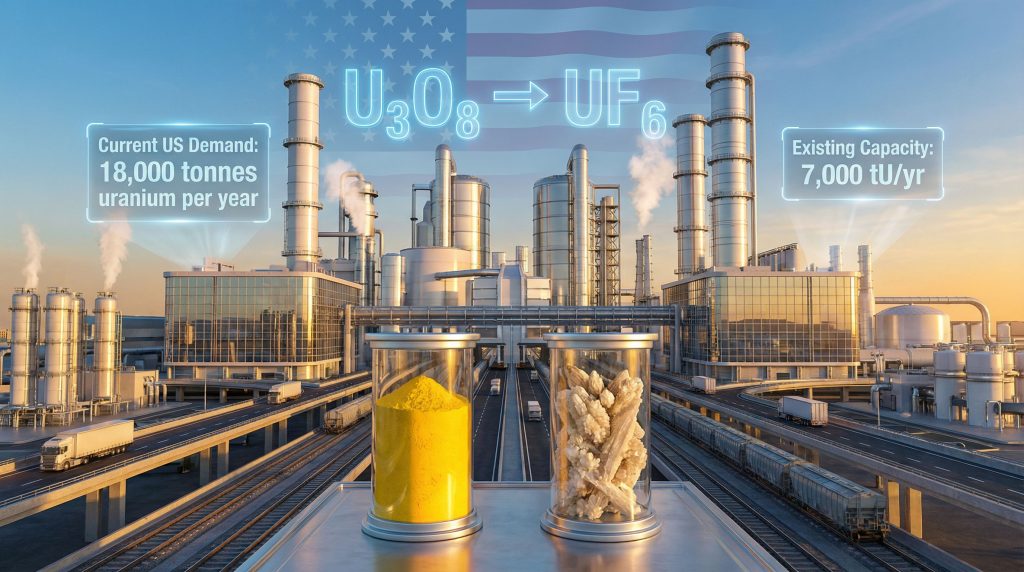
The United States currently operates with critical vulnerability in its nuclear fuel supply chain, maintaining only one active uranium conversion facility in USA. Honeywell's Metropolis Works facility in southern Illinois represents the entirety of domestic conversion capacity, operating at 7,000 tonnes uranium per year following its July 2023 restart.
Furthermore, this facility, constructed during the 1950s, experienced a six-year operational shutdown from 2017 to 2023 due to unfavourable market conditions and pricing pressures. The extended interruption demonstrated how economic factors can compromise national security infrastructure when private sector operations become unprofitable.
| Facility Characteristic | Current Status |
|---|---|
| Location | Metropolis, Illinois |
| Construction Era | 1950s |
| Current Capacity | 7,000 tU/yr |
| Operational History | Shutdown 2017-2023, Restarted July 2023 |
| Regulatory Status | 10 CFR Part 40 Licensed |
The vulnerability of single-facility dependency became apparent during the shutdown period, when American nuclear utilities relied on imported conversion services or existing inventory reserves to maintain reactor operations. This situation highlighted the strategic risk of allowing market forces alone to determine the viability of critical national security infrastructure.
Capacity Constraints and Future Demand
Current domestic conversion capacity of 7,000 tonnes uranium per year falls significantly short of America's 18,000 tU annual demand, creating an 11,000 tU supply deficit that requires import dependence or expanded domestic capability. However, federal policy initiatives targeting a fourfold increase in nuclear generating capacity by 2050 would exponentially increase this demand gap.
The mathematics of capacity expansion reveal the scale of infrastructure development required. If nuclear generation increases by the targeted four times current levels, uranium conversion demand would far exceed the combined capacity of existing and proposed facilities, necessitating multiple new conversion operations across the United States.
Federal Policy Driving Capacity Expansion
Recent US production executive order initiatives from the White House have designated nuclear fuel cycle development as a national security priority, establishing policy frameworks that encourage domestic conversion facility construction. These initiatives respond to strategic concerns about overseas supplier dependency and the need for secure fuel supply chains supporting expanded nuclear generation.
The federal policy approach recognises that market mechanisms alone proved insufficient to maintain conversion capability during the 2017-2023 Metropolis Works shutdown. Government intervention through policy incentives and strategic designation aims to ensure that national security considerations influence private sector investment decisions in nuclear fuel infrastructure.
Key Policy Objectives Include:
- Onshoring the complete nuclear fuel cycle from mining through fabrication
- Reducing dependence on overseas conversion services and suppliers
- Supporting nuclear capacity expansion through secure fuel supply chains
- Establishing strategic redundancy in critical fuel cycle infrastructure
- Coordinating with allied nations on nuclear fuel security initiatives
The policy framework creates market conditions intended to support private sector investment while recognising the national security imperative of maintaining domestic conversion capability regardless of short-term market fluctuations.
Engineering Complexity of New Facility Development
Building modern uranium conversion facilities requires integration of specialised chemical engineering, environmental compliance systems, and advanced safety technology that exceeds historical standards. Current facility development involves Fluor Corporation, a major international engineering firm with nuclear industry expertise, indicating the substantial technical complexity involved in contemporary conversion plant design.
Moreover, modern facilities must incorporate state-of-the-art technology that improves upon legacy infrastructure constructed during the 1950s and 1960s. This includes advanced process automation, enhanced environmental performance standards, and digital monitoring systems that optimise both efficiency and safety outcomes.
Design and Feasibility Considerations
The engineering design process addresses multiple technical challenges simultaneously:
Process Technology: Advanced UF6 conversion equipment incorporating modern automation and control systems that exceed the capabilities of legacy facilities like Metropolis Works.
Environmental Systems: Comprehensive emissions control and waste management systems designed to meet current environmental standards whilst minimising operational impacts.
Safety Infrastructure: Redundant safety systems and accident mitigation technology that incorporate lessons learned from decades of nuclear industry operations.
Integration Capability: Design for seamless integration with transportation logistics, utility infrastructure, and supply chain networks.
The involvement of major engineering contractors like Fluor Corporation reflects the complexity of these requirements and the need for proven expertise in nuclear facility development.
Critical Site Selection Factors
Location selection for uranium conversion facility in USA development involves optimising multiple technical, economic, and logistical factors that significantly impact operational efficiency and development costs. Current site evaluation processes consider transportation infrastructure, workforce availability, utility capacity, and regulatory environments across multiple states.
Primary Location Criteria:
- Transportation Logistics: Access to rail networks for uranium ore concentrate delivery and UF6 product shipment
- Workforce Availability: Local technical skills and training capacity for specialised conversion operations
- Utility Infrastructure: Reliable electrical power, water resources, and natural gas supply
- Economic Incentives: State and local tax benefits and regulatory support
- Industry Synergies: Proximity to mining operations and nuclear fuel cycle facilities
- Community Acceptance: Environmental and safety considerations affecting local support
Transportation infrastructure represents a particularly critical factor, as conversion facilities must receive substantial quantities of uranium ore concentrates whilst shipping UF6 products to enrichment facilities. Rail access provides the most efficient logistics for these bulk material movements, making proximity to major rail networks a significant advantage.
Workforce and Technical Requirements
Conversion facilities require specialised workforce capabilities that combine chemical processing expertise with nuclear industry safety protocols. States with existing nuclear operations or chemical processing industries possess advantages in workforce development and regulatory familiarity.
The technical skills required include chemical engineering, process control systems operation, radiation safety procedures, and environmental compliance management. Training programmes and workforce development initiatives become important considerations for communities seeking to host new conversion facilities.
Nuclear Regulatory Commission Licensing Framework
The regulatory pathway for new uranium conversion facilities involves multiple stages of Nuclear Regulatory Commission review and approval under 10 CFR Part 40 regulations. Furthermore, the licensing process begins with Letter of Intent submission, followed by docket number assignment and Pre-Application Engagement phases before formal licence application review.
Recent facility development has progressed through initial licensing milestones, with docket number assignment representing the first formal recognition of project viability by federal regulators. This administrative step enables structured engagement between facility developers and NRC staff regarding technical requirements and regulatory expectations.
Regulatory Timeline and Requirements
The licensing process typically involves several years of regulatory review, environmental analysis, and public consultation before construction authorisation. Key stages include:
Pre-Application Phase: Technical discussions between developers and NRC staff to identify regulatory requirements and potential issues before formal application submission.
Environmental Review: Comprehensive assessment of facility impacts including air quality, water resources, waste management, and community effects.
Safety Analysis: Detailed evaluation of facility design, operational procedures, emergency planning, and risk mitigation measures.
Public Participation: Community input opportunities and stakeholder consultation throughout the review process.
The regulatory framework ensures that new conversion facilities meet contemporary safety and environmental standards whilst supporting national security objectives for domestic fuel cycle capability.
The next major ASX story will hit our subscribers first
Economic Impact and Investment Requirements
Uranium conversion facility development represents substantial capital investment with significant economic multiplier effects for selected communities. Construction phase activities typically involve hundreds of workers across multiple years, whilst operational employment provides long-term, high-skill positions in specialised technical roles.
In addition, the economic impact extends beyond direct employment to include supply chain development, supporting services, and community infrastructure improvements. States competing for facility location recognise these economic benefits through incentive packages designed to attract nuclear industry investment.
Investment Scale and Financial Considerations
Modern conversion facilities require capital expenditures measured in hundreds of millions of dollars, reflecting the specialised equipment, environmental systems, and safety infrastructure necessary for nuclear fuel processing operations. These investment levels position facility development as major industrial projects with regional economic significance.
Economic Benefit Categories:
- Direct Employment: High-skill technical positions in conversion operations
- Construction Jobs: Multi-year construction phase employment opportunities
- Supply Chain Development: Local and regional supplier network expansion
- Tax Revenue: Property tax and business tax contributions to local governments
- Infrastructure Investment: Community improvements supporting facility operations
The long-term nature of nuclear fuel contracts provides revenue stability that supports sustained economic benefits over facility operational lifetimes measured in decades rather than years.
Integration with Mining Operations Strategy
Vertical integration between uranium mining and conversion operations offers significant strategic and economic advantages through supply chain control, transportation cost optimisation, and quality assurance throughout the fuel cycle process. Companies with existing mining operations can leverage conversion facilities to capture additional value whilst ensuring secure material supply.
Geographic coordination between mining regions and conversion facility locations reduces transportation costs and logistics complexity whilst enabling better inventory management and production scheduling. This integration particularly benefits in-situ recovery operations that produce uranium ore concentrates requiring conversion services.
Supply Chain Optimisation Benefits
Integrated mining and conversion operations achieve economies of scale and operational efficiencies unavailable to standalone facilities:
Cost Reduction: Elimination of third-party conversion service fees and reduced transportation expenses through optimised logistics networks.
Quality Control: Direct oversight of material handling and processing from mine through conversion, ensuring consistent specifications and reducing quality risk.
Production Flexibility: Coordinated production scheduling between mining and conversion operations that responds efficiently to market demand changes.
Risk Mitigation: Reduced exposure to conversion service availability and pricing volatility through captive processing capability.
The strategic value of integration increases during periods of conversion service shortage or price volatility, providing competitive advantages for vertically integrated operations.
International Competitive Context
Global uranium conversion capacity concentration in a limited number of countries creates strategic vulnerabilities for nuclear fuel supply security. Understanding international facility locations, technologies, and capacities reveals both competitive challenges and collaboration opportunities for American conversion facility development.
| Country | Annual Capacity (tU) | Key Facilities | Technology Status |
|---|---|---|---|
| United States | 7,000 | Metropolis Works | Legacy (1950s) |
| Proposed US Facility | 10,000 | Under Development | Modern Design |
| Russia | 28,000+ | Multiple Facilities | Advanced |
| China | 20,000+ | Expanding Network | Modern |
| France | 15,000 | Malvési | Established |
| Canada | 12,500 | Blind River | Proven Technology |
Consequently, the comparative analysis reveals America's current capacity deficit relative to both domestic demand and international competitors. Proposed new facility development would significantly improve U.S. positioning but would require multiple projects to achieve strategic independence from overseas suppliers.
Western Alliance Coordination Opportunities
NATO allies and democratic partners face similar challenges regarding nuclear fuel supply security, creating opportunities for technology sharing, joint development initiatives, and coordinated supply chain strategies. Collaboration among Western nations could strengthen collective energy security whilst reducing individual country dependencies on non-aligned suppliers.
Technical cooperation agreements could accelerate facility development timelines whilst sharing best practices for modern conversion technology deployment. Joint procurement and standardisation initiatives might reduce equipment costs and improve operational efficiency across allied conversion facilities.
Development Timeline and Market Entry Strategy
Current facility development projects indicate multi-year timelines from initial feasibility studies through commercial operations, reflecting the complex engineering, regulatory, and construction requirements involved in conversion facility deployment. Understanding these timelines helps establish realistic expectations for market impact and supply chain improvements.
Projected Development Phases:
- Engineering and Design: 2-3 years for feasibility studies and detailed design completion
- Site Selection and Permitting: 1-2 years for location finalisation and regulatory approvals
- Construction Phase: 3-4 years for facility construction and commissioning
- Operational Ramp-up: 1-2 years to achieve full production capacity
Total development timelines of 7-11 years from project initiation to full commercial operation emphasise the long-term planning horizon required for nuclear fuel infrastructure development.
What Market Conditions Will New Facilities Face?
New conversion facilities will enter markets where domestic demand substantially exceeds current supply capacity, providing favourable conditions for commercial success. Long-term contracts with utility customers offer revenue security that supports facility financing and operational planning.
The strategic positioning of modern facilities with advanced technology and environmental performance may command premium pricing compared to legacy facilities or international alternatives. However, the Russian uranium ban and uranium supply challenges create additional complexity for market planning.
Strategic Implications for Nuclear Fuel Independence
Development of additional uranium conversion facility in USA represents a critical component of broader nuclear fuel cycle security initiatives, reducing vulnerabilities associated with overseas supplier dependence whilst supporting expanded nuclear generation capacity. The strategic implications extend beyond energy policy to encompass national security, industrial capability, and geopolitical positioning.
Furthermore, successful facility development would position the United States as a more reliable partner for nuclear fuel supply to allied nations whilst reducing exposure to supply disruptions or geopolitical leverage from current overseas suppliers. This capability is particularly important as global nuclear capacity expands and fuel supply security becomes increasingly strategic.
Technology Leadership and Innovation Opportunities
Modern conversion facility development offers opportunities to deploy next-generation technology that improves upon legacy infrastructure whilst establishing American leadership in nuclear fuel cycle innovation. Advanced process control systems, enhanced environmental performance, and improved operational efficiency could set new industry standards.
Investment in domestic conversion capability supports broader nuclear technology leadership objectives whilst creating platforms for ongoing research and development activities. These facilities could serve as testing grounds for advanced conversion technologies that maintain American competitive advantages in global nuclear markets.
The intersection of national security priorities, growing nuclear demand, and technological advancement creates compelling rationales for conversion facility development that extend far beyond immediate fuel supply considerations. Consequently, these projects represent strategic infrastructure investments with long-term implications for American energy independence.
Moreover, given the current US uranium market risks and evolving uranium investment outlook, the development of additional conversion facilities becomes even more critical for maintaining energy security and nuclear fuel independence.
Want to Stay Ahead of Nuclear Fuel Supply Developments?
Discovery Alert's proprietary Discovery IQ model delivers real-time alerts on significant uranium and nuclear fuel sector discoveries across the ASX, empowering subscribers to identify actionable opportunities ahead of the broader market. Understand why historic mineral discoveries can generate substantial returns by exploring Discovery Alert's dedicated discoveries page, showcasing exceptional outcomes from major finds. Begin your 14-day free trial today to position yourself ahead of the market in this rapidly evolving sector.