July 17, 2026
The Storage Advantage That Rewrites the Energy Security Equation
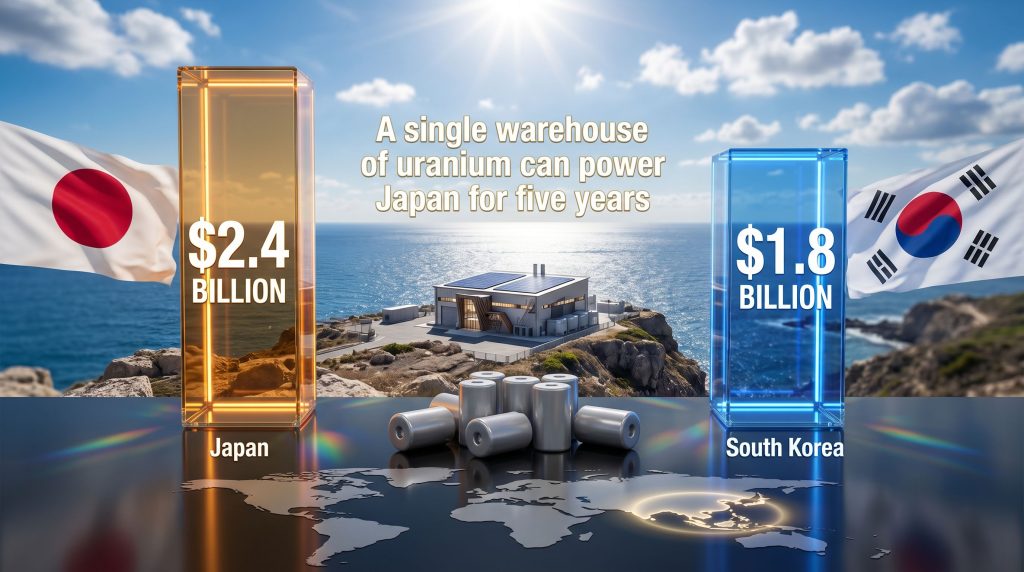
Imagine an energy source so dense that a single warehouse-scale stockpile could supply an entire industrialised nation for five years. No pipelines stretching thousands of kilometres across contested territory. No supertanker convoys vulnerable to chokepoint disruption. No weather-dependent generation intermittency. This is not a theoretical construct or a speculative future technology. It is the physical reality of uranium as a fuel, and it is precisely why uranium energy security in Japan and Korea has moved from an academic policy discussion to an urgent strategic imperative.
Understanding why two of Asia's most advanced economies are doubling down on nuclear power requires stepping back from daily market commentary and examining the structural physics and geopolitics that make their energy situations categorically unique. The answer is not about ideology, political preference, or even climate targets. It is about the mathematics of energy density and the geography of vulnerability.
When big ASX news breaks, our subscribers know first
Why Island and Peninsula Nations Cannot Afford Fossil Fuel Dependency
Japan and South Korea share a structural economic characteristic that sets them apart from most large economies: virtually zero domestic fossil fuel production combined with enormous industrial energy demand. Japan imports approximately 90% of its primary energy requirements, with petroleum alone accounting for roughly 36-40% of total energy consumption and virtually every barrel sourced from overseas. South Korea's position is similarly exposed, importing approximately 93% of its total energy needs.
These are not marginal dependencies. They are existential ones.
Japan ranks among the world's three largest oil importers, with imports averaging approximately 2.8 million barrels per day, according to U.S. Energy Information Administration data. South Korea, despite its smaller population, is consistently ranked within the world's five largest oil importers, averaging 2.6-2.8 million barrels per day. For both nations, approximately 85-90% of those oil imports transit the Strait of Hormuz, a 33-kilometre-wide chokepoint through which roughly 20-21% of all global petroleum flows.
The vulnerability this creates is not theoretical. It is priced into every energy cost, every industrial planning cycle, and every national security assessment both governments conduct. When geopolitical tension in the Middle East rises, Japanese and South Korean energy costs follow almost immediately. Their economies have no buffer against supply disruption because they cannot fall back on domestic production.
Uranium changes this equation entirely. Japan's annual uranium requirement for its operating reactor fleet runs to approximately 1,000-1,200 metric tonnes of uranium concentrate. Five years of supply would represent roughly 5,000-6,000 metric tonnes of material, storable in warehouse-scale facilities. By contrast, storing five years of Japan's oil imports would require infrastructure equivalent to hundreds of millions of cubic metres of dedicated tank capacity, vast port infrastructure, and ongoing logistical management. The storage advantage that uranium provides is not incremental. It is transformational.
| Energy Source | 5-Year Supply Volume | Storage Infrastructure | Geographic Chokepoint Exposure |
|---|---|---|---|
| Uranium | ~5,000-6,000 tonnes | Warehouse-scale | Minimal |
| Crude Oil | ~500+ million cubic metres equivalent | Massive tank farm + port infrastructure | High (Strait of Hormuz) |
| LNG | Cryogenic storage required at scale | Specialised terminals | High (Strait of Hormuz / Malacca) |
| Coal | Hundreds of millions of tonnes | Open-cut stockpiles, significant land | Moderate (shipping lane exposure) |
How the 1973 Oil Embargo Set the Nuclear Policy Template
The strategic logic now driving both Japan and South Korea's nuclear commitments is not new. It was field-tested and validated more than five decades ago, following one of the most significant economic disruptions of the twentieth century.
When OPEC imposed its oil embargo in October 1973, reducing global oil supply by approximately 7% (equivalent to 4-5 million barrels per day), the economic shockwaves hit import-dependent nations with disproportionate force. Oil prices surged from approximately $3 per barrel to $12 within months, a fourfold increase that triggered negative GDP growth across much of the industrialised world. Japan, with virtually no domestic fossil fuel production, was among the hardest hit. Japanese oil consumption fell approximately 20% during the embargo period, forcing industrial rationing and exposing the profound fragility of the nation's energy model.
The policy response that followed was not driven by environmental awareness or carbon accounting. It was driven by raw strategic necessity. Japan and France, independently, reached the same conclusion: uranium was the only fuel that could provide genuine energy sovereignty.
"The nuclear expansion decisions made in Tokyo and Paris during the 1970s were explicitly framed as national security measures, not environmental policies. This distinction is critical to understanding why the same logic is reasserting itself in 2025."
Japan's nuclear generating capacity grew from approximately 1.4 GW in 1973 to over 11 GW by 1985, representing a near-eightfold increase in just over a decade. France moved even more decisively. Through its Messmer Plan, announced in 1974 under President Giscard d'Estaing, France committed to making nuclear power its primary electricity source. French nuclear capacity expanded from approximately 0.9 GW in 1973 to 37 GW by 1985, with nuclear power accounting for approximately 70% of electricity generation by that point.
| Factor | 1973 Oil Embargo Era | 2025 Geopolitical Context |
|---|---|---|
| Primary Trigger | OPEC supply restriction | Middle East instability and Strait of Hormuz risk |
| Policy Response | Nuclear fleet expansion | Nuclear restarts and new capacity commitments |
| Public Sentiment (Japan) | Broadly supportive | Approximately 80% now favour nuclear power |
| Strategic Rationale | Energy independence | Energy independence and supply chain security |
| Financing Model | State-directed capital | Term market contracts with investment-grade utilities |
The parallel with 2025 is direct. The specific trigger differs, but the structural mechanism is identical: energy supply disruption risk in geographically constrained, import-dependent economies consistently strengthens the economic and strategic case for nuclear power. Furthermore, understanding the broader uranium market dynamics helps contextualise why these policy decisions are accelerating now rather than in prior cycles.
Fukushima's Political Legacy and Japan's Policy Reversal
For all its strategic logic, Japan's nuclear commitment proved politically fragile. The March 2011 Fukushima Daiichi disaster fundamentally shifted public sentiment in a way that energy economics alone could not immediately reverse. Within weeks of the disaster, polling showed opposition to nuclear power exceeding 70-74% nationally. At the nadir of public confidence in 2012-2013, support for nuclear power fell below 15%, with opposition sustained above 75% across most surveys.
Political pressure, rather than strategic or economic reassessment, drove the shutdown of Japan's entire nuclear fleet. By May 2012, all 50 of Japan's operating reactors were offline for the first time since the 1960s. The economic consequences were immediate and severe:
- LNG imports increased approximately 50% relative to pre-Fukushima baseline levels
- Japan's annual energy import bill increased by an estimated $50-80 billion during the 2011-2019 period as fossil fuel volumes and prices both rose
- CO₂ emissions from electricity generation increased approximately 15-20% relative to 2010 levels
- Industrial electricity costs rose significantly, eroding the competitiveness of Japanese manufacturing
The first reactor restart did not occur until August 2015 (Sendai Unit 1), and the return to meaningful nuclear generation has been gradual through Japan's Nuclear Regulation Authority approval processes. By 2024, approximately 12 reactors had returned to operation out of Japan's approximately 50-reactor fleet.
What has changed most dramatically is public opinion. A combination of rising energy costs, supply chain fragility during the 2021-2022 energy price shock, and renewed Strait of Hormuz concerns has driven a stunning reversal in sentiment. Where opposition exceeded 70% in the immediate post-Fukushima period, polling as of 2024 indicates approximately 70-80% of Japanese adults now favour nuclear power restarts and expanded capacity. A 2024 Pew Research Center global survey found 73% of Japanese adults favour nuclear power, substantially higher than even pre-Fukushima support levels.
Japan's government has repositioned nuclear energy as a central pillar of national energy policy, reflecting this public realignment. The decade of fossil fuel dependence that followed Fukushima served, paradoxically, as the most powerful advertisement for the strategic value of uranium that Japanese policymakers could have constructed. For further context on why U.S. allies in Asia are chasing nuclear energy, the geopolitical underpinnings extend well beyond simple economics.
South Korea's Structural Shift: From Enrichment Restrictions to Strategic Expansion
South Korea's nuclear trajectory has followed a different path, constrained historically by treaty obligations rather than public sentiment. The 1974 bilateral nuclear cooperation agreement between Washington and Seoul explicitly prohibited South Korea from pursuing domestic uranium enrichment, a restriction that limited South Korea's fuel cycle sovereignty for five decades.
That framework changed materially in 2025. Washington and Seoul reached an agreement permitting South Korea to enrich uranium up to 20% for civilian purposes, representing a significant departure from the restrictions embedded in the original 1974 treaty. Broader framework negotiations covering spent-fuel reprocessing and additional nuclear technology sharing, including potential submarine-nuclear technology arrangements, are ongoing.
This is not a marginal policy adjustment. It is a structural change in South Korea's position within the global nuclear fuel supply chain. South Korea already ranks as one of the world's largest nuclear energy producers and operators, with a fleet that generates approximately 25-30% of national electricity. Plans to expand capacity further are well advanced. The new enrichment capability adds a domestic fuel cycle dimension that fundamentally alters South Korea's strategic exposure to upstream uranium supply disruptions.
The contrast with where South Korea stood even five years ago is stark. A nation that was legally barred from enriching uranium domestically is now developing the infrastructure and regulatory framework to do so, positioning itself as a more self-sufficient actor in the Indo-Pacific nuclear fuel chain. However, the uranium supply deficit that underpins this strategic urgency remains a persistent structural concern for both nations.
Japan's Rokkasho Advantage: Fuel Cycle Sovereignty in Practice
While South Korea is only beginning to develop enrichment capability, Japan has held a significant but underappreciated advantage for years. Japan's uranium enrichment facility at Rokkasho, located in the Aomori Prefecture of northern Japan, gives Tokyo a domestic fuel cycle capability that very few non-nuclear-weapons states possess.
In strategic terms, this constitutes what analysts describe as nuclear latency: the capacity to maintain and potentially scale both civilian and, theoretically, defence-relevant nuclear capabilities without crossing weapons proliferation thresholds. Japan's enrichment rights are a product of decades of careful diplomatic positioning and are embedded in its bilateral nuclear cooperation frameworks with the United States.
"Japan's enrichment capacity at Rokkasho provides a degree of fuel cycle sovereignty that fundamentally differentiates its uranium procurement strategy from that of South Korea, which is only now beginning to develop comparable capabilities."
For investors and analysts evaluating uranium demand from the Indo-Pacific region, Rokkasho represents an important nuance. Japan does not simply consume enriched uranium purchased from foreign suppliers. It has the technical infrastructure to process and enrich uranium domestically, reducing its exposure to disruptions in foreign enrichment services. This gives Japan strategic flexibility that South Korea is still developing and that most other uranium-consuming nations in Asia do not possess at all.
The next major ASX story will hit our subscribers first
The U.S. Is Anchoring the Indo-Pacific Uranium Supply Chain
Beyond national enrichment capabilities, a broader restructuring of the Indo-Pacific nuclear fuel supply chain is underway, with the United States playing a central financing and strategic role.
General Matter, a U.S.-based uranium enrichment company, has secured letters of interest from the U.S. Export-Import Bank for financing arrangements targeting two of America's most important Indo-Pacific allies. In addition, the Russian uranium import ban has meaningfully accelerated Washington's push to establish allied supply chains independent of adversarial producers.
| Partner Nation | U.S. EXIM Financing Commitment | Duration | Strategic Objective |
|---|---|---|---|
| Japan | Up to $2.4 billion | 10 years | Reduce dependence on adversarial suppliers |
| South Korea | Up to $1.8 billion | 10 years | Enable enrichment capability and secure fuel supply |
The strategic objective is explicit: displacing suppliers that Washington considers strategically problematic from the nuclear fuel chains of key allied nations. This is not a marginal commercial arrangement. It represents institutionalised, long-term, investment-grade uranium demand being structured at the sovereign level.
For uranium markets, the signal this sends is significant. Government-backed, multi-year supply commitments with investment-grade counterparties represent exactly the type of demand anchor that enables long-term project financing for large-scale uranium mine development. The emergence of this term market structure fundamentally changes the risk calculus for uranium project developers. Energy security financing of this scale from Washington underscores just how seriously the U.S. views the Indo-Pacific supply chain as a strategic priority.
Why Uranium's Energy Density Is Categorically Different
The technical case for uranium's role in energy security ultimately rests on physics, not politics. When comparing energy density across fuel sources, the numbers are not merely impressive. They are disqualifying for alternatives at the scale and storage compactness Japan and South Korea require.
Using data from the International Atomic Energy Agency:
- Uranium (fully fissioned): approximately 82,000 GJ per kilogram
- Crude Oil: approximately 44-46 GJ per kilogram
- Natural Gas: approximately 38-55 GJ per kilogram
- Coal: approximately 24-30 GJ per kilogram
This represents an energy density advantage for uranium of approximately 2,700 to 3,400 times relative to fossil fuels on a per-unit-mass basis. The practical implication is precisely the warehousing advantage described earlier. No other fuel source allows a geographically constrained, land-scarce nation to stockpile years of energy supply in a physically manageable form.
For island and peninsula nations with limited land mass, no domestic fossil fuel reserves, and significant exposure to maritime chokepoint disruption, this characteristic makes uranium structurally irreplaceable as a foundation for energy sovereignty. Renewables, while increasingly cost-competitive for grid electricity, cannot provide the same stored energy resilience. Solar and wind generate power only when conditions permit and cannot be stockpiled in the way that uranium fuel can be warehoused.
The Term Market Transformation: Uranium Is Now Financeable at Scale
One of the most consequential structural changes in uranium markets over the past decade is the shift from spot market dominance to long-term contract frameworks. This shift has profound implications for project financing and the viability of bringing new supply to market. Consequently, understanding the divergence between spot versus term pricing has become essential for investors evaluating entry points and project valuations.
A critical insight from experienced uranium market participants is that the emergence of a robust term market changes what is financeable. Large-scale uranium projects with substantial upfront capital requirements, such as major undeveloped assets in the Athabasca Basin, previously faced a near-insurmountable financing challenge: no long-term contracted revenue to support project debt, and spot market price volatility that made equity financing difficult to structure at scale.
That constraint has changed materially. Investment-grade utilities including major power generators across Japan, South Korea, the United States, and Europe are now anchoring multi-year supply agreements. These contracts create predictable, bankable revenue streams that support project financing structures. As Rick Rule, CEO of Rule Investment Media, has articulated, a developer with sufficient long-term offtake contracts from investment-grade counterparties could theoretically engage a major engineering firm to construct processing facilities on a turnkey basis, capping capital cost uncertainty while locking in revenue certainty on the output side.
This creates a new dynamic for tier-one uranium assets: the option to build independently becomes a credible alternative to acquisition, which in turn creates competitive tension in any M&A process and supports stronger negotiated premiums.
Tier-One Uranium Assets: What Investors Need to Understand
Not all uranium assets benefit equally from rising demand. Understanding the distinction between uranium price exposure and uranium project quality is essential for investors navigating this sector.
Rick Rule has been particularly direct on the valuation complexity of tier-one undeveloped uranium assets, using NextGen Energy's Rook I project in the Athabasca Basin as the reference case. His framework identifies at least five dimensions of value that standard NPV analysis at 10% discount rates systematically fails to capture:
- NPV at standard discount rates: The baseline valuation measure, but incomplete and often misleading for long-life assets
- Tail value: For assets with 30-40 year mine lives, cash flows beyond year 10 receive near-zero weighting in standard NPV models, effectively giving investors the last 20-30 years of production for free in the model
- Undiscovered resource upside: Deposits are rarely fully drilled at acquisition; capital-efficient exploration programs consistently find additional mineralisation
- De-risking work value: Community agreements, baseline environmental studies, and permitting progress represent completed work that transfers to any acquirer, reducing their cost and timeline to production
- Strategic premium: The value a major diversified miner places on securing a cornerstone uranium asset in a stable, well-governed jurisdiction often substantially exceeds what discounted cash flow models produce
The tail value point deserves particular emphasis because it is systematically underweighted by analysts. A mine with a 40-year life, valued on a 10-year NPV framework, is essentially being acquired with 30 years of production assigned no present value in the model. For long-life, low-operating-cost uranium assets in jurisdictions like Saskatchewan, this represents a substantial embedded option that acquirers with multi-decade operating horizons will price differently than financial analysts using standard frameworks.
"Potential strategic acquirers for world-class undeveloped uranium assets include not only the obvious logical buyer but also major diversified miners such as BHP, which has existing uranium exposure through Olympic Dam, and Rio Tinto, which has harboured uranium expansion ambitions for years. The emergence of multiple credible acquirers creates genuine auction tension that supports premium valuations."
Key evaluation criteria for undeveloped uranium assets include:
- Permitting progress and regulatory pathway clarity
- Indigenous and community relations agreements (and their transferability)
- Baseline environmental study completion
- Capital stack optimisation and financing optionality
- Jurisdictional stability and regulatory framework quality
- Deposit scale relative to development capital requirements
The Geopolitical Tailwind: Middle East Risk as a Structural Uranium Demand Catalyst
The Strait of Hormuz is not a new risk for Japan and South Korea. What has changed in the current environment is the persistence and complexity of the disruption risk, which analysts increasingly describe as structural rather than episodic. The uranium supply-demand volatility that results from these geopolitical pressures is becoming increasingly difficult for policymakers to ignore.
The historical pattern is well established: major energy supply shocks consistently accelerate nuclear adoption in import-dependent economies. The 1973 oil embargo drove nuclear fleet expansion across Asia and Europe. The 2021-2022 energy price shock, which combined post-pandemic demand recovery with supply chain disruption and later the Russia-Ukraine conflict's impact on European gas markets, renewed the energy security argument for nuclear power across multiple continents.
The current Middle East environment adds a further layer of complexity, with Iran-related tensions, Houthi activity affecting Red Sea shipping, and broader regional instability creating sustained uncertainty around oil and LNG flows. For Japan and South Korea, which depend on that transit route for the overwhelming majority of their oil imports, this is not abstract geopolitical analysis. It translates directly into procurement planning and energy security strategy.
The compounding effect is significant. Simultaneous demand signals from Japan, South Korea, Taiwan, and European nations rebuilding or extending nuclear capacity create a demand dynamic that is qualitatively different from previous uranium bull markets. This demand is not speculative. It is anchored in sovereign policy commitments, long-term contracts with investment-grade counterparties, and treaty-level energy security frameworks.
Frequently Asked Questions: Uranium Energy Security in Japan and South Korea
Why did Japan shut down its nuclear fleet after Fukushima if uranium is so strategically important?
The Fukushima disaster in March 2011 triggered a collapse in public confidence, with opposition to nuclear power exceeding 70% in the immediate aftermath. Political pressure, rather than strategic or economic logic, drove the shutdown decision. The subsequent decade of fossil fuel dependence exposed Japan to significant energy cost volatility and import bill increases estimated at $50-80 billion over the 2011-2019 period, ultimately contributing to the policy reversal now underway.
Can South Korea now enrich its own uranium?
As of 2025, Washington and Seoul have agreed to permit South Korea to enrich uranium up to 20% for civilian purposes, a significant departure from the restrictions embedded in the original 1974 bilateral nuclear cooperation agreement. Broader framework negotiations covering spent-fuel reprocessing and additional nuclear technology sharing are ongoing.
What role does the United States play in Japan and South Korea's uranium supply chains?
The U.S. is actively working to anchor the nuclear fuel supply chains of both nations through financing mechanisms, including U.S. Export-Import Bank commitments of up to $2.4 billion for Japan and $1.8 billion for South Korea, directed at securing enriched uranium supply from American producers over a 10-year horizon.
Is uranium supply currently sufficient to meet rising demand from Asia?
Uranium supply is structurally constrained. Mine development timelines are long, permitting processes are complex, and the global supply base is geographically concentrated. The emergence of long-term contract markets is creating more predictable demand signals, but supply-side response takes years to materialise fully. This supply-demand lag dynamic sustains structural upward pressure on uranium prices over the medium term.
How does Japan's Rokkasho enrichment facility change its strategic position?
Rokkasho gives Japan a domestic uranium enrichment capability that most non-nuclear-weapons states do not possess. This reduces Japan's dependence on foreign enrichment services, provides a degree of fuel cycle sovereignty, and gives Japan strategic flexibility in procurement that South Korea is only now beginning to develop through its 2025 enrichment agreement with Washington.
Uranium's Strategic Moment Rests on Structural Foundations, Not Cyclical Momentum
The convergence of forces driving uranium demand from Japan and South Korea is not a temporary market cycle. It reflects the reassertion of a strategic logic that was established in the 1970s, temporarily suppressed by four decades of relatively stable energy markets, and is now returning with greater institutional depth and policy commitment than at any prior point in the post-Cold War era.
This demand cycle is qualitatively different from previous uranium bull markets in one critical respect: it is anchored in sovereign policy commitments, investment-grade supply contracts, and treaty-level energy security frameworks rather than speculative price movements or short-term procurement trends. The term market transformation, the U.S. Export-Import Bank financing commitments, the South Korean enrichment agreement, and Japan's public opinion reversal all point in the same direction and are all reinforcing each other simultaneously.
For investors, the implication is that uranium's role in the energy security strategies of two of the world's largest economies represents a structural, multi-decade demand signal that is still in its early stages. Supply-side response will take years to catch up. Tier-one undeveloped assets in stable, well-governed jurisdictions carry embedded strategic premiums that standard valuation frameworks consistently understate. And the geopolitical conditions that make uranium energy security in Japan and Korea a national priority show no signs of abating.
The warehouse full of uranium that Japan first conceptualised in the 1970s as a strategic asset is not just a compelling metaphor. It is the physical foundation of a sovereign energy security model that no other fuel source can replicate at any scale.
This article is intended for informational and educational purposes only and does not constitute financial or investment advice. Uranium markets involve significant volatility and risk. Forecasts, valuations, and policy projections discussed herein involve inherent uncertainty. Readers should conduct their own due diligence and consult qualified financial advisers before making any investment decisions.
Want to Know Which ASX Uranium Stocks Could Benefit From This Structural Demand Shift?
Discovery Alert's proprietary Discovery IQ model scans ASX announcements in real time, delivering instant alerts on significant mineral discoveries — including uranium — so investors can identify actionable opportunities before the broader market reacts. Explore historic discovery returns that demonstrate just how transformative early positioning can be, and begin your 14-day free trial at Discovery Alert to secure your edge in this multi-decade uranium demand cycle.