August 24, 2026
Global nuclear fuel markets face unprecedented transformation as the United States confronts decades of strategic dependency on foreign uranium enrichment services. The industry concentration among four major players has created vulnerabilities that extend far beyond energy security, touching the foundations of national defense and economic sovereignty. Understanding how America's nuclear renaissance unfolds requires examining the complex interplay of technology, geopolitics, and industrial policy that shapes modern uranium enrichment facility in Oak Ridge capabilities.
The nuclear fuel cycle operates through multiple critical stages, each representing potential strategic chokepoints. From uranium mining through conversion, enrichment, and fuel fabrication, control over these processes determines energy independence for nuclear-powered nations. Recent geopolitical tensions have exposed the risks of concentrated supply chains, particularly in uranium enrichment where technical barriers limit the number of capable operators worldwide. Furthermore, uranium market volatility continues to influence strategic planning decisions across the industry.
Strategic Legacy and Nuclear Infrastructure Concentration
Oak Ridge, Tennessee has maintained its position as America's nuclear technology epicentre for over eight decades, building upon infrastructure and expertise developed during the Manhattan Project era. The region's concentration of nuclear facilities creates unique advantages for commercial uranium enrichment development that extend beyond simple geographical convenience.
The Y-12 National Security Complex continues operating as a cornerstone of U.S. nuclear weapons maintenance, providing established security protocols, regulatory frameworks, and specialised workforce capabilities. This existing infrastructure reduces the complexity of introducing additional nuclear operations compared to greenfield development sites. The facility's experience handling various uranium enrichment levels, from depleted uranium through highly enriched materials, demonstrates operational competency relevant to commercial low-enriched uranium production.
Oak Ridge National Laboratory (ORNL) contributes advanced research capabilities in centrifuge technology development, isotope separation techniques, and nuclear fuel cycle optimisation. The laboratory's role in developing the Demonstration of Uranium Enrichment by Centrifuge Enhancement (DUECE) program illustrates ongoing technological innovation that supports commercial enrichment initiatives. Research conducted at ORNL provides the technical foundation for multiple companies pursuing uranium enrichment capabilities in the region.
The Heritage Centre Industrial Park, developed on the former K-25 uranium enrichment plant site, represents the transformation of historical nuclear infrastructure for modern commercial applications. This repurposing demonstrates how legacy nuclear facilities can support contemporary uranium enrichment projects while leveraging existing site characteristics, including power infrastructure, transportation access, and regulatory familiarity.
Regulatory and Security Framework Advantages
Oak Ridge's established relationship with nuclear regulatory bodies provides significant advantages for new uranium enrichment projects. The Nuclear Regulatory Commission (NRC) maintains familiarity with site characteristics, environmental conditions, and operational protocols developed over decades of nuclear operations. This regulatory history can streamline licensing processes that typically require extensive environmental assessments and security evaluations.
The region's security infrastructure, developed to protect weapons-grade material operations, exceeds requirements for commercial uranium enrichment facilities. Existing perimeter security, personnel screening protocols, and emergency response capabilities reduce the investment required for new facilities to meet NRC security standards. These established systems provide operational efficiency advantages while ensuring compliance with stringent nuclear security requirements.
Moreover, nuclear waste disposal safety considerations are already integrated into the region's operational protocols. This comprehensive approach to waste management further enhances the facility's regulatory compliance framework.
When big ASX news breaks, our subscribers know first
Project IKE: Commercial Scale Uranium Enrichment Returns
The $900 million Department of Energy award to Orano for Project IKE represents the largest federal investment in domestic uranium enrichment capability since the Cold War era. This funding, part of a broader $2.7 billion commitment across multiple enrichment initiatives, signals a fundamental shift in U.S. nuclear fuel strategy from import dependency toward domestic production capability.
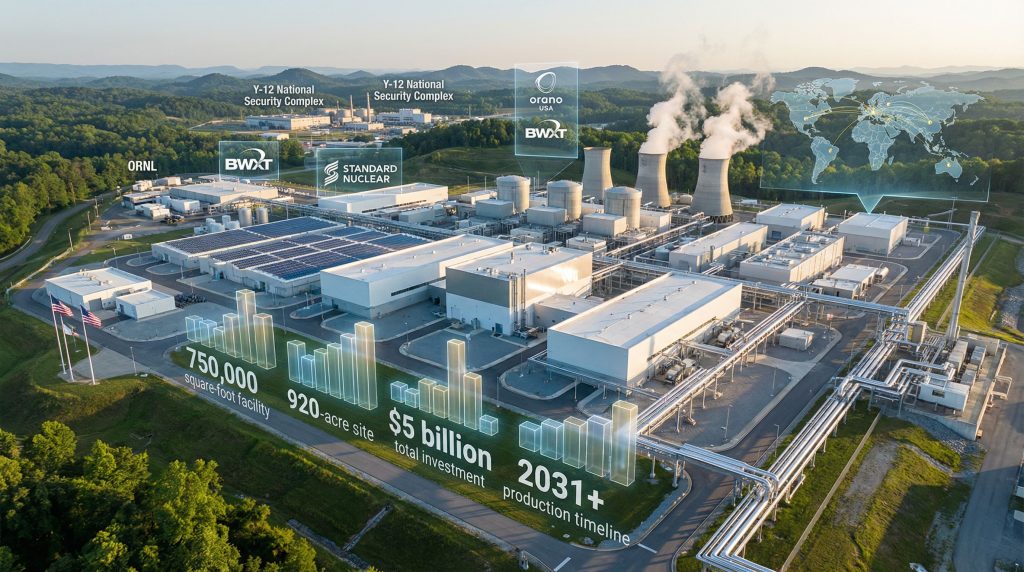
Project IKE's technical specifications reflect modern uranium enrichment standards adapted for American commercial reactor requirements. The 750,000 square-foot facility will employ gas centrifuge technology proven at Orano's Georges Besse II facility in France, which currently supplies approximately 12-16% of global enrichment capacity. This technology platform has demonstrated sustained operational capability since commissioning in the 2010s, providing a mature foundation for U.S. deployment.
Production Capacity and Market Impact
| Metric | Construction Phase | Operational Phase |
|---|---|---|
| Employment | 1,000+ positions | 300+ permanent roles |
| Investment | $5 billion total project | $900M federal contribution |
| Timeline | 2026-2031 construction | 2031+ production start |
| Facility Size | 750,000 square feet | 920-acre expansion site |
The facility's 920-acre site provides expansion potential for additional centrifuge cascades, suggesting the initial installation represents Phase 1 of a larger enrichment complex. This staged development approach allows capacity scaling based on market demand while minimising initial capital requirements. The site's infrastructure can support multiple enrichment lines, potentially doubling or tripling initial production capacity as domestic demand grows.
Low-enriched uranium (LEU) production targets the commercial nuclear reactor market, where uranium's U-235 isotope concentration requires enhancement from natural levels of 0.7% to approximately 3-5% for reactor fuel applications. This enrichment level serves civilian power generation while remaining well below weapons-grade concentrations above 90% U-235.
Technology Platform and Operational Timeline
Orano's gas centrifuge technology represents the current industry standard for commercial uranium enrichment, utilising high-speed rotation to separate uranium isotopes based on molecular weight differences. The uranium enrichment process employs centrifuge cascades that operate continuously, with interconnected units progressively concentrating U-235 isotopes through thousands of separation stages.
The facility will employ centrifuge technology matching European operational standards, derived from Orano's successful Georges Besse II deployment in France.
NRC licensing submission scheduled for 2026 initiates a comprehensive regulatory review process typically requiring 2-3 years for completion. This timeline accounts for environmental impact assessments, security evaluations, and technical design reviews necessary for commercial enrichment facility approval. The 2031 production target reflects realistic expectations for regulatory approval and facility construction completion.
The $900 million federal contribution de-risks early development phases while requiring substantial private investment for facility completion. This public-private partnership structure spreads financial risk while ensuring federal oversight of critical nuclear infrastructure development. The total $5 billion project cost reflects the capital intensity of modern uranium enrichment facilities, which require specialised equipment, extensive security systems, and sophisticated process control technology.
Multi-Company Competition Drives Technology Innovation
Multiple companies pursuing uranium enrichment capabilities in Oak Ridge demonstrates significant industry confidence in domestic market potential and federal policy support. This competitive environment encourages technological innovation while providing redundancy in domestic enrichment capability development. Additionally, the US mineral production order has created a supportive regulatory framework for domestic strategic material production.
Orano USA leads with proven commercial centrifuge technology and operational experience from Georges Besse II facility operations. The company's track record as the only Western entity to successfully commission large-scale enrichment capacity in the past 15 years provides credibility for Project IKE implementation. Orano's current global market position of 12-16% enrichment capacity with expansion trajectory demonstrates scalable technology and operational competency.
Technology Differentiation and Market Segmentation
| Company | Technology Platform | Target Market | Funding Source |
|---|---|---|---|
| Orano | Proven Commercial Centrifuge | Civilian Power Generation | DOE + Private Investment |
| BWXT | ORNL DUECE Development | National Security Applications | NNSA Funding |
| Standard Nuclear | Proprietary Technology | Commercial Fuel Supply | Private Investment |
BWXT's DUECE program focuses on national security applications, including naval reactor fuel production and tritium generation for weapons programmes. This market segmentation reduces direct competition with commercial providers while addressing specialised defence requirements. The Oak Ridge National Laboratory technology licensing provides access to domestically developed centrifuge designs potentially offering performance or cost advantages over foreign technology platforms.
Standard Nuclear represents emerging competition with undisclosed technology platforms and private investment funding models. The company's conditional site selection at East Tennessee Technology Park suggests alternative approaches to uranium enrichment that may employ different technological methodologies. Private funding independence potentially allows faster development timelines without federal contracting requirements.
Competitive Advantages and Market Positioning
Orano's competitive position stems from operational experience managing complex centrifuge cascades at commercial scale. The Georges Besse II facility processes thousands of tonnes of uranium annually while maintaining consistent product specifications and operational safety records. This demonstrated capability provides confidence for utility customers requiring reliable fuel supply contracts.
BWXT's national security focus creates protected market segments with specialised requirements and higher profit margins. Naval reactor fuel demands exact specifications and security clearances that limit competitive pressure while ensuring steady demand from defence programmes. Tritium production capabilities add revenue diversification beyond commercial uranium markets.
Standard Nuclear's private investment model offers operational flexibility and potentially faster decision-making compared to federal contracting processes. Private ownership may enable competitive pricing strategies and customised service offerings that appeal to specific utility customers. However, unproven technology platforms create execution risks that established operators have already overcome.
Geopolitical Realignment of Nuclear Fuel Markets
Global uranium enrichment capacity concentration among four major operators creates strategic vulnerabilities that extend far beyond commercial energy considerations. Russia's Rosatom controls 40-45% of global enrichment capacity, while Urenco holds approximately 30%, Orano maintains 12-16%, and China's CNNC provides 13-15% primarily for domestic consumption. This concentration means that disruptions to any major operator significantly impact global nuclear fuel availability.
U.S. import dependency developed gradually as domestic enrichment capabilities wound down after the Cold War. Approximately 70% of U.S. enrichment services relied on foreign suppliers, with Russian sources providing up to 25% of total requirements. This dependency appeared manageable during periods of stable international relations but became strategically problematic following geopolitical tensions starting in 2022.
Furthermore, the US Senate ban on Russian uranium has accelerated the urgency for domestic production capabilities. This legislative action underscores the strategic importance of establishing a uranium enrichment facility in Oak Ridge and similar domestic initiatives.
Strategic Material Reclassification
Uranium enrichment has undergone implicit reclassification from a commercial commodity to a strategic material requiring domestic production capability. This shift reflects broader recognition that energy security constitutes national security, particularly for nuclear-powered nations where reactor shutdowns could destabilise electrical grids and economic systems.
Federal policy responses include the restart of the sole U.S. uranium conversion facility in Illinois, funding for High-Assay Low-Enriched Uranium (HALEU) production capabilities, and the $2.7 billion commitment to rebuild domestic enrichment capacity through multiple provider awards. These initiatives represent coordinated efforts to restore complete nuclear fuel cycle sovereignty.
The 2028 prohibition on Russian uranium imports creates a definitive timeline for domestic capacity development while allowing transition periods for existing contracts. This legislative framework provides market certainty for private investment while ensuring adequate time for facility development and regulatory approval processes.
Global Market Dynamics and Supply Security
Civilian energy applications account for over 90% of global enriched uranium consumption, despite public perceptions linking enrichment primarily to weapons programmes. Russian and Chinese enrichment facilities overwhelmingly serve domestic nuclear power programmes and international commercial contracts rather than military applications. This civilian focus explains why enrichment capacity correlates with nuclear power expansion rather than weapons stockpile requirements.
Supply chain weaponisation risks emerged clearly following the 2022 sanctions regime implementation, when energy exports became tools of geopolitical pressure. Uranium enrichment services, unlike oil or gas, cannot be easily substituted or redirected due to technical specifications, security requirements, and long-term contract structures. These characteristics make enrichment particularly vulnerable to supply disruption with limited short-term alternatives.
Allied cooperation frameworks through Urenco's tri-national structure (UK, Netherlands, Germany) with U.S. operations provide some supply diversification, but insufficient capacity to replace Russian services entirely. The partnership demonstrates how international cooperation can enhance energy security while maintaining technological competitiveness against state-controlled competitors.
Critical Materials Strategy Integration
Oak Ridge's uranium enrichment development parallels broader U.S. critical materials re-industrialisation initiatives across multiple strategic sectors. The CHIPS and Science Act allocated $52 billion for semiconductor manufacturing reshoring, while the Inflation Reduction Act provided over $7 billion for battery materials refining capabilities. Rare earth processing investments exceed $3 billion across various federal and private initiatives.
However, the focus on critical minerals and energy security demonstrates how uranium enrichment fits within broader strategic material considerations for national security planning.
Cross-Sector Re-Industrialisation Patterns
| Strategic Sector | Vulnerability Period | Policy Response Timeline | Investment Scale |
|---|---|---|---|
| Semiconductors | 2020-2022 | 5-7 years | $52B (CHIPS Act) |
| Rare Earth Processing | 2019-2021 | 7-10 years | $3B+ (Multiple Programmes) |
| Nuclear Fuel Cycle | 2022-2024 | 6-8 years | $2.7B (DOE Commitment) |
| Battery Materials | 2021-2023 | 5-8 years | $7B+ (IRA Funding) |
These parallel initiatives demonstrate systematic recognition that midstream and downstream processing capabilities determine strategic autonomy more than raw material access. Countries controlling refining, enrichment, and manufacturing processes maintain leverage over those possessing only mineral resources. This principle applies across rare earths, semiconductors, battery materials, and nuclear fuel with similar strategic implications.
Industrial policy coordination through agencies like the Department of Energy's Loan Programmes Office, Defense Production Act authorities, and Buy American procurement preferences creates coherent frameworks supporting domestic capacity development. These mechanisms provide financing, regulatory support, and market access guarantees that reduce private sector investment risks in strategic industries.
Economic Security Framework Evolution
The uranium enrichment initiative reflects evolved thinking about economic security relationships between trade efficiency and strategic vulnerability. Previous decades emphasised cost optimisation through global supply chains, but recent experience demonstrates that excessive dependence creates systemic risks during geopolitical tensions or supply disruptions.
Resilience investment strategies now balance efficiency considerations against security requirements, accepting higher costs for domestic production capabilities in critical sectors. This approach recognises that short-term savings from foreign suppliers may generate long-term vulnerabilities that exceed immediate cost benefits.
Allied burden-sharing concepts encourage coordinated capacity development among partner nations rather than complete self-sufficiency. Uranium enrichment cooperation through Urenco demonstrates how allied nations can maintain strategic autonomy while sharing costs and technical expertise across national borders.
Implementation Challenges and Risk Assessment
Substantial technical, financial, and regulatory challenges could potentially delay or compromise Oak Ridge uranium enrichment development despite federal funding support and industry commitment. Understanding these risk factors provides realistic expectations for project timelines and success probability.
Centrifuge technology scaling requires precise engineering and manufacturing capabilities that differ significantly from laboratory or pilot-scale operations. Commercial enrichment facilities employ thousands of centrifuges operating continuously at extremely high rotational speeds with minimal vibration tolerance. Any manufacturing defects or operational disruptions can cascade through interconnected systems, requiring extensive redundancy and quality control protocols.
Workforce and Infrastructure Development
Skilled workforce recruitment presents ongoing challenges as nuclear industry expertise concentrated in ageing demographics with limited replacement pipelines. Enrichment facility operations require specialised knowledge of uranium chemistry, centrifuge mechanics, radiation safety protocols, and security procedures. Training programmes typically require 2-3 years for full competency development, creating potential bottlenecks for facility staffing.
Regulatory licensing complexity involves extensive NRC review processes that examine facility design, environmental impact, security measures, and operational procedures. Historical licensing timelines for nuclear facilities often exceed initial projections due to evolving safety requirements, public comment periods, and technical review iterations. The 2026-2031 timeline for Project IKE assumes smooth regulatory approval without significant design changes or additional safety requirements.
Construction cost inflation affects capital-intensive projects particularly severely, with specialised nuclear equipment, security systems, and regulatory compliance requirements limiting contractor competition. Recent infrastructure projects across multiple industries have experienced substantial cost overruns, suggesting the $5 billion Project IKE estimate may prove conservative depending on supply chain conditions and regulatory requirements.
Market and Financial Sustainability
Long-term uranium price volatility creates financial risks for enrichment facilities requiring 15-20 year investment recovery periods. Uranium markets historically demonstrate boom-bust cycles driven by reactor construction rates, mining supply additions, and geopolitical events. Enrichment facility profitability depends on maintaining favourable spreads between natural uranium costs and enriched uranium pricing over extended operational periods.
Utility contract negotiations will determine market acceptance and revenue stability for domestic enrichment services. Electric utilities traditionally prioritise cost minimisation and supply security, making contract terms critical for facility financial viability. Competitive pressure from existing suppliers may require domestic facilities to match international pricing while overcoming utility preferences for established supplier relationships.
Return on investment timelines spanning decades create vulnerability to policy changes, technological disruptions, and market shifts that could affect project economics. Private investors require confidence in long-term government support and market demand to justify substantial capital commitments in strategic industries with extended payback periods.
The next major ASX story will hit our subscribers first
Success Metrics and Future Trajectory
Measuring Oak Ridge uranium enrichment facility success requires comprehensive evaluation frameworks encompassing operational performance, strategic objectives, and long-term industry transformation. These metrics will determine whether domestic enrichment restoration achieves intended strategic autonomy goals while supporting broader nuclear energy expansion.
Operational performance indicators include annual production capacity measured in tonnes of Separative Work Units (SWU), facility utilisation rates, safety record maintenance, and cost competitiveness relative to international suppliers. Commercial success requires achieving technical specifications demanded by utility customers while maintaining operational efficiency comparable to established global operators.
Strategic Autonomy Achievement
Domestic market share restoration represents the primary strategic metric, with success defined as reducing Russian uranium import dependency below 10% by 2035. Intermediate targets include achieving 25-30% domestic enrichment capacity by the early 2030s, sufficient to supply core U.S. reactor requirements during supply disruptions while maintaining commercial competitiveness.
Allied nation supply diversification support measures contributions to broader Western energy security through potential export capabilities or technology sharing arrangements. Success includes establishing reliable alternative supply sources for European and Asian allies seeking to reduce dependency on Russian enrichment services.
Advanced reactor fuel capability development, particularly High-Assay Low-Enriched Uranium (HALEU) production for next-generation reactor designs, demonstrates technological leadership and future market positioning. HALEU requirements differ from traditional reactor fuel, requiring enhanced enrichment capabilities that few global operators currently provide.
Long-Term Industry Transformation
Transformational success scenarios envision Oak Ridge becoming a Western hemisphere enrichment hub, potentially serving markets across North and South America while supporting nuclear energy expansion. Technology export opportunities to allied nations could generate additional revenue streams while strengthening international partnerships in nuclear fuel security.
Nuclear energy renaissance catalysis measures the project's contribution to broader nuclear power expansion through reliable domestic fuel supply assurance. Success includes supporting new reactor construction projects by providing fuel supply confidence that encourages utility investment in nuclear capacity additions.
Baseline success achievement focuses on core objectives of supply chain resilience improvement, regional economic development, and energy security enhancement. Even limited success in these areas justifies federal investment by reducing strategic vulnerabilities and demonstrating domestic nuclear fuel cycle capabilities.
The uranium enrichment facility in Oak Ridge represents a pivotal moment in America's nuclear energy strategy, balancing immediate security concerns with long-term competitive positioning in global energy markets. Success will ultimately be measured by the facility's contribution to strategic autonomy while supporting the broader nuclear industry's role in clean energy transitions and national security requirements.
This analysis provides educational overview of uranium enrichment facility development and strategic implications. Readers should consult official Department of Energy announcements and nuclear industry sources for current project status and technical specifications.
Looking to Capitalise on America's Nuclear Renaissance?
Discovery Alert's proprietary Discovery IQ model delivers real-time alerts on significant uranium and nuclear fuel discoveries across the ASX, instantly empowering subscribers to identify actionable opportunities ahead of the broader market. Understand why historic discoveries can generate substantial returns by exploring examples of exceptional outcomes, then begin your 30-day free trial today to position yourself ahead of the market.