June 9, 2026
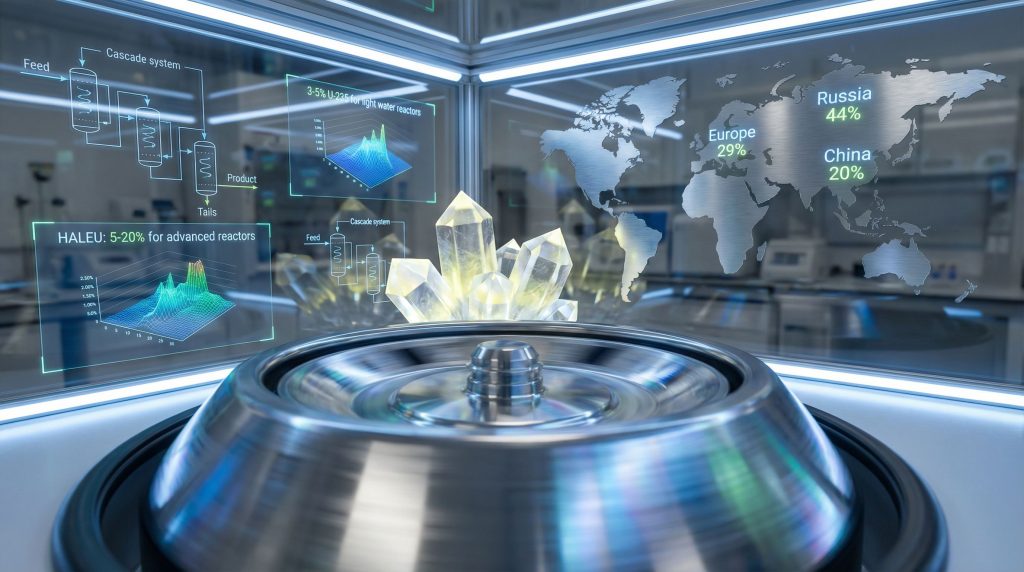
Looking at the current uranium enrichment market, uranium market volatility has significantly influenced enrichment capacity planning and investment decisions worldwide. Natural uranium contains only 0.7% of the fissile isotope uranium-235, while the remaining 99.3% consists of uranium-238, which cannot sustain nuclear fission reactions. This fundamental isotopic limitation drives the entire uranium enrichment industry, creating a critical bottleneck in nuclear fuel production that requires precise engineering and substantial infrastructure investment.
Understanding the Critical Role of Uranium Enrichment
The isotopic composition of natural uranium creates a fundamental challenge for nuclear power generation. Only uranium-235 can sustain the chain reactions necessary for nuclear fission, yet this isotope represents less than 1% of naturally occurring uranium. This scarcity necessitates enrichment processes that concentrate U-235 to usable levels.
The Isotope Separation Challenge
Commercial nuclear reactors require uranium fuel enriched to 3-5% uranium-235 for optimal performance in light water reactor designs. This represents a seven-fold increase from natural uranium concentrations, requiring sophisticated separation techniques that exploit the minimal mass difference between uranium isotopes.
Recent developments have expanded enrichment requirements beyond traditional levels. High-Assay Low-Enriched Uranium (HALEU), containing 5-20% uranium-235, has emerged as essential for advanced reactor designs and small modular reactors. Furthermore, uranium market dynamics continue to shape supply chain strategies as facilities adapt to changing demand patterns.
According to Nuclear Newswire reports from December 2025, Urenco USA achieved the first domestic production of enriched uranium above 5% uranium-235, marking a significant milestone in HALEU capability development.
Energy Density and Reactor Applications
The energy density difference between natural and enriched uranium demonstrates the critical importance of the enrichment process. Enriched uranium fuel provides significantly higher energy output per unit mass, enabling compact reactor designs and extended fuel cycles that make nuclear power economically viable.
Different reactor types require specific enrichment levels:
- Heavy water reactors: Natural uranium (0.7% U-235)
- Light water reactors: Low-enriched uranium (3-5% U-235)
- Advanced reactors: HALEU (5-20% U-235)
- Naval propulsion: Highly enriched uranium (20%+ U-235)
- Research reactors: Variable enrichment levels depending on design
When big ASX news breaks, our subscribers know first
The Technical Process of Uranium Enrichment
Modern uranium enrichment relies on gas centrifuge technology, which has revolutionised the industry through its energy efficiency and scalability. The process begins with converting uranium oxide concentrates into uranium hexafluoride gas, enabling isotopic separation through centrifugal force.
Chemical Conversion and Gas Phase Processing
The enrichment process starts with converting uranium oxide (U₃O₈) yellowcake into uranium hexafluoride (UF₆). This gaseous compound allows for isotope separation while maintaining chemical stability under controlled temperature and pressure conditions. UF₆ sublimes at relatively low temperatures, creating the gaseous state necessary for centrifuge operations.
Handling UF₆ requires specialised infrastructure due to its corrosive properties and the need for precise temperature control. Storage and transportation systems must accommodate the material's tendency to solidify at room temperature while maintaining purity standards throughout the process chain.
Modern Centrifuge Technology
Gas centrifuges operate at extraordinary speeds of 50,000-70,000 RPM, creating centrifugal forces that separate uranium isotopes based on their minimal mass difference. The heavier U-238 isotopes migrate toward the cylinder walls while lighter U-235 isotopes concentrate near the centre, enabling gradual separation through countercurrent flow patterns.
Modern centrifuge designs represent decades of engineering advancement in rotor materials, magnetic bearing systems, and vacuum technology. These improvements have achieved 50 times better energy efficiency compared to previous gaseous diffusion methods, reducing power consumption from 2,400-2,600 kWh per Separative Work Unit (SWU) to approximately 50 kWh per SWU.
Cascade Configuration Systems
Individual centrifuges achieve only modest isotopic separation, requiring series connections of multiple units called cascades. Each cascade stage slightly increases U-235 concentration, with the number of stages determining final enrichment levels. Modern facilities use computer-controlled cascade management to optimise throughput and maintain product quality specifications.
Recent facility expansions demonstrate cascade scalability. Nuclear Newswire reported in January 2026 that Centrus Energy announced major expansion plans for its Oak Ridge Technology and Manufacturing Center, enabling large-scale centrifuge deployment. Similarly, Urenco USA achieved operational milestones by bringing new centrifuge cascades online as part of capacity installation programmes.
The measurement standard for enrichment work is the Separative Work Unit (SWU), which quantifies the effort required to separate uranium isotopes. However, uranium spot price trends influence SWU pricing structures and long-term contract negotiations. SWU calculations consider feed material composition, desired product enrichment, and waste stream concentrations, providing a standardised metric for facility capacity and economic analysis.
Current Uranium Enrichment Technologies
Gas centrifuge technology dominates modern uranium enrichment due to its energy efficiency, modular design capabilities, and lower operational costs compared to historical methods. However, emerging technologies continue to evolve, potentially offering future alternatives for specialised applications.
Gas Centrifuge Dominance
Modern gas centrifuges have replaced gaseous diffusion plants entirely in commercial operations. The technology offers several key advantages:
- Energy efficiency: 98% reduction in power consumption versus gaseous diffusion
- Modular expansion: Cascades can be added incrementally to increase capacity
- Operational flexibility: Individual centrifuges can be maintained without shutting down entire facilities
- Reduced environmental impact: Lower energy consumption and smaller physical footprint
Centrifuge technology continues advancing through improved rotor materials, enhanced magnetic bearing systems, and automated control systems. These developments enable higher rotational speeds, longer operational lifespans, and improved separation efficiency.
Monitoring and Verification Technologies
Advanced monitoring systems support both operational control and nonproliferation verification. Pacific Northwest National Laboratory developed the UF₆ Gas Enrichment Sensor (UGES) prototype for treaty verification applications, which will undergo testing at the International Atomic Energy Agency Centre of Excellence for Safeguards and Non-Proliferation in the United Kingdom, according to January 2026 reports.
These monitoring systems provide real-time data on enrichment levels, material flow rates, and facility operations, supporting both commercial optimisation and international safeguards compliance.
Infrastructure Requirements
Enrichment facilities require substantial infrastructure investment, including:
- Power supply systems: Reliable electricity for centrifuge operations and facility support
- Containment structures: Buildings designed for UF₆ handling and emergency response
- Security systems: Physical protection and cybersecurity for sensitive nuclear technology
- Waste management: Depleted uranium storage and disposal capabilities
- Quality control: Analytical laboratories for product verification
Facility power consumption represents a significant operational cost, with modern plants consuming approximately 50 kWh per SWU. This creates opportunities for renewable energy integration and energy efficiency improvements as facilities modernise their operations.
Global Enrichment Market Structure
The international uranium enrichment market exhibits significant concentration among a small number of major producers, creating strategic supply chain considerations for nuclear fuel security. Market dynamics reflect both commercial competition and geopolitical factors that influence long-term supply arrangements.
Market Concentration Analysis
Global enrichment capacity is dominated by several major players, each controlling substantial market share:
Table: Major Global Enrichment Producers
| Producer | Technology | Primary Markets |
|---|---|---|
| Rosatom (Russia) | Gas centrifuge | Global commercial contracts |
| Urenco | Gas centrifuge | Western markets, HALEU development |
| CNNC (China) | Gas centrifuge | Domestic and regional supply |
| Domestic US Capacity | Gas centrifuge | National security applications |
This concentration creates both economies of scale and supply chain vulnerabilities. Western markets have historically relied on Russian enrichment services, prompting recent initiatives to rebuild domestic capacity in response to geopolitical tensions.
Strategic Supply Chain Development
Recent developments demonstrate shifting priorities toward supply chain security and domestic capability development. The US uranium import ban has accelerated these initiatives as the US government has funded multiple programmes to reestablish enrichment infrastructure:
- BWX Technologies opened its Centrifuge Manufacturing Development Facility in Oak Ridge, Tennessee, in January 2026, funded by the Department of Energy's National Nuclear Security Administration
- Centrus Energy announced major expansion plans for its Oak Ridge facility, supporting large-scale centrifuge deployment
- Urenco USA achieved HALEU production capability, addressing advanced reactor fuel requirements
These developments indicate a strategic shift toward rebuilding domestic enrichment capacity to reduce dependency on foreign suppliers and support both commercial and defence applications.
Technology Transfer and Security Considerations
Enrichment technology remains tightly controlled under international non-proliferation regimes. The Nuclear Suppliers Group maintains export controls on enrichment equipment and technology, limiting access to prevent weapons proliferation whilst enabling peaceful nuclear energy development.
Centrifuge technology represents particularly sensitive dual-use equipment, as the same systems used for commercial reactor fuel can potentially produce weapons-grade material with sufficient cascade expansion and operational time.
Economic Factors in Uranium Enrichment
Enrichment economics significantly impact nuclear fuel cycle costs and reactor operating expenses. Understanding these cost structures helps explain market dynamics and investment decisions in enrichment infrastructure.
SWU Pricing and Contract Structures
Separative Work Unit pricing operates through both long-term contracts and spot market transactions. Long-term agreements, typically spanning 5-15 years, provide price stability for both suppliers and customers whilst enabling capacity planning for major capital investments.
Enrichment costs represent approximately 25-30% of total nuclear fuel expenses, making SWU pricing a critical factor in nuclear power economics. Price volatility in uranium mining and conversion services can influence enrichment demand patterns and contract negotiations.
Capital Investment Requirements
Enrichment facilities require substantial upfront capital investment, typically ranging from $3-5 billion for facilities with 5 million SWU annual capacity. These costs include:
- Centrifuge manufacturing: Precision equipment requiring specialised materials and manufacturing
- Facility construction: Buildings designed for nuclear material handling and security
- Infrastructure systems: Power supply, cooling, waste management, and analytical laboratories
- Security measures: Physical protection, cybersecurity, and regulatory compliance systems
Return on investment timelines typically extend 15-20 years, requiring stable market conditions and long-term customer commitments to justify capital expenditure.
Operational Cost Structure
Operating expenses for enrichment facilities include several major components:
- Electricity costs: Representing the largest variable expense for centrifuge operations
- Maintenance and replacement: Centrifuge components require periodic maintenance and eventual replacement
- Labour costs: Skilled technicians and engineers for facility operations
- Security and regulatory compliance: Ongoing costs for safeguards, physical protection, and regulatory oversight
- Waste management: Depleted uranium storage and potential disposal costs
Capacity utilisation optimisation becomes critical for economic performance, as fixed costs represent a substantial portion of total expenses.
Regulatory Framework and International Safeguards
Uranium enrichment operations function within comprehensive regulatory frameworks designed to ensure safety, security, and non-proliferation compliance. These systems balance commercial nuclear energy development with weapons proliferation prevention.
International Atomic Energy Agency Oversight
The IAEA maintains comprehensive safeguards systems for enrichment facilities, including:
- Material accountancy: Detailed tracking of uranium input, output, and inventory
- Containment and surveillance: Physical measures to detect facility modifications or unauthorised activities
- Environmental monitoring: Sampling and analysis to verify declared activities
- Facility inspections: Regular and short-notice inspections to verify compliance
Modern safeguards incorporate advanced technologies like the PNNL-developed UGES system, enabling more precise monitoring of enrichment activities and enhanced verification capabilities.
Nuclear Suppliers Group Controls
Export controls govern enrichment technology transfer under Nuclear Suppliers Group guidelines, which establish trigger lists for controlled equipment and materials. These controls include:
- Centrifuge components: Specialised materials and manufacturing equipment
- Gas handling systems: Equipment designed for UF₆ processing
- Control systems: Computer hardware and software for cascade management
- Technical data: Design information and operational procedures
Physical Security Requirements
Enrichment facilities must implement design basis threat protections appropriate for their material categories and operational characteristics. Security systems address both external threats and insider risks through multiple layers of protection:
- Physical barriers: Facility design features and security zones
- Detection systems: Sensors and monitoring equipment for perimeter and facility protection
- Response capabilities: Security forces and coordination with law enforcement
- Personnel security: Background investigations and ongoing reliability assessments
- Information security: Protection of sensitive technical and operational data
The next major ASX story will hit our subscribers first
Future Capacity Development and Market Evolution
The uranium enrichment industry faces significant expansion requirements driven by growing nuclear power deployment, advanced reactor development, and supply chain security considerations. These factors are reshaping investment priorities and technology development paths.
Advanced Reactor Fuel Requirements
HALEU demand projections indicate substantial market growth as advanced reactor designs progress toward deployment. Unlike conventional reactors using 3-5% enriched uranium, many advanced designs require 15-20% enrichment levels for optimal performance and extended fuel cycles.
Current HALEU production capability remains limited, with Urenco USA's December 2025 achievement representing a significant milestone in domestic capability development. Industry projections suggest 40 tonnes annual HALEU demand by 2030, requiring substantial capacity additions beyond current production levels.
Small modular reactors and advanced reactor designs will likely drive additional HALEU demand growth, as these technologies often specify higher enrichment levels for compact core designs and extended operational cycles.
Domestic Capacity Building Initiatives
Multiple countries are prioritising domestic enrichment capability development to reduce supply chain dependencies and support energy security objectives. Recent US initiatives demonstrate this strategic shift:
- HALEU Availability Programme: DOE funding to establish domestic HALEU production capability
- Infrastructure investment: Government support for centrifuge manufacturing and facility development
- Technology partnerships: Collaboration between national laboratories and commercial entities
Additionally, US uranium production technology advances are supporting broader nuclear fuel cycle capabilities, complementing enrichment capacity development efforts.
European Union initiatives similarly emphasise strategic autonomy in nuclear fuel supply, including enrichment services, as part of broader energy security planning.
Infrastructure Modernisation Projects
Existing enrichment facilities are implementing modernisation programmes to improve efficiency, capacity, and operational flexibility. These upgrades include:
- Advanced centrifuge deployment: Next-generation designs offering improved separation efficiency
- Digital control systems: Enhanced automation and process optimisation capabilities
- Environmental improvements: Reduced energy consumption and waste generation
- Security enhancements: Updated physical and cybersecurity measures
Technology development continues advancing centrifuge designs, potentially offering significant improvements in separation efficiency and operational reliability for future installations.
Environmental Considerations and Waste Management
Uranium enrichment operations generate substantial quantities of depleted uranium whilst consuming significant electrical power, creating environmental management considerations that influence facility design and operational practices.
Depleted Uranium Management
The enrichment process generates approximately 7-8 tonnes of depleted uranium for each tonne of enriched product, creating long-term storage and potential disposal challenges. Depleted uranium contains reduced U-235 concentrations, typically 0.2-0.3%, making it unsuitable for further enrichment without additional processing.
Tails assay optimisation strategies balance enrichment costs against depleted uranium quantities. Lower tails assay values reduce depleted uranium generation but require additional SWU capacity, creating economic trade-offs that influence facility operations.
Potential applications for depleted uranium include:
- Radiation shielding: High-density material for medical and industrial applications
- Ammunition components: Dense metal applications (though controversial)
- Balance weights: Aircraft and marine applications
- Future re-enrichment: Potential feedstock if economics become favourable
Energy Consumption and Carbon Footprint
Enrichment facilities consume substantial electrical power, creating opportunities for renewable energy integration and efficiency improvements. Modern centrifuge technology has achieved dramatic efficiency gains, but large facilities still require significant power supply infrastructure.
Renewable energy integration offers potential benefits:
- Wind and solar power: Variable generation can potentially align with flexible enrichment operations
- Grid stability services: Large electrical loads can provide frequency regulation and load balancing
- Carbon footprint reduction: Clean electricity reduces overall nuclear fuel cycle emissions
Heat recovery systems can capture waste heat from centrifuge operations for facility heating or other applications, improving overall energy efficiency.
Decommissioning and Site Remediation
Historical gaseous diffusion plants provide examples of decommissioning challenges and costs associated with enrichment facilities. The Portsmouth Gaseous Diffusion Plant in Ohio has been undergoing demolition and remediation, with workers demolishing the massive X-333 Process Building as reported in November 2025.
Decommissioning considerations include:
- Contaminated equipment disposal: UF₆ residues and uranium contamination require specialised handling
- Building demolition: Large industrial structures with potential contamination
- Soil remediation: Ground contamination from facility operations
- Long-term monitoring: Continued surveillance of remediated areas
Modern centrifuge facilities may present different decommissioning challenges compared to gaseous diffusion plants, potentially offering advantages in contamination control and waste management.
Understanding Uranium Enrichment: Common Questions
How dangerous is uranium enrichment to workers and communities?
Modern enrichment facilities maintain low radiation exposure levels during normal operations through engineering controls and safety systems. Workers typically receive radiation doses well below regulatory limits, comparable to natural background radiation in many locations. Emergency response procedures address potential UF₆ releases, which present both radiological and chemical hazards requiring specialised response capabilities.
Community safety depends on facility design features, emergency preparedness, and regulatory oversight. Modern facilities incorporate multiple containment barriers and monitoring systems to prevent accidental releases.
What is the timeline for uranium enrichment processes?
Individual uranium atoms spend approximately 2-3 months in cascade systems during the enrichment process, though this represents residence time rather than active processing duration. Production scheduling depends on facility capacity, customer requirements, and inventory management strategies.
Quality control procedures include extensive testing and verification before product delivery, ensuring enrichment specifications meet reactor fuel requirements. Facilities maintain inventory buffers to accommodate varying demand patterns and delivery schedules.
Could enrichment facilities be converted for weapons production?
While enrichment technology can theoretically produce weapons-grade uranium, significant technical and operational barriers prevent easy conversion. Weapons-grade uranium requires 90%+ U-235 concentration, demanding extensive cascade expansion and prolonged processing time compared to reactor fuel production.
International safeguards systems monitor enrichment facilities through multiple verification methods designed to detect any unauthorised activities or facility modifications. These systems include material accountancy, environmental monitoring, and facility inspections that would identify attempts to produce weapons-grade material.
Nuclear enrichment processes require specialised knowledge and extensive infrastructure, making unauthorised weapons production extremely difficult without detection by international monitoring systems. Educational resources from organisations like the International Atomic Energy Agency and the American Nuclear Society provide additional perspectives on nuclear fuel cycle operations and safeguards effectiveness.
Considering Investing in the Nuclear Fuel Cycle?
Discovery Alert's proprietary Discovery IQ model delivers real-time alerts on significant mineral discoveries across the nuclear supply chain, including uranium exploration and mining opportunities on the ASX. Explore historic examples of exceptional market returns from major mineral discoveries to understand the potential of this rapidly evolving sector, then begin your 14-day free trial today to gain actionable insights ahead of the broader market.